The Return of Cultural Cringe

I was recently reminded of the phrase “cultural cringe”, a term which I hadn’t heard for a while, and which is often reserved for when Australian politicians resort to fawning over visiting dignitaries and royalty. (Remember Tony Abbot’s knighthood for the Duke of Edinburgh?) More usually, it reveals a misguided belief that nothing produced locally can be any good.

The latest use was in response to a discussion about Australian expats stuck overseas, who are trying to return home during the pandemic. There was a general view that the criticisms revealed in The Guardian article were “fair”; there were also some comments to the effect that the reason many Australians go overseas is to take advantage of work or other opportunities not available to them here; while another suggestion was that local cultural cringe can drive people away. Cultural cringe is part and parcel of Australia’s identity crisis and the associated tall poppy syndrome, but it’s a complex issue….

When I first came to Australia as a child in the early 1970s, I was very surprised to see how much American influence there was. From TV programmes, to consumer brands; from car makes to drive-in cinemas; from fast food chains to the local currency. While I wasn’t as crass or naïve as my schoolmates back in the UK (some of whom thought that Britain still “owned” Australia) it was nevertheless surprising how much American culture there was. Local TV content was mainly limited to sport, game shows, and a few police dramas from Crawford Productions – this was long before the heyday of Aussie soaps and the stream of pop stars they generated.

On the other hand, there was also a growing engagement with Asia Pacific (and not just a result of Australia’s involvement in the Vietnam war). Japanese-made electronics were available in the shops (items which were not as prevalent at the time in the UK, possibly due to the latter’s recent membership of the European Common Market). The Osaka Expo of 1970 had been a big deal in Australia, and even warranted a set of postage stamps. Then there was Gough Whitlam’s visit to China in 1971. At school, I studied South East Asia geography, and had the option to study Japanese alongside French and German.

But I was also painfully aware of being called a “Pommie bastard” (and the kids at school were equally free in their use of similar terms for anyone of Mediterranean or Eastern European heritage). In my case, the term of abuse was prompted by England winning the 1970-71 Ashes tour of Australia – as if it was my fault that Australia had lost the series, failing to win a single test match. Up to that point, I had no particular interest in cricket whatsoever – but it was a defining moment that has meant ever since, I always support England and whoever is playing Australia. Those school-yard experiences revealed a sense of parochialism, narrow-mindedness and a weird superiority complex when it comes to sport – which is still prevalent today when support for national teams leads to jingoistic flag-waving.

Anyway, when my parents took our family back to London a few years later, I never expected to return. However, I kept an interest in Australian culture, or at least the portion that found its way to the UK (pushed out by lack of domestic opportunity and/or local appreciation?). Figures such as Germaine Greer, Clive James, Barry Humphries and Robert Hughes, who were regulars on British TV; films and books by Peter Weir, Peter Carey and Bruce Beresford; music by The Saints, Nick Cave, The Go-Betweens and The Triffids – all of which seemed to find a better audience outside Australia rather than within. Maybe Australians didn’t think these cultural references represented them as well as more mainstream fare such as Cold Chisel, Midnight Oil and Crocodile Dundee? Of course, Australia also has a tendency to be quite censorious towards anything counterculture.*

The other side of the cultural cringe is the belief that everything local is “world class” (whatever that means) – that anything Aussie-made is simply the best. When I came back to live and work in Australia, I witnessed the “not made here” syndrome. Working for global brands, I would often meet with local companies, to present our products and services, most of which were developed overseas. “Is anyone already using this product in Australia?”, I’d be asked. “Er, not yet, we wanted to give you the first opportunity to try it.” “In which case, come back when you have some local customers.” (Conversely, if we introduced a new service that had been developed locally, I would sometimes be asked, “Who’s using this overseas?”. “Er, no-one – it’s specifically designed with regional customers in mind.” “OK, come back when you have some US or European clients.”)

Which brings me back to the point about Australian expats having to go overseas to get access to experience and opportunities unavailable here. The irony is that many of those expats who are trying to return home will be bringing a wealth of expertise with them, that would surely benefit the local economy.

Next week: FinTech Australia Road Show

* The “Barry McKenzie” books (created by Barry Humphries) were initially banned in Australia, while Richard Neville relocated some of his publishing operations to London after OZ magazine had been prosecuted for obscenity (ironically, OZ faced further prosecution in the UK). No doubt Daevid Allen, a mercurial figure in the beatnik and hippy counterculture, and founder member of both Soft Machine and Gong, would have struggled in the Australian music scene of the 1960s and early 1970s. As for artist and performer Leigh Bowery, his achievements in London are overlooked or unrecognsied here. But he was probably too out there for local tastes, notwithstanding the Australian appetite for mardi gras, drag and high camp (as epitomised by The Adventures of Priscilla, Queen of the Desert).
The Day That Can’t Be Named…

Today’s date, January 26th, has developed a deep identity crisis, much like the Australian psyche: who are we, how did we get here, and what does this day actually mean? A celebration of colonialism – or a day of indigenous mourning?

Leading up to this year’s public holiday, there has been: a muted response to suggested changes to the current National Anthem; a bewildering comment by the Prime Minister about finding equivalence in the circumstances of people sailing on the First Fleet and the impact those arrivals had on the indigenous population; constant bickering between the State and Federal governments about pandemic-related border controls (hardly an advertisement for Federation); renewed angst about the Australian cricket team (always a measure of the public mood); and an apparent drop in public support for an Australian Republic.

And there lies the nub of the issue. For some time now, it has felt that progress on a number of constitutional and cultural reforms has been hampered by the fact that Australia still hasn’t reached the maturity of declaring itself a Republic. The impediment to moving forward is the adherence to the post-colonial model of a Federation retaining the British Crown as the Head of State. The fact that we don’t formally recognise or celebrate Federation is in itself very telling.

Lack of maturity is endemic – from the habitual need to shorten words and phrases verging at times on baby talk (why on earth do the Prime Minister and the Leader of the Opposition choose to refer to themselves by their nicknames, “Scomo” and “Albo”?); to the suspicion of anything subtle, sophisticated or successful (the tall poppy syndrome).

Another foil to constitutional progression is the disproportionate influence (and position of privilege) that religious institutions retain in what is supposed to be a secular society.

Then there is the inability or reluctance to celebrate national success (apart from on the sporting field). Yes, Australia does “punch above its weight” in many areas, but there is so much inherent conservatism (small “c”) built into the system. The combination of 2-party politics, 3-tiers of government, cosy commercial duopolies, complex taxation, rigid regulatory frameworks, the laggardly trade union movement (not to say timid public policies on the environment, science, technology, education and the arts) inhibits innovation and experimentation. This institutional inertia (or conspiracy) all adds up to on overwhelming sense of acceptance, complacency and “she’ll be right”.

What if we had to work from the basis of some alternative histories? How would that change our views about January 26th? For example, what if either the French, Dutch, Spanish or Portuguese had colonised this land in the 17th or 18th century instead of the British arrived? What if the First Nations of Australia had developed metal tools and had fought back and won? What if Chinese fishing fleets or Indian trading vessels had established control of Australian waters and harbours long before the Europeans arrived? What if Indonesian or Malay tribes had settled here even further back than that? What if Japan had won the Pacific War?

This is not to excuse or justify the actions of the British in colonising the many nations that already existed in Australia, and all that followed from that. After all, the British Isles themselves had been invaded and conquered on many occasions over the centuries, so the First Fleet could be seen as a logical extension of that sequence of events. But perhaps this perspective can provide some additional context, helping us to reflect on the events and circumstances that have brought us to this point, and hopefully point to a way forward.

Next week: The Return of Cultural Cringe

NGV Triennial

As Melbourne and Victoria continue to emerge from lock-down, it was great to see that the NGV International has re-opened for the summer with the latest edition of its Triennial show. And while we should all be grateful to have the opportunity to visit this exhibition in person (rather than on-line), it’s not without some shortcomings.

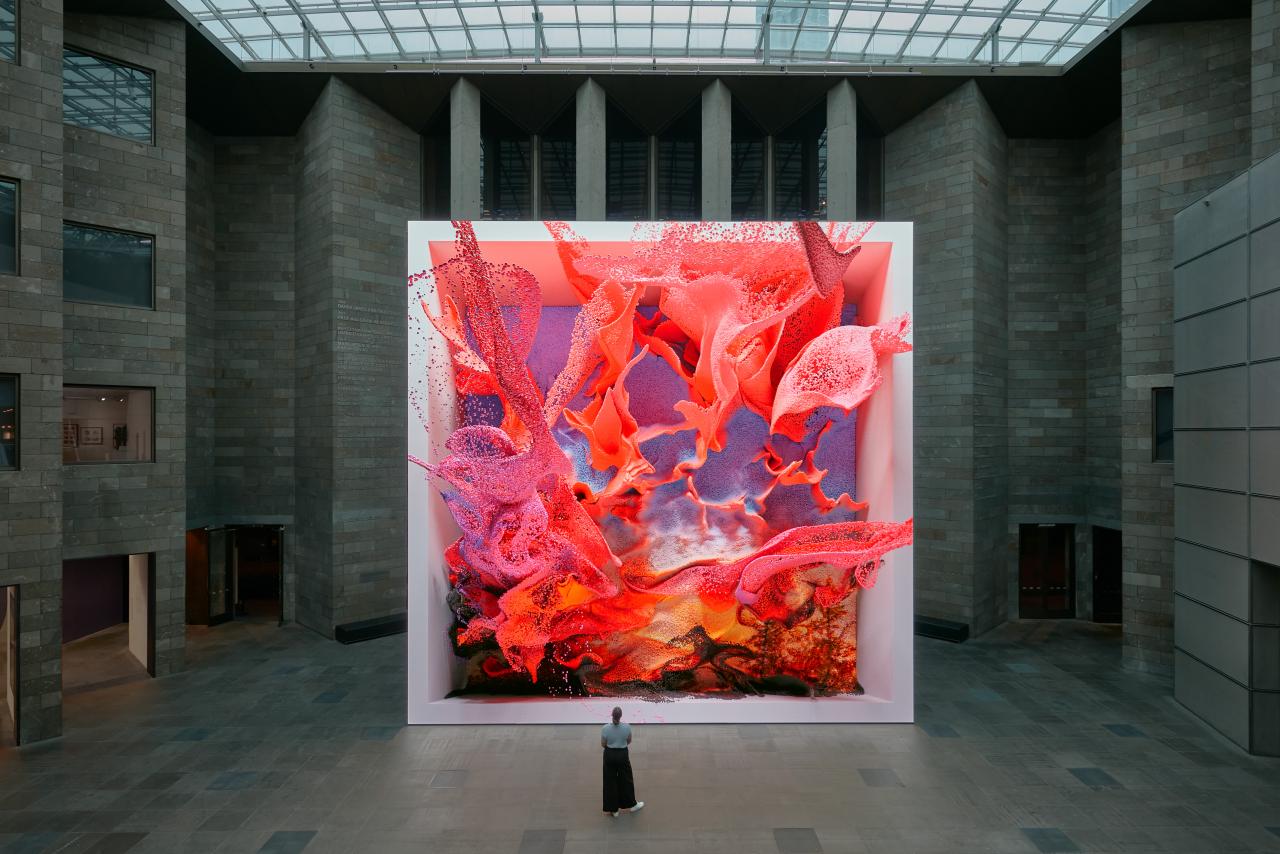
Refik Anadol: Quantum Memories (image sourced from NGV website)

First, the good news: no doubt it was a logistical headache to co-ordinate this exhibition while Melbourne was in strict lock-down for much of the past 10 months. Making admission free is also a wonderful public gesture given that the local population was starved of art exhibitions for most of last year – in particular, we missed out on the NGV’s winter blockbuster season.

The curators are also to be commended on assembling a diversity of artists, work and media; and for placing a great number of these new pieces among the NGV’s permanent collections, which forces visitors to assess these contemporary exhibits within the context of historic work.

But that’s probably where the positive ends.

A major drawback of this exhibition is the lack of anything truly ground-breaking, innovative or even challenging. It all felt very safe – but maybe that’s just what we needed after our extended social isolation: work that is comforting, familiar, cozy, cuddly, soothing, and certainly bright (lots of lively colours).

As a result, however, there seemed to be an emphasis of form over substance, technique over content, and scale over context. Much of the three-dimensional work felt flat and one-dimensional. Even the opening centrepiece, Refik Anadol’s “Quantum Memories” that dominates the entrance lobby, is a classic example of the “medium is the message”. Comprising a giant digital screen (incorporating a clever trompe-l’œil 3-D effect) to stream animated, computer-programmed images, ultimately gave the impression that this was all about the technology and the scale of the work. It was difficult to identify any meaning beyond mere decoration.

And unfortunately, “decorative” was a recurring theme, alongside some rather kitsch and lazy imagery – especially the digital and animated wallpaper that featured in several of the permanent galleries. These “displays” reminded me of cheesy son et lumière or pedestrian CGI effects – it may be technically adept, and even stylish to some degree, but that’s as far as it goes. Perhaps “deep” and “complex” are out of favour at the moment, as we make way for “shallow” and “simple”.

While some work might attempt to convey a more profound response, when shorn of its original context, the message is lost and the result is a void. I wasn’t necessarily looking for “deep and meaningful”, but I was hoping to be provoked or inspired. Or at least have my curiosity piqued.

Triennial? Could try harder.

Next week: Expats vs Ingrates?

The “new, new normal” post-Covid-19

After the GFC of 2007-8, we were told to get used to the “new normal” – of low/slow/no growth, record-low interest rates, constant tech disruption and market dislocation as economic systems became increasingly decoupled from one another. And just as we had begun to adjust to this new reality, along comes Covid-19 and totally knocks our expectations sideways, backwards and upside down, and with it some negative long-term consequences. Welcome to the “new, new normal”.

Just what the doctor ordered: “Stay home and read a book!”

In the intervening years since the GFC (and don’t those days seem positively nostalgic from our current vantage point?), we have already seen ever lower interest rates, even faster disruption in business models and services, and a gradual dismantling of the trend towards a global economy. The pre-existing geopolitical landscape has either exacerbated this situation, or has been a prime beneficiary of the dismantling of the established structures of pluralistic, secular, non-sectarian, social-democratic and liberal societies.

First, relations between the Superpowers (USA, Russia and China) have not been this bad since the Cold War. Second, nationalism has not been as rife since the 1930s. Third, political leadership has tended toward the lowest common denominator of populist sloganeering. Not to mention the rise of fundamental religious sects, doomsday cults and tribal separatist movements. Let’s agree that even before the current pandemic, our resistance was already low….

Whatever your favourite conspiracy theory on causes and cures for Covid-19, it’s increasingly apparent that populist leaders of both the left and the right will use the pandemic as vindication of their policies – increased xenophobia and tighter border controls, increased centralisation of power and resources, greater surveillance of their citizens, a heightened intolerance of political dissent, a continued distrust of globalisation, and a growing disregard for subject matter experts and data-driven analysis.

The writing’s on the wall? Message seen in East Melbourne

There are obviously some serious topics up for discussion when we get through this pandemic. Quite apart from making the right economic call (“printing money” in the form of Quantitative Easing seems the main option at the moment…), governments and central banks are going to have to come to grips with:

  • Universal Basic Income – even before Covid-19, the UBI was seen as a way to deal with reduced employment due to automation, robotics and AI – the pandemic has accelerated that debate.
  • Nationalisation – bringing essential services and infrastructure back into public ownership would suggest governments would have the resources they need at their disposal in times of crisis – but at the likely cost of economic waste and productivity inefficiencies that were the hallmark of the 1970s.
  • Inflation – as business productivity and industrial output comes back on-line, the costs of goods and services will likely increase sharply, to overcome the pandemic-induced inertia.
  • Credit Squeeze – banks were already raising lending standards under tighter prudential standards, and post-pandemic defaults will make it even harder for businesses to borrow – so whatever the central cash rates, commercial lenders will have to charge higher lending rates to maintain their minimum risk-adjusted regulatory capital and to cover possible bad debts.
  • Retooling Industry – a lot of legacy systems might not come out of the pandemic in good shape. If we have managed to survive for weeks/months on end without using certain services, or by reducing our consumption of some goods, or by finding workarounds to incumbent solutions, then unless those legacy systems and their capacity can be retooled or redeployed, we may get used to living without their products all together.
  • Communications Technology – government policy and commercial settings on internet access, mobile network capacity and general telco infrastructure will need to be reviewed in light of the work from home and remote-working experience.
  • The Surveillance State – I’m not going to buy into the whole “China-virus” narrative, but you can see how China’s deployment of facial recognition and related technology, along with their social credit system, is a tailor-made solution for enforcing individual and collective quarantine orders.

Another policy concern relates to the rate at which governments decide to relax social-distancing and other measures, ahead of either a reliable cure or a vaccine for Covid-19. Go too early, and risk a surge or second wave of infections and deaths; go too late, and economic recovery will be even further away. Plus, as soon as the lock-downs start to end, what’s the likelihood of people over-compensating after weeks and months of self-isolation, and end up going overboard with post-quarantine celebrations and social gatherings?

Next week: The lighter side of #Rona19