#Rona19 – beyond the memes

More commentary on Covid-19 – at the time of writing, Victoria is at Stage 3 restrictions, with Stage 4 possible very soon. Generally, people seem to adapting to if not actually coping with this daily reality (although people are still flouting their quarantine obligations). But there is still some confusion on how to interpret, observe and enforce the social distancing measures, and of course, huge economic uncertainty remains for many people who have seen their working hours evaporate, especially if they are in vulnerable industries, and/or they can’t work from home.

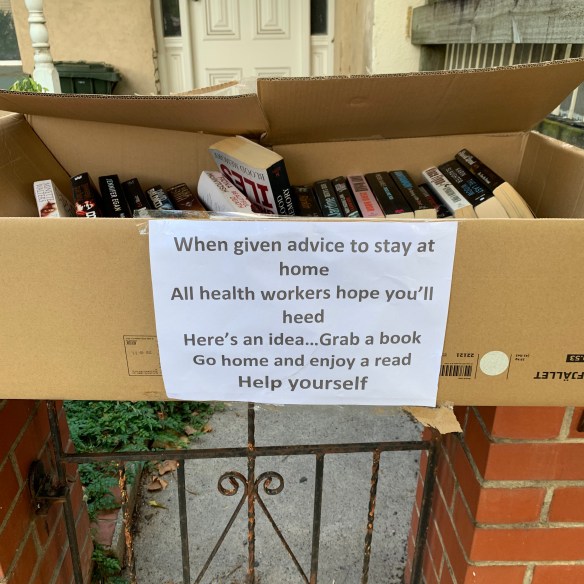
Sign of hope? (Seen on my daily walk)

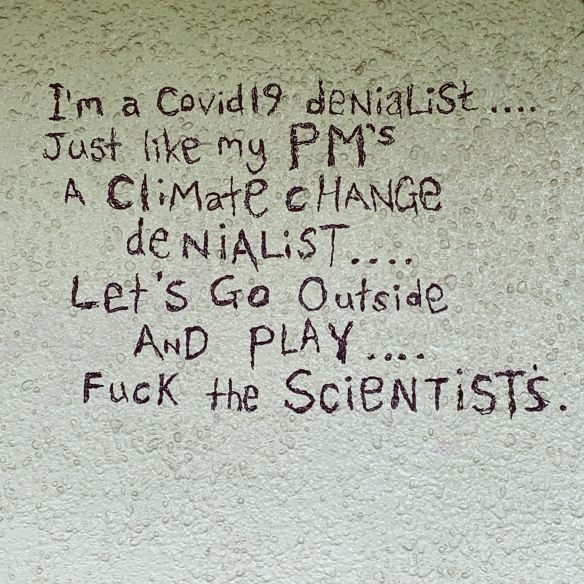
Meanwhile, the shutdown has prompted a fair number of less serious responses, from toilet paper memes, to “viral” GIFS, from parodies of “My Sharona” and “Bohemian Rhapsody”, to unfortunate examples of the downside of company video conferences while working from home.

But beyond the hashtags, what might we expect once we get through the current pandemic? Here is a somewhat random list of possible outcomes:

  • A renewed appreciation of personal space in public places – will we continue to observe such protocols where and whenever practical, as it becomes a community norm?
  • Greater respect for introverts – possibly better able to handle self-isolation, they are comfortable with their own company and don’t feel the need to seek out crowds  – social distancing does not represent an existential crisis, and they don’t rely on social situations for their personal validation.
  • Passenger airlines and cruise companies are toast – the tourism and travel industries will be hard hit, and may struggle to rebuild in their current form.
  • The online economy will get a boost  – restaurants and providores are already retooling to offer D2C food and meal deliveries (even cutting out the likes of Uber Eats, Deliveroo and Menu Log). Some brick and mortar retail is adapting fast, but will face a reduced share of available discretionary spending.
  • Naturally, digital services will thrive – from communication solutions to virtual classes, from remote working support services to telehealth. But bandwidth capacity and internet down/upload speeds remain a challenge in Australia.
  • The end of physical cash – if retailers prefer contactless payments (less contamination), what use are those notes and coins in your wallet?
  • A higher community standard for the individual duty of care we owe to each other – Covid-19 will certainly test the “duty of care” we owe to neighbours, colleagues, members of the public… if I knowingly infect someone, or act recklessly or negligently, can the victim sue me?
  • Likewise, the corporate social license to operate will be tested and re-cast – in light of monopolistic practices, price gouging, market abuse and disregard for the “new normal”, companies will need to re-assess many of their standard policies.
  • Increased use of facial recognition and other technology for surveillance purposes – if people cannot be trusted to observe their quarantine, self-isolation and social distancing obligations, the authorities will not shy away from further incursions into civil liberties that we currently take for granted.
  • A hybrid of on-site and working from home employment structures – not everyone will want to continue working remotely, nor will everyone be in a rush to head back to the office (or the daily commute), which will likely cause headaches for employers….

More on these themes next week….

Next week: The “new, new normal”


Margaret Tan and Dragon Ladies Don’t Weep

Last week, I mentioned the number of ageing rock stars having to cancel concerts. In contrast, Margaret Leng Tan, aged 74, performed a 75-minute one-person show as part of the Asia TOPA festival in Melbourne. She made it look effortless, producing an almost choreographic style of piano playing, as she performed the world premiere of “Dragon Ladies Don’t Weep”.

Both autobiographical and a tribute to two of her greatest influences, John Cage and her mother, the show is a mix of live piano, prerecorded audio, digital art, multimedia and spoken word. It is comprised of anecdotes from her life, personal musings on loss, and practical aphorisms, such as “DRC” – the “daily reality check” – a must for all artists and anyone else needing to make sense of the modern world.

Clearly a very focused and determined musician, Margaret Tan has carved out a niche for herself in the modern classical world, with her championing of the toy piano. She has made it an instrument for serious composition and concert performance.

The physicality of her performance ensured that the digital technology neither dominated nor descended into gimmickry (no “tech for tech’s sake” here). Her presence on stage was captivating yet self-contained – despite largely being all about her, it was authentic and self-effacing in equal measure.

Margaret Tan revealed two key aspects of herself that go some way to explaining her success. First, at an early age she realised she had to concentrate on the piano – she couldn’t maintain her other music and dance studies – from which we get the sense of her single-minded purpose. Second, her lifelong obsession with numbers – almost a form of synesthesia; and given the strong relationship between numbers and music, it felt that she has learned to live with, even appreciate, this “affliction” in the pursuit of her art.

If there was one thing missing, it was Margaret Tan’s own music. While she is best-known for her interpretations of John Cage and other modern composers, I was curious about her own work, and whether she has ever explored composition herself.

Next week: My Four Years in Crypto


Stereolab at Melbourne Zoo

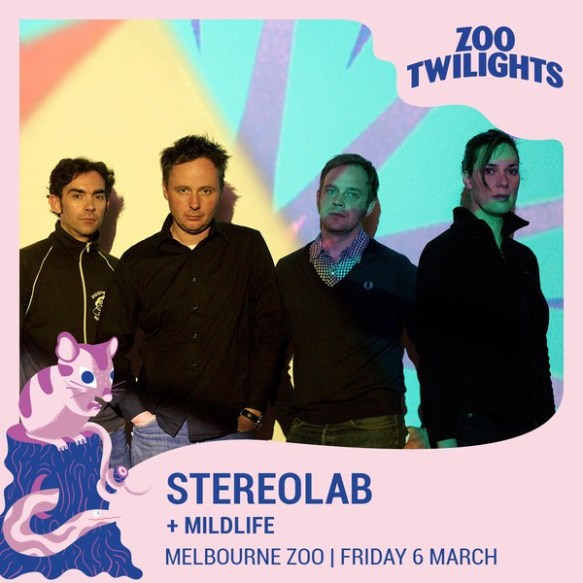
There was a recent newspaper article about the number of older rock stars having to cancel tour dates due to ill health, injury and just plain old age. The irony is that when most of those performers started out as professional musicians, no-one really expected their careers to last 10 or 15 years, let alone 40 or even 50 years. Now that artists increasingly rely on income from ticket sales (rather than royalties from streaming services), there could be lean times ahead for ageing rockers – and that’s before we take the effects of COVID-19 into account. Thankfully, Stereolab were able to play at Melbourne Zoo last week, before cancelling the rest of their Asia Pacific concerts due to the virus. Of course, by comparison to much of rock’s gnarly royalty, they are mere babes, having “only” formed in 1990. And although they have not released any new material for 10 years, during which time the band has been on hiatus, Stereolab have an extensive back catalogue to draw upon now they have started touring again.

Alongside contemporaries Saint Etienne, Stereolab were part of a reaction against late-80s grunge and acid house, and between them they ushered in a return to more interesting melodic and harmonic structures, vintage/retro sounds and complex textures, all informed by an aesthetic that embraces electronica, exotica, soundtracks, bossa nova and dub effects. In fact, both bands have collaborated with similar post-rock artists on each side of the Atlantic such as Jim O’Rourke, Tortoise, Mouse on Mars and To Rococo Rot, not to mention The High Llamas’ Sean O’Hagan. (Both bands also have extensive back catalogues, with frequent non-album, one-off, limited and rare 7″ singles scattered throughout their discographies.)

By going back on the road after such a long break (and with no new material to promote), there was a risk that Stereolab might simply be going through the motions – even coming across as their own tribute act at best, a self-parody at worst. Thankfully, despite the familiarity of the songs, the band managed to keep everything sounding fresh, energetic and full of enthusiasm. And despite maintaining that original aesthetic, Stereolab have enough variety to remain interesting and avoid sounding samey – which has no doubt helped with their own longevity, unlike many contemporary artists who will likely be forgotten quicker than a Crazy Frog ringtone.

Next week: Margaret Tan and Dragon Ladies Don’t Weep


Joy Division and 40+ years of Post-Punk

In the aftermath of its 1976-77 heyday, UK punk rock morphed into five main trends: new wave; goth; new romantics; synth-pop; and post-punk. The latter term was applied to a number of bands that had emerged during the punk era, but were not defined by its limitations. Although they were initially influenced by punk, and shared many of the same attitudes, they had quickly moved beyond the three chord thrash, frenetic pace and nihilism of punk to create music that was more cerebral, complex, challenging and enduring. They were not afraid to reference influences outside punk, such as literature, film and philosophy. Key among these bands were PiL, Gang of Four, The Fall, Wire, Magazine, Pop Group, Cabaret Voltaire and Joy Division.

Although Joy Division only released two studio albums (one of which came out just after the band’s singer, Ian Curtis, committed suicide), their influence has been long-lasting. Rather like the Velvet Underground in the late 1960s, many people who heard them early on were inspired to form their own bands.

Their first album, “Unknown Pleasures” emerged in June 1979. It was just after Margaret Thatcher had come to power following the strike-ridden “winter of discontent”. The sonic palette created by the band and their producer, Martin Hannett, revealed a post-industrial sound that could only have come from Manchester. At times it sounded nothing like their contemporaries, so strong was their unique musical identity. Reflecting the rugged local landscape surrounding the music’s urban setting, the gritty realism of “Unknown Pleasures” demonstrated that as with British society after Thatcher, music after Joy Division would never be the same again. I first saw them live a few weeks after the album’s release, and already the songs made an indelible impression.

The band was incredibly prolific during the next few months, touring constantly, and releasing a number of non-album tracks and singles. I saw them again in early 1980, by which time they were already playing songs from their next album, as well as their forthcoming single, “Love Will tear Us Apart” – one of the most iconic and frequently covered songs of its era.

The last time I saw Joy Division performing was on the second night of the “Factory By Moonlight” mini-residency at West Hampstead’s Moonlight Club (also artfully referencing Maximilien Luce’s late 19th century painting). I spoke briefly to Ian Curtis before the gig, which turned out to be one of the band’s last concerts. He was polite, and came across as rather shy, but probably he was just exhausted, given the band’s work rate and his own physical and emotional problems. Within a few weeks he was dead.

Soon after, the second and final studio album, “Closer” was released. Inevitably, it was seen as a sort of memorial for Curtis, especially given the sleeve’s funereal design (although the image had been selected months earlier). Apart from a couple of uptempo numbers (I am using the term relatively), the songs are melancholic, majestic, and yes, morbid. Whether intentional or not, side two of “Closer” has always reminded me of the mainly instrumental and proto-ambient songs on side two of David Bowie’s “Low” album. (Given that Joy Division’s previous name, Warsaw, owes something to the “Low” track, “Warszawa“, it seems possible that the similarity is deliberate.)

Much has been written about Joy Division over the past 40 years, and a number of commemorative activities are likely in 2020. The band’s presence has been perpetuated not just by the lasting influence of their slim studio output (since bulked out with compilations and live albums) but by the fact that the remaining band members morphed into New Order – one of the most successful bands of the 80s and early 90s who brought electronica to rock music, and rock music to the dance floor.

The other week, my next door neighbour mentioned he had only recently heard “Unknown Pleasures” for the first time – thanks to a playlist recommendation. He hadn’t realised the album was so old, and thought it was a newish release. Hopefully, by now, he has also heard “Closer”.

Next week: Stereolab at Melbourne Zoo