What might we expect in 2017?

On a number of measures, 2016 was a watershed year. Unexpected election results, fractious geopolitics, numerous celebrity deaths, too many lacklustre blockbuster films, spectacular sporting upsets (and regular doping scandals), and sales of vinyl records are outpacing revenue from digital downloads and streaming services. What might we expect from 2017?

Detail from "The Passing Winter" by Yayoi Kusama (Photo by Rory Manchee)

Detail from “The Passing Winter” by Yayoi Kusama [Photo by Rory Manchee]

Rather than using a crystal ball to make specific predictions or forecasts, here are some of the key themes that I think will feature in 2017:

First, the nature of public discourse will come under increased scrutiny. In the era of “post-truth”, fake news and searing/scathing social commentary, the need for an objective, fact-based and balanced media will be paramount. In addition, the role of op-ed pieces to reflect our enlightened liberal traditions and the need for public forums to represent our pluralist society will be critical to maintaining a sense of fairness, openness, and just plain decency in public dialogue.

Second, a recurring topic of public conversation among economists, politicians, sociologists, HR managers, career advisors, bureaucrats, union leaders, technologists, educators and social commentators will be the future of work. From the impact of automation on jobs, to the notion of a universal basic income; from the growth of the gig economy, to finding purpose through the work we do. How we find, engage with and navigate lifelong employment is now as important as, say, choosing high school electives, making specific career choices or updating professional qualifications.

Third, the ongoing focus on digital technology will revolve around the following:

  • The Internet of Things – based on a current exhibit at London’s Design Museum, the main use cases for IoT will continue to be wearable devices (especially for personal health monitoring), agriculture, transport and household connectivity
  • Fintech – if a primary role of the internet has been for content dissemination, search and discovery, then the deployment of Blockchain solutions, the growth in crypto-currencies, the use of P2P platforms and the evolution of robo-advice are giving rise to the Internet of Money
  • Artificial Intelligence – we are seeing a broader range of AI applications, particularly around robotics, predictive analytics and sensory/environmental monitoring. The next phase of AI will learn to anticipate (and in some cases moderate) human behaviour, and provide more efficacious decision-making and support mechanisms for resource planning and management.
  • Virtual Reality/Augmented Reality – despite being increasingly visible in industries like gaming, industrial design, architecture and even tourism, it can feel like VR/AR is still looking for some dedicated use cases. One sector that is expected to benefit from these emerging technologies is education, so I would expect to see some interesting solutions for interactive learning, curriculum delivery and student assessment.

Fourth, and somewhat at odds with the above, the current enthusiasm for the maker culture is also leading to a growing interest in products that represent craft, artisan and hand-made fabrication techniques and traditions. Custom-made, bespoke, personalized and unique goods are in vogue – perhaps as a reaction to the “perfection” of digital replication and mass-production?

Fifth, with the importance of startups in driving innovation and providing sources of new economic growth, equity crowdfunding will certainly need to come of age. Thus far, this method of fund-raising has been more suited (and in many cases, is legally restricted) to physical products, entertainment assets, and creative projects. The delicate balance between retail investor protection and entrepreneurial access to funding means that this method of startup funding is constrained (by volume, amounts and investor participation), and contrary to stated intentions, can involve disproportionate set up costs and administration. But its time will come.

Finally, as shareholder activism and triple bottom line reporting become more prevalent (combined with greater regulatory and compliance obligations), I can see that corporate governance principles are increasingly placing company directors in the role of quasi-custodians of a company’s assets and quasi-trustees of stakeholder interests. It feels like boards are now expected to be the conscience of the company – something that will require directors to have greater regard to the impact of their decisions, not just whether those decisions are permitted, correct or good.

One thing I can predict for 2017, is that Content in Context will continue to comment on these topics, and explore their implications, especially as I encounter them through the projects I work on and the clients I consult to.

Next week: The FF17 Semi Finals in Melbourne

The Startup of You v2.0

Through my blogs on startups, meetups and portfolio careers, I was recently interviewed by Peter Judd from News Corp., who is trying to bring the discussion on entrepreneurship, startups and innovation to a wider audience, particularly people who may be looking at a career change. (We both agree that the National Innovation and Science Agenda is not cutting through to the general public.)  Apart from being an advocate for portfolio careers, I also pointed out that entrepreneurship or working with startups is not for everyone. Instead, it may be possible to change your current role to the one you want. Alternatively, taking a new look at your current circumstances can provide some fresh perspective on finding your dream career.

Francis Kenna: The Unbearable Lightness of Seeing (2016) [Photo by Rory Manchee]

Francis Kenna: The Unbearable Lightness of Seeing (2016) [Photo by Rory Manchee]

The impetus following the 2012 publication of “The Startup of You” has done much to fuel the current entrepreneurial phenomenon, combined with lean startup business models and agile product development processes. The drive for innovation in response to digital disruption and lowering technology costs also means that launching your own venture can be increasingly de-risked.

For example, I recently saw some data by Ian Gardner from Amazon Web Services, that showed the “cost of failure” has come down from $5m to $5k, in just 15 years. This is based on a comparison between what it typically cost to launch a new business at the height of the dot.com boom/bust in 2000, and what it costs today. With a mix of open source tools, cloud computing, APIs, SDKs and social media platforms, launching a new business has never been cheaper or easier.

Of course, there is a paradox here: if an increasing number of people, especially younger graduates and new entrants to the workforce, are more interested in doing their own thing and less interested in joining large or established organisations, it’s going to get harder for employers to attract and retain the best talent; on the other hand, without appropriate experience, on-the-job training and personal development, how do these aspiring entrepreneurs acquire the necessary business, technical and leadership skills to succeed in their own ventures?

For some people, it may be appropriate to take their entrepreneurial spirit of adventure into a “traditional” role to test some of their ideas, as well as build networks and get some practical experience. Equally, I can see a huge opportunity for companies to create the right opportunities to engage employees for flexible roles aligned with specific projects or objectives (rather than plugging them into org charts). Companies are also finding new ways of tapping into their existing workforce to identify hitherto hidden and unknown skills and knowledge. Many employers also recognise that leadership roles will increasingly be filled by people who are comfortable with rapid change, increasing complexity and heightened uncertainty, as well as having enhanced soft skills. (There’s even some current thinking that utilising “rebel talent” is a good thing.)

Whether you are starting out on your entrepreneurial journey, looking to reboot your career, or searching for meaningful work that aligns with your values and purpose, there are numerous opportunities (via meetups, hackathons, pitch nights and networking forums) to explore your options before you make a decision. And for companies looking to re-invigorate your workforce and unleash hidden talent, there are many ways to experiment through taking informed risks, by building in-house innovation hubs, running consultative and collaborative workshops, and inviting ideas and inspiration from your existing people, who are familiar with the challenges you face.

Next week: Banksy – an artist for our times?

Summing up the #FinTech summit

Coinciding with the launch of the inaugural EY FinTech Australia Census 2016*, FinTech Australia’s first industry summit Collab/Collide was a major beneficiary of the initial round of funding from the Victorian government’s LaunchVic program. The summit provided a useful opportunity to survey the global landscape, to compare notes and of course, to network. But did we learn anything new?

6278fd_bc2f12c8b40744a281f9afbb37ba1a3emv2The summit was programmed around key FinTech themes of payment services, alternative funding, robo-advice, Blockchain, data and regulation. Participation by some key industry figures from Asia, Europe and the USA (both founders and investors) also provided some international perspective.

While Australia appears to be maintaining a top 5 position in the global FinTech rankings, our focus on things like P2P lending, payments and robo-advice risks losing sight of bigger opportunities in Blockchain assets, enterprise solutions and institutional services.

And although it was good to see a team from the Treasury Corporation of Victoria in the audience, as well some of their colleagues from DEDJTR, it was surprising that there was hardly any representation from among institutional investors (superannuation funds, asset managers, insurance industry), major financial institutions, or the traditional financial markets (exchanges, intermediaries, brokers, vendors)**.

Some of the best sessions were the comparative panels on Blockchain, regulation and funding. In particular, there was an interesting discussion on whether Australia should be worried or concerned about UK opportunities post-Brexit, or focus more on Asian markets. But with the development of reciprocal financial licensing arrangements between Australia and the UK, and Australia and Singapore (and between the UK and Singapore), ASIC is clearly trying to engage with both markets.

The Federal Treasurer, Scott Morrison also took time out of his busy schedule to address the audience on the topic of Open Banking Standards, following on from the Productivity Commission’s Draft Report on Data Availability and Use. The overall goal is to have a system of FinTech data and operating standards that is “regulatory match fit”, that delivers frictionless inter-party transactions and enhanced industry participation and collaboration. For example: once the New Payment Platform launches in 2017, we should have more open access to transaction data; the ATO is implementing a “single-touch” payroll process; and ASIC is due to publish recommendations for the financial services Regulatory Sandbox by the end of 2016.

Unfortunately, given the changes in venue and content, the program struggled to stretch to a second full day, as audience numbers dwindled. Something for the organisers to think about next time? I would also advocate organising specific sessions, e.g., for B2B and B2C, or for vendors and institutions.

Finally, speaking to a member of the DEDJTR team, there is a clear desire on the part of the State government that the FinTech community will come together along with other market participants to figure out how to scale this emerging sector. In other words, how to turn the growing number of FinTech startups (often with directly competing products and services), hubs, incubators, accelerators and VC funds into a sustainable industry?

* For a handy summary of the EY survey, check out Lucinda de Jong’s blog for Timelio

** In the interests of full disclosure, a FinTech startup I work with, Brave New Coin (a market data vendor for Blockchain assets) was a Strategic Partner for the Summit

Next week: The Startup of Me v2.0

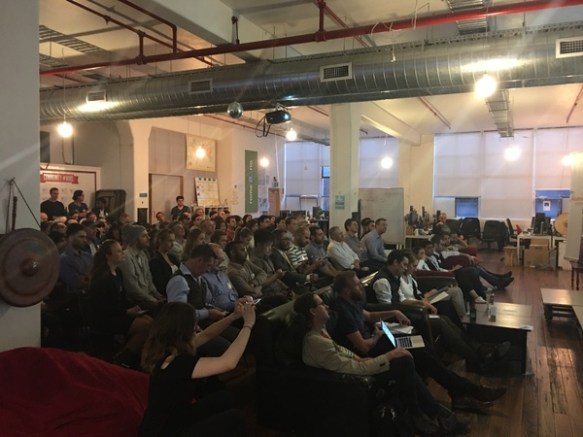
StartupVic’s #Pitch Night for October

The crowds are getting bigger, the list of sponsors is getting longer, there’s a new logo, and they’ve even managed to (sort of) fix the PA system. The Startup Victoria monthly pitch night is now a firm fixture on Melbourne’s Meetup calendar…

Image sourced from Startup Vic's Meetup page (Photo by Daniel)

Image sourced from Startup Vic’s Meetup page (Photo by Daniel)

As usual, there were 4 startup pitches, and I’ll comment on each in order of their presentations:

Next Address

This Ballarat-based startup has built a P2P website that offers “direct to market” property sales, removing the need for traditional estate agents. Recognising that the real estate sector is still ripe for some digital disruption, Next Address is challenging the commission-based fees and cost++ price markup on services that many estate agents charge their clients.

They have established an affiliate programme, and generated some positive media coverage, but have yet to complete any sales. Charging a fee of around $549 to vendors (there is a sliding scale), compared to similar competitors priced at between $800 and $2,000, Next Address is also offering a Facebook package.

I think it’s fair to say that this pitch did not come across as one of the strongest or most compelling presentations at these pitch nights (possibly due to some stage nerves?). There were also questions among people I spoke to about market traction, the customer acquisition model and the conversion process.

Given that there is a lot of competition within real estate listings and aggregation (often backed by major media companies), and given that many vendors still prefer to use the auction process, it was difficult to see how Next Address can cut through, unless they focus on a point of differentiation: geographic market, property type, price range, marketing support or add-on services.

However, the founders must be doing something right, as on the night they managed to attract the attention of a senior executive from a well-known real estate listings website.

DragonBill

DragonBill is an invoicing and remittance solution aimed at sole traders and micro businesses, which has featured in this blog before. The focus is on helping clients manage their cashflow and providing them with a level of financial literacy and education.

Since launching, DragonBill has found a substantial niche market among sporting clubs and associations, in large part because 50% of club members are also SME owners. They are continuing to build partnerships with accountants and are now starting to market themselves via co-working spaces.

Further ahead, there are plans to build some sort of superannuation offering, given that many SME owners and sole traders may not be making sufficient contributions to their personal funds. There are also regulatory changes in payroll administration following the roll out of SuperStream by the ATO.

The judges were interested to know what plans DragonBill has for international growth, and whether the platform can output financial and tax reporting for accounting purposes – both of which are under consideration. Meanwhile, DragonBill was recently shortlisted for an award by VISA.

Spee3d

In short, this business supports “3-D printing of metals at production speeds“. Using a proprietary “Lightspee3d” technology, the goal is to offer a low-cost, high-speed solution for full-scale production output, not just prototypes and medical devices. Primarily manufacturing in copper and aluminium 6061, current output is 100g/minute ( expecting to soon reach 250g/minute), and the maximum size is 300mm x 300mm x 300mm.

For the technically minded, the additive process is described as something like “bugs hitting a windshield”. It does not use any gasses, and deploys a “line of sight” process, meaning that some hollow objects are possible. The business has picked up a Bosch Venture Award.

Targeting products traditionally fabricated by sand casting, Spee3d is working with clients who have a preference for low-cost powders, initially within the university market, then the auto industry. They are also aiming at new products, and not parts manufactured from existing casts that have associated sunk costs. There was quite a lot of excitement around this pitch, judging by the number of questions it prompted.

Foddies

This startup is launching a fructose friendly food business, offering products, recipes and outlets (shops, cafes, catering) that can also appeal to people with other food allergies and dietary requirements. If, like me, you were unaware of the “Low FODMAP” diet,
it was researched and created in Melbourne (Monash Uni), and from my initial reading, it has some similarities with diets designed for people needing gluten-free, lactose free and low GI solutions.

Admittedly not the first to market, Foddies claims to be the first to develop a holistic solution, which includes a wholesale strategy for ready-made meals, a cafe franchise and an online store. Next, they plan to work with airlines and hospitals. Although building on their social media engagement, the biggest challenge, when asked by the judges, was the lack of public awareness or education on the Low FODMAP model.

From a personal perspective, I appreciate the importance of helping people with food allergies or intolerance to manage their condition through appropriate diet. But I can’t be alone in thinking that the higher reported incidence of these complaints may be due to multiple factors such as the increased use of chemicals in the environment (especially food production), the lower resistance in our immune systems caused by too many antibiotics, and our over-reliance on certain strains and varieties of crops. More research is called for.

So, after a very mixed bag of startup pitches, the winner was Spee3d, based on the audience and panel voting.

Next week: Richmond 3121