StartupVic’s #Pitch Night for October

The crowds are getting bigger, the list of sponsors is getting longer, there’s a new logo, and they’ve even managed to (sort of) fix the PA system. The Startup Victoria monthly pitch night is now a firm fixture on Melbourne’s Meetup calendar…
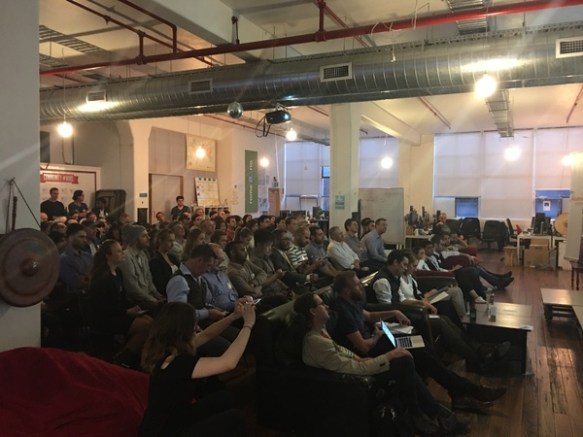
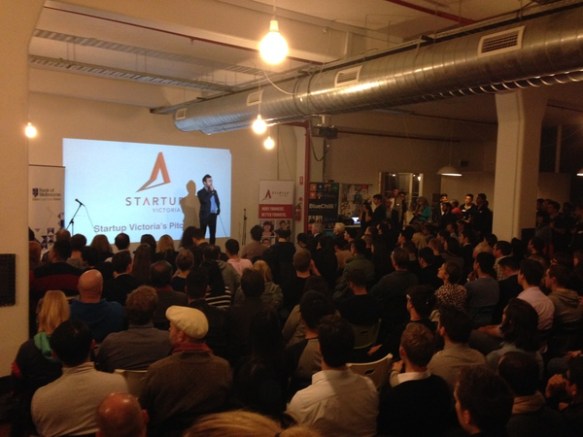
Image sourced from Startup Vic's Meetup page (Photo by Daniel)

Image sourced from Startup Vic’s Meetup page (Photo by Daniel)

As usual, there were 4 startup pitches, and I’ll comment on each in order of their presentations:

Next Address

This Ballarat-based startup has built a P2P website that offers “direct to market” property sales, removing the need for traditional estate agents. Recognising that the real estate sector is still ripe for some digital disruption, Next Address is challenging the commission-based fees and cost++ price markup on services that many estate agents charge their clients.

They have established an affiliate programme, and generated some positive media coverage, but have yet to complete any sales. Charging a fee of around $549 to vendors (there is a sliding scale), compared to similar competitors priced at between $800 and $2,000, Next Address is also offering a Facebook package.

I think it’s fair to say that this pitch did not come across as one of the strongest or most compelling presentations at these pitch nights (possibly due to some stage nerves?). There were also questions among people I spoke to about market traction, the customer acquisition model and the conversion process.

Given that there is a lot of competition within real estate listings and aggregation (often backed by major media companies), and given that many vendors still prefer to use the auction process, it was difficult to see how Next Address can cut through, unless they focus on a point of differentiation: geographic market, property type, price range, marketing support or add-on services.

However, the founders must be doing something right, as on the night they managed to attract the attention of a senior executive from a well-known real estate listings website.

DragonBill

DragonBill is an invoicing and remittance solution aimed at sole traders and micro businesses, which has featured in this blog before. The focus is on helping clients manage their cashflow and providing them with a level of financial literacy and education.

Since launching, DragonBill has found a substantial niche market among sporting clubs and associations, in large part because 50% of club members are also SME owners. They are continuing to build partnerships with accountants and are now starting to market themselves via co-working spaces.

Further ahead, there are plans to build some sort of superannuation offering, given that many SME owners and sole traders may not be making sufficient contributions to their personal funds. There are also regulatory changes in payroll administration following the roll out of SuperStream by the ATO.

The judges were interested to know what plans DragonBill has for international growth, and whether the platform can output financial and tax reporting for accounting purposes – both of which are under consideration. Meanwhile, DragonBill was recently shortlisted for an award by VISA.

Spee3d

In short, this business supports “3-D printing of metals at production speeds“. Using a proprietary “Lightspee3d” technology, the goal is to offer a low-cost, high-speed solution for full-scale production output, not just prototypes and medical devices. Primarily manufacturing in copper and aluminium 6061, current output is 100g/minute ( expecting to soon reach 250g/minute), and the maximum size is 300mm x 300mm x 300mm.

For the technically minded, the additive process is described as something like “bugs hitting a windshield”. It does not use any gasses, and deploys a “line of sight” process, meaning that some hollow objects are possible. The business has picked up a Bosch Venture Award.

Targeting products traditionally fabricated by sand casting, Spee3d is working with clients who have a preference for low-cost powders, initially within the university market, then the auto industry. They are also aiming at new products, and not parts manufactured from existing casts that have associated sunk costs. There was quite a lot of excitement around this pitch, judging by the number of questions it prompted.

Foddies

This startup is launching a fructose friendly food business, offering products, recipes and outlets (shops, cafes, catering) that can also appeal to people with other food allergies and dietary requirements. If, like me, you were unaware of the “Low FODMAP” diet,
it was researched and created in Melbourne (Monash Uni), and from my initial reading, it has some similarities with diets designed for people needing gluten-free, lactose free and low GI solutions.

Admittedly not the first to market, Foddies claims to be the first to develop a holistic solution, which includes a wholesale strategy for ready-made meals, a cafe franchise and an online store. Next, they plan to work with airlines and hospitals. Although building on their social media engagement, the biggest challenge, when asked by the judges, was the lack of public awareness or education on the Low FODMAP model.

From a personal perspective, I appreciate the importance of helping people with food allergies or intolerance to manage their condition through appropriate diet. But I can’t be alone in thinking that the higher reported incidence of these complaints may be due to multiple factors such as the increased use of chemicals in the environment (especially food production), the lower resistance in our immune systems caused by too many antibiotics, and our over-reliance on certain strains and varieties of crops. More research is called for.

So, after a very mixed bag of startup pitches, the winner was Spee3d, based on the audience and panel voting.

Next week: Richmond 3121

My Extended Gap Year

I was recently interviewed for a story about the Future of Work. One of the questions asked how I had arrived at my current portfolio career. As I reflected on the past few years of my working life, I realised that my ongoing journey resembled something of an extended gap year, because of the wide range of interests I have been exploring and the variety of projects I have been working on.

gap-year

Image sourced from Ivy League Admissions Club

During my “original” gap year between school and university, I was a postman, I volunteered at a community law centre, I worked in a bread factory, on a building site and at a law firm, and travelled abroad. My primary goals then were to get some “real” life and work experiences and think about what I might like to do as a career once I graduated. If nothing else, it showed me how to work with other people, develop some resilience and resourcefulness, and discover what I might be passionate about. And while my career went in quite a different direction to the one I had imagined, the gap year experience was an invaluable part of the learning process.

Since my last corporate gig, I have embarked on what feels to be a continuous personal development programme. Aside from undertaking some professional development, participating in hackathons, serving on advisory boards, guest blogging, co-presenting numerous radio shows, developing a prototype HR app, joining various Meetup Groups, and working with a number of startups and entrepreneurs, most recently I have been working in the digital asset space (Bitcoin, Blockchain etc.) and in innovation using design thinking and collaboration models.

As part of my extra-curricular activities, I have continued to explore various digital tools and platforms for composing, recording and distributing my music – I even wrote a piece for Melbourne’s Federation Bells which is on semi-regular rotation – and I have learned some practical skills in picture framing and constructing display boxes out of Perspex.

What this all adds up to is a continuous desire to keep learning, to keep exploring interesting stuff, maintaining a sense of curiosity and not standing still – stagnation is the death of creativity! And while I may not have imagined embarking on such a career path after working in senior corporate roles for many years, the current journey is varied, seldom boring, and frequently rewarding.

For anyone who may feel they are stuck in their current work, or cannot see where there career is going, I would encourage you to think about taking a “gap year” – to explore, experience and experiment with your career options, to challenge your current perceptions, to take yourself out of your comfort zone, and above all to embrace the potential for change. Even if this does not feel like re-inventing yourself, it should be an invigorating and rewarding experience – and I’m more than happy to share some of my own insights if you want to contact me via this blog.

Next week: Spaghetti in the Cloud


Bridging the Digital Divide

Is there still a digital divide in Australia? If so, how do we bridge that gap? If not, how do we address the apparent chasm that is leaving some “digital have-nots” behind? Is it as simple as rolling out the National Broadband Network and equipping every school child with their own tablet device? Or is it also about creating a digital mindset to ensure everyone can take advantage of the educational, social and economic opportunities that the range of digital technologies has to offer?

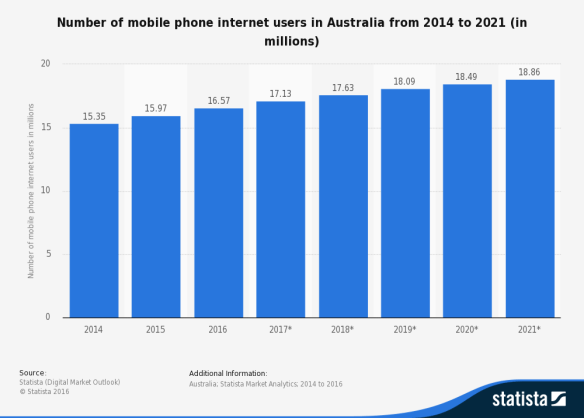
Mobile phone internet usage is projected to keep growing. Source: Statista

Mobile phone internet usage is projected to keep growing. Source: Statista

Based on consumer research, we would appear to be a well-connected country, with a high concentration of PC, smart phone and tablet devices, if data from Roy Morgan is any indicator. However, some recent research by Scott Ewing of Swinburne University based on ABS data has suggested that despite the narrowing of the divide, there is a deeper disconnect among those who do not have internet access.

There are multiple factors contributing to this disconnect: socio-economic, age, location and education. I would expect that within 5-10 years, age will be a far less relevant factor in who does or doesn’t have access to the internet. You could also argue that with more people accessing the internet via mobile devices, and with the increasing number of free WiFi zones across our cities (cafes, shopping centres, office buildings), public institutions (libraries, museums and galleries) and transport infrastructure (plus the reducing price of data and storage), cost may not be as much of an issue either. And once the NBN is complete, the percentage of the population without physical access to the internet should likewise be much smaller.

So that leaves education – according to the ABS-derived data, the more educated you are, the more likely you are to access the internet. Should this infer that we aren’t doing enough to teach digital skills in the classroom? Or are we teaching the wrong set of skills? Or is it a bit like learning English grammar or applied mathematics – unless you use them in your everyday life, you soon forget them, and never remember why it was important to learn them in first place?

Computer science, programming and coding courses are increasingly being taught in schools, either as part of the core syllabus or as extra-curricular activities. Many pupils have to use tablets as an integral part of their school lessons. And some schools are also running hackathons and entrepreneurial projects to help students navigate the new world of work shaped by innovation, digital disruption and the “gig” economy.

The changing nature of work is challenging schools and parents to think about how we should be preparing pupils for the future. It’s not just learning about the technology (important as it is to study data analytics, automation, robotics, AI etc.), it’s also about understanding the context and the potential for what it can do. It’s also increasingly apparent that more and more of today’s students want to do work that is meaningful, rewarding, challenging and which helps connect them to their values and “purpose”.

I like to think that as part of a well-rounded liberal education, today’s pupils will receive:

  • a solid grounding in digital literacy (as important and as vital as the 3 R’s)
  • an awareness of how “digital displacement” (through automation etc.) may impact their chosen career path (even in ways which we cannot yet predict – we must assume it will happen, as no profession, trade or vocation will be totally immune)
  • an appetite for lifelong learning (as one of the ways to cope with the inevitable changes they will face)
  • a set of life skills that instill self-awareness, curiosity, resilience, empathy, flexibility and adaptability.

Finally, if we are to truly grasp why this ability to adapt and change is important, we only need look beyond the digital debate and ask why the National Innovation and Science Agenda is failing to cut through. In large part, the NISA message failed to connect with the general electorate because many people could not identify with it, and therefore it did not resonate with them. Just as “necessity is the parent of invention”, so adversity often needs to be the catalyst for embracing change.

Notwithstanding the economic, environmental and societal challenges we face, there is considerable complacency and acceptance that “she’ll be right” – especially within the political, institutional and corporate elites that claim to lead us. As long as so few of the main actors among these bastions of power and influence decline to change their own culture, behaviours and ways of doing business, then it’s not surprising that the public feels unwilling or unable to change.

So our only real hope is to empower the next generations to shape their own future, not to be constrained by our traditional notions of “job” (in my view, an increasingly outmoded economic unit of value….) and think for themselves as to what change they want to create with all the technology, resources and opportunities at their disposal.

Next week: My Extended Gap Year

101 #Startup Pitches – What have we learned?

During the past 3 years of writing this blog, I have probably heard more than 100 startup founders pitch, present or share their insights. Most of these pitch nights have been hosted by Startup Victoria, with a few on the side run by the Melbourne FinTech Meetup and elsewhere.

Image sourced from Startup Victoria Meetup

Image sourced from Startup Victoria Meetup

Based on all these presentations, I have collated a simple directory of each startup or pitch event I have covered or mentioned in this blog, as well as a few key accelerators and crowdfunding platforms.

What have we learned over that time?

First, apart from the constant stream of new startups pitching each month, it’s been impressive to witness the Melbourne startup community collaborate and support one another.

Second, some of the international founders who have spoken are among the rock stars of startups – and we are fortunate that they have been willing to spend time in Melbourne.

Third, a number of the local startups who have pitched during this time have become well-established and well-known businesses in their own right.

This all means that besides creating great products and services, and being willing to share their experiences, the founders have helped aspiring founders and entrepreneurs to appreciate the importance of:

  • product-market fit;
  • working with agile processes and lean startup models;
  • tackling prototyping and launching MVPs;
  • learning what to measure via key metrics;
  • figuring out funding; and
  • knowing when to pivot or fold.

Looking at the cross section of pitch nights, panel discussions and guest speakers, there are some significant trends and notable startups to have emerged:

Industry focus: Not surprisingly, the pitches are heavily biased towards FinTech, MedTech, Education, Digital Media, Enterprise Services and Consumer Services. There are a some key startups focused on devices (e.g., SwatchMate and LIFX); a smattering in recruitment, fashion, gaming, health and well-being, property services, social media and even logistics. But there are surprisingly few in environmental technology or services.

Business models: Two-sided market places abound, as do customer aggregators, sharing platforms (“the Uber for X”, or “the AirbnB of Y”), freemium apps and subscription services (as opposed to purely transactional businesses). There are also some great social enterprise startups, but surprisingly no co-operative models (apart from THINC).

Emerging stars:  Looking through the directory of startups, some of the star names to have come through during this time, based on their public profile, funding success, awards (and ubiquity at startup events….) include:

CoinJar, LIFX, Tablo, SwatchMate, etaskr, DragonBill, Culture Amp, Eyenaemia, Timelio, Moula, nuraloop,  Konnective, OutTrippin and SweetHawk.

Acknowledgments: Some of the startups and pitches in the list are just ideas, some don’t even have a website, and some didn’t get any further than a landing page. However, I have not been able to include all the startups that turned up at Startup Alley, nor the many more startup founders I have met through these events (but whom I didn’t get to see pitch or present), nor the startup ideas that were hatched during the hackathons I have participated in. And there are a few startups that I could not include because I heard them pitch at closed investor events. Finally, I am and have been very fortunate to work with a number of the startups listed, in various capacities: Brave New Coin, Ebla, Re-Imagi, Slow School of Business and Timelio. To these startups and their founders, I am extremely grateful for the opportunities they have given me.

Next week: Putting a Price on Value