End of the road for Lime?

Earlier this month, Yarra City Council announced it was ending a 6-year trial programme for ride share e-bikes, after the incumbent commercial operator, Lime failed to meet the Council’s procurement requirements.

Despite this, Lime continues to operate elsewhere in the State of Victoria (City of Melbourne and the City of Port Phillip), and in other local government areas in Australia (Sydney, Brisbane, Canberra).

Some of the reasoning behind Yarra Council’s decision appears to echo safety concerns and public complaints regarding Lime in other cities around the world, such as London.

These issues include:

  • Riding on footpaths and in pedestrian-only zones
  • Inappropriate “parking” of ride-share vehicles
  • Joy-riding
  • Speeding
  • Tandem riding
  • Riding without helmets (a requirement in Australia)

In the case of Yarra Council, the original 1-year pilot programme had been extended or renewed unchanged since 2020. According to the Council’s website announcement and FAQs, Yarra did not receive any operating fees, and did not have the certainty and enforceability a commercial contract would have provided.

The biggest obstacle in Yarra appears to be Lime’s refusal or inability to take more responsibility for tracking and retrieving abandoned and illegally parked vehicles – which meant the Council has been picking up the cost.

If this is true, then it appears to be incredibly short-sighted behaviour on the part of Lime – and perhaps reveals a degree of obstinacy bordering on arrogance that comes with incumbency (and a degree of ubiquity).

I can’t believe that Lime cannot do a better job of tracking and retrieving its assets – if I was a shareholder, I would be concerned about this lack of financial management and poor corporate governance. If we can track our suitcases around the world with a simple e-tag, surely Lime knows where all its bikes are located at any given time, and identify which vehicles are illegally parked?

Likewise, Lime should be able to do a better job of immobilising vehicles so they cannot be used for joy-riding, or by under-age riders?

I’m sure we have all seen the social media posts of Lime bikes strewn across footpaths, dumped in waterways, or “parked” on bus shelters. Anecdotally, I’ve also seen ride share vehicles lined up outside my local pub – I get that we don’t want people to drink and drive, but should operators be implicitly encouraging intoxicated pub patrons to use their e-bikes and e-scooters instead?

I have also seen branded ride share helmets littered all over the place – I’ve even had them chucked in my garden. Most of these discarded helmets end up in landfill (as confirmed by one council street cleaner I spoke to in Melbourne’s CBD) because once they are damaged, they can’t be used again. (This also points to a lack of asset management and poor financial governance by the operators.)

There have also been increased incidents of accidents and serious injuries involving e-bikes and e-scooters. I’m not suggesting these are only caused by ride share vehicles, but there is no doubt an element of “don’t own, don’t care” when people use these short-term rental bikes. It would be illuminating to measure the percentage of accidents involving ride share vehicles (and food delivery drivers), as compared to privately-owned e-bikes and e-scooters.

I’d be interested to see more data on programme objectives, and whether or not those goals are being met. For example, a common argument in favour of the local ride share schemes is they help to reduce the number of cars on our roads – but again, anecdotally, where I live in the City of Yarra, I’ve not seen any reduction in car traffic in recent years. Other stated benefits are increased local mobility (easier to take short trips from A to B) – but Yarra is well-served by public transport (trains, trams and buses), and no-one is that far from a tram stop or train station. Another aim might be improved public health (less people using their cars) – but if these schemes result in more trips to A&E (and worse), surely that outweighs any perceived benefit?

Going forward, maybe we will see more local authorities take a similar stance to Yarra Council, or at least tighten up the operating licenses granted to ride share providers, and do more to weigh up the pros and cons of such schemes.

Next week: No More Songs
 

Unintended Consequences?

Last month, Melbourne City Council banned e-scooters for hire. The City’s Lord Mayor argues that the current trial needs to be re-set, as a result of increased traffic violations and personal injuries. So far, similar trials running in other local government areas adjacent to the City will continue, but they will no doubt be seeking to ensure the hire schemes are implemented and managed in a responsible, compliant and sustainable fashion, when the trials expire.

Despite the promised (and welcome) benefits of e-scooter hire schemes, I have yet to see current data that would support their continued operation. E.g., has the introduction of e-scooters reduced either the overall number of cars on the road, or the number of short car journeys under 2km?

I can see that e-scooters are probably popular with shift workers, largely because public transport services do not run at the times these commuters need them or where they need to go.

As well as living close to the City, I live in an adjacent LGA that is running a similar trial, so I have plenty of anecdotal evidence of the downside.

It’s not just users riding on pavements and in pedestrian-only areas with little care for those on foot. Many riders are carrying passengers (unlawfully) and choosing not to wear helmets (also unlawful). There appear to be a large number of joy riders, who often leave vehicles strewn across footpaths, rather than parking them responsibly. Then there are the helmets discarded without care or thought. Many of which probably end up in landfill, especially if they have been cracked or damaged through misuse. (A few months ago, I spoke to a Melbourne City Council street cleaner, and he admitted that if helmets are discarded like litter, they go into the general waste collection.)

I also see e-scooters for hire being lined up by their operators outside pubs and bars. I get that we don’t want people to drink and drive, but riding an e-scooter while drunk is hardly the answer!

I suspect that the obvious problems and misuse could have easily been anticipated, and even mitigated. Here are just a few suggestions:

1. Require all ride-share customers to have appropriate insurance. This could be done via the operator apps, and/or via a subscription model.

2. E-tag all helmets as well as the scooters themselves, so operators can keep track of their property. If I was an investor in these companies, I’d be concerned that they aren’t protecting their assets!

3. Require users to pass some sort of proficiency test – including basic road rules, and traffic regulations.

4. As well as limiting the vehicle speed, disable any e-scooter that is being driven on pedestrian-only footpaths or other “out of bounds” areas. The City of Melbourne and surrounding LGAs now have extensive cycle lanes, so there shouldn’t be any excuse for riding on pavements.

5. Consider attaching breathalysers to each scooter and applying weight limits on vehicles (to counter the problem of passenger over-loading).

Finally, the use of contributory negligence in assessing potential damages should be a default position. Indeed, any rider who causes an accident, injures a pedestrian or damages another vehicle or property, directly or indirectly as a result of the rider’s misuse or negligence should result in strict liability for all damages.

Next week: Ticket scalpers? Blockchain could fix that!


101 #Startup Pitches – What have we learned?

During the past 3 years of writing this blog, I have probably heard more than 100 startup founders pitch, present or share their insights. Most of these pitch nights have been hosted by Startup Victoria, with a few on the side run by the Melbourne FinTech Meetup and elsewhere.

Image sourced from Startup Victoria Meetup

Image sourced from Startup Victoria Meetup

Based on all these presentations, I have collated a simple directory of each startup or pitch event I have covered or mentioned in this blog, as well as a few key accelerators and crowdfunding platforms.

What have we learned over that time?

First, apart from the constant stream of new startups pitching each month, it’s been impressive to witness the Melbourne startup community collaborate and support one another.

Second, some of the international founders who have spoken are among the rock stars of startups – and we are fortunate that they have been willing to spend time in Melbourne.

Third, a number of the local startups who have pitched during this time have become well-established and well-known businesses in their own right.

This all means that besides creating great products and services, and being willing to share their experiences, the founders have helped aspiring founders and entrepreneurs to appreciate the importance of:

  • product-market fit;
  • working with agile processes and lean startup models;
  • tackling prototyping and launching MVPs;
  • learning what to measure via key metrics;
  • figuring out funding; and
  • knowing when to pivot or fold.

Looking at the cross section of pitch nights, panel discussions and guest speakers, there are some significant trends and notable startups to have emerged:

Industry focus: Not surprisingly, the pitches are heavily biased towards FinTech, MedTech, Education, Digital Media, Enterprise Services and Consumer Services. There are a some key startups focused on devices (e.g., SwatchMate and LIFX); a smattering in recruitment, fashion, gaming, health and well-being, property services, social media and even logistics. But there are surprisingly few in environmental technology or services.

Business models: Two-sided market places abound, as do customer aggregators, sharing platforms (“the Uber for X”, or “the AirbnB of Y”), freemium apps and subscription services (as opposed to purely transactional businesses). There are also some great social enterprise startups, but surprisingly no co-operative models (apart from THINC).

Emerging stars:  Looking through the directory of startups, some of the star names to have come through during this time, based on their public profile, funding success, awards (and ubiquity at startup events….) include:

CoinJar, LIFX, Tablo, SwatchMate, etaskr, DragonBill, Culture Amp, Eyenaemia, Timelio, Moula, nuraloop,  Konnective, OutTrippin and SweetHawk.

Acknowledgments: Some of the startups and pitches in the list are just ideas, some don’t even have a website, and some didn’t get any further than a landing page. However, I have not been able to include all the startups that turned up at Startup Alley, nor the many more startup founders I have met through these events (but whom I didn’t get to see pitch or present), nor the startup ideas that were hatched during the hackathons I have participated in. And there are a few startups that I could not include because I heard them pitch at closed investor events. Finally, I am and have been very fortunate to work with a number of the startups listed, in various capacities: Brave New Coin, Ebla, Re-Imagi, Slow School of Business and Timelio. To these startups and their founders, I am extremely grateful for the opportunities they have given me.

Next week: Putting a Price on Value


Another #pitch night in Melbourne…

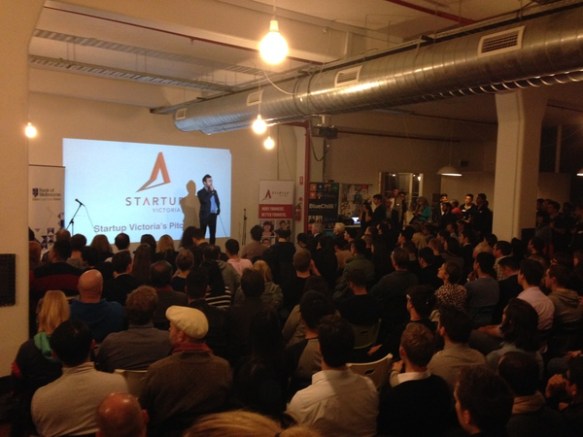
If there is one basic theme emerging from Startup Victoria‘s monthly pitch nights, it is this: whatever market you are in, regardless of your business model, and however disruptive you are trying to be, if you don’t know how to engage or reach your customers your idea is far less likely to succeed. This message came across loud and clear during last week’s event where four startup hopefuls pitched their business ideas to a panel of judges in front of a packed audience.

Picture sourced from Startup Victoria Meetup page

Picture sourced from Startup Victoria Meetup page

So let’s look at this specific issue in respect to each of the pitches:

First came JobPokes, an online recruitment service designed to help candidates match job opportunities to their career preferences. Because it claims to be addressing the hidden job market, candidates aren’t applying for specific roles – instead, it’s a form of reverse enquiry, where recruiters target potential applicants via their registered profiles. I applaud the focus on the non-advertised job market, but while it may well offer an additional channel for recruiters, I’m not sure there was a clear strategy to reach job candidates who need to create a user account, and who are probably already using platforms like LinkedIn and Seek.

Next was Airly, which is sort of “Uber for private aircraft”. The business model involves signing up a minimum number of customers (who pay a monthly subscription fee, entitling them to unlimited flights), and securing sufficient seat capacity via scheduled charter contracts. There is no doubt that the idea of flight flexibility, and an element of passenger exclusivity met with audience approval (Airly took out the people’s choice vote on the night). Also, the PR around Airly has generated in-bound enquiries, suggesting there is demand. But how does this market interest convert to individual customers, when many corporate travel policies rely on wholesale and bulk-purchase models (i.e., aggregation, consolidation, vendor discounts, agency rebates, preferred airlines) rather than catering for individual travel needs or preferences? Unless the target customers are business travelers that manage and pay for their own tickets?

If Airly was about the Uberisation of air travel, RagRaider revealed another aspect of the shared economy model. Squarely aimed at fashion- and budget-conscious women, RagRaider offers a peer-to-peer service whereby customers can hire clothes for one-time use. No doubt there is a market (high school formal, spring carnival, wedding reception…) but the question is how to connect with actual lenders and hirers? We know that the per customer cost of acquisition for 2-sided markets is a key metric, and it wasn’t clear how the founders were addressing this, other than a pre-launch website and some social media. As one observer has commented, the “model is focusing on the ‘product’ part first which is the reverse of how it should be”, and another commented that despite a defined market, the barriers to entry are considerable. The judges also questioned some of the proposed pricing, commission rates and logistics.

Finally, Rounded is another FinTech startup looking to service the SME sector, specifically sole traders, freelancers, sub-contractors and tradies. Another spin on the invoice solution when suppliers need to get paid efficiently, Rounded does not claim to be a full-service accounting software – but, as one attendee commented, key to success will be reaching and educating the end-user market.  Also, they are entering a competitive space, where a new entrant like Xero has already disrupted incumbents like QuickBooks, Reckon and MYOB. I wasn’t able to stay for the pitch, but I did have the opportunity to speak with the founders beforehand. Clearly driven by their own experience and needs, there is a solid but simple idea here – but as Xero and others are increasingly able to serve similar customers, Rounded will find it really difficult to compete.

If anything, these latest pitches showed how hard it is to compare apples with oranges, although the voting criteria (market traction, product viability, team composition, pitch presentation, and responses to judges’ questions) are designed to deliver a consistent evaluation. It was also apparent that these pitches divided audience opinion more so than previous contestants – which is probably a good thing as variety is the spice of life….

Acknowledgments: thanks to Graphican, Marlene M., Cornell and Dale G. for their input.

Next week: Re-Imagining Human-led #Innovation