Unintended Consequences?

Last month, Melbourne City Council banned e-scooters for hire. The City’s Lord Mayor argues that the current trial needs to be re-set, as a result of increased traffic violations and personal injuries. So far, similar trials running in other local government areas adjacent to the City will continue, but they will no doubt be seeking to ensure the hire schemes are implemented and managed in a responsible, compliant and sustainable fashion, when the trials expire.

Despite the promised (and welcome) benefits of e-scooter hire schemes, I have yet to see current data that would support their continued operation. E.g., has the introduction of e-scooters reduced either the overall number of cars on the road, or the number of short car journeys under 2km?

I can see that e-scooters are probably popular with shift workers, largely because public transport services do not run at the times these commuters need them or where they need to go.

As well as living close to the City, I live in an adjacent LGA that is running a similar trial, so I have plenty of anecdotal evidence of the downside.

It’s not just users riding on pavements and in pedestrian-only areas with little care for those on foot. Many riders are carrying passengers (unlawfully) and choosing not to wear helmets (also unlawful). There appear to be a large number of joy riders, who often leave vehicles strewn across footpaths, rather than parking them responsibly. Then there are the helmets discarded without care or thought. Many of which probably end up in landfill, especially if they have been cracked or damaged through misuse. (A few months ago, I spoke to a Melbourne City Council street cleaner, and he admitted that if helmets are discarded like litter, they go into the general waste collection.)

I also see e-scooters for hire being lined up by their operators outside pubs and bars. I get that we don’t want people to drink and drive, but riding an e-scooter while drunk is hardly the answer!

I suspect that the obvious problems and misuse could have easily been anticipated, and even mitigated. Here are just a few suggestions:

1. Require all ride-share customers to have appropriate insurance. This could be done via the operator apps, and/or via a subscription model.

2. E-tag all helmets as well as the scooters themselves, so operators can keep track of their property. If I was an investor in these companies, I’d be concerned that they aren’t protecting their assets!

3. Require users to pass some sort of proficiency test – including basic road rules, and traffic regulations.

4. As well as limiting the vehicle speed, disable any e-scooter that is being driven on pedestrian-only footpaths or other “out of bounds” areas. The City of Melbourne and surrounding LGAs now have extensive cycle lanes, so there shouldn’t be any excuse for riding on pavements.

5. Consider attaching breathalysers to each scooter and applying weight limits on vehicles (to counter the problem of passenger over-loading).

Finally, the use of contributory negligence in assessing potential damages should be a default position. Indeed, any rider who causes an accident, injures a pedestrian or damages another vehicle or property, directly or indirectly as a result of the rider’s misuse or negligence should result in strict liability for all damages.

Next week: Ticket scalpers? Blockchain could fix that!


Another #pitch night in Melbourne…

If there is one basic theme emerging from Startup Victoria‘s monthly pitch nights, it is this: whatever market you are in, regardless of your business model, and however disruptive you are trying to be, if you don’t know how to engage or reach your customers your idea is far less likely to succeed. This message came across loud and clear during last week’s event where four startup hopefuls pitched their business ideas to a panel of judges in front of a packed audience.

Picture sourced from Startup Victoria Meetup page

Picture sourced from Startup Victoria Meetup page

So let’s look at this specific issue in respect to each of the pitches:

First came JobPokes, an online recruitment service designed to help candidates match job opportunities to their career preferences. Because it claims to be addressing the hidden job market, candidates aren’t applying for specific roles – instead, it’s a form of reverse enquiry, where recruiters target potential applicants via their registered profiles. I applaud the focus on the non-advertised job market, but while it may well offer an additional channel for recruiters, I’m not sure there was a clear strategy to reach job candidates who need to create a user account, and who are probably already using platforms like LinkedIn and Seek.

Next was Airly, which is sort of “Uber for private aircraft”. The business model involves signing up a minimum number of customers (who pay a monthly subscription fee, entitling them to unlimited flights), and securing sufficient seat capacity via scheduled charter contracts. There is no doubt that the idea of flight flexibility, and an element of passenger exclusivity met with audience approval (Airly took out the people’s choice vote on the night). Also, the PR around Airly has generated in-bound enquiries, suggesting there is demand. But how does this market interest convert to individual customers, when many corporate travel policies rely on wholesale and bulk-purchase models (i.e., aggregation, consolidation, vendor discounts, agency rebates, preferred airlines) rather than catering for individual travel needs or preferences? Unless the target customers are business travelers that manage and pay for their own tickets?

If Airly was about the Uberisation of air travel, RagRaider revealed another aspect of the shared economy model. Squarely aimed at fashion- and budget-conscious women, RagRaider offers a peer-to-peer service whereby customers can hire clothes for one-time use. No doubt there is a market (high school formal, spring carnival, wedding reception…) but the question is how to connect with actual lenders and hirers? We know that the per customer cost of acquisition for 2-sided markets is a key metric, and it wasn’t clear how the founders were addressing this, other than a pre-launch website and some social media. As one observer has commented, the “model is focusing on the ‘product’ part first which is the reverse of how it should be”, and another commented that despite a defined market, the barriers to entry are considerable. The judges also questioned some of the proposed pricing, commission rates and logistics.

Finally, Rounded is another FinTech startup looking to service the SME sector, specifically sole traders, freelancers, sub-contractors and tradies. Another spin on the invoice solution when suppliers need to get paid efficiently, Rounded does not claim to be a full-service accounting software – but, as one attendee commented, key to success will be reaching and educating the end-user market.  Also, they are entering a competitive space, where a new entrant like Xero has already disrupted incumbents like QuickBooks, Reckon and MYOB. I wasn’t able to stay for the pitch, but I did have the opportunity to speak with the founders beforehand. Clearly driven by their own experience and needs, there is a solid but simple idea here – but as Xero and others are increasingly able to serve similar customers, Rounded will find it really difficult to compete.

If anything, these latest pitches showed how hard it is to compare apples with oranges, although the voting criteria (market traction, product viability, team composition, pitch presentation, and responses to judges’ questions) are designed to deliver a consistent evaluation. It was also apparent that these pitches divided audience opinion more so than previous contestants – which is probably a good thing as variety is the spice of life….

Acknowledgments: thanks to Graphican, Marlene M., Cornell and Dale G. for their input.

Next week: Re-Imagining Human-led #Innovation


Seeing Japan with #Airbnb

Hotels in Japan can be very expensive, and despite the fact that the shared economy operates in something of a regulatory grey area, I am pleased to say that the experience of using Airbnb throughout my recent visit was a great success. Luckily, my travelling partner had done extensive advance research, so there were very few hitches.

Kan Yasuda: “Shape of Mind” (2006) Photo © Rory Manchee – all rights reserved

Whether innovation is on the rise in Japan, or whether the “illicit” sharing economy is gaining traction, it seems that Airbnb in particular appeals to certain enterprising and entrepreneurial types who see an opportunity in the current market. The various hosts comprised an agent managing several properties on behalf of the owners, professional couples renting out an investment or spare apartment, and a self-motivated entrepreneur also building social enterprises.

I won’t specify the apartments I stayed in, partly because these particular hosts in Tokyo, Kobe and Kyoto are proving very popular (especially over the upcoming holiday season), and partly to avoid any potential “regulatory” hassles. But hopefully the following insights will be helpful in planning your own trip.

First, the bookings were all for self-contained apartments (usually a studio dwelling, close to public transport), and selected based on previous positive feedback. In each case, the accommodation was situated in older, low-rise developments, located in mainly residential neighbourhoods. In one case, it was a traditional apartment, complete with tatami mats, sliding doors/room dividers, and an older style wet-room bath and shower.

Second, the “hosts” were all very helpful in giving travel directions, offering suggestions on where to eat nearby, and/or providing local guides and maps. One had even posted a self-made YouTube video showing the walk from the train station to the front door. Obviously, the fact that they were happy to take bookings from foreign visitors meant that all of the communication was conducted in English.

Third, for the most part decor was simple but comfortable, but some of the beds were on the small side. And one apartment was owned by a fan of a certain cartoon character, with furnishings to match, which was quite surreal.

Fourth, due to the apparent semi-legal nature of Airbnb in Japan, the hosts were keen to make sure that not only did their guests not make any noise or disturb the neighbours, they did not want guests either to talk to or to answer the door to strangers. One host even suggested that if guests put rubbish in the wrong place for collection, they would be extorted by the local Yakuza.

Lastly, although the basics were consistent (bedding, towels, soap, shampoo, hairdryer, cutlery, crockery), there were some significant differences in what other facilities were provided, as follows:

Apartment 1

Location: Close to the Metro, convenience stores, restaurants, bars and a shopping mall. Also, in the vicinity of museums, galleries and other cultural attractions.

Accommodation: Studio apartment, with own bathroom and kitchenette.

Amenities: No TV, but free WiFi, kettle, microwave, single-burner stove, fridge, washing machine.

Apartment 2

Location: Reasonably close to the local private railway station, supermarkets nearby, and a couple of small shops in the area. No bars or restaurants in the immediate neighbourhood, which was mostly residential, but there were the ubiquitous vending machines. More choices in the nearby suburbs.

Accommodation: 3-bedroom traditional apartment (tatami mats, futons), with own bathroom and kitchen/diner. Very spacious.

Amenities: No WiFi and no washing machine, but free-to-air TV, kettle, microwave, single-burner stove, fridge. And no knives. Of any kind.

Apartment 3

Location: Very near to a large JR station and major bus routes, with a supermarket and a couple of convenience stores on the same street, and several small bars and restaurants close by. Mixed residential, commercial and light-industrial area.

Accommodation: Studio apartment, with own bathroom and kitchenette.

Amenities: Free portable WiFi, free-to-air TV, kettle, single-burner stove, fridge, washing machine. But no microwave.

Apartment 4

Location: Few hundred meters from a major interchange station, and very close to several convenience stores, bars, restaurants and a decent coffee shop. Adjacent to a very popular shopping, eating and entertainment precinct, getting very trendy with the hipster brigade (even some co-working spaces in the neighbourhood!).

Accommodation: Studio apartment, with own bathroom and kitchen/diner.

Amenities: No microwave, no stove and no TV. But free WiFi, hot-water urn, fridge, and washing machine.

Finally, the only major criticism I have is that the Airbnb app itself was not that easy to use while travelling, so messages to/from hosts were often delayed. (More on Japan in coming weeks….)

Next week: navigating #MedTech

The future of #FinTech is in Enterprise Solutions

Talk to anyone involved in FinTech, and apart from telling you the sector is “hot”, there’s little consensus on what happens next. Despite positioning itself as a disruptive force within financial services, much of what goes on in the sector is either driven by regulatory reform, or by technological developments in allied fields. Most of the disruption so far is in retail and B2C services, yet the more significant opportunities are likely to be found in enterprise and B2B solutions. But as The Economist commented recently, “The fintech firms are not about to kill off traditional banks.”

The Current State

In broad terms, FinTech is working in four main areas:

  • Cryptocurrencies
  • Payments
  • P2P lending
  • Financial Advice and Planning

The first two are responding to dual technological advances – namely, the use of block chains and cryptography; and increased sophistication around mobile and GPS. Patrick Maes, CTO of ANZ Bank, has stated that “Bitcoin and block chain are the first payments innovations in 2,000 years.” He also has a FinTech “wish list”.

The second two (at least, within Australia) are benefitting from regulatory changes, such as the new positive consumer credit reporting regime, and the Future of Financial Advice reforms. And when the National Payments Platform scheduled for 2017 mandates real-time settlements, everyone will have access to immediate inter-bank payment services.

Of course, there is some overlap among these categories, which in turn are also benefitting from developments in big data analytics, mobile solutions, social media platforms, and consumer trends like crowdsourcing and the shared economy.

CCE2z9TVIAENCcE

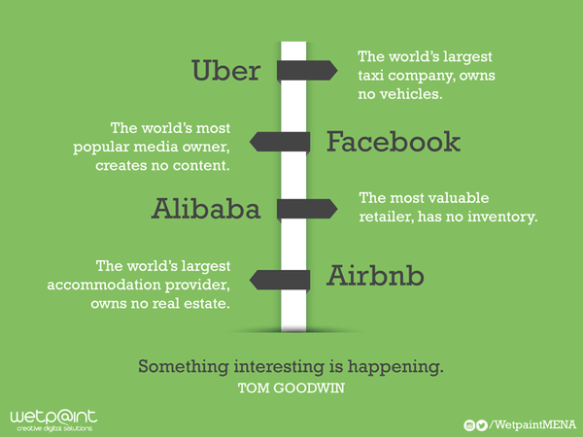
It may be interesting – but it’s not whole picture

Disintermediation May Not Be Enough?

Most of the FinTech disruption has been in the nature of disintermediation – displacing the role of traditional banks and merchant services in providing payment solutions, point-of-sale facilities and personal loan products. But given the relatively small margins on these services, you either need to have a totally different cost structure, or a significantly large market position to achieve scale and volume.

You will have seen the above infographic, often quoted with a sense of wonder at how these companies have built huge businesses seemingly without having to own any physical assets. Well, yes, but dig deeper, and what do we find? The banks have always worked on the same principle – they take customer deposits (which they don’t own), and then lend them to borrowers (whose secured assets they don’t own unless there is a default).

The main difference is that banks are highly regulated (unlike most of these digital market disruptors), and as such they have to hold sufficient capital assets to cover their exposures. Meanwhile, the banks finance the car loans taken out by Uber drivers, they provide credit facilities and export guarantees to Alibaba traders, they underwrite the mortgages on properties used for Airbnb, and will likely provide e-commerce services to advertisers who use Facebook.

For me, probably the last major FinTech disruptor was Bloomberg (founded back in 1981), because it changed the way banks and brokers accessed news and information to support their trading activities, by introducing proprietary analytics and data tools via dedicated terminals, screens and datafeeds. So successful has Bloomberg been that it now owns about one-third of the global market for financial data, and is the single-largest player (albeit by a very small margin over main rival Thomson Reuters – itself, a merger of two key data vendors). Plus Bloomberg is still privately held.

The Future State

I don’t believe FinTech can truly come of age until a major enterprise solution appears. For different reasons, Stripe and BlueDot could be on their way, but both are primarily operating in the consumer payments sector.

I have written previously on the areas where FinTech could impact institutional banking and securities trading, including loan origination, data analytics and risk management. I’ve also reported on the opportunity to disrupt traditional market data vendors by changing the pricing and consumption models. And elsewhere, I have hypothesized on how banks’ trade finance services could be disrupted.

The areas where “Big FinTech” could truly make a difference are:

  • Counterparty Risk Management
  • Predictive Credit Risk Analytics
  • Loan Pricing Models
  • Unit Pricing Calculations
  • Collateral Management
  • Portfolio Performance Attribution
  • Sentiment-based Trading and Risk Pricing

However, the final word should go to Patrick Maes, who suggested that a huge opportunity exists in deposit products linked to customer loyalty programs and frequent flyer points – what if your credit card points could be used to finance a car lease or as part of the deposit on your first home?

Next week: Change Management for Successful Product Development