BYOB (Bring Your Own Brain)

My Twitter and LinkedIn feeds are full of posts about artificial intelligence, machine learning, large language models, robotics and automation – and how these technologies will impact our jobs and our employment prospects, often in very dystopian tones. It can be quite depressing to trawl through this material, to the point of being overwhelmed by the imminent prospect of human obsolescence.

No doubt, getting to grips with these tools will be important if we are to navigate the future of work, understand the relationship between labour, capital and technology, and maintain economic relevance in a world of changing employment models.

But we have been here before, many times (remember the Luddites?), and so far, the human condition means we learn to adapt in order to survive. These transitions will be painful, and there will be casualties along the way, but there is cause for optimism if we remember our post-industrial history.

First, among recent Twitter posts there was a timely reminder that automation does not need to equal despair in the face of displaced jobs.

Second, the technology at our disposal will inevitably make us more productive as well as enabling us to reduce mundane or repetitive tasks, even freeing up more time for other (more creative) pursuits. The challenge will be in learning how to use these tools, and in efficient and effective ways so that we don’t swap one type of routine for another.

Third, there is still a need to consider the human factor when it comes to the work environment, business structures and organisational behaviour – not least personal interaction, communication skills and stakeholder management. After all, you still need someone to switch on the machines, and tell them what to do!

Fourth, the evolution of “bring your own device” (and remote working) means that many of us have grown accustomed to having a degree of autonomy in the ways in which we organise our time and schedule our tasks – giving us the potential for more flexible working conditions. Plus, we have seen how many apps we use at home are interchangeable with the tools we use for work – and although the risk is that we are “always on”, equally, we can get smarter at using these same technologies to establish boundaries between our work/life environments.

Fifth, all the technology in the world is not going to absolve us of the need to think for ourselves. We still need to bring our own cognitive faculties and critical thinking to an increasingly automated, AI-intermediated and virtual world. If anything, we have to ramp up our cerebral powers so that we don’t become subservient to the tech, to make sure the tech works for us (and not the other way around).

Adopting a new approach means:

  • not taking the tech for granted
  • being prepared to challenge the tech assumptions (and not be complicit in its in-built biases)
  • question the motives and intentions of the tech developers, managers and owners (especially those of known or suspected bad actors)
  • validate all the newly-available data to gain new insights (not repeat past mistakes)
  • evaluate the evidence based on actual events and outcomes
  • and not fall prey to hyperbolic and cataclysmic conjectures

Finally, it is interesting to note the recent debates on regulating this new tech – curtailing malign forces, maintaining protections on personal privacy, increasing data security, and ensuring greater access for those currently excluded. This is all part of a conscious narrative (that human component!) to limit the extent to which AI will be allowed to run rampant, and to hold tech (in all its forms) more accountable for the consequences of its actions.

Next week: “The Digital Director”


Same, same – but different?

At the time of writing, Melbourne and the rest of Victoria are waiting to know when (if?) the current lock-down will be lifted.

Just to recap: Melbourne is presently in its sixth shut down since March of last year, and the fourth so far of 2021. All combined, Melbourne has now clocked up more than 200 days under lock-down. The present measures were introduced on August 5, originally scheduled to last one week, and came barely a week after the previous lock-down ended. Lock-down #6 was soon extended by another week, and then by another two weeks, and will now extend beyond September 2. This is not counting the “stay at home” directive that was in place for most of 2020, along with the various limits and restrictions on social interaction, workplace capacity, public gatherings, hospitality, events, sport, gyms, retail, schools, funerals and weddings. We also have a night-time curfew for good measure.

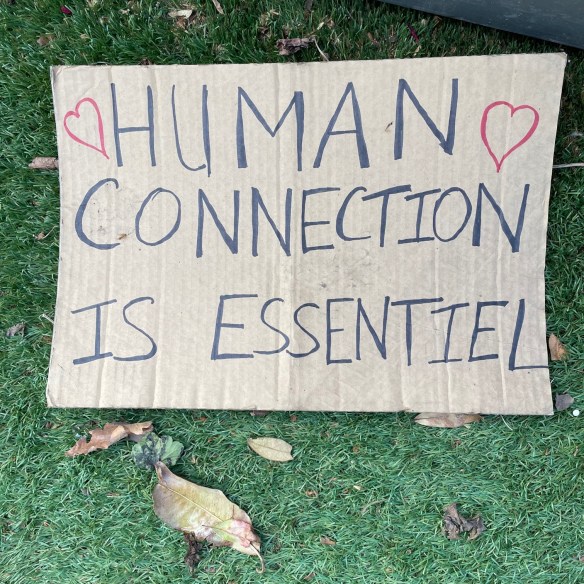
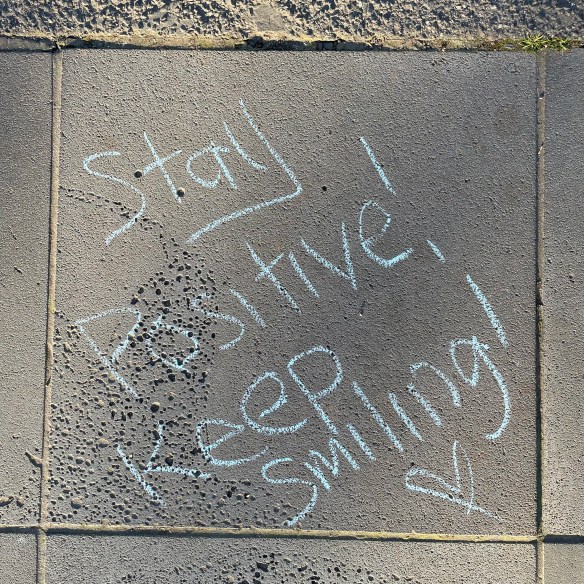
The following two pictures convey similar human sentiments, but they also represent very different responses to the situation we are living under. One is an example of the numerous messages of hope and encouragement that I see around my neighbourhood on my statutory daily walks. The other is a discarded placard seen a few days after an anti-lock-down protest.

The first reflects a “let’s grin and bear it” attitude – nobody likes being in lock-down, but we are all in this together, and if we can just remain positive, we will come through it OK.

The second is more reactive, and emotionally charged – the enforced isolation brought on by the lock-down is having an enormous effect on peoples’ mental health.

It’s hard to argue with either message….

I thought I would be able to cope better with each successive lock-down. Building a daily routine, maintaining some physical discipline (courtesy of the permitted daily exercise), managing at least 2-3 AFDs per week, treating myself to a nice restaurant-prepared meal now and then, catching up on films that I didn’t get to see at the cinema. But despite the recurring groundhog scenario, this lock-down seems different, and much harder to manage mentally.

First, the uncertainty of when it will end creates a sense of dread that we could be like this for 100 days or more (like lock-down #2). Second, the daily drip feed of data and the endless press conferences only reinforce the sense that we are not being given the full picture. Third, the sense of helplessness that for all our individual sacrifices of the past 18 months, we don’t seem to be any further ahead (if anything, we have gone backwards on so many counts). Fourth, State politicians seem to view this public health scare as a war of attrition between themselves and the voters (and their interstate and Federal counterparts). Gone is any sense that we are all in this together.

Quite apart from the cracks in Federation that the pandemic and its response has exposed, entire sections of the community are being driven apart and/or pitted against one another. Despite the so-called “National Plan” that the Commonwealth, State and Territory governments have all signed-up for, it’s clear that individual Premiers each reserve the right to interpret it differently, and will continue to impose internal border closures if they see fit. So, while Victoria and New South Wales seem aligned on this National Plan, Western Australia and Queensland in particular are more circumspect. Then there is the “race” to vaccinate their respective populations (or, as has been said a few times already, “our State citizens”, rather than “our Commonwealth citizens”).

At what point will the 70% and 80% vaccination levels be achieved to herald the promised social and economic freedoms? Is it the % of total population, or only the adult population, or only the eligible population, or only those between certain ages? Is it going to be calculated Federally, or at the State/Territory and/or LGA level? What about mandatory vaccinations for essential and front line workers, and those that have face-to-face dealings with the public? What about employers who require their staff to be fully vaccinated, but face resistance from unions?

Continued lock-down risks becoming a blunt instrument, and a tool of first (rather than last) resort. As such, it also risks alienating the majority of the population who are doing the right thing, in observing the public health directions and getting vaccinated (like, where’s the benefit?). And a prolonged lock-down risks undermining the efficacy of the vaccine, so we’ll need booster shots before we know it!

It seems that Covid19 is challenging our notions of the social contract between the government and the governed, and even testing the social license to operate we grant to big business (especially monopolies and cozy duopolies). The pandemic is also demonstrating the limits of individual responsibility and accountability, and potentially undermining the duty of care we owe to one another. If I knowingly, recklessly or carelessly (and as a result of breaching public health orders or OH&S measures) infect my family, my neighbour, my colleague or my customer, am I culpable? Does that mean I forfeit certain of my rights, especially if infection leads to death?

Just on the data, another reason the current lock-down seems different is because the information is being presented is not the same. Last year, everything was about the R0 number, flattening the curve, and “double-donut days”. There was also confusion over agreed terminology for “clusters”, “unknown cases”, “hot spots”, “red zones”, “complex cases” and “linked cases”. Politicians and bureaucrats talked about “settings”, “circuit breakers”, and “gold standards” for contact tracing. This year, it’s all about the “number of days infected”, “chains of transmission”, “mystery cases”, as well as the number of tests and vaccinations – much less analysis, it seems, on the number of confirmed cases per 1,000 tests or per 1,000 of the population, recovery rates or deaths as a percentage of cases.

From what I can glean, the stubborn levels of “mystery” cases can only be explained by the following:

  • more asymptomatic cases (are people building natural immunity?);
  • legacy cases shedding (a result of long Covid?);
  • longer incubation (and reporting) periods (less obvious initial symptoms?);
  • novel forms of transmission (or the virus is lingering longer on outdoor surfaces?);
  • QR codes and contact tracing not working (or the data is not usable?);
  • confusion over domestic/social/workplace/health/retail settings (e.g., extended families and multi-generational households?);
  • people being unclear about their movements (for fear of being victimised?).

Finally, I’m also not sure if lessons are being learned from elsewhere. We are still applying 14 day quarantine/isolation periods (albeit now with a day 17 test), yet in Hong Kong, for example, quarantine was extended to 21 days some time ago.

Next week: To be or NFT?


Victorian Tech Startup Week

Last week, I mentioned that Australia’s headline employment numbers appeared to be making a strong post-lockdown recovery – however, the latest ABS data shows that while the unemployment rate has declined, the overall participation rate has remained the same, and the underemployment rate has actually increased. “Underemployed” is defined by the ABS as the number of “employed people who would prefer, and are available for, more hours of work than they currently have”. For many people, the traditional solution to bridging the gap between the amount of work they have, and the amount they want, is to juggle multiple part-time jobs, while others may choose to seek freelance work. Another approach is to create your own role, by becoming a startup founder, or joining a startup.

Of course, as I have written elsewhere, startups might not be for everyone. But until you try (or at least explore the idea), how will you know? This was one theme to have emerged from the recent Victorian Tech Startup Week, hosted by YBF Melbourne, with support from OVHcloud, AirTree Ventures, Silicon Beach Melbourne, the Victorian Government and YBF’s network of mentors, programme partners and community of members.

In part an effort to rekindle the local community of startups, in part a celebration of YBF’s Startup Immersion Programme, the week also showcased the benefits of co-working, and included sessions on startup funding, R&D grants, engaging with corporate clients, and a pitch night (more on that next week).

Of course, as a YBF member, and having worked with startups and founders for more than 10 years, I’m naturally biased. I have been working from their Melbourne co-working facility for the past two years (lock-down permitting), and I have been attending events and workshops there for many years (including participating in my very first hackathon….). I have also worked with some of their earliest startup founders.

Even though I am used to working from home and working remotely, the value of being on-site with other startup teams and founders within a supportive environment cannot be overestimated. And it’s not just about access to great facilities, and the many benefits that YBF offers. For one thing, as a member I get invited to meetings and events not open to the wider public. For another, I can host clients and other visitors without having to maintain my own office. But most of all, it’s the opportunity for chance encounters with potential clients, partners and suppliers, often triggered by casual conversations by the coffee machine or during other networking sessions.

A few years ago, it was reported that there were over 300 co-working spaces in Australia, and more then 80 of them in the Melbourne area alone. I’m not sure what those numbers are now, post-pandemic, especially as offices in Melbourne are still not back to full operating capacity. Nevertheless, co-working spaces are in demand again as (ex-)employees consider their future career options in light of the COVID recession, and as startups and their founders are expected to support the anticipated economic growth in areas like new technology, sustainability, smart manufacturing, healthcare and financial services. Of course, before making a decision on where to locate your new business or where to start co-working, it pays to do your due diligence.

Next week: Victorian Tech Startup Week – Pitch Night

Transition – post-pandemic career moves

Even before the latest lock-down v3.0 in Melbourne, one of the other members of my co-working space in the CBD decided they’d already had enough of being confined to a 5km radius, working from home, and other lock-down related restrictions. Having had their interstate travel curtailed over the past 12 months, and suffering from cabin fever, they have opted to spend the next few months living in and working from various Airbnb locations around regional Victoria. Even though they are used to WFH, recent experience has shown that they don’t need to be confined to one place. And this post-COVID shift in our work/life patterns (already being disrupted and enabled by remote working) is only increasing.

Likewise, a client I spoke to in the USA last week informed me that they had just settled into a new location on the west coast, and was “living the dream” of a nomadic existence.

More extreme is the recent example of a Guardian employee who, having had to travel from Sydney to the UK for a family funeral last year, then took several months to get back home (due to flight cancellations), but managed to keep working remotely from various European locations as he moved around to stay ahead of border closures.

Prior to this past weekend, and despite the city being out of Stage 4 lock-down for 3 months, private offices in Melbourne’s CBD have only been allowed to operate at 50% of capacity – the proposed move to 75% capacity has been put back. It means, for example, that even on a really good day, my local coffee shop is still only doing 60% of its pre-COVID business.

It’s my guess that the combination of office restrictions and many retail and hospitality businesses simply not bothering to re-open at all means the CBD is barely operating at 40-50%. It’s deceptive – some activities (e.g., construction) have continued pretty much unabated (even expanding while there is less traffic on the roads); while others have been shut down altogether (e.g., entertainment). Certainly food delivery services are still in demand, while some retail has been doing a bit better as customers appreciate the novelty of shopping in-person.

Monday to Friday in the CBD is like a bell-curve distribution – Mondays and Fridays are much quieter, as people choose to WFH part of the week. Which is challenging for employers, as they try to revert to “normal”. But assuming a mix of remote and on-site working continues, it probably means less overall demand for office space. (It’s also difficult to assess the impact of the CBD exodus on suburban hubs.)

So all that construction work suggests we will have an over-supply of commercial premises (offices, shops, restaurants and hotels).

Residential property is a similar story – student accommodation is far from full, as overseas students aren’t returning; and more inner-city apartment buildings are still going up, but there is something of an exodus from the city to regional and rural locations.

The latter tree- and sea-changes are being fueled by a number of factors: a desire to leave the city (which is more prone to lock-downs); low interest rates (so, cash out the equity in your suburban home and move to the country where your money buys you more); increased opportunity to WFH (see, 5G and the NBN have their benefits!); and a broader wish for a different work/life balance.

Unfortunately, this shift is also putting pressure on local housing supply – average property prices are going up faster in some regional centres than in the capital cities; and more nomadic lifestyles are driving up demand for short-stay accommodation. The combined effect is higher rental costs and reduced supply, tending to squeeze out the locals.

Ironically, we’ve heard farmers and primary producers in rural and regional Australia complain that they can’t get seasonal workers due to COVID restrictions on international visitors (especially students, back-packers and experienced fruit pickers). Conversely, we’re told that 90% of jobs lost after March last year have now been recovered – although this apparent rebound is mainly in part-time roles, not full-time positions. It would be interesting to see a detailed breakdown by industry, as some sectors (tourism, aviation, universities) are still struggling.

The hiatus (and disruption) brought about by COVID and subsequent lock-downs has no doubt prompted many people to reassess their careers: where do I want to live/work? what type of work do I want to do? which industries or companies are hiring? and for what roles? As part of a wider re- and up-skilling initiative, the Federal and State governments are offering a range of free vocational courses (mostly Cert I to IV programmes), as well as some enhanced “pathways” to trade apprenticeships.

While this is to be applauded, I can’t help feeling the effort is at least 5-10 years too late to address the technological, demographic and societal changes that began at the end of the last century, with the advent of the internet, cheaper technology, an ageing population, increased globalisation, inefficient taxation and tariff systems, and general economic restructuring. If nothing else, COVID has demonstrated the need for more resilience in the domestic economy, (and a reduced reliance on overseas imports and supply chains) such as smart manufacturing and food security.

Meanwhile, a friend of mine recently related that a nephew of his had dropped out of college (like many of his peers in the USA and elsewhere) and decided to become a self-taught expert in DeFi, as there is more chance of financial success (and career satisfaction) than obtaining an “off the shelf” bachelor degree….

Next week: Corporate Art