How about that AAA rating?

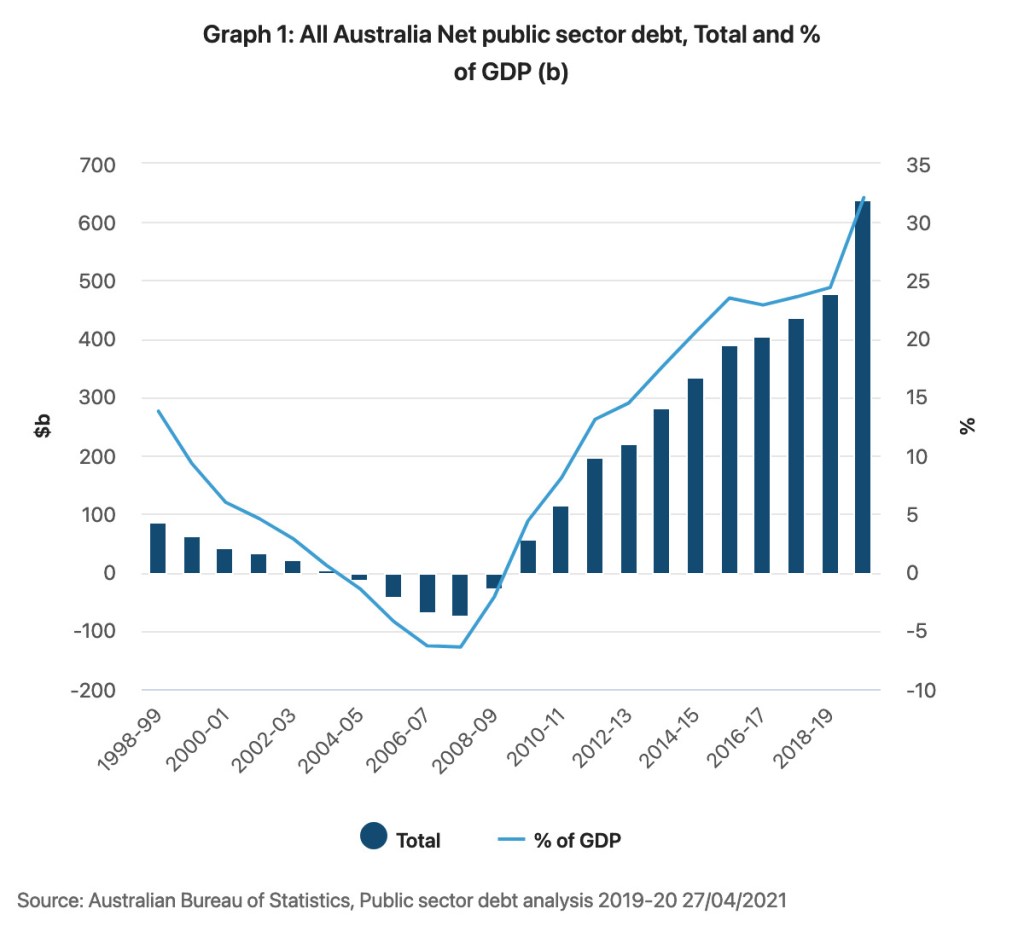
As the State of Victoria weighs up the costs of yet another lock down, you could be forgiven for thinking that the local economy has taken a further beating after the horrendous events of the past 15 months. Across Australia, thousands of companies and individuals accessed various government-sponsored financial aid packages to keep afloat, causing the federal government to borrow more money, at something like 8x the equivalent rate pre-COVID. National public debt is now expected to grow to more than 40% of GDP by the 2024-25 fiscal year – effectively double what it was in 2018-19.

So what has Australia done to retain its coveted AAA sovereign rating from Standard & Poor’s, and have the rating outlook upgraded from negative to stable? According to the ratings agency, and economists such as Westpac’s Bill Evans, there are probably three or four key factors that have warranted this optimistic economic reckoning.

First, while government borrowing (Quantitative Easing) has blown out as a proportion of GDP, the current low interest rates mean that the cost of servicing that debt is manageable.

Second, while the pursuit of QE has destroyed any hope of returning to an overall budget surplus, the deficit will return to similar levels last seen after the GFC, and the current account will continue to return a modest surplus over the coming quarters.

Third, despite the significant economic risks that were identified at the start of the COVID pandemic, the actual impact on the budget has been less than feared, and the economy is recovering faster than expected (as evidenced by latest employment data and consumer sentiment).

Fourth, Australian banks have seen an increase in customer deposits, meaning they are less reliant on more expensive overseas borrowing for their own funding.

Overall, just as with the GFC, Australia has managed to dodge a bullet (the shock to the system was less than anticipated) – in large part thanks to a resurgence in iron ore prices (again).

But weaknesses and disparities remain:

The over-reliance on commodity prices (mainly based on demand from China) hides the true nature of Australia’s balance of payments – we manufacture less than we used to, and our supply chains have been severely tested during the pandemic. And with international borders closed, we won’t see the same levels of GDP growth that resulted from immigration.

Our household savings rate as a percentage of disposable income has come down from its peak of 22% in July 2020, to less than 12% this past quarter, as people held on to their cash for a rainy day (or 3 months lock-down). The savings rate is expected to come down even further as consumers feel more confident and start spending again.

As with the GFC, home owners have chosen to pay down their mortgage debt – but the picture is more complex. Yes, interest rates remain low (and will likely stay so for at least another 18 months), despite commentary from another economist, Stephen Koukoulas suggesting that the RBA will have to raise rates sooner than expected. With property prices expected to increase 5-10% over the next 12 months, home owners will feel wealthier (but asset rich and cash poor?) as mortgage repayments reduce as a percentage of their home’s value. And while analysts at S&P expect banks’ credit loses to remain low while the economy recovers, the fact that two-thirds of banks’ exposures are to highly leveraged residential property could see increased stress when interest rates rise and if wage growth remains sluggish (more on the latter next week).

Australia’s sovereign credit rating is something of a badge of honour, and represents membership of an exclusive club – fewer than a dozen countries are rated AAA; no wonder it’s a big deal, and partly explains why the Prime Minister gets to attend the G7 (albeit as an observer). Comparatively speaking, Australia is doing very well when it comes to managing COVID (although we could be doing a lot better on a number of measures), and has an economy that continues to be the envy of many. Expect more on that AAA rating (“How good was that?”) as we head into the next Federal election…

Next week: Where is wage growth going to come from?

Transition – post-pandemic career moves

Even before the latest lock-down v3.0 in Melbourne, one of the other members of my co-working space in the CBD decided they’d already had enough of being confined to a 5km radius, working from home, and other lock-down related restrictions. Having had their interstate travel curtailed over the past 12 months, and suffering from cabin fever, they have opted to spend the next few months living in and working from various Airbnb locations around regional Victoria. Even though they are used to WFH, recent experience has shown that they don’t need to be confined to one place. And this post-COVID shift in our work/life patterns (already being disrupted and enabled by remote working) is only increasing.

Likewise, a client I spoke to in the USA last week informed me that they had just settled into a new location on the west coast, and was “living the dream” of a nomadic existence.

More extreme is the recent example of a Guardian employee who, having had to travel from Sydney to the UK for a family funeral last year, then took several months to get back home (due to flight cancellations), but managed to keep working remotely from various European locations as he moved around to stay ahead of border closures.

Prior to this past weekend, and despite the city being out of Stage 4 lock-down for 3 months, private offices in Melbourne’s CBD have only been allowed to operate at 50% of capacity – the proposed move to 75% capacity has been put back. It means, for example, that even on a really good day, my local coffee shop is still only doing 60% of its pre-COVID business.

It’s my guess that the combination of office restrictions and many retail and hospitality businesses simply not bothering to re-open at all means the CBD is barely operating at 40-50%. It’s deceptive – some activities (e.g., construction) have continued pretty much unabated (even expanding while there is less traffic on the roads); while others have been shut down altogether (e.g., entertainment). Certainly food delivery services are still in demand, while some retail has been doing a bit better as customers appreciate the novelty of shopping in-person.

Monday to Friday in the CBD is like a bell-curve distribution – Mondays and Fridays are much quieter, as people choose to WFH part of the week. Which is challenging for employers, as they try to revert to “normal”. But assuming a mix of remote and on-site working continues, it probably means less overall demand for office space. (It’s also difficult to assess the impact of the CBD exodus on suburban hubs.)

So all that construction work suggests we will have an over-supply of commercial premises (offices, shops, restaurants and hotels).

Residential property is a similar story – student accommodation is far from full, as overseas students aren’t returning; and more inner-city apartment buildings are still going up, but there is something of an exodus from the city to regional and rural locations.

The latter tree- and sea-changes are being fueled by a number of factors: a desire to leave the city (which is more prone to lock-downs); low interest rates (so, cash out the equity in your suburban home and move to the country where your money buys you more); increased opportunity to WFH (see, 5G and the NBN have their benefits!); and a broader wish for a different work/life balance.

Unfortunately, this shift is also putting pressure on local housing supply – average property prices are going up faster in some regional centres than in the capital cities; and more nomadic lifestyles are driving up demand for short-stay accommodation. The combined effect is higher rental costs and reduced supply, tending to squeeze out the locals.

Ironically, we’ve heard farmers and primary producers in rural and regional Australia complain that they can’t get seasonal workers due to COVID restrictions on international visitors (especially students, back-packers and experienced fruit pickers). Conversely, we’re told that 90% of jobs lost after March last year have now been recovered – although this apparent rebound is mainly in part-time roles, not full-time positions. It would be interesting to see a detailed breakdown by industry, as some sectors (tourism, aviation, universities) are still struggling.

The hiatus (and disruption) brought about by COVID and subsequent lock-downs has no doubt prompted many people to reassess their careers: where do I want to live/work? what type of work do I want to do? which industries or companies are hiring? and for what roles? As part of a wider re- and up-skilling initiative, the Federal and State governments are offering a range of free vocational courses (mostly Cert I to IV programmes), as well as some enhanced “pathways” to trade apprenticeships.

While this is to be applauded, I can’t help feeling the effort is at least 5-10 years too late to address the technological, demographic and societal changes that began at the end of the last century, with the advent of the internet, cheaper technology, an ageing population, increased globalisation, inefficient taxation and tariff systems, and general economic restructuring. If nothing else, COVID has demonstrated the need for more resilience in the domestic economy, (and a reduced reliance on overseas imports and supply chains) such as smart manufacturing and food security.

Meanwhile, a friend of mine recently related that a nephew of his had dropped out of college (like many of his peers in the USA and elsewhere) and decided to become a self-taught expert in DeFi, as there is more chance of financial success (and career satisfaction) than obtaining an “off the shelf” bachelor degree….

Next week: Corporate Art

The Limits of Technology

As part of my home entertainment during lock-down, I have been enjoying a series of Web TV programmes called This Is Imminent hosted by Simon Waller, and whose broad theme asks “how are we learning to live with new technology?” – in short, the good, the bad and the ugly of AI, robotics, computers, productivity tools etc.

Niska robots are designed to serve ice cream…. image sourced from Weekend Notes

Despite the challenges of Zoom overload, choked internet capacity, and constant screen-time, the lock-down has shown how reliant we are upon tech for communications, e-commerce, streaming services and working from home. Without them, many of us would not have been able to cope with the restrictions imposed by the pandemic.

The value of Simon’s interactive webinars is two-fold – as the audience, we get to hear from experts in their respective fields, and gain exposure to new ideas; and we have the opportunity to explore ways in which technology impacts our own lives and experience – and in a totally non-judgmental way. What’s particularly interesting is the non-binary nature of the discussion. It’s not “this tech good, that tech bad”, nor is it about taking absolute positions – it thrives in the margins and in the grey areas, where we are uncertain, unsure, or just undecided.

In parallel with these programmes, I have been reading a number of novels that discuss different aspects of AI. These books seem to be both enamoured with, and in awe of, the potential of AI – William Gibson’s “Agency”, Ian McEwan’s “Machines Like Me”, and Jeanette Winterson’s “Frankissstein” – although they take quite different approaches to the pros and cons of the subject and the technology itself. (When added to my recent reading list of Jonathan Coe’s “Middle England” and John Lanchester’s “The Wall”, you can see what fun and games I’m having during lock-down….)

What this viewing and reading suggests to me is that we quickly run into the limitations of any new technology. Either it never delivers what it promises, or we become bored with it. We over-invest and place too much hope in it, then take it for granted (or worse, come to resent it). What the above novelists identify is our inability to trust ourselves when confronted with the opportunity for human advancement. Largely because the same leaps in technology also induce existential angst or challenge our very existence itself – not least because they are highly disruptive as well as innovative.

On the other hand, despite a general shift towards open source protocols and platforms, we still see age-old format wars whenever any new tech comes along. For example, this means most apps lack interoperability, tying us into rigid and vertically integrated ecosystems. The plethora of apps launched for mobile devices can mean premature obsolescence (built-in or otherwise), as developers can’t be bothered to maintain and upgrade them (or the app stores focus on the more popular products, and gradually weed out anything that doesn’t fit their distribution model or operating system). Worse, newer apps are not retrofitted to run on older platforms, or older software programs and content suffer digital decay and degradation. (Developers will also tell you about tech debt – the eventual higher costs of upgrading products that were built using “quick and cheap” short-term solutions, rather than taking a longer-term perspective.)

Consequently, new technology tends to over-engineer a solution, or create niche, hard-coded products (robots serving ice cream?). In the former, it can make existing tasks even harder; in the latter, it can create tech dead ends and generate waste. Rather than aiming for giant leaps forward within narrow applications, perhaps we need more modular and accretive solutions that are adaptable, interchangeable, easier to maintain, and cheaper to upgrade.

Next week: Distractions during Lock-down


Business as Unusual

At the time of writing, the Victorian Government has decided to defer the easing of Covid-19 restrictions, in the wake of a sudden spike in community transmissions. There was always a risk that opening up too much, too soon, would result in a second wave of coronavirus infections, as people returned to work, as shops, restaurants and bars started to re-open, and as people began socializing on a larger scale. There is even talk of more drastic local restrictions in so-called hot-spot areas.

Meanwhile, the deferment (and the extended State of Emergency) is creating further uncertainty for businesses in an already fragile economy. In recent weeks, I have been attending a number of on-line seminars on the broad theme of business in the post-pandemic era. Variously described as the “new normal”, the “new new normal”, and even the “next normal”, things are unlikely ever to be the same, and not many punters are willing to bet on the resumption of business as usual.

Here are some of the challenges and opportunities that lay ahead:

Future of Work

As employees head back to the workplace, employers will need to balance the need for productivity and business continuity with the obligation to provide a safe working environment. Some staff can’t wait to get back to the office, some will prefer to continue working from home (if they can), while a large number would probably welcome a mix between the two. This has prompted debate on introducing a 4-day working week, the introduction of team rostering (e.g., alternating one week in, one week out), and possibly the end of hot-desking.

Overall, new work practices will necessitate a re-think on office space, workplace location and employee facilities. Some commentators have predicted that companies will need to extend their current premises (to allow for adequate space per employee); while others suggest CBD workplaces may need to decentralize towards more suburban or regional hubs (to reduce commuting times, to relieve congestion on public transport and to allow people to work closer to home). The latter may also stimulate local economies as people reallocate their commuting costs and daily expenses into local shops, cafes and services.

Innovation

Change and uncertainty should drive companies to innovate – in fact, former Prime Minister Malcolm Turnbull recently spoke about innovation in light of the pandemic. His view is that current technological trends will only accelerate, and industries facing disruption will be displaced even faster. So no time for complacency, and no point waiting for normal service to resume.

Necessity has driven many retail and restaurant businesses towards more online engagement with their customers, and those that have been shown to be creative, resilient and agile appear to have found a way through the lock-down. Equally, many businesses used to delivering their services in person have had to find ways to embrace digital solutions – no doubt enhancing their digital transformation in the process.

Self-sufficiency

We’ve heard about the need for food and fuel security – especially when supply chains are disrupted, and when countries pursue “domestic first” policies in relation to essential goods and commodities.

While Australia is a net food exporter, we still have to import many daily staples. Primary producers have come to rely on lucrative export markets, so in the light of trade wars and import bans, local farmers and consumers alike will need to adjust their expectations – on choice, price, seasonal availability and market volumes.

Australia is also in the enviable position of being potentially self-sufficient in energy – but although we are rich in renewables, we are still reliant on fossil fuels, and recent events revealed our vulnerability to volatility in the oil markets. It suggests the current environmental and economic debates around weaning ourselves off coal, oil and gas are only going to become more critical.

There has also been a call for a larger domestic manufacturing base – not only to enhance workforce skills and productivity, but also to ward off supply chain disruption. Some have called for a return to domestic car production. Even if that were desirable, let alone a realistic option, I don’t imagine that anyone would welcome the bad old days of churning out Australian-made gas guzzlers that nobody wants to buy. We would need to advocate for smarter cars, energy efficient and non-fossil fuel vehicles, environmentally sustainable materials and manufacturing process, and possibly different car ownership models (in line with the trend for ride share businesses and smart city solutions) and more creative financial incentives to the industry than wholesale subsidies.

Other manufacturing sectors that are getting attention include medicines and medical supplies (surely there must be a market for domestically-produced PPE made from bio-degradable materials?), clothing (again, an opportunity for environmentally sustainable materials and manufacturing processes), processed goods (after all, we already have much of the raw material), domestic appliances and technology.

One area where Australia has also proven vulnerable is in recycling. China and the Indian Sub-continent are pushing back at taking and processing our exported waste. So we have to get smarter at recycling household waste (paper, plastic, glass and metal) especially if in a post-pandemic world we see a return to single-use items and additional sterile and protective packaging for foodstuffs and personal products. We also need to look at e-waste, and find ways to extract more recycling value from obsolete devices.

The lock-down during the pandemic has also highlighted an opportunity to re-connect with the “make do and mend” mentality of our parents and grandparents. Again, if supply chains are disrupted, buying a replacement item might not be an option. But often, nor is it possible to buy replacement parts – either they rely on the same supply chains, or there are no user-serviceable parts available. What if manufacturers and distributors had more of an obligation to take back and recycle their products, or to include more interchangeable parts in their designs, and enable consumers to become more self-sufficient in repairing and maintaining their electronic and electrical goods?

Federal, state and local governments have a huge role to play here – from mandating the use of more recycled and recyclable materials, to incentivizing recycling schemes, from supporting local repair workshops and “maker” projects, to creating more common and open standards around components and replaceable parts.

Finance and Digital Money

At a time when many people are on reduced income and/or or relying on government welfare, the pandemic has also demonstrated a need to rethink our relationship with money in general, and cash in particular.

The latest round of QE by governments and central banks to offset the financial impact of the pandemic has highlighted once again the fragility of current monetary policies, including fractional reserves and treasury buy-backs. The decision to print money on demand will only increase public appetite for crypto currencies as a legitimate store of value – including stable coins and (ironically) central bank digital currencies – and paradoxically, accelerate the removal of physical cash from the economy.

In times of crisis, digital currencies can also transfer money to remote recipients faster and cheaper than traditional means (i.e., incumbent remittance businesses, bank transfers, payment gateways), and actually increase transparency and traceability.

The lock-down also revealed that many people did not have a sufficient financial buffer to withstand job losses, especially in the casual workforce and the so-called gig economy. This suggests a new approach is required for how people are remunerated for their labour and services, taxed on their income, and incentivized to save for the future. Current systems cannot address these issues because they are over complex, far too rigid, and totally dis-empowering of the people they are designed to serve and support.

Digital currencies (along with the benefits of Blockchain technology, and the new economic models represented by digital assets and tokenization) will enhance trends such as decentralization, peer-to-peer networks, trust-less systems, fractional ownership and more sophisticated barter structures.

Bitcoin was created in response to the GFC, it has now come of age in the post-COVID-19 era.

Next week: Antler Demo Day – Rewired