Unstructured Hours

Since I left my last corporate role more than 10 years ago, I have not had a full-time, permanent job; instead, I have worked as a freelance, independent consultant and contractor, for a variety of organisations, and in multiple roles. I’ve not had a “regular” 9 to 5, Monday to Friday job, so it’s meant some adjustments and compromises: I don’t get a regular salary, or sick leave, or holiday pay, or employer pension contributions; but I have flexibility as to where/when/how I work, who I work for, and what projects I take on.

Talking to a business associate recently, who is in a similar position, he defined his current status as “unstructured hours”. I think this applies to my own situation, and it made me think that more and more people are in the same boat, but for different reasons.

First, the gig economy has flourished in the last 10 to 15 years (a trend that began well before ride share and food delivery services came along), with the growth of tech-based freelance work in the software industry and creative services, thanks to on-line market places and accessible productivity tools. So, people are less likely to have fixed hours.

Second, the pandemic and associated lock downs revealed a significant divide between those who are able to work from home (WFH), and those who can’t. For those employees who continue to WFH, the separation of work and non-working hours has become increasingly blurred, with the proliferation of remote working and accompanying tech that means we are “always on”. Add to this the global nature of remote working (and “work from anywhere” policies) it means that even different time zones are no longer a barrier to cross-border employment and collaboration.

On the other hand, WFH has meant that some employees have become more efficient and/or productive, especially when commuting time is reduced. More companies are experimenting with remote working, hybrid working (a mix of WFH and on-site), and even a shorter working week. Parkinson’s law states that a given task expands to fill the time available – something that can become pervasive with enforced on-site office hours, so if employees are effectively choosing the hours they work, they may be incentivised to work smarter, and free up their time for other pursuits.

Third, for employees who still need to attend their place of work to perform their duties in person (health care, hospitality, retail, logistics, manufacturing etc.) many of them work shifts, which in itself requires some significant restructuring of daily and weekly routines, albeit not totally “unstructured” hours. And given our voracious appetite for on-line shopping, all-day deliveries, and access to 24/7 services, shift workers are having to respond to employer demands for a flexible and on-demand workforce.

Fourth, the “always on” phenomena means that it’s easy to erode the boundaries between work and personal life, with the consequence that we are now seeing the introduction of “Right to Disconnect” legislation. This will require careful navigation. What about employees who are required to be on call, even if they are not on site? How will this legislation be reflected in client contracts and service level agreements, especially when there may be penalty clauses and similar provisions? Who determines what is “reasonable”?

When I was in corporate roles, there were always requirements for weekend and over night travel, early morning and late night conference calls, lengthy overseas business trips, and deadlines outside the 9 to 5 routine. Even early on in my career, working in the public sector, I was required to attend evening council meetings and public events. So perhaps I’ve always experienced an element of unstructured hours?

Achieving and maintaining a work-life balance means setting time-based boundaries, managing expectations with clients, and above all, prioritising tasks and projects. It also means establishing routines, so that when we are “off”, we don’t feel any guilt.

Finally, the notion of working within “unstructured hours” may become second nature as more and more people embark on portfolio careers. The ability to juggle multiple roles, as well as remaining flexible to changing demands on our time, will be a prerequisite for anyone working outside the “traditional” 38 hours a week schedule.

Next week: Triennial? Could try harder!
More Music for Lock-down

Last year, as Melbourne was entering its second, lengthy lock-down, I listed some of the music that helped to sustain me during the endless days of working from home. Now, as the city faces another (twice-extended) 4 week lock-down, music is one of the few pleasures still available….

My updated list includes:

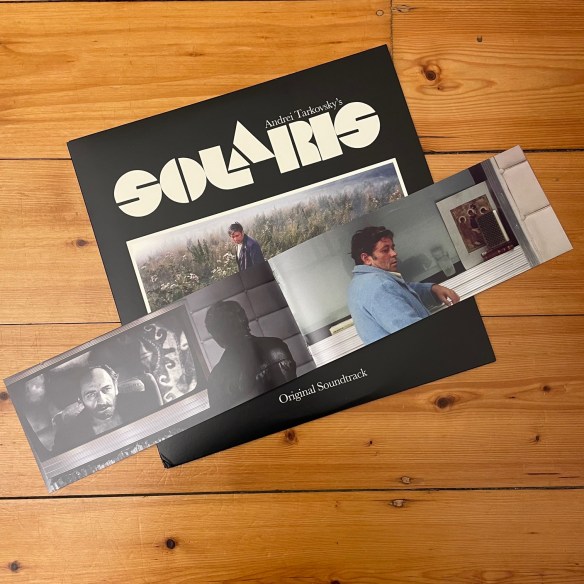
Eduard Artemiev – Solaris (Original Soundtrack) A science fiction film from 1972, and in the vein of JG Ballard or Brian Aldiss, it concerns the strange psychological illness that afflicts scientists on-board a space station orbiting the planet Solaris. The slightly claustrophobic electronic score is offset by a number of compositions by JS Bach. Note the early Zoom call and all-day PJs featured in the accompanying stills from the film.

Various Artists Pacific Breeze: Japanese City Pop, AOR & Boogie 1976-1986 Perfect antidote to lock-down blues, this compilation of mostly up-tempo numbers reveals more depth below the shiny surface – the arrangements, choice of textures and compositional structures make this more than just easy listening. (Released by the excellent Light in The Attic label, there’s also a second volume, plus related compilations that focus on the more ambient and experimental end of the spectrum.) Definitely a mood-enhancer.

Hans-Joachim Roedelius – Drauf Und Dran The prolific Roedelius has released one of the most sublime albums of his lengthy career – which is saying something for an artist closely associated with ambient and minimalist styles. A piano-based album, with very few electronics or effects, the clarity of composition and playing make for a brief but welcome respite from the mental fug of lock-down. In a similar vein, I would also recommend Brian Eno’s soundtrack to the Dieter Rams documentary, and Eno’s recent work with his brother, Roger, the albums Mixing Colours and Luminous.

Mogwai – ZeroZeroZero Another soundtrack, for the TV series of the same name (which I have not seen). Like the Solaris soundtrack, the music is more about the atmosphere than the narrative, and all the more powerful as a result. Also worth mentioning is Mogwai’s recent studio album.

Khruangbin = クルアンビン* ‎– 全てが君に微笑む Khruangbin are a band whose music I heard on a couple of sampler albums, without knowing anything about them. Playing an infectious blend of instrumental Funk, Psychedelia and Dub Reggae, this compilation brings together a number of their early singles (including inspired covers of Serge Gainsbourg and Yellow Magic Orchestra). Rather beautiful for these monochrome times.

Michel Legrand – La Piscine Yet more soundtracks, this deceptively lightweight but lush album, featuring just the right amount of economic violin solos by Stéphane Grappelli (who could let his virtuosity get the better of him), recently got a re-boot for Record Store Day, so it’s pretty hip at the moment. Other soundtrack and library music compilations I have been delving into include Adventures in Soundtracks, The Music Library and Unusual Sounds. Mostly reflecting the anonymous/unsung world of studio session composers and players of the 60s and 70s, most people would recognise at least one or two tunes, if only from their use as samples in other records.

Greg Davis – Somnia Finally, a work of stillness and contemplation – built on sustained drones and minimal instrumentation, this album nevertheless manages to generate immense depth and emotion. Again, perfect listening in this stilted yet listless environment of lock-down, curfew, social isolation and pent-up frustration and sorrow. (Also check out the Davis’ contemporaneous work, Diaphanous.)

Next week: Startupbootcamp Sports & EventTech Demo Day 2021

Revisiting Purpose

Enforced lock-down thanks to the COVID-19 pandemic has provided ample opportunity for each of us to reflect on our “purpose” – especially if we typically identify our purpose with going to the office or other workplace (and the time spent on our daily commute).

In addition to the mandatory furlough, the inability to do the everyday things we usually take for granted can create some sort of existential crisis. So even though many of us continue to work from home, there is a very practical purpose in having a structured routine (including the all-important daily exercise allowance!) – for both physical and psychological needs.

But this time of reflection also provides an opportunity to reassess our priorities, and re-calibrate what is important to us, once we get through the pandemic. It feels that the paradox of having more time on our hands, but fewer options as to what to do with it, might mean we should be jealously protective of how and where we spend it once we get the chance.

So some of the factors we may consider in deciding how we spend our time and how we define our purpose might include:

  • what have I really missed, and what can I do without?
  • what will sustain me, and what will be a drain on my resources?
  • what can support my personal development, and what will hold me back?
  • what can I do independently, and what will require collaboration?
  • what has engaged me, and what has bored me?
  • what new skills have I had to learn, and what will continue to be relevant?
  • what do I wish I had done more of (or less of) before the lock-down?

While “time spent” shouldn’t be the defining criteria of our purpose, as a valuable (and finite) resource, how we allocate our time should be a significant measure of what is important to us, and what enables us to pursue our purpose.

Next week: Three Wise Monkeys

Always Look On The Bright Side…

Following the so-called roadmap to reopening the Victorian economy, this week I was sorely tempted to vent my anger and frustration at the situation we find ourselves in Melbourne – a situation in large part due to the failure of the hotel quarantine programme, which has been identified as the source of the community transmission, and the consequent devastating impact on the aged care and health care sectors. (Unlike our politicians and civil servants, I refuse to use the term “settings” – “settings” are what you use on a microwave oven…..). I was going to describe how our current Federal and State leaders decline to take specific responsibility for their respective Administration’s mistakes, while continuing to treat the citizens of Melbourne like a political football…. Instead, I decided to be more hopeful, and reflect on some of the positive aspects of the continuing lock-down.

First, most of us are still here, and most of us remain healthy – and although I have not socialized with family or friends for 6 months, I can still have Zoom calls and virtual drinks.

Second, despite the lack of social interaction, thanks to “no contact” front doorstep drop-offs, friends and neighbours have provided small gifts such as home-made bread and home-grown herbs and vegetables.

Third, on-line shopping has got a lot better, despite some of the shipping delays – on the downside, I probably won’t be in a hurry to revisit bricks and mortar retail….

Fourth, by not eating out, and by not using public transport, I’m saving money – some of which is being redirected to small luxuries such as dine-at-home restaurant meals and domestic gadgets.

Fifth, my local green space, Yarra Park is thriving, because the lawns are not being used as a car park several days a week – it’s actually encouraging more people to use it for its original purpose of public recreation.

Sixth, courtesy of the 1-hour daily exercise regime, on my walks I have been exploring parts of the City that I thought I knew well, often discovering new historical aspects or architectural features I had never noticed before (and all within a 5km radius of my home, of course).

Seventh, when I do venture out for food shopping, thanks to the limits on numbers, the supermarket is less crowded and the experience is actually far more relaxing than when having to shop in normal peak hours.

Eighth, the enforced and extended work-from-home regime means I have come to appreciate my domestic surroundings, even though it can get a bit claustrophobic being cooped up most of the time.

Ninth, I have found time to finish and release a new album on Bandcamp (thanks to the few generous souls who have actually paid to download it!).

Tenth, notwithstanding some testing days, I find that after nearly 25 years, my relationship with my significant other has proven to be remarkably resilient.

So, on reflection, I can think of far worse situations and locations to be in. I know I will get through this, and although things will never be “normal” again, I think I will have re-set my personal priorities and regained a sense of what is or isn’t important. It’s been a hard lesson (and continues to be a challenging experience), but hopefully it will bring long-term benefits.

Next week: Revisiting Purpose