Australia’s Blockchain Roadmap

The Australian Government recently published its National Blockchain Roadmap – less than 12 months after announcing this initiative. While it’s an admirable development (and generally, to be encouraged), it feels largely aspirational and tends towards the more theoretical rather than the practical or concrete.
First, it references the US Department of Homeland Security, to define the use case for Blockchain. According to these criteria, if a project or application displays three of the four following requirements, then Blockchain technology may offer a suitable solution:

  • data redundancy
  • information transparency
  • data immutability
  • a consensus mechanism

In a recent podcast for The Crypto Conversation, Bram Cohen, the inventor of the BitTorrent peer-to-peer file sharing protocol, defined the primary use case for Blockchain as a “secure decentralized/distributed database”. On the one hand, he describes this as a “total oxymoron; on the other, he acknowledges that Blockchain provides a solution to the twin problems of having to have trusted third parties to verify transactions, and preventing double-spend on the network. This solution lies in having to have consensus on the state of the database.

Second, the Roadmap speaks of adopting a “principles based but technology-neutral” approach when it comes to policy, regulation and standards. Experience tells us that striking a balance between encouraging innovation and regulating a new technology is never easy. Take the example of VOIP: at the time, this new technology (itself built on the newish technology of the internet) was threatened by incumbent telephone companies and existing communications legislation. If the monopolistic telcos had managed to get their way, maybe the Post Office would then have wanted to start charging us for sending e-mails?

With social media (another internet-enabled technology), we continue to see considerable tension as to how such platforms should be regulated in relation to news, broadcasting, publishing, political advertising, copyright, financial services and privacy. In the music and film industries, content owners have attempted to own and control the means of production, manufacture and distribution, not just the content – hence the format wars of the past in videotape, compact discs and digital file protocols. (A recurring theme within  Blockchain commentary is the need for cross-chain interoperability.)

Third, the Roadmap mentions the Government support for Standards Australia in leading the ISO’s Technical Committee 307 on Blockchain and DLT Standards. While such support is to be welcomed, the technology is outpacing both regulation and standards. TC 307 only published its First Technical Report on Smart Contracts in September 2019 – three years after its creation. In other areas, regulation is still trying to catch up with the technology that enables Initial Coin Offerings, Security Token Offerings and Decentralized Autonomous Organizations.

If the ICO phenomenon of 2016-18 demonstrated anything, it revealed that within traditional corporate and market structures, companies no longer have a monopoly on financial capital (issuance was largely subscribed via crowdfunding and informal syndication); human capital (ICO teams were largely self-forming, self-sufficient and self-directed); or networks and markets (decentralized, peer-to-peer and trustless became catch words of the ICO movement). Extend this to DAOs, and the very existence of, and need for traditional boards and shareholders gets called into question.

Fourth, the Roadmap makes reference to some existing government-related projects and initiatives in the area of Blockchain and cryptocurrencies. One is the Digital Transformation Agency’s “Trusted Digital Identity Framework”; another is AUSTRAC’s “Digital Currency Exchange” regulation and registration framework. With the former, a more universal commercial and government solution lies in self-sovereign identity – for example, if I have achieved a 100 point identity check with Bank A, then surely I should be able to “passport” that same ID verification to Bank B, without having to go through a whole new 100 point process? And with the latter, as far as I have been able to ascertain, AUSTRAC does not publish a list of those digital currency exchanges that have registered, and exchanges are not required to publish their registration number on their websites.

Fifth, the need for relevant training is evident from the Roadmap. However, as we know from computer coding and software engineering courses, students often end up learning “yesterday’s language”, rather than acquiring flexible and adaptable coding skills and core building blocks in software development. It’s equally evident that many of today’s developers are increasingly self-taught, especially in Blockchain and related technologies – largely because it is a new and rapidly-evolving landscape.

Finally, the Roadmap has identified three “showcase” examples of where Blockchain can deliver significant outcomes. One is in agricultural supply chains (to track the provenance of wine exports), one is in education and training (to enable trusted credentialing), and one is in financial services (to streamline KYC checks). I think that while each of these is of interest, they are probably just scratching the surface of what is possible.

Next week: Brexit Blues (Part II)
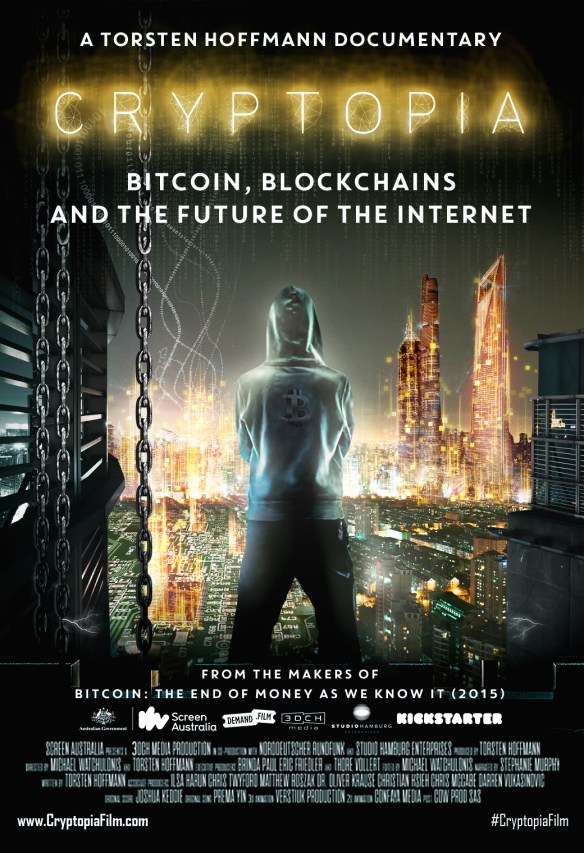
 

Cryptopia – The Movie

A quick plug for Torsten Hoffman‘s new documentary, Cryptopia: Bitcoin, Blockchains and the Future of the Internet. After a series of preview screenings around Australia and  New Zealand last last year, the film has its world premiere tonight in Melbourne.

Five years after producing Bitcoin: The End of Money As We Know it, the director has gone back and interviewed a number of key figures who appeared in the last film, to update their stories, and to dig deeper into the whole Blockchain, Bitcoin and crypto narrative.

I haven’t yet seen the latest film, but I first met Torsten when he was screening the previous documentary on the meetup circuit. He was kind enough to show me some early edits of Cryptopia, and I have to say the new content looks very promising.

Given the speed at which Blockchain and Bitcoin markets move (a week in crypto is often referred to as a year in any other asset class), it’s actually important that we stand back and take stock of where we are in this new paradigm for FinTech, decentralisation and distributed ledger technology.

Even if you can’t make it to the Melbourne premiere, look out for Cryptopia the movie as it tours globally.

Next week: Tarantino vs Ritchie

Crypto House Auction

Earlier this month, through my work with Brave New Coin, I was lucky enough to attend the first live property auction to be conducted in cryptocurrency. Although the property was passed in on the day, the event generated enough interest and PR value that it will surely be only a matter of time before more large ticket assets are transacted in this way.

Image sourced from LJ Hooker

Let’s not forget that it’s nearly 9 years since Laszlo Hanyecz paid 10,000 BTC for two pizzas (then valued at about US$41).

Although we may not yet be paying for our morning espresso with Bitcoin, a growing number of merchants are enabling customers to pay for goods and services with crypto, via payment platforms and intermediaries such as Living Room of Satoshi, and TravelbyBit. And services such as Coin Loft and CoinJar make it easier to buy and sell the most popular cryptocurrencies without having to set up accounts on multiple exchanges.

Meanwhile, the house in Casuarina, on the northern coast of New South Wales, was passed in at 457 BTC (A$3.4m). The property was listed by LJ Hooker, and the auction was facilitated by TrigonX and Nuyen, while Brave New Coin supplied real-time market data convert the crypto bids to Australian dollars.

Next week: Demo Day #1 – Startupbootcamp


Blockchain and Crypto Updates

Courtesy of Techemy and Brave New Coin, I’ve just been on another whistle-stop global tour: 5 cities, 4 countries, 3 continents in two and a half weeks….. Along the way, I caught up on some of the latest market and regulatory developments in Blockchain and cryptocurrency.

Giant billboard in Tokyo’s Ginza district

First, there was no hiding the fact that the past six-month “correction” in crypto markets has had an impact on trading volumes, investor appetite and institutional enthusiasm – as well as generating some regulatory noises. More on the latter below. At the same time, many of the first wave of Blockchain projects that attracted funding over the past 4 years are still at the development or test net stage, or only just launching their MVPs. Hence some investor caution on new token issuance.

Second, there are probably far too many Blockchain and crypto conferences – or rather, volume is diluting the quality of content, meaning too many sub-par events. There is no shortage of interesting topics and informed speakers, but the format and delivery of so many panel discussions and plenary sessions end up sounding tired and lacklustre.

Third, expect a crypto-backed ETF to be listed on a major exchange very soon. I even think it will come out of Europe, rather than the US, but that’s just a personal view. Such a product is going to help with investor diversification and will eventually enable retail investors to get exposure to this new asset class, even within their personal pension plans, without the same level of risk and volatility than direct holdings or spot trading.

Fourth, institutional investors are still looking for institutional products and services: proper custody solutions, robust benchmarks, hedging instruments, portfolio tools and risk analytics. One challenge is that the market is still trying to define crypto fundamentals – the sorts of analysis we take for granted in other asset classes (earnings per share, p/e ratio, yields, Sharp ratio, credit risk, etc.).

Fifth, Japan feels like a case of “two steps forward, one step back”. Just over a year ago, cryptocurrencies were formally recognised as a legal form of payment. Then in late 2017, the FSA issued the first batch of crypto licenses to qualifying exchanges. Japan continues to represent a significant portion of crypto trading (partly a legacy of retail FX trading, partly a result of regulatory restriction in other markets). But yet another exchange hack earlier this year prompted the regulator to put the industry on notice to smarten up, or face the consequences. Exchanges are subject to monthly monitoring, and the self-regulating industry body is undergoing a few changes. Plus, exchanges are no longer able to list privacy coins.

Finally, with the lack of legal clarity or regulatory detail around initial coin offerings (aside from blanket statements that “all ICOs are securities until proven otherwise”), there is still a lot of regulatory arbitrage. Certain jurisdictions are actively attracting new issuance projects to their shores, and positioning themselves as being “ICO friendly”. Ironically, even though the SEC in the USA has been particularly vocal about ICOs that may actually be deemed securities, it has not defined what constitutes a utility token (or made any announcement on the new category of security tokens). However, there have been some recent announcements out of the SEC suggesting that neither Ethereum nor Bitcoin are in fact securities. More interestingly, the State of Wyoming is looking to make Blockchain and associated crypto assets a major pillar of its economy.

NOTE: The comments above are made in a purely personal capacity, and do not purport to represent the views of Techemy or Brave New Coin, their clients or any other organisation I work with. These comments are intended as opinion only and should not be construed as financial advice.

Next week: Bad sports