Bitcoin – Big In Japan

I spent the past week in Tokyo on behalf of Brave New Coin, meeting with various participants in the cryptocurrency industry – from exchanges to brokers, from industry bodies to information vendors, from connectivity providers to technology platforms. Given its share of Bitcoin trading volumes, and the legal developments currently in motion, Japan is now the focus of attention as it navigates towards a fully regulated and orderly cryptocurrency market.

Bitcoin is now accepted in Bic Camera stores in Japan (Photo: Rory Manchee – all rights reserved)

On my previous visit to Japan, I commented on the extent to which it was still a cash economy – even major museums and galleries don’t accept plastic, and my pre-paid foreign currency card issued by a major Australian bank was only accepted at a limited number of ATMs: 7-Eleven, and Japan Post. But according to expats I spoke to last week, this situation has changed over the past couple of years.

One of the reasons I was given as to why Japan is taking a lead in regulating cryptocurrencies is its previous perception of having a somewhat lax approach to money laundering. Part of this might be explained by the limited technical integration and interoperability with the global banking system (somewhat akin to Japan’s approach to telecoms, where in the past, it was impossible for overseas visitors to use their mobile phones on the domestic network).

In addition, as China has cracked down on most things crypto, so has Bitcoin trading activity shifted to Japan. This growth in Bitcoin trading volumes can also be linked to Japan’s passion for retail forex trading, now expanding into crypto.

Earlier this year, the Japanese government passed legislation that recognises bitcoin as a legal form of payment. (Note: this does not mean that bitcoin is legal tender – shops do not have to accept it; but if they choose to take it as payment for goods and services, then it is no different to paying in cash or by credit card when it comes to things like consumer rights, for example.)

Later this month, the main regulator, the FSA is expected to announce new regulations to govern cryptocurrency exchanges and brokers. Currently, exchanges that accept Yen deposits for cash trading of crypto must be licensed as payment institutions. By the end of March 2018, my understanding is that all exchanges and brokers must be fully licensed to operate – for both cash trading, and futures and margin trading. Anywhere between 20 and 50 exchanges have applied for a license.

Currently, participants in the “legacy” securities and futures industry are either registered with the JSDA or the FFA. Likewise, it is expected that the FSA will appoint a similar self-regulating entity to have official oversight of the cryptocurrency markets, under the overarching authority of the FSA. However, there are two rival blockchain and cryptocurrency industry associations that are vying for this role – which is where things become a little political. One group claims to represent the “pure” crypto world, whereas the other might be seen to represent more of the traditional market. No doubt the FSA would prefer not to have to choose…

Key considerations for the FSA are retail investor protection, and market stability. The total market cap of all cryptocurrencies is now around US$150bn. If we assume that 10% of these assets are held in Japan, when compared to the total capitalisation of the cryptocurrency exchanges themselves, this creates a significant risk for the FSA should there be a market collapse or a run on Yen-based crypto deposits.

Equally, the FSA does not want to stifle innovation in an area of financial services where Japan is keen to take the lead. For example, Japan has witnessed a couple of bitcoin-denominated corporate bonds (more like privately syndicated short-term commercial paper) that demonstrate an investor appetite for this new asset class.

Meanwhile, in preparation for this new regulatory environment, and in anticipation of the increased interest by major banks and asset managers, there is a project underway to create an institutional-strength order management platform connecting banks, brokers and exchanges. I also heard of offshore fund managers looking to launch a crypto-based ETF for distribution in Japan.

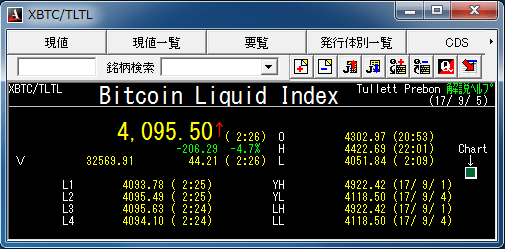
Finally, at the risk of blowing our own trumpet, Japan’s leading financial vendor, Quick is now quoting the Bitcoin Liquid Index (BLX) alongside other FX data it distributes from around the world:
 

NOTE: The comments above are made in a purely personal capacity, and do not purport to represent the views of Brave New Coin, its clients or any other organisations I work with. These comments are intended as opinion only and should not be construed as financial advice.

Next week: Tech, Travel and Tourism



YBF #FinTech pitch night

It’s getting difficult to keep up with all the FinTech activity in Melbourne – from Meetups to pitch nights, from hubs to incubators. The latest Next Money / York Butter Factory / Fintech Victoria pitch night was a showcase for three startups-in-residence at YBF. As such, it was not the usual pitch competition – more an opportunity for the startups to hone their presentations.

First up was Handy, an app-based solution that connects trades with customers to streamline the settlement process for property insurance claims. There is an industry-wide low-level of satisfaction with property claims – which can take up to 60 days to process, even though 80% of claims are for less than $5,000. Handy offers a faster solution, and doesn’t require a lengthy estimate or quoting process, using instead fixed-price rates. With a target market of 100,000 claims per annum, Handy expects to generate 25% savings to the insurance industry, as well as having a broader societal impact in terms of speedier claims, better appreciation of service providers, and more consideration of the respective needs of householders and trades. Launching an MVP in November, there are four insurance firms in pilot test mode. Aiming for a white label solution, Handy will charge clients basic setup and maintenance fees, as well as volume transaction costs (although the exact pricing and revenue model still needs to be worked out). There were audience questions about the liability for quality of work and dispute resolution, the trade supplier on boarding and verification process, and the process for communicating to policy holders whether their insurance provider or broker is covered by the platform.

Next was FinPass, a startup appealing to the 40% of the workforce expected to be freelance by 2020 – a key feature of the gig economy. Targeting so-called “slashies“, FinPass is designed to help customers apply for personal loans when they don’t have a single, steady or stable source of income – and therefore, may lack a formal credit rating or personal credit score – while adhering to the five Cs of credit. Using a combination of blockchain and API to validate a loan applicant’s income profile, FinPass would then make this data available to approved lenders (subject, presumably, to consumer credit and lending standards, customer privacy and data protection requirements). To be fair, this project was fresh from winning a recent hackathon event, and therefore is still at the concept stage. However, it was clear that much needs to be done to define the revenue model, as well as designing the actual blockchain solution. Audience feedback questioned the need for a standalone solution, given the existence of various block explorers, APIs, vendors, protocols and bank feed sources. In addition, while blockchain provides a level of transaction immutability, and since only the hash-keys will be captured, the SHA’s will only confirm the hash itself, not the veracity of the underlying data?

Finally, there was Resolve, a two-sided market place for the insolvency services – a platform to buy and sell distressed businesses. Designed to capture turnaround opportunities, the platform has a target market of 14,000 transactions per annum – of which only 1% currently advertised, simply because it’s too expensive to use traditional media (i.e., finance and business publications). In addition, 92% of companies that enter insolvency return zero cents in the dollar to their creditors. Part bulletin board, part deal room, Resolve aims to create a passive deal flow for this alternative asset class. When asked about their commercial model, the founders expect a turnover based on a few hundred businesses each year, and revenue coming from a flat $1,000 per listing – but the key to success will be building scale.

Each of these early-stage startups represent promising ideas, revealing some innovative solutions, so it will be interesting to follow their respective journeys over the coming months.

Next week: Bitcoin – Big In Japan

Supersense – Festival of the Ecstatic

Taking a break from startups, FinTech and digital disruption, I spent the past weekend at this year’s Supersense at the Melbourne Arts Centre. This underground festival (both literally and culturally) is back after 2015’s launch event, with an even more ambitious yet also more coherent line-up. It was still an endurance test, and while there were several absorbing performances, in the end it felt like there was nothing that was totally outstanding.

Part of the problem is we are so overloaded with aural stimulation that it takes something truly special to capture our imagination. First, we have access to an endless supply of music (thanks to Apple, Spotify, Bandcamp, Soundcloud, BitTorrent, Vimeo, Resonate, Napster, Vevo, Gnutella, YouTube…). Second, what was once deemed subversive or cutting edge, has now been appropriated by the mainstream and co-opted into the mass media. Third, and as a result of which, when it comes to the avant-garde, there is a sense of “been there, seen that”.

Alternatively, perhaps after more than 40 years of watching live music my palette has become jaded. But I’m also aware that theses days, some of the really interesting and engaging “live” audio experiences are to be found in art gallery installations, site-specific works and interactive pieces. For much of the festival, there was the traditional boundary between performer and audience – even though the idea was to wander between the different performance areas, we were still very much spectators.

A large part of the programme was given over to genre-pushing performances.  But even here I realize that, whether it’s free jazz, improvisation or experimental sounds, there is an orthodoxy at work. Many of these performers are playing a pre-defined musical role, whether it’s torch singer, axe hero, R&B diva, stonking saxophonist, glitch supremo, string scraper, drone aficionado or ur-vocalist.

Some performers played the venue as much as their instruments (stretching the acoustic limits of the building). Some even ended up “playing” the audience (in the sense of stretching their patience and tolerance). And in the many collaborative pieces, the musicians were mainly playing for or against each other, somewhat oblivious to the audience. In such circumstances, the creative tension did provide for some interesting results; but as so often with virtuoso performances, the players that relied only on speed, noise, volume or however many (or few) notes they produced were probably the least interesting.

Overall, few performers offered much variety within their allotted time slots. For all the colour, range and styles on display, many of the individual sets were extremely monochromatic, with little in the way of transition or shade. The volume, tones and textures were always full on. Pieces lacked development, and did not reveal or explore the aural equivalent of negative space. I understand and appreciate the importance of minimalism, repetition and compressed tonality in contemporary composition, but I was also hoping for a more layered approach to these live performances, and even some juxtaposition or contrast.

The subtitle of Supersense is “Festival of the Ecstatic”, with the implication that the audience will be swept away on a (sound) wave of transcendence. When it came to being enraptured, as with so many things these days, less is more. So the key sessions for me included: Oliver Coates who mesmerized with his solo cello performance; Jannah Quill and Fujui Wang whose laptop glitches sounded like a version of Philip Jeck’s “Vinyl Requiem” using only the works of Karlheinz Stockhausen; Zeena Parkins‘ sublime piano drone harmonics; JG Thirwell‘s minimalist sound poem; and Stephen O’Malley’s plaster-shredding guitar feedback oscillation. Whether or not it was the intended effect, during a number of performances I actually found myself drifting into a soporific state of semi-consciousness – but maybe it was just fatigue setting in?

Of course, I am extremely grateful that this type of event exists – it’s essential to have these showcases, for all their limitations and challenges. But it’s a bit like being a tourist: there are lots of destinations we may like to visit, but we wouldn’t want to live there – and there are some places where it’s enough just to know they are there.

Next week: FinTech and the Regulators

Bringing Back Banter

Last week I watched “The Trip To Spain”, the latest in the “Trip” franchise. For anyone who has not yet seen these films (or the TV series from which they are compiled), the narratives revolve around a pair of actors playing fictional versions of themselves, as they embark on road trips to sample some of the best restaurants, hotels and historic locations. The semi-improvised dialogue between the two main characters is classic banter – as in “the playful and friendly exchange of teasing remarks“.

The gentle art of banter is at the heart of “The Trip To Spain” – Image sourced from British Comedy Guide

Sadly, just as the public discourse has become much uglier in recent years (despite various calls for a “kinder, gentler politics”), it seems there is something of a backlash against neo-banter (or “bantaaaaaaah!” as some would have it). Maybe there is a connection?

If our political leaders cannot engage in the natural ebb and flow of an ideological discussion shaped as informed conversation (rather than embarking on all out verbal warfare), then don’t be surprised if this is the same boorish, belligerent and bellicose tone adopted by protagonists in social media, op eds and parliamentary “debates”. (And I am not defending anyone who uses the term “banter” to excuse/explain the inappropriate.)

Banter can help to explore hypothetical scenarios, suggest alternative opinions, and take a discussion in different directions, without participants being hidebound by the first thing they say. Plus, if done really well, it allows us to see the ultimate absurdity of untenable positions.

Next week: Supersense – Festival of the Ecstatic