How about that AAA rating?

As the State of Victoria weighs up the costs of yet another lock down, you could be forgiven for thinking that the local economy has taken a further beating after the horrendous events of the past 15 months. Across Australia, thousands of companies and individuals accessed various government-sponsored financial aid packages to keep afloat, causing the federal government to borrow more money, at something like 8x the equivalent rate pre-COVID. National public debt is now expected to grow to more than 40% of GDP by the 2024-25 fiscal year – effectively double what it was in 2018-19.

So what has Australia done to retain its coveted AAA sovereign rating from Standard & Poor’s, and have the rating outlook upgraded from negative to stable? According to the ratings agency, and economists such as Westpac’s Bill Evans, there are probably three or four key factors that have warranted this optimistic economic reckoning.

First, while government borrowing (Quantitative Easing) has blown out as a proportion of GDP, the current low interest rates mean that the cost of servicing that debt is manageable.

Second, while the pursuit of QE has destroyed any hope of returning to an overall budget surplus, the deficit will return to similar levels last seen after the GFC, and the current account will continue to return a modest surplus over the coming quarters.

Third, despite the significant economic risks that were identified at the start of the COVID pandemic, the actual impact on the budget has been less than feared, and the economy is recovering faster than expected (as evidenced by latest employment data and consumer sentiment).

Fourth, Australian banks have seen an increase in customer deposits, meaning they are less reliant on more expensive overseas borrowing for their own funding.

Overall, just as with the GFC, Australia has managed to dodge a bullet (the shock to the system was less than anticipated) – in large part thanks to a resurgence in iron ore prices (again).

But weaknesses and disparities remain:

The over-reliance on commodity prices (mainly based on demand from China) hides the true nature of Australia’s balance of payments – we manufacture less than we used to, and our supply chains have been severely tested during the pandemic. And with international borders closed, we won’t see the same levels of GDP growth that resulted from immigration.

Our household savings rate as a percentage of disposable income has come down from its peak of 22% in July 2020, to less than 12% this past quarter, as people held on to their cash for a rainy day (or 3 months lock-down). The savings rate is expected to come down even further as consumers feel more confident and start spending again.

As with the GFC, home owners have chosen to pay down their mortgage debt – but the picture is more complex. Yes, interest rates remain low (and will likely stay so for at least another 18 months), despite commentary from another economist, Stephen Koukoulas suggesting that the RBA will have to raise rates sooner than expected. With property prices expected to increase 5-10% over the next 12 months, home owners will feel wealthier (but asset rich and cash poor?) as mortgage repayments reduce as a percentage of their home’s value. And while analysts at S&P expect banks’ credit loses to remain low while the economy recovers, the fact that two-thirds of banks’ exposures are to highly leveraged residential property could see increased stress when interest rates rise and if wage growth remains sluggish (more on the latter next week).

Australia’s sovereign credit rating is something of a badge of honour, and represents membership of an exclusive club – fewer than a dozen countries are rated AAA; no wonder it’s a big deal, and partly explains why the Prime Minister gets to attend the G7 (albeit as an observer). Comparatively speaking, Australia is doing very well when it comes to managing COVID (although we could be doing a lot better on a number of measures), and has an economy that continues to be the envy of many. Expect more on that AAA rating (“How good was that?”) as we head into the next Federal election…

Next week: Where is wage growth going to come from?

Here We Go Again…

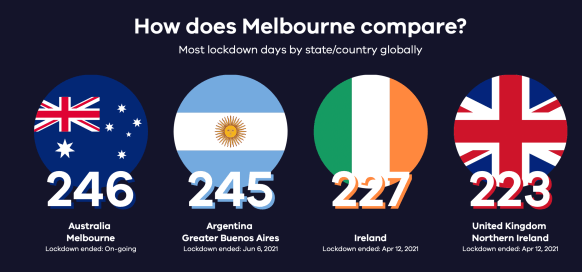
At the time of writing, Melbourne is once again under a COVID19-related lock down. Currently, we are three-quarters of the way through a 14-day “snap” lock down or “circuit breaker”. Variously known as #lockdown4, v4.0 (now v4.1 with the added week), or simply “The South Australian One”. Along with a prevailing sense of déja vu, much of the political, media and social coverage has a very familiar ring to it – like, here we go again!

Overall, I would much rather be in Australia at the moment, compared to many other places in the world that are still struggling to cope with the pandemic. But there is no doubt that this latest lock down is once again revealing some political and structural weaknesses in the Australian Federal and State system – and the people of Victoria (and especially Melbourne) are paying a heavy price for these combined failings.

The blame game between Federal and State politicians is becoming a farce – most of us would rather see some effective leadership and practical solutions, as well as a bit more owning up and taking responsibility for where and when things have gone wrong. After all, the first known case of COVID19 was reported in Australia in late January 2020, so our elected representatives at levels and of all persuasions have had nearly 18 months to sort this out. It doesn’t help that our Prime Minister is generally regarded as being absent whenever there is a crisis – on the other hand, does it help to have him turn up in hi-vis and hard hat for another photo opportunity? And sometimes when he does bother to make it, he’s often made to feel unwelcome.

Here are just a few of the disconnects between Federal and State roles and responsibilities when it comes to managing COVID19:

First, the Federal government is responsible for external border control (i.e., immigration and quarantine). It’s generally argued that the Feds have failed to deliver a workable quarantine solution for anyone coming to or returning to Australia. For whatever reason (and we’ll probably have to wait 20 years before the relevant papers are released), National Cabinet in March 2020 agreed to delegate the management of hotel quarantine (HQ) to the individual States and Territories. The big question is: why did the States agree? Where there incentives on offer, or did they do so because they could see no solution coming from the Federal government? At the same time, the States have applied inconsistent border controls as between each other, and at times, Victoria has been able to suspend in-bound international flights, putting more demand on the other States’ HQ programmes.

On the other hand, Melbourne still managed to host an international Grand Slam tennis event in the summer (notwithstanding some COVID scares and cases), and our nation’s softball players have already been vaccinated prior to heading off to Japan for the Tokyo Olympic Games (which many locals want to cancel for obvious reasons). Plus, AFL teams were somehow able to travel interstate from Melbourne immediately prior to the lock down (did they get a tip-off?). Yet, at least one AFL club has breached COVID regulations, when travelling on a domestic passenger flight. I’m so glad we have got our priorities right when it comes to professional sport!

Second, health services (along with education, aged care and social services) are a strange mix of Federal and State responsibilities, services and delivery. As a result, there is bound to be some overlap and double handling, as well as some obvious gaps. The Federal government is being blamed for failing to secure and distribute adequate vaccine supplies when and where they are needed, and for failing to meet their own aspirational targets in terms of vaccine roll-out. Yet, as with so many public services, there is a (confusing) dual delivery system. Victoria set up a number of vaccination hubs – only it still hasn’t deployed an online booking system: only phone bookings (or walk-ins) are available. But the Federal delivery is via health clinics and GPs, with each service provider offering different booking systems.

Third, the vaccination roll-out (by age and priority categories) has seen the criteria move around, somewhat arbitrarily. There is anecdotal evidence that due to low take-up rates in March and April, some people within one of the priority age categories (initially 60, it was suddenly moved to 50 in May) could access a jab at a clinic or hub at short notice, as otherwise those stocks were going to waste. It doesn’t help that there was/is confusion over the vaccine requirement for certain front line workers (e.g., in aged care) and who is responsible for administering those vaccinations. Of course, since the latest lock down in Victoria, demand is outstripping supply, and it is difficult to verify data on whether anyone who was in a priority category was initially unable to access a vaccine (or was denied access) at the time they became eligible and wanted a jab.

Fourth, hotel quarantine continues to be the key weak point in the transmission chain. I’m not going to dwell on the systemic failure that led to Victoria’s second (and lengthy) lock down last winter/spring – from which we were only just starting to recover when #lockdown4 was imposed. The fact that the latest lock down was triggered by an apparent breach in South Austalia’s HQ is of some significance, as it re-introduced the Kappa “Variant of Interest” into Victoria. More worrying is the presence of the Delta “Variant of Concern”, whose precise source in Victoria is still unknown, but likely to have come from our own troubled HQ system.

Fifth, the calls for the Federal government to pay for dedicated and purpose-built quarantine facilities in each State are understandable – but I’m not sure why Victoria in particular didn’t just go ahead and build their own (and then later stick the Feds with the bill). It’s not as if there is a shortage of construction work going on at the moment in Victoria (much of it State-funded), so it would have been quite easy to pull that project together without waiting for the Feds to come to the party. After all, construction was one of the few industries to continue relatively unscathed during last winter’s lock down – and with the Federal job keeper and job maker subsidies available at the time, Victoria could easily have completed the task by now, especially with the support of a key developer such as the union-backed Cbus.

Sixth, Victoria has only just mandated a universal QR code system for checking visitors in at all business, commercial, retail and hospitality premises. Why it took so long, and why it allowed a mish-mash of third party apps and pen and paper systems is yet another example of poor IT implementation by government. (The Feds appear to be no better with their own COVID tracing app.)

Seventh, the Federal Government, via last week’s National Cabinet, appears to have established a common definition for a COVID19 “hot spot”. Again, it’s only taken the best part of 18 months, and we still don’t have consistent and national terms for defining “red zone”, “complex case”, “cluster”, “mystery case”, “complex case”, “unknown case”, “fleeting transmission”, “stranger to stranger transmission”, “primary contact”, “close contact” or “exposure site” tiers. Nor do we have a consistent framework for responding to a “hot spot”, especially when comparing Victoria to other States.

Finally, the latest lock down again reveals weaknesses and vulnerabilities in Australia’s manufacturing capabilities and supply chains (in terms of producing and distributing sufficient vaccines). It’s also shown up economic fragility with many people living pay cheque to pay cheque, and many small businesses, especially in retail, tourism and hospitality, will not manage to bounce back from a fourth shut down.

Next week: How about that AAA rating?

Monash University Virtual Demo Day

Last week I was invited to participate in a Virtual Demo Day for students enrolled in the Monash University Boot Camp, for the FinTech, Coding and UX/UI streams. The Demo Day was an opportunity for the students to present the results of their project course work and to get feedback from industry experts.

While not exactly the same as a start up pitch night, each project presented a defined problem scenario, as well as the proposed technical and design solution – and in some cases, a possible commercial model, but this was not the primary focus. Although the format of the Demo Day did not enable external observers to see all of the dozen-plus projects, overall it was very encouraging to see a university offer this type of practical learning experience.

Skills-based and aimed at providing a pathway to a career in ICT, the Boot Camp programme results in a Certificate of Completion – but I hope that undergraduates have similar opportunities as part of their bachelor degree courses. The emphasis on ICT (Cybersecurity and Data Analytics form other streams) is partly in response to government support for relevant skills training, and partly to help meet industry requirements for qualified job candidates.

Industry demand for ICT roles is revealing a shortage of appropriate skills among job applicants, no doubt exacerbated by our closed international borders, and a downturn in overseas students and skilled migration. This shortage is having a direct impact on recruitment and hiring costs, as this recent Tweet by one of my friends starkly reveals: “As someone who is hiring about 130 people right now, I will say this: Salaries in tech in Australia are going up right now at a rate I’ve never seen.” So nice work if you can get it!

As for the Demo Day projects themselves, these embraced technology and topics across Blockchain, two-sided marketplaces, health, sustainability, music, facilities management, career development and social connectivity.

The Monash Boot Camp courses are presented in conjunction with Trilogy Education Services, a US-based training and education provider. From what I can see online, this provider divides opinion as to the quality and/or value for money that their programmes offer – there seems to be a fair number of advocates and detractors. I can’t comment on the course content or delivery, but in terms of engagement, my observation is that the students get good exposure to key tech stacks, learn some very practical skills, and they are encouraged to follow up with the industry participants. I hope all of the students manage to land the type of opportunities they are seeking as a result of completing their course.

Next week: Here We Go Again…

Intersekt FinTech Pitch Night

The opening event of the Intersekt 2021 Australian FinTech Conference was a startup pitch night, organised by FinTech Australia, hosted by YBF Ventures, and sponsored by Seed Money. The esteemed judging panel was drawn from a range of VC funds: Todd Forest (NAB Ventures), Nicole Small (Rampersand), Rohen Sood (Reinventure), Lynda Coker (SpeedSpace) and Lucinda Hankin (Grok Ventures).

The pitches in order of presentation (links are in the names):

Boulevard

A cloud-based share registry management platform for startups, founders and their employees. Designed to to be an exchange for unlisted securities, the platform also offers Investor Relations support and automated compliance solutions. Using Distributed Ledger Technology (which underpins Blockchain), the team are working with ASX DLT Solutions (responsible for the CHESS replacement) and deploying DAML, the programming language for modelling digital assets. They have also developed ASICLink, to automate company filings with the corporate regulator, plan to support corporate actions (including the verification of company financials), and are working with equity crowdfunding platforms. Boulevard has already on-boarded 30 companies, comprising 4,000 shareholders.

COGSflow

Describing itself as “Performance based finance”, this is essentially a merchant service offering cash-flow funding solutions for physical goods. This involves purchasing client inventory, and getting repaid on the sales performance. Using a funding ratio calculation as the basis of its credit risk model, the COGSflow will track sales data from the likes of eBay and Amazon (although both of these platforms, like PayPal, Alibaba etc. already offer SME financing of various forms). COGSflow will also analyze variable marketing and customer acquisition costs as inputs to its lending model, and plans to become a member of the Personal Property Securities Register (PPSR), as well as seeking B Corp certification.

Archa

Archa is solving the challenges many SMEs face when trying to access corporate credit cards – banks generally demand personal guarantees from owners or directors before they issue cards, and when they do the “product is awful”. As the pitch described it, many bank-issued corporate cards are really designed as “a line of credit to acquire air miles”. With a mobile app already in the market, Archa incorporates an administration and expense management solution. A major bug bear for many companies is managing corporate subscriptions – all those SaaS apps that are tied to individual employee cards; consolidating, renewing and cancelling those services can be time-consuming and painful. The account administrator can also manage each card’s credit limit. Archa itself has principal issuer membership with MasterCard. In addition to an equity raise, the team is seeking debt funding to offer lines of credit. Channels to market will include SME lenders, accountants and lawyers.

Sherlok

According to the founders, most people paying too much on their mortgages – based on their home loan rate. Because mortgage brokers have 60% of the market, and rely on trailing commissions, there is little incentive for brokers to help their clients find a better rate or provider. However, 15% of brokers’ clients are leaving each year. Sherlok is an SaaS platform that uses AI to help brokers reprice and refinance their existing mortgage book. Using a broker subscription model, Sherlok is aiming to offer “single click refinancing”, although there was some equivocation about becoming a virtual brokerage itself. The founders feel that mortgage broking is still a relationship based business, and requires a human touch.

Axichain

Axichain is building a blockchain-based agricultural supply chain – a digital trading solution for cross-border commodities trading, with an initial focus on red meat. The founders are addressing three main supply chain pain points – market access, paperwork and payment.
Axichain combines smart contracts, an escrow solution and traceability linked to legal processes. Overall, the platform envisages multiple products and revenue streams. The team are seeking both equity and debt funding, the latter to provide lines of credit lines.

Parpera

The meaning of “Parpera” is “fair wallet”. By that, the founders mean they want to offer a range of banking and related services aimed at SME owners, sole traders and freelances. This could include business registration and set-up, better financial insights, and access to smarter banking products etc. It will include card services, payments and invoicing. The plan is to target customers who are about to set up a business, and to promote the service at the start/end of the financial year, hence the intention to use accountants as a channel to market.

Next week: Monash University Virtual Demo Day