Is crypto finally going mainstream?

Just as my last blog on crypto regulation went to press, news broke that CBA (one of Australia’s “four pillar” banks) will be adding crypto assets to its mobile banking app. Add that to the launch of a crypto equities ETF by BetaShares, and further media coverage of local digital asset fund manager Apollo Capital, and you may start to believe that crypto is finally going mainstream in Australia.

But, before anyone gets too excited, a few caveats are in order.

First, the recent flurry of announcements from the Australian Senate, ASIC and AUSTRAC are simply the latest stages in a long-running debate about how crypto assets should be regulated, serviced and distributed. Despite these positive noises, there is still some way to go before crypto reaches critical mass (even though data for Australia shows we have one of the higher rates of market adoption).

Second, there is a lot of noise out there, and not all of it here in Australia. The SEC, FATF, ISDA, Cboe and SGX are just a few of the institutional voices making announcements on crypto and digital assets in recent weeks. On top of that, of course, there is the President of El Salvador (and the Mayor-Elect of New York) weighing in on behalf of the politicians. Some of this commentary is mere posturing; some is about being seen to be doing something; and a large part is just the legacy markets trying to catch up (and hoping to take control?).

Third, a closer look at CBA, BetaShares and Apollo Capital reveal some significant limitations in terms of what their products actually offer:

The CBA is planning to launch a trial among a small sample of their mobile banking users (although, no doubt, if things go well, it will be rolled out more extensively). But it does not mean the app becomes a fully-fledged crypto wallet: customers will only be able to buy/sell crypto within the app, and they won’t be able to send crypto to third parties. Plus, only a small set of crypto assets will be available.

The BetaShares ETF is not offering direct exposure to Bitcoin or other crypto assets. Instead, the fund is designed to invest in companies (mainly crypto exchanges, miners and technology providers) that are significant or strategic industry players. While that may mitigate the market volatility (and price fluctuation) that crypto experiences, it doesn’t necessarily make for higher returns.

The Apollo Capital fund is only available to wholesale or accredited investors – not retail customers. And while Apollo has done a reasonable job of growing its AUM, I don’t believe there are any major allocations from Industry Super Funds (which manage 27% of Australians’ retirement savings), Retail Funds (21%) or Public Sector Funds (18%). And despite anecdotal evidence that Self-Managed Super Funds (SMSF) are more active in crypto assets (along with Family Offices and HNWIs), recent data from the ATO suggests crypto assets held within SMSF are not much more than $200m.

Having worked in this industry since 2016, it’s always been apparent from an institutional perspective that few want to go first, but nobody wants to be last, when it comes to launching crypto products and services. Of the three Australian stories this week, the most significant is probably the CBA; it certainly got a lot of attention at the recent State of Play presentation by Blockchain Australia, in large part due to the industry implications, and how it will help bring crypto to an even wider audience.

Next week: Summing Up (and Signing Off)



Crypto Regulation in Australia

You wait ages for a bus, then several come along at the same time. The past week has seen three major developments in Australia regarding the regulation of cryptocurrencies, digital assets and the industry in which they operate.

First, there was the Final Report of the Senate Select Committee on Australia as a Technological and Financial Centre. Among other things, the Committee has recommended a specific regulatory framework for Digital Currency Exchanges, a formal custody regime for digital assets, a classification (or “token mapping exercise”) for the various types of digital assets, and a legal framework to recognize Decentralised Autonomous Organisations as a form or company structure.

Second, AUSTRAC issued a Statement on De-banking, that urges banks and financial institutions to take a case-by-case approach when reviewing potential risks associated with clients engaged in Blockchain and cryptocurrencies. Rather than applying a blanket ban or refusal to deal with Blockchain and crypto businesses, banks and other providers should exercise more discretion, and adopt workable and practical solutions to meet their risk management and KYC/AML obligations. Echoing the overarching theme of the Senate Select Committee, AUSTRAC recognises that de-banking crypto risks stifling innovation, and/or forcing crypto businesses to resort to less than ideal alternative service providers.

Third, ASIC released its Response to submissions made under the recent consultation on Crypto-assets as underlying assets for ETPs (aka Report 705 on CP 343). While there is some overlap with the scope and terms of reference of the Senate Select Committee, ASIC maintains its position that it does not want to be responsible for developing policy on regulating digital assets (that’s the role of Government); while at the same time stating in very clear terms how it believes cryptocurrencies should or shouldn’t be classified (and regulated). For example, ASIC did not accept the view of many respondents that crypto-assets which are not deemed financial products should be treated as commodities. In part, because there is no definition of “commodity” in the Corporations Act; but also because the discussion has been more about market operators, rather than the specific nature of the assets themselves.

Meanwhile, ASIC remains very prescriptive about the criteria for approving certain cryptocurrencies as the underlying assets for exchange traded products (ETPs) – including criteria which received push back from the industry as being too restrictive or inflexible. On the other hand, ASIC does appear to accept that if crypto-assets cannot be defined as financial products (or commodities), then a distinct category is required. This is the case that has often been put forward by the industry, namely the need to define instruments commonly known as utility tokens. To its credit, ASIC has made a fair stab at coming up with a workable definition of crypto-asset as:

“a digital representation of value or rights (including rights to property), the ownership of which is evidenced cryptographically and that is held and transferred electronically by:
(a) a type of distributed ledger technology; or
(b) another distributed cryptographically verifiable data structure.”

While the overall tone of these developments is encouraging, they still reveal a need for greater consistency (and inter-agency co-ordination), and the lack of a well-articulated policy on this fast-growing FinTech sector.

Next week: Is crypto finally going mainstream?


Opening Up…

This week, Melbourne is trying to get back to some semblance of normality, following 11 weeks of the current lock-down. But it’s far from “business as usual”.

Based on casual observations, people were desperate to queue up for personal grooming services, restaurants and outdoor shopping. (I did see at least one classic mullet, but I wasn’t sure if it was a fashion statement or just another case of Covid hair…)

Despite the latest changes announced by the Victorian Government over the past week, the ongoing public health provisions mean there will still be a “work from home” directive, retail and restaurants will be subject to density limits (and vax certificates) and masks will be required indoors.

One cafe in my neighbourhood, which has kept going during lock-down with serving takeaways, is deferring opening up for dining-in because they can’t get enough staff. This demand for talent within the hospitality sector means that employers are having to offer sign-on bonuses and higher wages.

While this should be good news for job seekers, the resulting upward pressure on staffing costs will likely trigger a rise in inflation (and higher interest rates?), and possibly further disruptions in supply chains.

Added hiring shortages will come from those employees who have used the lock-down to reassess their career options, and have decided to change jobs – also known as the “Great Resignation”.

Even among those employees who are returning to the office, many of them are only intending to be there 2-3 days a week. This will create a mid-week bulge in the CBD, with various knock-on effects: traffic jams, cramped public transport, and erratic trading patterns for small businesses in retail and hospitality. Employers will also be stressing how they maintain productivity levels with the adoption of extended weekends.

Finally, some industries such as tourism and international travel will take several months to get back to pre-pandemic levels – expect to see steep prices while capacity and supply remain constrained.

Next week: Crypto Regulation in Australia


Dead Pop Stars

Back in the 1960s, rock stars weren’t expected to have long careers. “I hope I die before I get old,” sang The Who. Soon after, the likes of Hendrix, Jones, Morrison and Joplin joined the 27 club. Nobody associated pop music with longevity, let alone a pension fund. But now we have octogenarian rockers releasing new albums and even touring (health permitting). It’s almost indecent….

Of course, most musicians don’t go out in a blaze of glory, at the height of their career. Instead, they fade away gracefully after their 15 minutes of fame (or pursue a career in reality TV). With better management of their back catalogues (and thanks to streaming services, box-set reissues, band reunions and come-back package tours), a decent living can even be had by artists from the second and third divisions.

As we ourselves age, we may measure our own mortality against the stars we were fans of. I’m not quite old enough to remember (or register) the passing of Hendrix or Joplin, but I certainly remember where I was when Elvis Presley, Keith Moon and Sid Vicious each left this mortal coil. For various reasons, none of these untimely deaths were totally unsurprising, based on their lifestyles. I was somewhat shocked when I heard about the death of Ian Curtis – I was still a teenager, he was only a few years older than me, and I’d even spoken to him, albeit briefly, at one of his last ever gigs. But again, not totally unexpected in the circumstances.

Understandably, John Lennon’s murder was pivotal in popular culture (due both to the manner and timing of his demise), but otherwise, major rockers from the 60s & 70s have reached old age intact (but not always with dignity). Sure, there have been many exceptions, mostly thanks to lifestyle choices or misadventure. But it’s not uncommon for pop, rock and jazz musicians to live (mostly happily) to a ripe old age – in recent times, we have lost Harold Budd, Jon Hassell, Lee Perry, McCoy Tyner and Charlie Watts, who each enjoyed more than their three score years and ten. Bob Dylan and Ringo Starr are still troubling the charts in their 80s (and what about Sir Elton!), while the remaining members of the Beatles and The Stones are close to joining octogenarian rock royalty.

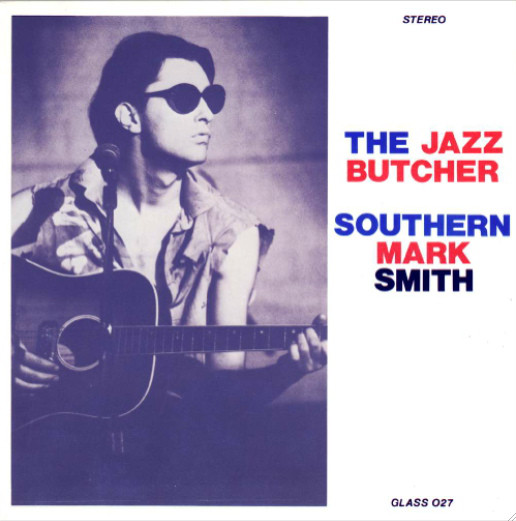
So it was with some sadness that I read about the recent death of Pat Fish, aka The Jazz Butcher. Not only was he just a few years older than me, but I’d enjoyed seeing his band play several times around London (most memorably, supporting R.E.M. in late 1985). I’d also met Pat a few times via a mutual friend, and he was always charming and entertaining.

Pat was one of the last “gentleman rock and rollers” – he wasn’t just in it for the money or glory (although both help to sustain a long music career). He was a chronicler of the absurd, the whimsical and the eccentric (in the nature of other English songwriters such as Ray Davies, Syd Barrett, Robyn Hitchcock and Julian Cope), and as epitomized by “Mr. Odd” and the self-referential “Southern Mark Smith”. Yet, despite this, he found loyal audiences across North America and Europe, where he was probably more appreciated than in the UK. (For example, a Paris-based American musician I knew at the time only became aware of The Jazz Butcher thanks to a tribute to Olaf Palme they recorded after the Swedish prime minister’s murder.)

If the calibre of a band can be measured by the songs and artists they cover, The Jazz Butcher made some interesting choices, revealing their influences and personal tastes: “Road Runner” (Jonathan Richman), “Sweet Jane” (Velvet Underground), “Take The Skinheads Bowling” (Camper Van Beethoven) and “Spooky” (Dusty Springfield). And Pat was also supportive of other bands that were associated with his home base in the East Midlands, or signed to the same labels he was. In this way, and at various times, he was connected to the likes of Bauhaus, Spacemen 3, Eyeless in Gaza, In Embrace, The Pastels, Teenage Fanclub, Bron Area and The Woodentops.

Finally, in keeping with the times, The Jazz Butcher have been the subject of a recent reissue campaign, and there may be a posthumous album released shortly.

Cheers, Pat!

Next week: Opening Up…