The Fall – always different, always the same

During the latest Melbourne lock-down, I have been revisiting the music of The Fall. A strange (or should that be Kurious?) choice, but at a time when you feel like ranting (or mithering) at the absurdity of it all, The Fall make perfect sense. It might not always be comfortable listening, but sometimes you need a bit of grit and gristle as a catalyst to move on.

When exploring The Fall, it’s hard to know where to begin (and, just as importantly, how to end). Although they emerged from the 70’s punk movement and were associated with the Manchester music scene, The Fall identified with neither. But if punk hadn’t happened, and without that link to Manchester, I doubt they would have got as far. They out-lived all of their contemporaries, without the tired reunions or desperate comeback tours of their peers. Perhaps only Wire or Gang of Four can claim a similar longevity, but they both had long periods of inactivity.

Named after an Albert Camus novel, The Fall were not afraid to acknowledge their influences and interests, in particular those of their core founder and only consistent member, Mark E Smith. Scattered across lyrics, album covers, sleeve notes, press interviews and side projects, it is possible to find references to literature, art, theatre, dance, philosophy, politics, psychology, spiritualism and the occult. Elements of Wyndham Lewis, Samuel Beckett, Edgar Allan Poe, Aleister Crowley, Jean-Paul Sartre, William Blake, H.P. Lovecraft, Luke Rhinehart, Bertolt Brecht, Alfred Jarry and Kurt Schwitters can be found strewn across The Fall’s output.

This should not be too surprising: during a 40-year recording career, The Fall released 30+ studio albums, 60+ singles and EPs, and more than a hundred live albums and compilations. Integral to their recording career are the two-dozen sessions The Fall recorded for John Peel’s BBC Radio 1 program. (Peel was an early champion, and often cited them as his favourite band – he is also credited with the quotation that provides the title of this blog.) It’s the sort of discography that will keep fans busy for years – and represents something of a licensing headache for record labels and music publishers alike.

The Fall’s prolific (and challenging) body of work only came to an end when Smith died in early 2018, although the posthumus re-issues and compilations have continued with almost indecent frequency – I hope his estate are keeping tabs.

Of course, with that sort of work ethic, quality control can suffer. Smith was equally feted and feared for his wilful determination and unwillingness to conform. His refusal to compromise or comply with current fads and fashion was certainly an admirable trait. But this steadfast and stubborn control over his content reveals a weakness – the absence of any discernible editorial oversight means that there is a law of diminishing returns, especially in the band’s later years. Although it must also be acknowledged that even on the last few albums, there was something of a return to form.

When Smith died, he was honoured with an obituary in the Washington Post, which must have had more than a few readers perplexed – (Mark E who? Marquis Cha-Cha of course!). Smith would have loathed/laughed at the attention. He had a love/hate relationship with journalists, but he also understood the value of the media to reach his audience, especially in the pre-internet heyday of the UK’s weekly music press (the NME, Melody Maker and Sounds). At the same time, he could be dismissive towards certain sections of his fans, although he saved most of his bile for other bands, especially those whom he felt were mere plagiarists.

Trying to summarise what The Fall represent musically is no easy task. Their antecedents can be traced to 1950’s rockabilly, 1960’s garage rock and 1970’s glam. In terms of outlook and attitude, it’s possible to discern similarities to American groups such as Captain Beefheart and Pere Ubu, and German bands such as Can and Faust. Yet another reference point might be their choice of cover songs, ranging from The Kinks to Sister Sledge, from Hank Mizell to Lee Perry.

Another way to approach their music is to break it down into chronological chapters: the post-punk and dense sounds of their first few albums, the rapid evolution into art rock and neo-pop in the mid-1980s, the brief period with a major label in the early-19990s that saw a transition to a more electronic sound (and mild flirtations with techno and big beat), the peaks and troughs of the middle-aged years, and then the erratic coda in their dotage that showed glimpses of former glories. But this hardly does their back catalogue justice. If you asked fifty fans to list their top 10 tracks by The Fall, you would get as many different compilation albums.

I was fortunate to see The Fall in their early- and mid-1980s peak – so my own preferences mainly stem from that era – the run of albums that comprises “Grotesque (After The Gramme)”, “Perverted by Language”, “Hex Enduction Hour”, “Room to Live”, “The Wonderful and Frightening World of The Fall”, “I Am Kurious Oranj”, “Bend Sinister”, “This Nation’s Saving Grace” and “The Frenz Experiment”, plus the myriad singles and EPs dotted around those releases.

If pushed, I’d have to say my favourite track is “Leave the Capitol”, from 1981 – to me, it sums up what The Fall represent.

Next week: Eileen Agar – My Brush With Surrealism
Goya – allegories and reportage for the modern age

Just prior to the latest COVID-related lock down in Melbourne, I managed to visit the exhibition of drawings and prints by Goya at the NGV. Although these works were produced 200 years ago, they are still relevant today.

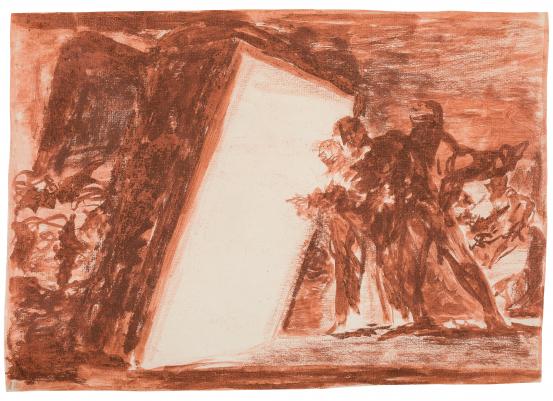
Goya: Two People Looking into a Luminous Room – Image sourced from NGV

Working at the time of the Enlightenment, and despite his status and reputation as a court painter, Goya still had to navigate the political oppression of both Spanish and French rulers, and the religious persecution in the form of the Inquisition.

His series of drawings and etchings reveal a very personal side to Goya’s work, combining allegory, satire, reportage, surrealism and the sub-conscience. The images provide a commentary on the horrors of war and its aftermath, while his domestic scenes on courtship, gold diggers and hapless suitors would not be out of place on Married at First Sight or The Bachelor… There’s a lot that’s familiar about these images.

The exhibition provide some insights into Goya’s working methods – from his use and development of preparatory drawings, to the different etching techniques he deployed to create the finished prints.

One drawing in particular caught my attention – a red crayon sketch entitled “Two People Looking into a Luminous Room”. It’s a remarkable image on a number of levels. The room of the title does not look like a typical building or structure. It almost resembles the bellows of a giant camera, except that photography had not yet been invented. Perhaps it refers to a type of camera obscura or similar device that Goya had seen? On the other hand, it could be a metaphor for Hell, a glimpse into the white heat of the Inferno. For me, it even suggests Goya’s prescience for the work of James Turrell. It’s a remarkable piece in an absorbing exhibition.

Next week: The Fall – always different, always the same

Accounting for Crypto

The period leading up to June 30 saw the usual raft of end of financial year updates, special offers and reminders from equipment suppliers, business service providers, accountants, tax specialists and even the ATO itself.

Crypto is certainly getting a lot of attention in Australia at the moment.

First, there is a Senate Select Committee on Australia as a Technology and Financial Centre, including “opportunities and risks in the digital asset and cryptocurrency sector”. The Select Committee is also looking at ways to define and/or potentially regulate crypto assets.

Second, ASIC has launched a public consultation process on crypto ETFs. This follows a desire from the regulator for more policy guidance from the Federal Government on the “regulatory perimeter” for crypto assets.

Third, the CPA published an op ed on the need for more clarity in crypto asset accounting. Not just in Australia, but across the world of International Financial Reporting Standards.

None of this should be surprising, as governments, regulators, tax authorities, professional bodies and institutional investors are still struggling to comprehend this new asset class, and the technology that underpins it.

Do crypto and digital assets represent currency, commodity, real estate, software license, network membership, utility access, payment mechanism, store of value, financial security, or unique property rights? Depending on the design, use case and origination of a token and its economic properties, the answer could be “yes” in each case – albeit not all at the same time.

In my consulting work with Brave New Coin, I get to speak to clients on a daily basis about their own crypto activities – be they exchanges, asset managers, accountants, tax authorities, regulators or investors. A lot of the discussion involves education – helping them to make sense of the technology and its potential. Some of the time they are simply asking our advice about how to address a particular issue, or they need a recommendation for a custodian or broker. A few share the regulatory challenges they face, and seek our perspective in how to navigate them. Others need more technical help, in building software solutions, or with on-chain analysis and wallet tracking (even though “free” block explorers already do a pretty good job in that regard). While many simply need a source of market data and indices for price discovery and NAV calculations, or a process to capture and track the crypto equivalents of corporate actions.

If anyone wonders how we are doing to make the reporting of crypto holdings as simple as equities or fixed income assets, my own experiences suggest we have a way to go. Legacy accounting and portfolio tools struggle with crypto: for example, can they calculate to 8 decimal places? how do they deal with an air drop? and how do they distinguish between Ether and Ethan Minerals (both use ETH as their ticker symbols), or Cardano and Adacel Technologies (both use ADA). And if I am an accountant, auditor, financial planner or adviser, how can I make sure I understand my clients’ portfolio of crypto investments, if I don’t have the appropriate tools?

Next week: Goya – allegories and reportage for the modern age

Startup Vic FinTech Pitch Night

The Australian tech sector, especially at the startup end of the industry, is having to grapple with what is fast becoming a major structural and operational challenge: how to hire, remunerate and retain staff. With closed international borders cutting off the supply of overseas students and graduates, and a lack of sufficient home-grown skills, it’s a problem that established businesses and startup ventures alike are having to address. Just last week, the AFR reported that some wages in the tech sector have gone up 30% in the past 12 months. Perhaps this issue was on the minds of the four founders who presented at the recent Startup Victoria FinTech Pitch Night.

The judges for this on-line event, sponsored by LaunchVic, were: Nicole Small, Investment Director at Rampersand; Kim Hansen, Co-founder and CEO of Cake Equity; Caitlin Zotti, Operations Manager at Pin Payments; and “the people’s judge,” Eike Zeller, Community Lead at Stone & Chalk Melbourne. Compered by Josh Sharma, Head of Labs & Startups at LUNA, the evening also featured a virtual fireside chat between Rebecca Schot-Guppy, CEO of FinTech Australia, Dom Pym, Co-Founder of Up, and Julia Bearzatto, Head of Technology for Financial Services at MYOB.

The four startups in order of presentation were (links in the names):

Elbaite

Claiming to be the “first non-custodial cryptocurrency exchange“, part of Elbaite’s mission is to prevent theft or misappropriation of crypto assets held in exchange wallets. What makes Elbaite different from other decentralized exchanges (DEXs) and peer-to-peer platforms is that they escrow the fiat involved in any transaction. While they may not be charging the fees of centralized exchanges (CEXs), they are charging a 1% on crypto purchases (although there is 0% commission on sales). Elbaite is hoping to target institutional clients who may not be as comfortable trading on “traditional” crypto exchanges – although in my experience, many institutional clients actually need third-party custody services as part of their governance and compliance obligations. The judges felt that this is a crowded space (there are more than 250 crypto exchanges globally, plus numerous fiat on/off ramps, brokers, OTC desks and P2P platforms).

Sequrr

Speaking of custody and escrow, who would have guessed that stolen house purchase deposits are such a major issue, unless the team at Sequrr had told us? Despite the use of Real Estate Trust Accounts within the industry, apparently there is not much to stop the account holders from walking off with the deposits. Which rather begs the question why the industry does not already use something like multi-signature digital wallets, which mean that the funds can only be moved once all parties to the transaction agree. Even though this is a tech solution using a 3-way verification model (innovation patent pending), the different real estate laws in each State means that it’s not that simple to roll out nationally. However, the team also see opportunities for other professional and commercial sectors: solicitors, builders, aged care. (Note to the founders: I know that invented brand names were once flavour of the month for tech startups, but I question the wisdom of adopting a word that reads like a spelling error, and sounds like someone coughing up phlegm – especially if you want to be taken seriously by banks and solicitors. Just a thought.)

Nextround

Another issue of trust exists between employers and employees when it comes to reward and recognition schemes. There’s always a risk that whatever structure and incentives companies use, someone will try to game the system (or collude with colleagues) especially if the stakes are high; or, if the rewards are simply handed out for turning up and doing your job, their currency becomes debased. Then there’s the (ill-advised) link between rewards and recognition on the one hand, and performance reviews (plus bonuses and salary adjustments) on the other. It’s a balancing act which Nextround are addressing by making it easier (and less expensive) to reward and recognise all of your staff, not just the usual top 5-15%. They do this by offering managers and team leaders access to rewards of a smaller (yet still meaningful) value, which can be easily redeemed by the recipients, for hospitality rewards, events and experiences. The commercial model relies on an annual corporate subscription fee, and taking a cut of the reward vouchers. Nextround consults with employers on their preferred merchants and suppliers, who don’t necessarily see the vouchers as eroding their margins – rather, it’s another sales channel. This is not a hospitality app (e.g., loyalty program), more of a procurement app. And although there are numerous competitors for reward and recognition schemes, the “smarts” are in the way managers and HR teams can budget and allocate accordingly, without the need for onerous expense form claims because the transactions can all be tracked from the point of redemption back to the point of issuance. The resulting data will also generate a further revenue stream from the valuable analytics, although would I want my employer to know how I used my vouchers (assuming they are not tied to a specific reward)? My other reservation is that if the rewards really are as small as a cup of coffee, or even a round of drinks at the pub, isn’t it a bit like tipping?

SpendAble

Letting people make their own financial decisions is also a form of trust. Most of us would feel we can be trusted to spend our own money how we like. But this assumption may be challenged when it comes to people with a disability. SpendAble is developing payment, saving and investment solutions for people who face physical, societal and intellectual barriers to managing the financial affairs. Starting with a budget-based spending app, SpendAble helps users to allocate, identify and track their purchases more easily, and with much of the payment friction removed. The team will also develop specific applications such as voice-controlled functions for the visually impaired. Largely reliant upon the NDIS for funding and end users to cover transaction costs, SpendAble will plug into existing banking platforms – which might be a better way to underwrite the app? However, some of the online chat on the night suggested that SpendAble could provide well-needed general financial education to school kids as part of its offering, as well as helping to address financial inclusion.

Such was the enthusiasm for SpendAble that they took out the Peoples’ Choice as well as the Judges’ Award.

Next week: Accounting for Crypto