Rebooting the local economy

Continuing the theme from my previous, post-lockdown blog, there are definitely some growing challenges ahead as the local economy tries to gather momentum. Yes, the jobs recovery looks encouraging for the hoped-for recovery (at least, based on headline numbers); and property prices (that staple of banks and economists alike) are getting very frothy again. But the end of JobKeeper later this month will hurt both employees and employers – it will be especially hard to stomach when you consider that a few household brands have chosen to keep their government-funded windfalls, despite making significant profits even during (or as a result of) the pandemic, while these same public companies have also been paying out shareholder dividends.

It will be very interesting to monitor ABS data on the number of business entries and exits (CABEE), which is now also being reported quarterly, instead of just annually. The latest annual data released in February (for the period ending June 30, 2020) shows that there were more new businesses registered than the number of businesses that were de-registered – but the net gain was a lot lower than in recent years, as can be seen from this graph:
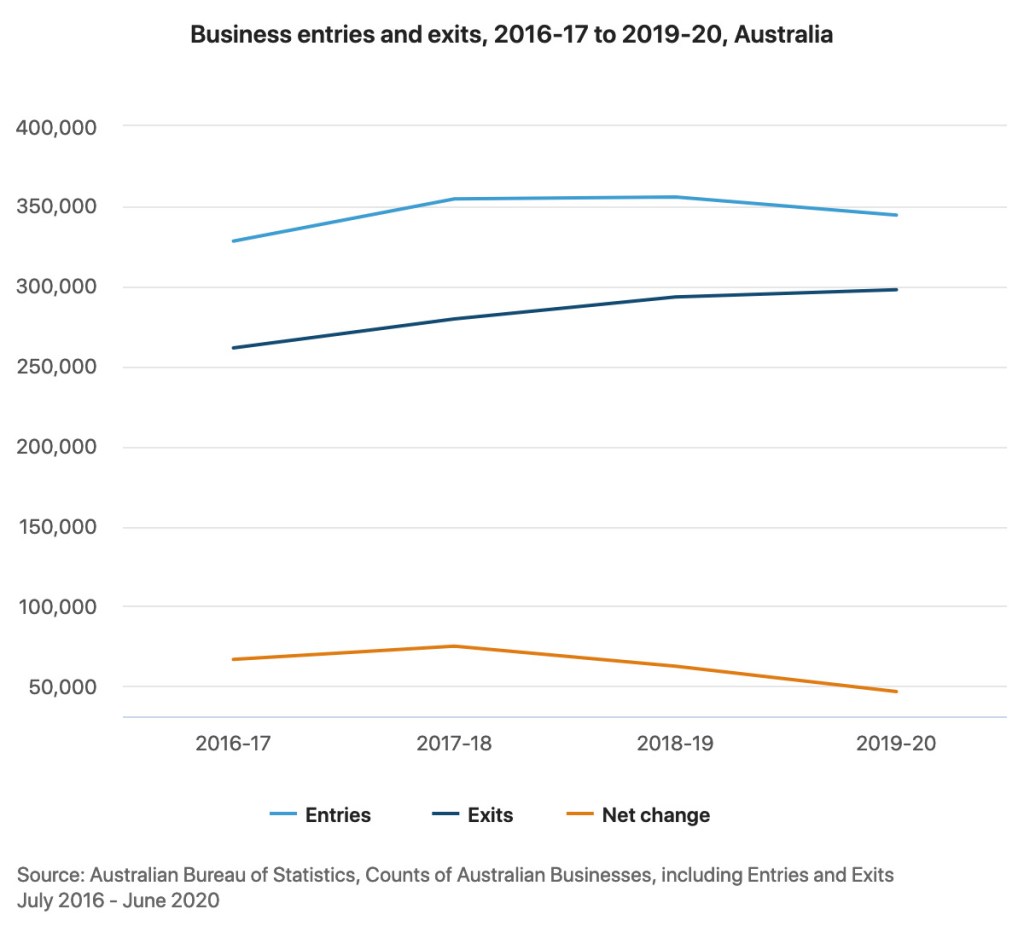
Even after a few months of the pandemic, the number of new entries looks to have declined significantly, with a corresponding rate of increase in exits – and the net increase was already on a steep downward trajectory from 2017-18.

According to the ABS data, “In 2019-20 three industries accounted for more than half of the net annual increase in businesses, these were:

  • Transport, postal and warehousing
  • Professional, scientific and technical services
  • Health care and social assistance”

None of this data should be too surprising; further, we should expect to see a significant number of exits from the retail, hospitality and tourism sectors. Government support in the form of domestic travel vouchers and discounted air tickets will only go so far to reverse the fortunes of airline, hotel and tour operators. (The folks in Queensland must be happy with the twin benefit of being a desirable destination for both domestic holidays and Hollywood film production.)

While on-line shopping has helped to keep retail afloat, bricks and mortar retail has been dealt a heavy blow, from which it will take a long time to recover – many people have no doubt got used to e-commerce, and can’t be enticed back to the shops.

From what I see in Melbourne, the CBD is still running at 40-60% capacity (depending on location, sector, and day of the week). Mondays are definitely quiet, it gets busier on Wednesdays and Thursdays, and then starts to taper off again on Fridays, with people opting to “work from home” as the weekend draws near. Last week, one business group wants companies to close at 4.00pm on Fridays, to encourage workers to hang out in the city after work – but Fridays has always been known as POETS day, so I hardly think anyone still here at the end of the week needs any encouragement to down tools any earlier…

There are still so many construction sites within the CBD, both new build and renovations. But who is going to be occupying this new and refurbished real estate – especially as offices are still limited to 75% capacity, and employees seem reluctant to come back to the office full time? Many shops (old and new) remain boarded up. Some cafes have not even bothered to re-open at all, let alone just on the busy days. Doubtless some current construction projects have been brought forward to take advantage of JobKeeper payments, quieter streets and low interest rates – but it means that in some areas, whole blocks lie empty and virtually devoid of any business, and it feels that many shops don’t see a customer all day.

Unfortunately, with politicians distracted by non-economic matters (plus the small tasks of managing hotel quarantine and rolling out a vaccination programme), we are only seeing short-term responses and band-aid solutions, rather than strategic and visionary policy-making. Neither our governments nor the opposition parties (of all persuasions) seem willing or capable of serious (and non-partisan) debate on things like Universal Basic Income, structural reform of the economy, and instilling innovation across all areas of industry. Instead, they prefer to tinker at the edges (tax, superannuation, industrial relations), engage in Parliamentary point-scoring, and maintain the status quo within their respective supporter base. Something has to change, and soon.

Next week: Victorian Tech Startup Week

Transition – post-pandemic career moves

Even before the latest lock-down v3.0 in Melbourne, one of the other members of my co-working space in the CBD decided they’d already had enough of being confined to a 5km radius, working from home, and other lock-down related restrictions. Having had their interstate travel curtailed over the past 12 months, and suffering from cabin fever, they have opted to spend the next few months living in and working from various Airbnb locations around regional Victoria. Even though they are used to WFH, recent experience has shown that they don’t need to be confined to one place. And this post-COVID shift in our work/life patterns (already being disrupted and enabled by remote working) is only increasing.

Likewise, a client I spoke to in the USA last week informed me that they had just settled into a new location on the west coast, and was “living the dream” of a nomadic existence.

More extreme is the recent example of a Guardian employee who, having had to travel from Sydney to the UK for a family funeral last year, then took several months to get back home (due to flight cancellations), but managed to keep working remotely from various European locations as he moved around to stay ahead of border closures.

Prior to this past weekend, and despite the city being out of Stage 4 lock-down for 3 months, private offices in Melbourne’s CBD have only been allowed to operate at 50% of capacity – the proposed move to 75% capacity has been put back. It means, for example, that even on a really good day, my local coffee shop is still only doing 60% of its pre-COVID business.

It’s my guess that the combination of office restrictions and many retail and hospitality businesses simply not bothering to re-open at all means the CBD is barely operating at 40-50%. It’s deceptive – some activities (e.g., construction) have continued pretty much unabated (even expanding while there is less traffic on the roads); while others have been shut down altogether (e.g., entertainment). Certainly food delivery services are still in demand, while some retail has been doing a bit better as customers appreciate the novelty of shopping in-person.

Monday to Friday in the CBD is like a bell-curve distribution – Mondays and Fridays are much quieter, as people choose to WFH part of the week. Which is challenging for employers, as they try to revert to “normal”. But assuming a mix of remote and on-site working continues, it probably means less overall demand for office space. (It’s also difficult to assess the impact of the CBD exodus on suburban hubs.)

So all that construction work suggests we will have an over-supply of commercial premises (offices, shops, restaurants and hotels).

Residential property is a similar story – student accommodation is far from full, as overseas students aren’t returning; and more inner-city apartment buildings are still going up, but there is something of an exodus from the city to regional and rural locations.

The latter tree- and sea-changes are being fueled by a number of factors: a desire to leave the city (which is more prone to lock-downs); low interest rates (so, cash out the equity in your suburban home and move to the country where your money buys you more); increased opportunity to WFH (see, 5G and the NBN have their benefits!); and a broader wish for a different work/life balance.

Unfortunately, this shift is also putting pressure on local housing supply – average property prices are going up faster in some regional centres than in the capital cities; and more nomadic lifestyles are driving up demand for short-stay accommodation. The combined effect is higher rental costs and reduced supply, tending to squeeze out the locals.

Ironically, we’ve heard farmers and primary producers in rural and regional Australia complain that they can’t get seasonal workers due to COVID restrictions on international visitors (especially students, back-packers and experienced fruit pickers). Conversely, we’re told that 90% of jobs lost after March last year have now been recovered – although this apparent rebound is mainly in part-time roles, not full-time positions. It would be interesting to see a detailed breakdown by industry, as some sectors (tourism, aviation, universities) are still struggling.

The hiatus (and disruption) brought about by COVID and subsequent lock-downs has no doubt prompted many people to reassess their careers: where do I want to live/work? what type of work do I want to do? which industries or companies are hiring? and for what roles? As part of a wider re- and up-skilling initiative, the Federal and State governments are offering a range of free vocational courses (mostly Cert I to IV programmes), as well as some enhanced “pathways” to trade apprenticeships.

While this is to be applauded, I can’t help feeling the effort is at least 5-10 years too late to address the technological, demographic and societal changes that began at the end of the last century, with the advent of the internet, cheaper technology, an ageing population, increased globalisation, inefficient taxation and tariff systems, and general economic restructuring. If nothing else, COVID has demonstrated the need for more resilience in the domestic economy, (and a reduced reliance on overseas imports and supply chains) such as smart manufacturing and food security.

Meanwhile, a friend of mine recently related that a nephew of his had dropped out of college (like many of his peers in the USA and elsewhere) and decided to become a self-taught expert in DeFi, as there is more chance of financial success (and career satisfaction) than obtaining an “off the shelf” bachelor degree….

Next week: Corporate Art

Golden Years

This week I turned 60, which in the Chinese Zodiac means this is my Golden Year (I’m a Metal Rat, to be precise). Despite the global pandemic, and the challenges of having spent the best part of the last 7 months in Melbourne lock-down, I would say that this year I have been more fortunate than many others. For which I am grateful.

Golden Years – Image sourced from Discogs

But with more time for reflection on what this milestone might signify, I have been thinking about the circumstances in which I find myself – whether it’s true that “60 is the new 40”, or is it all downhill from here?

My own father left full-time employment before he was 60. And although he had planned to do some part-time consulting work in his semi-retirement, he ended up volunteering for numerous not-for-profit organisations, for the next 25 years. This included lengthy stints serving on various boards and committees, at times almost a full-time job in itself. I’m sure he found this work to be fulfilling and rewarding, alongside his U3A classes and other social activities, but I’m not certain it’s how he intended to spend his retirement. It seems like he fell into this type of role, and since he was good at it, people kept asking him to do more, and he couldn’t always say no.

On the other hand, my paternal grandfather, who ran a small building company, died before he was 50, so I never knew him. While my maternal grandfather had an erratic employment history (not helped by the 1930s depression and war-time disruption), and was still working in manual jobs until he passed away in his late 60s.

I left my last corporate job when I was 50. At first, I thought I would look for a new full-time role, but the combination of the fall-out from the GFC and an implicit age barrier made that less likely the longer I looked. Some of the job interviews I attended revealed a significant prejudice towards older candidates: either their experience represented a threat to incumbents; or their past seniority meant they were unlikely to be hands-on, and/or less adaptable to new technology and new working practices.

Realising I was heading into self-employment (comprising part-time, contract, temporary, casual, freelance and consulting roles) I decided to reorganise my affairs, in order to sustain this new lifestyle. A key reason for seeking another full-time corporate gig would have been to service my mortgage, which didn’t really make sense. I was fortunate that I was able to restructure my finances, and effectively live debt-free. This gave me the flexibility to do some retraining, and to venture into the start-up world, which is where I was able to apply my skills and experience more creatively than in a corporate environment. This is how I came to encounter new technology and new opportunities in the form of FinTech, Blockchain and Cryptocurrency. And the rest is history (thus far…)

I appreciate that not everyone has the same opportunities; and working in disruptive industries or joining a start-up is not for everyone, either. But I also know that if I hadn’t made similar or significant career changes (and personal choices) over the past 35 years, I wouldn’t be in a position to be enjoying a golden period of my life right now.

Next week: Startmate Virtual Demo Day

Responsibility vs Accountability

One of the issues to have emerged from the response to the current coronavirus pandemic is the notion that “responsibility” is quite distinct from “accountability”.

In the Australian political arena, this is being played out in two specific aspects, both of which reveal some weaknesses in the Federal and State delineation. The first is the Ruby Princess, the passenger cruise ship that appears to have been a significant source of Covid19 infections from returning and in-bound travellers. In this case, blame or liability for the breach in quarantine measures is being kicked around between Border Force (Federal), and NSW Health (State): who was responsible and/or accountable for allowing infected passengers to disembark?

The second arises from the number of Covid19 cases among aged care residents in the Melbourne Metropolitan area. Here, the issue is the governance of aged care facilities as between privately-run homes (Federal oversight), and public homes (State operation). As an example of the strange delineation between Federal and State, “…the Victorian government mandates minimum nurse-to-resident ratios of up to one nurse for every seven residents during the day, the Commonwealth laws only call for an “adequate” number of “appropriately skilled” staff – both terms are undefined.”

As with all key areas of public policy and administration (health, education, social services), the relationship between different government departments and administrative bodies can be confusing and complex. In very broad terms, public funding comes from the Commonwealth (via direct Federal taxes and the redistribution of GST back to the States), since States have limited options to raise direct revenue (land taxes, stamp duty, payroll tax, and fees from licenses and permits). The Commonwealth funding can be allocated direct, or co-mingled with/co-dependent upon State funding. Likewise, service delivery can be direct by the Commonwealth, jointly with the States, or purely at the State (or even Local) level.

Within Victoria, there is an added dimension to the “responsibility” vs “accountability” debate, largely triggered by apparent failures in the oversight of the hotel quarantine programme. This in turn led to the second wave of Covid19 infections via community transmission (and the tragic number of deaths among aged care residents). The Premier has said he wasn’t responsible for the decision to use private firms to operate the security arrangements at the relevant hotels. In fact, the Premier appears not to have known (or wasn’t aware) who made that decision (or how/why it was made). But he does admit to being accountable for it.

Meanwhile, his departmental ministers have similarly denied knowing who made the decision, or they have said that it was a “multi-agency” response – maybe they are trying to shield each other in a strange show of cabinet collective responsibility, and to avoid apportioning direct blame to their colleagues. But if the government didn’t know who was supposed to be running the hotel quarantine programme, then surely the private security firms certainly couldn’t have known either – if so, who was paying them, and from whom did they take their orders and direction?

We are being drip-fed information on the failures in the hotel quarantine programme: did the AMA “write a letter” to the Victoria Department of Health & Human Services about their concerns over the hotel quarantine programme? did the DHHS provide “inappropriate advice” on the use of PPE by hotel security staff? did the Victorian Premier actually propose the hotel quarantine programme at National Cabinet, and then omit to request support from the police and/or the ADF?

It’s not surprising, therfore, that confusion reigns over who was responsible, and who is accountable; more importantly, who will be liable? What would be the situation if, for example, front line medical staff or employees in “high risk settings” have died from Covid19 as a result of community transmission within their workplace (itself stemming from the hotel breakout), and where there were inadequate workplace protections, especially if the latter were based on government advice and supervision?

The new offence of criminal manslaughter applies in Victoria since July 1, 2020. It will only apply to deaths caused since that date and as a result of “negligent conduct by an employer or other duty holders … or an officer of an organisation, which breaches certain duties under the Occupational Health and Safety Act 2004 (OHS Act) and causes the death of another person who was owed the duty”.

Finally, in reading around this topic, I came across an academic paper which discusses the treatment of responsibility, accountability and liability in the context of professional healthcare. In trying to define each from a clinical, professional and legal perspective, the author concluded that:

“….[R]esponsibility means to be responsible for ensuring that something is carried out whilst accountability moves beyond this to encompass the responsibility but adds a requirement that the healthcare professional provides an account of how they undertook the particular task. Liability moves the definition forward by adding a dimension of jeopardy to the definition of accountability. In a strict legal sense once the accountable person has provide their account they have fulfilled their duty. However, if the healthcare professional is liable rather than accountable for their action then the account they provide will be judged and, if found to be wanting, there may be a penalty for the healthcare professional.” (emphasis added)

I wonder if we should be assessing political and administrative liability by the same standard?

Next week: Startupbootcamp Demo Day – Sports & EventTech