My Twitter and LinkedIn feeds are full of posts about artificial intelligence, machine learning, large language models, robotics and automation – and how these technologies will impact our jobs and our employment prospects, often in very dystopian tones. It can be quite depressing to trawl through this material, to the point of being overwhelmed by the imminent prospect of human obsolescence.
No doubt, getting to grips with these tools will be important if we are to navigate the future of work, understand the relationship between labour, capital and technology, and maintain economic relevance in a world of changing employment models.
But we have been here before, many times (remember the Luddites?), and so far, the human condition means we learn to adapt in order to survive. These transitions will be painful, and there will be casualties along the way, but there is cause for optimism if we remember our post-industrial history.
Second, the technology at our disposal will inevitably make us more productive as well as enabling us to reduce mundane or repetitive tasks, even freeing up more time for other (more creative) pursuits. The challenge will be in learning how to use these tools, and in efficient and effective ways so that we don’t swap one type of routine for another.
Third, there is still a need to consider the human factor when it comes to the work environment, business structures and organisational behaviour – not least personal interaction, communication skills and stakeholder management. After all, you still need someone to switch on the machines, and tell them what to do!
Fourth, the evolution of “bring your own device” (and remote working) means that many of us have grown accustomed to having a degree of autonomy in the ways in which we organise our time and schedule our tasks – giving us the potential for more flexible working conditions. Plus, we have seen how many apps we use at home are interchangeable with the tools we use for work – and although the risk is that we are “always on”, equally, we can get smarter at using these same technologies to establish boundaries between our work/life environments.
Fifth, all the technology in the world is not going to absolve us of the need to think for ourselves. We still need to bring our own cognitive faculties and critical thinking to an increasingly automated, AI-intermediated and virtual world. If anything, we have to ramp up our cerebral powers so that we don’t become subservient to the tech, to make sure the tech works for us (and not the other way around).
Adopting a new approach means:
not taking the tech for granted
being prepared to challenge the tech assumptions (and not be complicit in its in-built biases)
question the motives and intentions of the tech developers, managers and owners (especially those of known or suspected bad actors)
validate all the newly-available data to gain new insights (not repeat past mistakes)
evaluate the evidence based on actual events and outcomes
and not fall prey to hyperbolic and cataclysmic conjectures
Finally, it is interesting to note the recent debates on regulating this new tech – curtailing malign forces, maintaining protections on personal privacy, increasing data security, and ensuring greater access for those currently excluded. This is all part of a conscious narrative (that human component!) to limit the extent to which AI will be allowed to run rampant, and to hold tech (in all its forms) more accountable for the consequences of its actions.
Australia’s Prime Minister recently announced his Government’s plans to hold a national referendum on the “Indigenous Voice to Parliament“. The Voice is a key outcome from the Uluru Statement from the Heart, and the path towards Treaty and Truth. It will require amendments to the Australian Constitution. The inevitable debate about the detail, purpose and scope to be enshrined in the Voice has now been heightened by the death of Queen Elizabeth II, and related issues of Australia’s pre- and post-colonial history, the experience of Federation and the fate of the Republican movement.
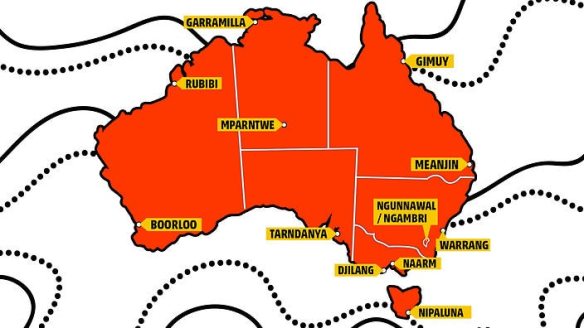
NAIDOC guide to Indigenous place names in Australia (image sourced from SBS)
One of the first comments in the wake of the Prime Minister’s announcement came from the Green Party, who indicated that their support for the Voice would be conditional on there being a Treaty first. Indeed, Greens Senator Lidia Thorpe called the proposed referendum “a waste of money”, indicating that she wanted to see a Treaty with Indigenous Australians before any talk of a Republic. Since the Queen’s death, it seems the Senator has changed her mind, and is now calling for both a Treaty and a Republic. But the Prime Minister has determined that the first order of business for his Government is the Voice, and that the Republican debate is not for his first term in office.
The question to be presented in the Referendum will be:
“Do you support an alteration to the Constitution that establishes an Aboriginal and Torres Strait Islander Voice?”
And the proposed additions to the Constitution would read something like this:
1.There shall be a body, to be called the Aboriginal and Torres Strait Islander Voice.
2.The Aboriginal and Torres Strait Islander Voice may make representations to Parliament and the Executive Government on matters relating to Aboriginal and Torres Strait Islander Peoples.
3.The Parliament shall, subject to this Constitution, have power to make laws with respect to the composition, functions, powers and procedures of the Aboriginal and Torres Strait Islander Voice.
While refusing to be drawn on the precise details of the Voice, the Prime Minister has defined what it is NOT going to be: “Not a third chamber, not a rolling veto, not a blank cheque.” Meanwhile, two bodies have been appointed to prepare for the Referendum proposal and implementation: the Referendum Working Group, and the Referendum Engagement Group, whose terms of reference are not entirely clear – and Senator Thorpe complained that the appointees “did not represent First Nations voices”.
Given the history of Referendums in Australia (most notably the failure of the Republican Movement to secure a “Yes” vote in 1999), it’s understandable that people are either wary about the form of the question and/or the Constitutional amendments, or are concerned about the apparent lack of detail that the Government has so far provided on the remit of the Voice. There is a possibility that the electorate votes “Yes” in the Referendum, but that agreement cannot be reached on the changes to the Constitution, or the structure of the Voice. So it’s understandable that some people are seeking more detail, or at least more clarity.
Whatever the sequence of events (Voice, Treaty, Republic?), it’s going to be a complicated process. For example, putting the Republic before the Voice may mean that the latter becomes redundant, assuming the Republican Constitution embeds principles such as the United Nations Declaration on the Rights of Indigenous Peoples. And Treaty before Republic would mean that the agreement(s) would be between the First Nations people and the Australian Constitutional Monarchy, whose Head of State is now King Charles III.
Perhaps that is the point – the formal process of healing, reconciliation and reparation cannot be meaningfully done without some involvement by the British Crown, in whose name Indigenous lands were appropriated in 1788. But does that potentially “absolve” Australia’s post-Federation Governments and Administrations from any responsibility for the act of British colonisation? Since Federation in 1901, Australia has had ample opportunity to make amends. It is no longer possible to suggest that any change to the Australian Constitution would require Royal Assent by the King or Queen in person – the purely ceremonial role of the British Monarchy in respect to Australia’s domestic affairs has always been predicated on the advice from both the Governor General (who serves as the Monarch’s local representative, and who gives Royal Assent to Australian Acts of Parliament), and Australia’s own government ministers and civil servants. In any event, it’s long been understood that the Crown would not prevent Australia becoming a Republic; in effect, the Crown could not intervene in any Constitutional amendment. Such a change is entirely a matter for the Australian Parliament.
The Westminster Act of 1931 confirmed that Australia is an independent state able to form its own foreign policy and defence free from British control; and the Australia Act 1986 formally severed all remaining legal ties between Australia and the United Kingdom except for the Monarchy. So a Treaty with Indigenous peoples could have been possible since 1901 when the Commonwealth of Australia Constitution Act came into force, heralding Federation. (Interestingly, King Charles III has had to be proclaimed by the Federal Government, and by each State – which might suggest the need for multiple Treaties?)
Another argument against embodying the Voice within the framework of the current Australian Constitutional Monarchy is because it would appear to “ratify” colonisation, and thereby imply Sovereignty had been granted (retrospectively?) to the Crown, which would therefore negate the need for Treaty. Indeed, the whole point of Treaty is to re-assert that Indigenous Sovereignty was never ceded, and that unlike other British colonies such as Canada and New Zealand, the British Crown has never attempted to negotiate any form of direct agreement with the Indigenous Nations of Australia.
Alternatively, Associate Professor Hannah McGlade has stated that a national Treaty needs a national body to negotiate (hence a key purpose of the Voice). Further, she argues that Aboriginal Sovereignty relates to the “right to shape the national dialogue” on issues of primary concern to the Indigenous population. While not quite equating to full self-determination, it does provide a persuasive argument in favour of establishing the Voice to Parliament.
Finally, some other factors to consider as we move through this multi-faceted debate on Treaty, the Republic, and defining Australia’s post-colonial, post-Federation and post-Monarchy identity:
1. A Republic is no guarantee of getting Treaty right – indeed, look at the number of republics that have ridden rough-shod over their own indigenous and minority peoples – oppression and dictatorship is not the preserve of monarchs and emperors.
2. There is the question of how Crown land in Australia will be resolved, both in relation to Treaty, and the Republic. This would include the commercial arrangements for agriculture, mining and tourism, as well as land development and construction.
3. Inconsistencies in how Indigenous people are acknowledged at public events, meetings and in other similar settings. Here in Victoria, we are very used to some statement of recognition towards Indigenous nations and the traditional custodians of the land, along with their elders past, present and emerging. On my recent trip the Kimberley, I was surprised that no such formal statements were made when visiting culturally significant landmarks, usually under the direction of official tour guides, including National Parks. Not that there was an absence of awareness, knowledge or public signage, but I had expected there might have been a more vocal expression from some of our hosts.
4. Despite the need for a cohesive approach to the Voice and Treaty, it would be a mistake to view the Indigenous populations and their respective Nations as an homogenous entity. Even within Indigenous communities, as in any society, there are differences and inconsistencies. So there will be different demands placed on those charged with navigating the Voice, and negotiating Treaty. But a speedy outcome should not preclude the establishment of a solid consensus. After all, what’s 240 years compared to 50,000?
Nowadays, no TV or movie franchise worth its salt is deemed complete unless it has some sort of origin story – from “Buzz Lightyear” to “Alien”, from “Mystery Road” to “Inspector Morse”. And as for “Star Wars”, I’ve lost count as to which prequel/sequel/chapter/postscript/spin-off we are up to. Origin stories can be helpful in explaining “what came before”, providing background and context, and describing how we got to where we are in a particular narrative. Reading Jeanette Winterson’s recent collection of essays, “12 Bytes”, it soon becomes apparent that what she has achieved is a tangible origin story for Artificial Intelligence.
Still from “Frankenstein” (1931) – Image sourced from IMDb
By Winterson’s own admission, this is not a science text book, nor a reference work on AI. It’s a lot more human than that, and all the more readable and enjoyable as a result. In any case, technology is moving so quickly these days, that some of her references (even those from barely a year ago) are either out of date, or have been superceded by subsequent events. For example, she makes a contemporaneous reference to a Financial Times article from May 2021, on Decentralized Finance (DeFi) and Non-Fungible Tokens (NFTs). She mentions a digital race horse that sold for $125,000. Fast-forward 12 months, and we have seen parts of the nascent DeFi industry blow-up, and an NFT of Jack Dorsey’s first Tweet (Twitter’s own origin story?) failing to achieve even $290 when it went up for auction, having initially been sold for $2.9m. Then there is the Google engineer who claimed that the Lamda AI program is sentient, and the chess robot which broke its opponent’s finger.
Across these stand-alone but interlinked essays, Winterson builds a consistent narrative arc across the historical development, current status and future implications of AI. In particular, she looks ahead to a time when we achieve Artificial General Intelligence, the Singularity, and the complete embodiment of AI, and not necessarily in a biological form that we would recognise today. Despite the dystopian tones, the author appears to be generally positive and optimistic about these developments, and welcomes the prospect of transhumanism, in large part because it is inevitable, and we should embrace it, and ultimately because it might the only way to save our planet and civilisation, just not in the form we expect.
The book’s themes range from: the first human origin stories (sky-gods and sacred texts) to ancient philosophy; from the Industrial Revolution to Frankenstein’s monster; from Lovelace and Babbage to Dracula; from Turing and transistors to the tech giants of today. There are sections on quantum physics, the nature of “binary” (in computing and in transgenderism), biases in algorithms and search engines, the erosion of privacy via data mining, the emergence of surveillance capitalism, and the pros and cons of cryogenics and sexbots.
We can observe that traditional attempts to imagine or create human-made intelligence were based on biology, religion, spirituality and the supernatural – and many of these concepts were designed to explain our own origins, to enforce societal norms, to exert control, and to sustain existing and inequitable power structures. Some of these efforts might have been designed to explain our purpose as humans, but in reality they simply raised more questions than they resolved. Why are we here? Why this planet? What is our destiny? Is death and extinction (the final “End-Time”) the only outcome for the human race? Winterson rigorously rejects this finality as either desirable or inevitable.
Her conclusion is that the human race is worth saving (from itself?), but we have to face up to the need to adapt and continue evolving (homo sapiens was never the end game). Consequently, embracing AI/AGI is going to be key to our survival. Of course, like any (flawed) technology, AI is just another tool, and it is what we do with it that matters. Winterson is rightly suspicious of the male-dominated tech industry, some of whose leaders see themselves as guardians of civil liberties and the saviours of humankind, yet fail to acknowledge that “hate speech is not free speech”. She acknowledges the benefits of an interconnected world, advanced prosthetics, open access to information, medical breakthroughs, industrial automation, and knowledge that can help anticipate danger and avert disaster. But AI and transhumanism won’t solve all our existential problems, and if we don’t have the capacity for empathy, compassion, love, humour, self-reflection, art, satire, creativity, imagination, music or critical thinking, then we will definitely cease to be “human” at all.
The Bibliography to this book is an invaluable resource in itself – and provides for a wealth of additional reading. One book that is not listed, but which might be of interest to her readers, is “Chimera”, a novel by Simon Gallagher, published in 1981 and subsequently adapted for radio and TV. Although this story is about genetic engineering (rather than AI), nevertheless it echoes some of Winterson’s themes and concerns around the morals and ethics of technology (e.g., eugenics, organ harvesting, private investment vs public control, playing god, and the over-emphasis on the preservation and prolongation of human lifeforms as they are currently constituted). Happy reading!
Even before the latest lock-down v3.0 in Melbourne, one of the other members of my co-working space in the CBD decided they’d already had enough of being confined to a 5km radius, working from home, and other lock-down related restrictions. Having had their interstate travel curtailed over the past 12 months, and suffering from cabin fever, they have opted to spend the next few months living in and working from various Airbnb locations around regional Victoria. Even though they are used to WFH, recent experience has shown that they don’t need to be confined to one place. And this post-COVID shift in our work/life patterns (already being disrupted and enabled by remote working) is only increasing.
Likewise, a client I spoke to in the USA last week informed me that they had just settled into a new location on the west coast, and was “living the dream” of a nomadic existence.
More extreme is the recent example of a Guardian employee who, having had to travel from Sydney to the UK for a family funeral last year, then took several months to get back home (due to flight cancellations), but managed to keep working remotely from various European locations as he moved around to stay ahead of border closures.
Prior to this past weekend, and despite the city being out of Stage 4 lock-down for 3 months, private offices in Melbourne’s CBD have only been allowed to operate at 50% of capacity – the proposed move to 75% capacity has been put back. It means, for example, that even on a really good day, my local coffee shop is still only doing 60% of its pre-COVID business.
It’s my guess that the combination of office restrictions and many retail and hospitality businesses simply not bothering to re-open at all means the CBD is barely operating at 40-50%. It’s deceptive – some activities (e.g., construction) have continued pretty much unabated (even expanding while there is less traffic on the roads); while others have been shut down altogether (e.g., entertainment). Certainly food delivery services are still in demand, while some retail has been doing a bit better as customers appreciate the novelty of shopping in-person.
Monday to Friday in the CBD is like a bell-curve distribution – Mondays and Fridays are much quieter, as people choose to WFH part of the week. Which is challenging for employers, as they try to revert to “normal”. But assuming a mix of remote and on-site working continues, it probably means less overall demand for office space. (It’s also difficult to assess the impact of the CBD exodus on suburban hubs.)
So all that construction work suggests we will have an over-supply of commercial premises (offices, shops, restaurants and hotels).
Residential property is a similar story – student accommodation is far from full, as overseas students aren’t returning; and more inner-city apartment buildings are still going up, but there is something of an exodus from the city to regional and rural locations.
The latter tree- and sea-changes are being fueled by a number of factors: a desire to leave the city (which is more prone to lock-downs); low interest rates (so, cash out the equity in your suburban home and move to the country where your money buys you more); increased opportunity to WFH (see, 5G and the NBN have their benefits!); and a broader wish for a different work/life balance.
Unfortunately, this shift is also putting pressure on local housing supply – average property prices are going up faster in some regional centres than in the capital cities; and more nomadic lifestyles are driving up demand for short-stay accommodation. The combined effect is higher rental costs and reduced supply, tending to squeeze out the locals.
Ironically, we’ve heard farmers and primary producers in rural and regional Australia complain that they can’t get seasonal workers due to COVID restrictions on international visitors (especially students, back-packers and experienced fruit pickers). Conversely, we’re told that 90% of jobs lost after March last year have now been recovered – although this apparent rebound is mainly in part-time roles, not full-time positions. It would be interesting to see a detailed breakdown by industry, as some sectors (tourism, aviation, universities) are still struggling.
The hiatus (and disruption) brought about by COVID and subsequent lock-downs has no doubt prompted many people to reassess their careers: where do I want to live/work? what type of work do I want to do? which industries or companies are hiring? and for what roles? As part of a wider re- and up-skilling initiative, the Federal and State governments are offering a range of free vocational courses (mostly Cert I to IV programmes), as well as some enhanced “pathways” to trade apprenticeships.
While this is to be applauded, I can’t help feeling the effort is at least 5-10 years too late to address the technological, demographic and societal changes that began at the end of the last century, with the advent of the internet, cheaper technology, an ageing population, increased globalisation, inefficient taxation and tariff systems, and general economic restructuring. If nothing else, COVID has demonstrated the need for more resilience in the domestic economy, (and a reduced reliance on overseas imports and supply chains) such as smart manufacturing and food security.
Meanwhile, a friend of mine recently related that a nephew of his had dropped out of college (like many of his peers in the USA and elsewhere) and decided to become a self-taught expert in DeFi, as there is more chance of financial success (and career satisfaction) than obtaining an “off the shelf” bachelor degree….