When is a print not a print?

Alongside drawing, painting and sculpture, print-making is one of the oldest forms of visual art. Although it wasn’t generally recognised as a fine art discipline in the west until the European Renaissance (with the work of Dürer, among others), the practice can be traced back to Paleolithic times when humans first made hand-prints on cave walls. It evolved largely through developments in paper-making and image creation, such as Japanese wood-block printing 1200 years ago, or metal plate engravings in the Middle Ages, and has developed alongside related technologies in lithography, etching, off-set press printing, photography, lino-cut and silk-screen printing, to name a few key methods.

Print-making in this “classical” sense uses a combination of mechanical, manual and chemical processes to transfer an image (created from one or more media) from one surface to another, using ink or paint to “carry” the image between the plate and paper or other printed surface.

While the printing industry has been using the same techniques for centuries (in the service of book publishing, newspapers, advertising, packaging, textiles, etc.) there are key differences between the commercial and the artistic.

First, traditional print-making still retains a high-degree of manual process, and the work is usually produced in limited numbers (sometimes in single editions), and even where multiple copies are generated, variations and differences will appear thanks to inherent “imperfections” of the process.

Second, despite the importance of technical process in print-making, the practice should not be seen as a mere mechanical exercise in reproducing an image – the resulting image is still far more important than the actual technique (i.e., content over form should be the order of the day).

Third, the role of “mark-making” in print-making is as significant as the brush strokes in an oil painting, and are part of the artist’s signature. Equally, choice of materials is also important, just as an artist working in oils will make specific decisions about their brushes, pigments, medium and canvass.

In terms of art curation, print-making can get lumped in with other “works on paper”, which may extend to collage, photography, photo-montage, graphic design and illustration. Photography itself can be used in the course of print-making (e.g., rayographs), but a photographic print of a film-based negative is not the same as print-making in this context.

Likewise, the use of digital processes to capture, create, manipulate, transfer and reproduce an image on paper (or other medium) is further blurring the boundaries as to what constitutes a “print” as opposed to a “technique”.

This delineation between traditional print-making and image creation processes was further highlighted by the recent Experimental Print Prize organised by Castlemaine Art Museum in Victoria’s gold field region. While there were examples of etching, lino-cut, lithography, photographic and other techniques on display, the prize is intended to push the boundaries into more conceptual notions of “what is a print?”.

Examples included the use of light-sensitive paper to create long-delay images, a neon-light to generate an after-image on the viewer’s retinas, and a muon particle detector to track and plot their “image” onto a computer monitor. Although these are all interesting approaches, they perhaps over-step the boundary of permanence, which is usually a feature of print-making, to the extent that the fixed paper and ink endure long after the artist has made his or her mark. Nevertheless, the museum is to be applauded for bringing a new dimension to an ancient art-form.

Next week: Literary legacies


To be or NFT?

If there’s one consistent lesson to be learned from Blockchain and crypto is that the enabling technology often outpaces our understanding of the viable use case, commercial application or sustainable business model. For example, smart contracts have only recently proven their value with the rise of decentralized finance (DeFi). Even then, they are not perfect and if not well-coded can result in hacks, losses or other damage. Plus, until scaling (transaction throughput) and gas fees (transaction costs) are properly resolved, mass adoption is still some way off.

CryptoPunk #7523 (Image sourced from Reuters)

The latest crypto phenomenon is the market for NFTs (non-fungible tokens). Artworks in the form of digital files are being created, auctioned and traded for serious (or very silly?) amounts of money – just Google EtherRock, Beeple, CryptoPunk or Rare Pepe for recent examples.

NFTs are not just confined to digital art – animation, video, music and text are all being created in the form of NFTs. In addition, NFTs are being minted to represent ownership or other IP rights for physical artworks, real estate assets, collectibles and luxury goods.

Why would anyone pay the best part of US$12m for the original digital file of CryptoPunk #7523, a copy of which I have displayed above?

Perhaps we need to consider the following:

First, the image above is simply a low-res web image, easily reproduced via copy and paste – it’s not the “real” image as represented by the code or digital file embedded in the NFT. The original file is owned by the NFT buyer, and if it is an edition of one, then that is the only authentic version. Scarcity (as well as kudos) is a key market driver in NFTs – but only if someone else attaches financial value to the work (just as in any art market).

Second, owning the NFT does not necessarily mean you own the copyright or other rights associated with the art work. (I may own a Picasso painting, but I don’t own the image contained in the work.) So, apart from holding an NFT in your digital wallet or displaying it in a virtual art gallery, the only right you have is to re-sell the work. This means you can’t commercialise the image for t-shirts, on-line redistribution or reproduction (unless the owner has agreed to grant such rights within the NFT). (My use of the image here would be covered by the “fair use” principle, for the purposes of illustration and/or critical analysis.)

Third, unless you are able to export the NFT from the marketplace or platform that sold it, the NFT may “vanish” if the platform goes offline for any reason. (Doubtless, platforms need to enable token transfers to other market places and to users’ own digital wallets, otherwise there could be a lot of stranded and/or worthless NFTs in years to come.)

Fourth, the creator of the original work may be entitled to a % of the resale value of the NFT. This is obviously an important consideration for artists and other content creators, and I see this as a positive development. By extension, musicians, authors, film-makers and designers can more easily track and control the downstream revenue generated by the use and licensing of their works by third-party marketplaces, streaming platforms or 3D printing and fabrication services.

Fifth, NFTs support improved authentication, provenance and chain of ownership, as well as bringing more transparency to the world of art auctions – valuations, bidding and prices could all be hashed on the Blockchains that track the NFTs.

Finally, if NFTs are seen as a form of bearer bond (linking ownership to whomever controls the token), they could also be used to package up a portfolio of different crypto or digital assets, and auctioned as a single lot. The buyer could then unlock the disparate assets, and combine them into subsequent bundles – bringing a new dimension to block trades and the transfer of large bundles of stocks.

Next week: I got nothing


Eileen Agar – My Brush With Surrealism

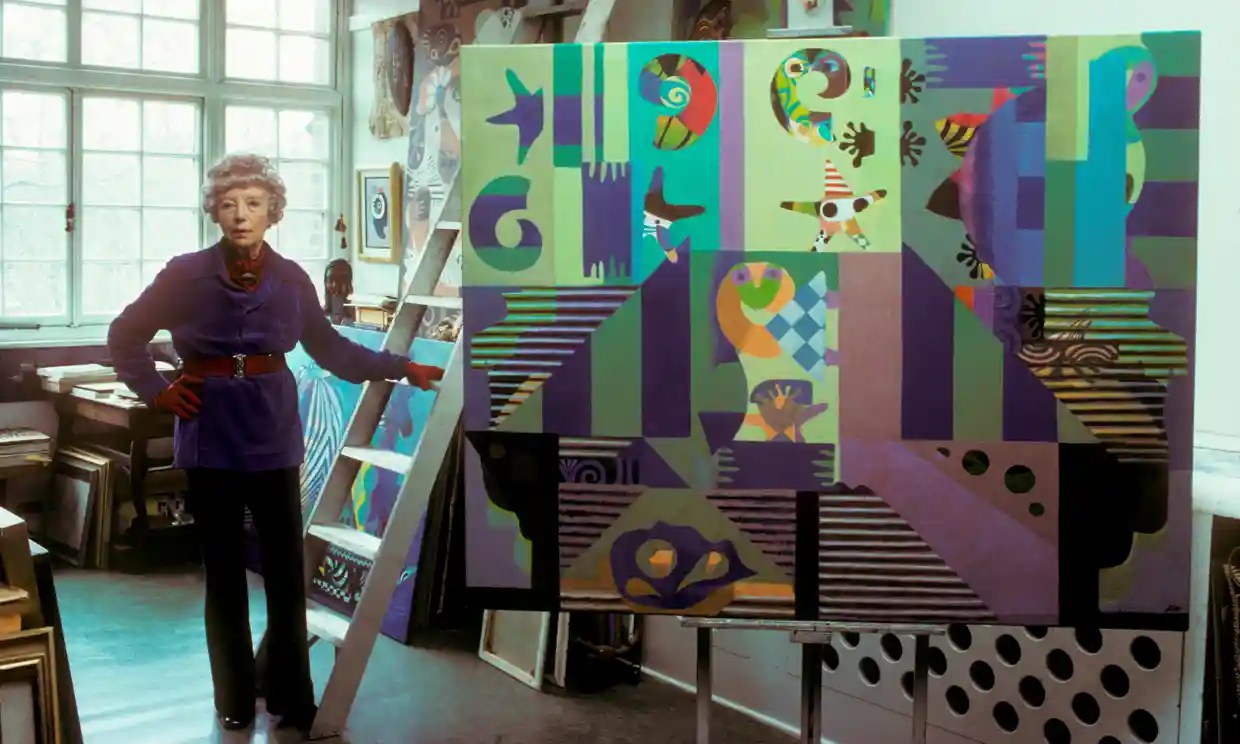
When I was a teenager, I kept a scrapbook of newspaper and magazine clippings, mostly relating to art, film, music and design. There was no particular theme, other than images that caught my eye. Sometimes, choices were triggered by things I had watched on TV, heard on the radio or seen at exhibitions. But there was one photograph which I cut out for no other reason than it mentioned Surrealism, featuring the artist Eileen Agar standing next to one of her paintings.

Eileen Agar in her studio, 1977 (Photo by David Reed) – Image sourced from The Guardian)

Although I had been interested in surrealist art for a while (probably thanks to ubiquitous reproductions of Dali and Magritte), I don’t think I had heard the name Eileen Agar, nor was I aware of having seen her work. That changed, somewhat, the following year, when I visited the major retrospective of Dada and Surrealism art at London’s Hayward Gallery, where she had several pieces on display. Yet, with such a huge exhibition, I don’t recall registering the name, nor making the immediate connection with the photo I had seen some months earlier.

A few years later, I was working for Kensington & Chelsea Council, where part of my role was to assist local residents with their housing problems. One day, I received a call from a woman who was concerned about her neighbour, whom she described as the “well-known artist, Eileen Agar”. The caller thought that Ms Agar needed some assistance with her accommodation, perhaps even relocating to somewhere more suitable. Following up the call, I duly contacted Ms Agar, but when asked about her housing situation, she replied “I’m fine, thank you, as long as I have enough light to paint by.” So I respected her wish not to be bothered or troubled by the Council.

By now, the penny had dropped, and I made the connection between the name Eileen Agar, her comment about “enough light to paint by” and the photo in my scrapbook – with its enormous studio window behind her.

Soon after, I was talking to some friends who were looking for ideas that would make good subjects for TV documentaries. I suggested a couple of topics, and happened to mention Eileen Agar, who by then was probably the last surviving surrealist artist who had been directly connected to figures like Picasso, Moore, Dali, Eluard, Breton, Man Ray, Penrose et al. Certainly, she was one of the few women included in the International Surrealist Exhibition of 1936.

Eventually, that idea turned into a documentary, called “Colour of Dreams” directed by Susanna White, originally broadcast in 1989. It formed part of Channel 4’s series “Five Women Painters”, with an accompanying book of the same name. Ms Agar was the only artist of the five still living at the time, and was guest of honour at the preview screening I was fortunate enough to attend.

Ironically, despite not receiving the same level of recognition that most of her male counterparts did during their lifetimes, Ms Agar attracted quite a lot of attention in her final years. Apart from being included in the TV series, she was the subject of a significant retrospective exhibition, and published her autobiography, before she passed away in 1991.

On my first visit to Auckland Art Gallery a few years ago, I was reminded again of that tangential connection, when I saw Ms Agar’s mixed media collage called “Tree of Knowledge”. Within the context of a modest collection of European surrealism, this was a significant work, and immediately recalled that original cutting.

(Sadly, unless it tours Australia, I won’t get to see the current Whitechapel show, “Angel of Anarchy”.)

Next week: Getting out of town

Goya – allegories and reportage for the modern age

Just prior to the latest COVID-related lock down in Melbourne, I managed to visit the exhibition of drawings and prints by Goya at the NGV. Although these works were produced 200 years ago, they are still relevant today.

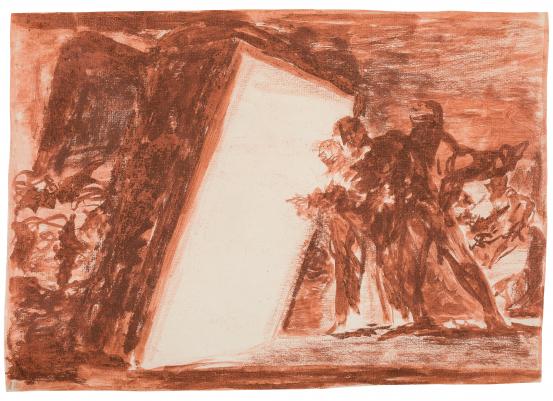
Goya: Two People Looking into a Luminous Room – Image sourced from NGV

Working at the time of the Enlightenment, and despite his status and reputation as a court painter, Goya still had to navigate the political oppression of both Spanish and French rulers, and the religious persecution in the form of the Inquisition.

His series of drawings and etchings reveal a very personal side to Goya’s work, combining allegory, satire, reportage, surrealism and the sub-conscience. The images provide a commentary on the horrors of war and its aftermath, while his domestic scenes on courtship, gold diggers and hapless suitors would not be out of place on Married at First Sight or The Bachelor… There’s a lot that’s familiar about these images.

The exhibition provide some insights into Goya’s working methods – from his use and development of preparatory drawings, to the different etching techniques he deployed to create the finished prints.

One drawing in particular caught my attention – a red crayon sketch entitled “Two People Looking into a Luminous Room”. It’s a remarkable image on a number of levels. The room of the title does not look like a typical building or structure. It almost resembles the bellows of a giant camera, except that photography had not yet been invented. Perhaps it refers to a type of camera obscura or similar device that Goya had seen? On the other hand, it could be a metaphor for Hell, a glimpse into the white heat of the Inferno. For me, it even suggests Goya’s prescience for the work of James Turrell. It’s a remarkable piece in an absorbing exhibition.

Next week: The Fall – always different, always the same