Bridging the Digital Divide

Is there still a digital divide in Australia? If so, how do we bridge that gap? If not, how do we address the apparent chasm that is leaving some “digital have-nots” behind? Is it as simple as rolling out the National Broadband Network and equipping every school child with their own tablet device? Or is it also about creating a digital mindset to ensure everyone can take advantage of the educational, social and economic opportunities that the range of digital technologies has to offer?
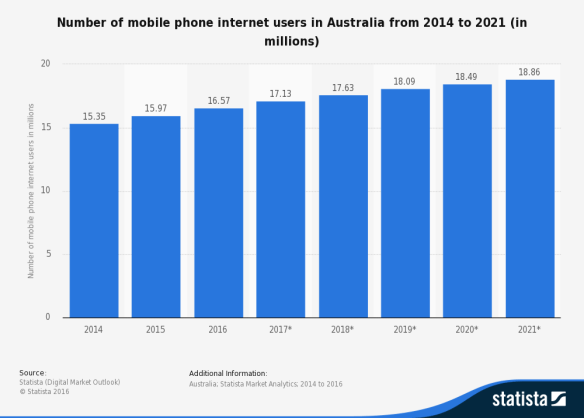
Mobile phone internet usage is projected to keep growing. Source: Statista

Mobile phone internet usage is projected to keep growing. Source: Statista

Based on consumer research, we would appear to be a well-connected country, with a high concentration of PC, smart phone and tablet devices, if data from Roy Morgan is any indicator. However, some recent research by Scott Ewing of Swinburne University based on ABS data has suggested that despite the narrowing of the divide, there is a deeper disconnect among those who do not have internet access.

There are multiple factors contributing to this disconnect: socio-economic, age, location and education. I would expect that within 5-10 years, age will be a far less relevant factor in who does or doesn’t have access to the internet. You could also argue that with more people accessing the internet via mobile devices, and with the increasing number of free WiFi zones across our cities (cafes, shopping centres, office buildings), public institutions (libraries, museums and galleries) and transport infrastructure (plus the reducing price of data and storage), cost may not be as much of an issue either. And once the NBN is complete, the percentage of the population without physical access to the internet should likewise be much smaller.

So that leaves education – according to the ABS-derived data, the more educated you are, the more likely you are to access the internet. Should this infer that we aren’t doing enough to teach digital skills in the classroom? Or are we teaching the wrong set of skills? Or is it a bit like learning English grammar or applied mathematics – unless you use them in your everyday life, you soon forget them, and never remember why it was important to learn them in first place?

Computer science, programming and coding courses are increasingly being taught in schools, either as part of the core syllabus or as extra-curricular activities. Many pupils have to use tablets as an integral part of their school lessons. And some schools are also running hackathons and entrepreneurial projects to help students navigate the new world of work shaped by innovation, digital disruption and the “gig” economy.

The changing nature of work is challenging schools and parents to think about how we should be preparing pupils for the future. It’s not just learning about the technology (important as it is to study data analytics, automation, robotics, AI etc.), it’s also about understanding the context and the potential for what it can do. It’s also increasingly apparent that more and more of today’s students want to do work that is meaningful, rewarding, challenging and which helps connect them to their values and “purpose”.

I like to think that as part of a well-rounded liberal education, today’s pupils will receive:

  • a solid grounding in digital literacy (as important and as vital as the 3 R’s)
  • an awareness of how “digital displacement” (through automation etc.) may impact their chosen career path (even in ways which we cannot yet predict – we must assume it will happen, as no profession, trade or vocation will be totally immune)
  • an appetite for lifelong learning (as one of the ways to cope with the inevitable changes they will face)
  • a set of life skills that instill self-awareness, curiosity, resilience, empathy, flexibility and adaptability.

Finally, if we are to truly grasp why this ability to adapt and change is important, we only need look beyond the digital debate and ask why the National Innovation and Science Agenda is failing to cut through. In large part, the NISA message failed to connect with the general electorate because many people could not identify with it, and therefore it did not resonate with them. Just as “necessity is the parent of invention”, so adversity often needs to be the catalyst for embracing change.

Notwithstanding the economic, environmental and societal challenges we face, there is considerable complacency and acceptance that “she’ll be right” – especially within the political, institutional and corporate elites that claim to lead us. As long as so few of the main actors among these bastions of power and influence decline to change their own culture, behaviours and ways of doing business, then it’s not surprising that the public feels unwilling or unable to change.

So our only real hope is to empower the next generations to shape their own future, not to be constrained by our traditional notions of “job” (in my view, an increasingly outmoded economic unit of value….) and think for themselves as to what change they want to create with all the technology, resources and opportunities at their disposal.

Next week: My Extended Gap Year
The Day of the Mavericks – the importance of intrapreneurship

As part of my notes on Melbourne’s recent Startup Week, I mentioned an interesting discussion on “innovation from within”, and the importance of intrapreneurship. There has been a steady stream of articles on the rise of intrapreneurship, an often overlooked skill set or resource that all organisations need to tap into, harness and deploy successfully. But what does it take to be an intrapreneur, and where can we find them?

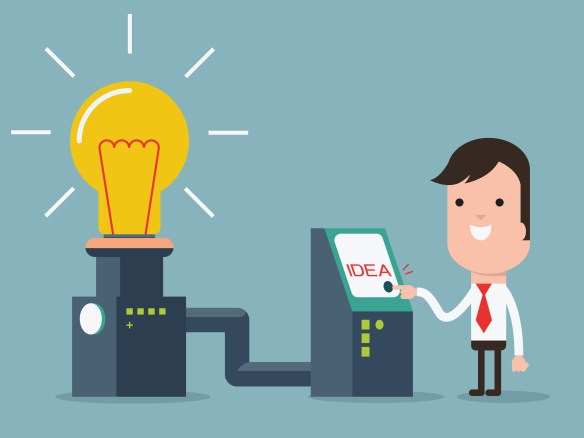
Idea Machine - image sourced from Vocoli

Idea Machine – image sourced from Vocoli

The panel discussion on “Innovation from the inside out” was mostly about what leaders are doing to foster entrepreneurial-thinking from within their own organisations, featuring Janet Egber (NabLabs), Phil Harkness (EY), Martin Kennedy (GE) and Liza Noonan (CSIRO). Much of this effort revolves around connecting individual purpose with collective purpose (team, organisation, society). For example, at EY, there is a program to “promote purpose-led transformation, grounded in humanity and a call to action”, while GE also places importance on purpose. CSIRO, meanwhile, is clearly undergoing some huge transformational change of its own, with a key focus on “making the treasure chest of ideas happen.” (For a couple of related blogs, see here and here.)

When asked about how to incentivize intrapreneurship, and how to prioritise efforts, Liza Noonan was of the view that the “grass-roots” of the organisation “give us permission” to pursue particular projects. While Phil Harkness talked about the need to develop appropriate career paths, and the importance of change management engagement.

In my own experience, intrapreneurs are likely to display a healthy mix of the following characteristics:

Curiosity – This is critical. If you don’t display any interest in what is going on around you;  if you don’t think about how things could be done differently, better or more effectively; or if you don’t care about how things work, you are unlikely to discover anything new or uncover new business opportunities. This is not only about formal technical skills, this is also about personal outlook. It’s not intended to be disruptive, but maverick thinking is often what gets results.

Creativity – While I am not a big fan of formulaic management methodologies, I do see some value in certain aspects of the Six Hats model – of which Green for Creative Thinking is key here. As well as being a vital part of ideation and innovation, having a creative mindset (coupled with innate curiosity) is essential to problem solving – especially when it comes to “what if?” scenarios, and joining the dots between seemingly disparate data.

Commercial – Intrapreneurs don’t need to be financial wizards, or be the best sales people – but they need to be grounded in the commercial realities of how businesses work, how markets develop, what customers think, and what it takes to launch a new product or service. Being open and receptive to customer feedback is essential, along with an ability to manage solution sales and consultative selling.

Uncertainty – Being comfortable with uncertainty, and learning to be resilient, flexible and adaptive are essential to the intrapreneurial mindset. This may include a different approach to risk/reward models, as well as being able to look beyond the normal business plan cycle into the “unknown” of the future.

Scepticism – Having a healthy degree of doubt and not falling prey to over-optimism can help to manage expectations and enthusiasm built on irrational exuberance. We know most new ideas never get off the whiteboard (which is OK!), so the skill is to challenge everything until proven, but in a constructive, pro-active and collaborative way.

The key to intrapreneurship is being able to find your role or niche in the organisation, from where you can develop your expertise, establish your influence and build a foundation for solid outcomes. While at times it can feel a bit like “right person, right place, right time”, there are strategic steps you can take to manage your own career as an intraprenuer, including networking, self-directed learning, volunteering for new projects and taking responsibility for fixing things when they go wrong, even if they are outside your immediate responsibilities. It’s these sorts of behaviours that get noticed.

I know from personal experience that being curious and asking the right questions can lead to exciting new opportunities (in my case, six years in Hong Kong to establish a greenfield business). I also value the advice of a senior colleague soon after I joined an organisation: “You need to be part of the solution, not be part of the problem” when it comes to organisational change. And some of the best indirect feedback I ever received was from a colleague who introduced me to a new hire: “This is Rory, he’s our lateral thinker”.

Finally, it’s not always easy or comfortable to challenge the status quo from within (which is what a lot of intrapreneurship involves). Intrapreneurship can also feel lonely at times, which is why it’s vital to make the right connections and build sustainable relationships because, in army terms, you don’t want to get a reputation for being part of the “awkward squad”.

Next week: “Language is a virus” – a look at coding skills

#StartupVic launches new-look #pitch event

The team at Startup Victoria have been working hard over the summer: not only have they brought on a whole bunch of new commercial sponsors, but they have also launched a new format for their pitch nights. The idea is to invite startup founders to register their interest in pitching to a panel of judges. The contestants get the opportunity to compete in front of a live audience, for a chance to win face time with local VC’s, along with some other startup goodies.

global_446720634It’s not Shark Tank (there’s no hard cash on offer), nor is it an open mic night (there is a pre-screening and audition process) – but it does enable entrepreneurs to test their pitch, get some early exposure, and receive some great feedback and advice. It also doesn’t matter what stage the startups are at, although businesses that already have some market traction or have built and tested an MVP are probably in a better position to compete.

The launch night saw pitches from four startups, who are at various stages of development. In no particular order they were:

Ad Hoc Media with Passenger Pad, a digital Out Of Home advertising medium for taxis, using interactive touch screens inside the cab. To date, there has been a low take-up rate of this technology by the taxi industry in Australia, mainly due to regulatory issues, but the landscape is changing. With a background in taxi electronics and hardware, the founders are about to launch with 400 taxis in Melbourne, and plan to expand to other cities. There is no doubt that using a combination of passenger, location and fare data (duration, time of day, pick-up and drop-off points), the screens will be able to offer brands and their media buyers targeted audiences and in-depth customer analytics. The challenge will be to offer advertisers a competitive rate card, especially as this is essentially a new medium: it offers viewer choice like TV, can serve up targeted content like web or mobile, and is ideal for special offers linked to location and time of day.

Global Patient Portal offers a free platform for e-health records. Having already launched in Kolkata, India with 40,000 users signed up in 11 weeks, GPP is aiming at lower socio-economic communities and emerging markets. The initial business goal is simple: to support ownership of e-health records by users. Using a combination of bootstrapping and NGO funding, GPP has been able to hire a team of “scribes” in India who sit in on patient consultations and capture the medical notes, which can then be referred to at the next consultation. (Currently, a lot of time and resource is wasted because patient records are captured on paper, which is easily lost once the patient leaves the clinic.) Commercial revenue will come from selling anonymized patient data (subject to legal compliance, privacy obligations and data accuracy) for research and policy planning purposes. In choosing to launch in Kolkata, GPP was aware that in some more affluent urban communities in India, the favoured means of patient communication is WhatsApp?, so they would be less likely to adopt a separate platform. Also, in Australia, having talked to GPs about the various government attempts to establish the e-health system for patient records, I am aware of a reluctance within the medical profession to buy in to the scheme: first, there is no financial incentive for them to capture patient data via a common e-health platform; second, why would they want to share patient data with their competitors?

prevyou is aiming to disrupt a large part of the recruitment and job ad market, by directly connecting students with job opportunities at SMEs. The two-sided market effectively crowdsources available jobs from SMEs, who typically do not have access to the hiring market or to full-time and dedicated HR resources. The goal is to streamline the hiring process, and to offer a mix of standard and premium services (e.g., video resumes, applicant screening, skills matching, personality profiling etc.) and later to add validation of applicant credentials and qualifications. In return, the business will take a commission once a job has been offered and/or candidate hired. While the focus is initially on capturing the market for casual and part-time jobs, the judges urged them to look at the enterprise HR market (under an outsourcing or white label model?). Looking ahead, there is the opportunity include student internships (although, like the legal issues with Year 10 work experience, internships and placements present additional challenges such as achieving student learning outcomes and other employment law issues).

OurHome is an app to help families manage, share and track household chores, so that children learn to take some responsibility around the house, and they can get rewarded for their contribution. It emerged out of an earlier app, Fairshare, that was aimed at shared houses. Apparently, people living in shared houses don’t care enough about whose turn it is to clean the bathroom, or are happy with paper charts and lists on the fridge door. Describing itself as “an integral household tool with indirect network effects (i.e., like Google, not Facebook)”, OurHome also claims to be the #1 chores app. Using advanced algorithms, and other features such as customisation and Dropbox integration, the app also introduces an element of gamification through rewards (intrinsic and extrinsic). For busy families, it replaces those fridge notes and task charts (although, as the judges noted, there’s no calendar yet). Of particular interest is the very positive feedback the team have had from families who have children with ADD.

Despite a few technical glitches (concerning mics and audio quality), the first new-look pitch night was a success, and Global Patient Portal won the on-line audience vote. I was luck enough to meet with one of the teams a few days later. They thought it was a useful experience, but they hadn’t quite known what to expect, and they had anticipated more of a grilling from the judges and tougher questions from the audience.

Next week: More In The Moment


Technology vs The Human Factor

Several times over the past month I have been reminded that the pursuit of technology for its own sake can give rise to misguided innovation; so-called solutions that are divorced from real world problems cannot justify the effort or resources. It feels like we are entering a new phase of the post-industrial revolution era, where a lack of “the human touch” will render many new inventions as worthless, irrelevant or redundant.

Street scultpure, Nagoya. Photo © Rory Manchee (all rights reserved)

Street sculpture, Nagoya. Photo © Rory Manchee (all rights reserved)

In no particular order:

  • At the second Above All Human conference in Melbourne, there was a consistent theme: how do we make sure there is a real connection between human needs and bleeding edge technology?
  • A Slow School of Business excursion to an eco-friendly homestead in rural Victoria offered a practical lesson on how to create harmony between technology and nature, and still achieve a modern (but modest), highly personal and comfortable home.
  • The economic debate about whether technology is improving our standard of living (as reported in the latest CPA magazine), which also echoes a recent CEDA report on automation and the implications for job losses.
  • A Q&A with Shayne Elliott, the new CEO of ANZ Bank, which prompted the observation that big data analytics, process automation and digital disruption are all very well, but will prove meaningless unless they can improve the customer experience. (But Elliott also conceded that the likes of Uber and Airbnb have succeeded because of complacency among industry incumbents.)

Advances in technology don’t have to lead us to the dystopian worlds of “Modern Times” or “Metropolis” (or any of the other post-apocalyptic visions that cinema and literature like to give us). However, the understandable focus on innovation must take the “human factor” into greater account when making design decisions, undertaking cost-benefit analysis and opting for one technology format over another.

Conclusion? It’s not totally clear whether we are entering another dot.com market correction, but there is a case to be made for whether or not we are seeing enough of a “technology dividend” from the current digital disruption and economic displacement centred on the use of cloud, social and mobile platforms; and whether we need a new methodology to measure the impact of the Internet of Things, robotics, AI, nano-technology, AR/VR, cognitive apps, wearables, 3-D printing, etc.

Next week: It’s never too late to change….