All that jazz!

I’d be the first to admit I’m a music snob. Not that I think my tastes are better than anyone else, just that they are very particular. I like to think I have an informed opinion about the listening choices I make.
When I went to university, I was asked if I had any preferences about whom I shared student accommodation with. “No heavy metal freaks or jazz buffs”. I’ve still not changed my opinion of heavy metal, but my attitude towards jazz, like my appreciation for red wine, has only improved with age.

Not all, jazz, mind. Two words that strike dread in me are “gypsy jazz” – along with trad, dixieland and rag time, I find it most of it too fiddly, over-ornate, bordering on cheesiness. Similarly, for me, listening to “smooth” artists like Kenny G is akin to wading through treacle. There are certain instruments that I find very difficult to stomach in a jazz context – trombone, soprano saxophone, violin and acoustic guitar. And the big band sound is something I can only endure very selectively. Much of what is labelled fusion also leaves me cold, although I do make an exception for Soft Machine.

I suppose my point of entry is post bop, along with modal and free jazz. And while cool jazz can take itself far too seriously, at least it generally doesn’t fall into the trap of virtuosity for its own sake. (I’m always reminded of the criticism of Mozart attributed to Emperor Joseph II – “too many notes!” – when it comes to the noodly end of the jazz spectrum.)

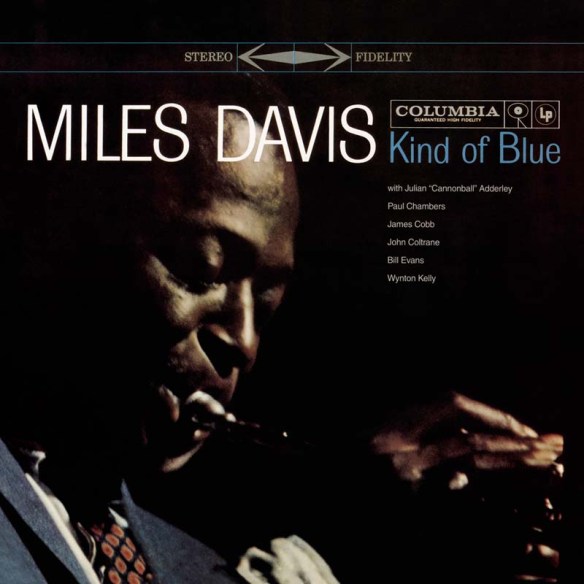
Like many people, one of my first real engagements with jazz was Miles Davis’s “Kind of Blue”. As a self-contained statement on “modern” jazz, it still astonishes with each listen. Despite its ubiquity, I never tire of hearing it. (In point of fact, the first Davis album I sought out was “In A Silent Way”, after it was used as a reference point in a review of A Certain Ratio’s debut album. Strange but true.) I’ve since come to appreciate the full canon of Davis’s work, although I have never warmed to his final records, recorded for the Warner Brothers label. His albums are often grouped into specific periods, rather like Picasso’s art, which only adds to his status and legacy.

At various times, my personal journey (and at specific stages in their careers) has encompassed Thelonious Monk, Modern Jazz Quartet, John Coltrane, Oscar Peterson, Ornette Coleman, Herbie Hancock, Pharoah Sanders, Alice Coltrane, Nina Simone, Stan Getz, Keith Jarrett, Freddie Hubbard, Wayne Shorter, Ahmad Jamal, Mulatu Astatke, Sun Ra, Chet Baker, Antonio Carlos Jobim, McCoy Tyner, Eric Dolphy, Hank Mobley, Joe Henderson, Cecil Taylor, Marion Brown and Albert Ayler.

In terms of newer and contemporary artists, the only one who has managed to sustain my interest is Brad Mehldau, in particular his live solo performances – where he seems to have picked up from where Keith Jarrett left off in the 1990s.

And as I get older, I find that the only music radio station I can listen to is ABC Jazz….

Next week: Wholesale Investor’s Crypto Convention 

Modern travel is not quite rubbish, but….

OK, this might be a first world problem – but where has the glamour gone in modern travel? I’m fortunate enough to have the opportunity to travel for work – however, so much of the pleasure has gone out of the experience.

“They promised us cocktail bars…” (image sourced from Australian Business Traveller)

Of course, safety is paramount, and increased surveillance, screening and security checks are to be expected, if not actually welcomed. So we are all accustomed to allowing extra pre-boarding time to clear each stage of the process. It also makes sense, I suppose, that each airport has slightly different requirements – but the need for variety should not be an excuse for inefficient systems, poor directions from airport staff and a lack of clarity on what is expected of passengers.

There’s also the issue of how much actual time to leave to clear pre-boarding – up to two hours or more for some international flights. Then there’s the challenge of being in transit – in recent months, I have found myself on more than one occasion having to run from one terminal to another, even though the airline has assured me there was plenty of time between connecting flights. The implication being, passengers will have to endure even longer stopovers…

It also seems that about 40-45% of flights I have taken over the past couple of years have not departed on time. Sure, things like weather conditions can cause schedules to be impacted, but how many times have you heard the mealy-mouthed announcement: “we apologise for the delayed departure of this flight – this was due to the late arrival of the incoming aircraft.” And the reason the incoming flight was late? Never a mention.

Often, the pilot is able to make up for lost time – which makes you wonder how much “fat” is built into airline schedules? And then so many times the arrival gate is not available, or the air-bridge is not in place, or the passenger steps are not ready…

And as for waiting to collect your luggage off the belt, the usual delay is just another factor contributing to customer frustration. No wonder passengers try to take as much cabin baggage with them as possible – which only adds to the boarding and disembarkation time.

I could look at some of the positives, in things like catering and on-board entertainment. Overall, airline food has become rather more acceptable than my experiences of charter flights in the 70s and 80s; and passenger preferences and dietary requirements are accommodated – that is, where food is available and included in the price of a standard ticket. But at times I’m reminded of the story that the only reason airlines offer meals is to keep passengers in their seats during the flight.

Which is probably why in-flight movies were introduced….  an area where airlines have managed to lift their game, in terms of the variety of content, quality of devices, and personalised, on-demand service.

But have you noticed the trend for travelogues masquerading as in-flight safety videos? Or the comedy routines? Or the big-name stars? No doubt an attempt to gain passenger attention, and get them off their mobile devices for a few minutes. How realistic are these safety films? Rarely are they made to show the exact cabin layout or filmed from the actual passenger perspective. (The films reveal far more generous leg room than most passengers experience.) If you don’t think these pre-take-off instructions are that important (or if you believe that most passengers must already know what to do), consider this: during a recent fatal air accident, mobile phone footage showed so many passengers wearing their oxygen masks incorrectly – despite the number of times they must have sat through the safety screening.

I’ve often thought that before long, with all the safety and other factors, the only way we will be able to travel by air is either naked, or comatose.

Next week: All that jazz!

MoMA comes to Melbourne

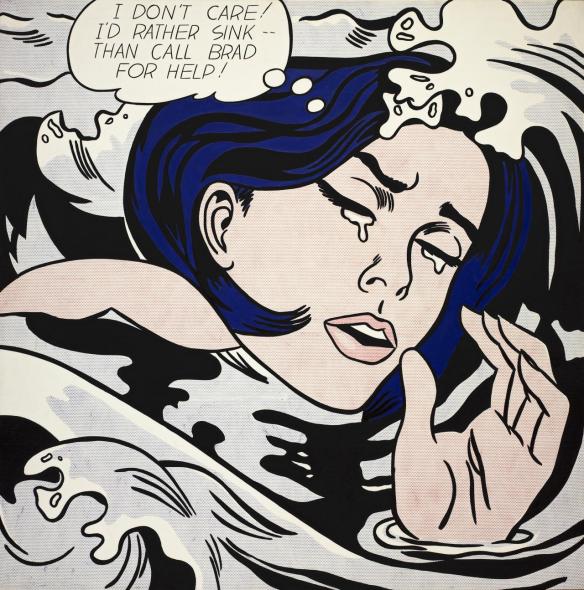
For its current “Winter Masterpieces”, Melbourne’s NGV International gallery is displaying around 200 works from MoMA’s permanent collection. And a finely selected, and well-curated exhibition it is. But this focus on the received canon of mainly 20th century European art has the inevitable effect of sidelining other eras/schools – and perhaps overlooks the importance of Australia’s own art movements.

Roy Lichtenstein (American 1923–97): “Drowning girl” (1963 – oil and synthetic polymer paint on canvas, 171.6 x 169.5 cm); The Museum of Modern Art, New York – Philip Johnson Fund (by exchange) and gift of Mr. and Mrs. Bagley Wright, 1971
© Estate of Roy Lichtenstein/Licensed by Copyright Agency, 2018

The NGV International display presents the work in a broad chronological sequence, but specifically collated by reference to key movements, themes and styles. It also takes in print-making, photography, industrial design, graphics and illustration, not just painting and sculpture.

Even though I have visited MoMA many times, and seen the bulk of these works in their usual setting (as well as when they have been on loan to other galleries), there were still some surprises – like Meret Oppenheim’s “Red Head, Blue Body”, which I don’t recall seeing before. And Salvador Dali’s “The Persistence of Memory” always feels like it is much smaller than the ubiquitous reproductions and posters imply.

Of course, one of the benefits of presenting a survey of modern art like this is that it affords us the opportunity to re-assess and re-calibrate the works within a contemporary context. Both to find new meaning, and to compensate for the over-familiarity that many of these images convey. While at times, we have to separate the artists’ lives and times from the legacy of their work – the changing conventions and social mores of our contemporary society cannot always be used to judge the behaviours, values or common prejudices that were acceptable 100, 50 or even 25 years ago.

Meanwhile, over at NGV Australia, there is a reconstruction of the exhibition that marked the opening of the gallery’s new building in 1968. In “The Field Revisited”, we have a fascinating opportunity to experience a slice of Australian art that feels over-looked and under-appreciated – ironic, given that at the time, this exhibition revealed the cutting-edge nature of young artists working in Australia, and divided opinion among established artists and the art establishment. “Where are the gum trees, where are the shearers, where are the landscapes, where are the figurative images?” might have been the refrain in response to this startling collection of bold colours, geometric designs, psychedelic undertones, modern materials, and unorthodox framing.

The fact that far more people are flocking to see the MoMA collection (and it is worth seeing), than are visiting the re-casting of The Field sadly confirms that Australia’s cultural cringe is alive and well….

Next week: Modern travel is not quite rubbish, but….


Bad sports

This past weekend saw the culmination of two major sporting events – the Wimbledon Championships and the FIFA World Cup. Both tournaments featured some amazing matches and some outstanding results. They also were largely free of the player tantrums and unprofessional conduct that often besmirch these occasions. In fact, the number of red cards issued at Russia 2018 was the fewest for 40 years. At the risk of ruffling a few feathers, it feels such a shame that much of Australian professional sport appears to be out of step with this broader mood.

Australian sporting prowess is something of a national (if not economic) obsession. After every Olympics, there is a post mortem on how many (or few) gold medals Australia wins compared to the amount of tax payer money invested in elite athletes. (It is sometimes said that the job of Prime Minister competes for importance with that of captaining the Australian cricket team.)

Sadly, the desire to win at any cost, or to do whatever it takes to succeed, has had some serious and negative consequences in recent times. Whether it’s the Australian cricket team (playing the game their way – by “headbutting the line”…), certain Australian tennis players (competing only when and if it suits them), or the national basketball team (taking matters into their own hands….), there is an uncomfortable sense of entitlement among some sports professionals.

In the wake of the Test Match ball tampering incident, there was a considerable amount of Schadenfreude – as if the Australian cricket team had got their comeuppance. If the history of on-field sledging and the boorishness of their coach had not been enough to tarnish the reputation of the national side, “tampergate” was the final straw.

My own first exposure to a key part of Australian sporting culture was age 10. I had recently moved here from the UK, and the English cricket team had just won the Ashes, the first time for many years (a familiar pattern for their long-suffering supporters). Such was the impact of this apparent shock to the Australian psyche that at school, I was called a “Pommy bastard”. The irony is that up until that point, I had no interest in the Ashes – thereafter, I resolved to support England ….and any team playing Australia.

Next week: MoMA comes to Melbourne