Unstructured Hours

Since I left my last corporate role more than 10 years ago, I have not had a full-time, permanent job; instead, I have worked as a freelance, independent consultant and contractor, for a variety of organisations, and in multiple roles. I’ve not had a “regular” 9 to 5, Monday to Friday job, so it’s meant some adjustments and compromises: I don’t get a regular salary, or sick leave, or holiday pay, or employer pension contributions; but I have flexibility as to where/when/how I work, who I work for, and what projects I take on.

Talking to a business associate recently, who is in a similar position, he defined his current status as “unstructured hours”. I think this applies to my own situation, and it made me think that more and more people are in the same boat, but for different reasons.

First, the gig economy has flourished in the last 10 to 15 years (a trend that began well before ride share and food delivery services came along), with the growth of tech-based freelance work in the software industry and creative services, thanks to on-line market places and accessible productivity tools. So, people are less likely to have fixed hours.

Second, the pandemic and associated lock downs revealed a significant divide between those who are able to work from home (WFH), and those who can’t. For those employees who continue to WFH, the separation of work and non-working hours has become increasingly blurred, with the proliferation of remote working and accompanying tech that means we are “always on”. Add to this the global nature of remote working (and “work from anywhere” policies) it means that even different time zones are no longer a barrier to cross-border employment and collaboration.

On the other hand, WFH has meant that some employees have become more efficient and/or productive, especially when commuting time is reduced. More companies are experimenting with remote working, hybrid working (a mix of WFH and on-site), and even a shorter working week. Parkinson’s law states that a given task expands to fill the time available – something that can become pervasive with enforced on-site office hours, so if employees are effectively choosing the hours they work, they may be incentivised to work smarter, and free up their time for other pursuits.

Third, for employees who still need to attend their place of work to perform their duties in person (health care, hospitality, retail, logistics, manufacturing etc.) many of them work shifts, which in itself requires some significant restructuring of daily and weekly routines, albeit not totally “unstructured” hours. And given our voracious appetite for on-line shopping, all-day deliveries, and access to 24/7 services, shift workers are having to respond to employer demands for a flexible and on-demand workforce.

Fourth, the “always on” phenomena means that it’s easy to erode the boundaries between work and personal life, with the consequence that we are now seeing the introduction of “Right to Disconnect” legislation. This will require careful navigation. What about employees who are required to be on call, even if they are not on site? How will this legislation be reflected in client contracts and service level agreements, especially when there may be penalty clauses and similar provisions? Who determines what is “reasonable”?

When I was in corporate roles, there were always requirements for weekend and over night travel, early morning and late night conference calls, lengthy overseas business trips, and deadlines outside the 9 to 5 routine. Even early on in my career, working in the public sector, I was required to attend evening council meetings and public events. So perhaps I’ve always experienced an element of unstructured hours?

Achieving and maintaining a work-life balance means setting time-based boundaries, managing expectations with clients, and above all, prioritising tasks and projects. It also means establishing routines, so that when we are “off”, we don’t feel any guilt.

Finally, the notion of working within “unstructured hours” may become second nature as more and more people embark on portfolio careers. The ability to juggle multiple roles, as well as remaining flexible to changing demands on our time, will be a prerequisite for anyone working outside the “traditional” 38 hours a week schedule.

Next week: Triennial? Could try harder!
More on Purpose

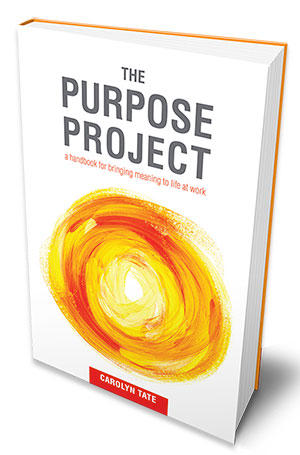
Regular readers may be familiar with the name Carolyn Tate from my previous blogs on purpose, and the Slow School of Business. Last week, Carolyn launched her latest book, The Purpose Project, a distillation of the past seven years of her work, and quite possibly a road map for anyone wanting to take control of their own destiny at work.

I would describe The Purpose Project as a cross between a first aid kit for a disillusioned workforce and a survival guide for the modern workplace. But as with defining your own “purpose”, the value is in the mind of the reader, rather than in any prescriptive solution or outcome.

Having spent the past few years working with Carolyn at Slow School, I know that her views on this topic have subtly changed. Slow School itself initially appealed to, and was designed for, independent consultants (“solopreneurs”) and aspiring consultants (“corporate escapees”). But as the concept of finding purpose in our work has started to take hold, Carolyn now encourages her readers to find their own purpose where they are, rather than rushing headlong into a new job, a new company, a new career or even into entrepreneurship (which as we know, isn’t for everyone).

I first connected with Carolyn at the Slow School, when I was exploring my own purpose as an independent consultant (and sometime corporate escapee….). Slow School provides a community of like-minded souls with a “safe” space to test new ideas, a playground to kick around new concepts, and an environment to challenge our own assumptions. Unsurprisingly, a key part of The Purpose Project is a list of 50 questions designed to help readers dig deeper into their own purpose, modeled on the Japanese concept of ikigai”. There are also some tools and practices to bring purpose to life in our current work.

In my own case, I still think my purpose is a work in progress, and is never settled – much of my career has been driven by a need for new ideas and experiences, work that is intellectually stimulating, and a willingness to engage in continuous learning (while feeding an enduring curiosity and maintaining a healthy dose of skepticism). These factors, even more than formal qualifications or faddish management theories, have helped me to build resilience and navigate a rapidly changing work environment.

One point where I may disagree with Carolyn is this notion about finding purpose through staying in your current role or workplace – that it’s not necessary to leave. While I agree that it may be possible to reshape your current job to suit your personal needs and preferences, staying in an unrewarding job or remaining with an organisation that does not value you is like persevering with an unhealthy relationship.

In short, I’m quite pessimistic about the ability for large corporations and large institutions (as they are currently framed and constituted) to help us connect with our individual purpose, or even to provide the space to do so. And of course, rapid changes in the very nature of work, the way we work, the economic structures and business models that have traditionally underpinned employment and the value exchange of labour require us to take more control over where, how and with whom we choose to spend our working time.

Next week: Agtech Pitch Night at SproutX


Tribute

It’s two months since my father passed away, and nearly a year to the day since he went into hospital for scheduled heart surgery. Sadly, although the operation itself appears to have been a success, the ordeal seemed to trigger a whole series of complications and underlying conditions: within 6 months he was admitted to a dementia ward, and by late last year, he was in a nursing home undergoing palliative care. Less than three months later, he passed away, the shadow of his former self.

I was able to spend several weeks back in the UK over Christmas and New Year, visiting him up to three times a day. Most of the time, he was living in his own little world, and I would simply sit with him and listen to some of his favourite music, mainly baroque and opera. But in his lucid moments there were flashbacks to the distant past, and some recollections of more recent memories. On one occasion, even though he had lost most of his capacity for speech, he did manage a sage piece of advice: “Don’t play with fire”.

More recently, I was in the UK again to scatter his ashes and help sort out his study and his workshop. Memories of impromptu DIY lessons came flooding back. There were also several quirks and surprises in his personal archive: photos of him at management conferences in the 1970s and 1980s, a scrapbook of his time in Germany in the late 1950s during National Service (including some chilling images of Belsen), and a spreadsheet showing his annual income and income tax right up to his retirement.

Although he was fortunate in being able to take early retirement in his late 50s, he spent the next 25 years volunteering, building a portfolio of interests and serving on multiple committees for the arts, small business, veteran affairs, U3A and other community projects. My mother likes to joke that he’d rather chair a committee than mow the lawn. He also continued to learn, and I found recent certificates of proficiency for speaking German, and for formatting Word documents (very handy for writing up agendas and minutes).

He was the product of a classic liberal education, not a polymath, but possessing a solid knowledge about lots of different things: the arts, politics, language and history as well as science and technology. All the things you need to solve The Times crossword.

There are probably three key things that my father taught me:

  • Think for yourself
  • Don’t follow the herd
  • And of course, being an engineer, don’t take something apart unless you know how to put it back together again.

The latter is particularly useful when working with clients on their business reviews!

Next week: Music Streaming Comes of Age

Putting a Price on Value

In the course of my consulting work, I often work with clients (who are themselves consultants and service providers) to review their pricing models. The goal is to help my clients clarify what they are charging for, to ensure that both they and their own customers are comfortable with the price. What often emerges is that on its own, “time-based” pricing is becoming harder to justify, unless there is a clear understanding of the resulting value created and transferred.

adding-valueAmong some of the major consulting and professional service firms, there is a growing awareness that pricing based on billable hours alone is no longer sustainable. This in turn is forcing firms to review how they put a price on their work. They recognise the need to shift from billing clients for “time and materials”, to generating license fees and royalties for the use of proprietary IP, and to offering “XaaS” models that comprise a blend of “always on” retainer and actual service delivery, neither of which is wholly based on time or effort spent.

At the same time, many input costs are actually decreasing:

  • Reduced staff overheads via offshoring and outsourcing
  • Cheaper technology (although we consume more of it)
  • More open source tools and freeware available
  • Ubiquity of BYOD
  • Greater use of remote working, telecommuting and hot desks

What this means for the clients I work with is that they need to have a better grasp of the amount of effort applied and the level of expertise they deliver to their customers. If there are significant parts of the project costs that have to be measured by actual time spent, then it is important to make sure that the customer understands the effort required.

How else can consultants and professional service firms demonstrate value, other than by billable hours alone?

To begin with, clarify exactly what the customer thinks they are paying for. There can be nothing worse than consultants spending most of their time and effort on tasks or activities where the customer does not see a material benefit, or which the customer does not value.

Clearly, if there are measurable and quantifiable outcomes for the customer, then that is a good basis for demonstrating value. For example, direct cost savings to the customer, or reduced opportunity costs in terms of time to market or other factors. However, it may be harder to demonstrate the direct benefit of some qualitative outcomes, at least in the short term.

Some pricing models include a consultant “success fee” coupled to a share of revenue, profit or costs savings (which can be high-risk for consultants if they have no control over the implementation and execution). Other consultants are working with their clients to co-create products and services, which can generate standalone revenue streams from the shared IP. Others are adopting more collaborative approaches to consulting which build long-term value through the quality and nature of the relationships which are more like partnerships than transactions. This can remove the customer’s anxiety that the “meter is always running”, although such arrangements still require expectations to be managed through agreed boundaries and clear rules of engagement.

One model I use with clients is to figure out the nature (as well as the amount) of the value they are being asked to deliver, based on why the customer is buying, as much as what they are paying for. Some of the factors to consider include:

  • Risk mitigation – is the customer in effect buying an insurance policy, transferring their own risk, or reducing their exposure to risk?
  • Must have – is the customer having to meet a regulatory or compliance obligation?
  • Best practice – does the customer aspire to be among the best in their industry?
  • Competitive advantage – is the customer getting something unique or hard to replicate?
  • Peer pressure – does the customer need to meet a recognised standard or level of competence?
  • Situational – does the customer need to build or acquire appropriate skills and capabilities?
  • Urgency – is the customer willing to pay more for a speedier service? (This is one area where time-based pricing can still be relevant!)

It’s also important to understand how customers are funding their purchase. For example:

  • which cost centre is paying for the service?
  • what is the purchasing criteria?
  • what cost/benefit analysis has been done?
  • is there a specific budget allocation, or is it coming out of existing operating costs?

Of course, consultants are frequently hired to bring an alternative (and sometimes critical) perspective to their clients’ problems. In which case, getting an external opinion has value in itself, and the customer should accept there is a cost associated with having access to someone else’s brain – even if it is only for a few hours.

Finally, for an alternative perspective, I would refer to recent comments made by Ash Maurya (author of “Running Lean”, and creator of Lean Canvas) when he was in Melbourne. Talking about how to scale startups, he made the observation that, “selling time [as a consultant] is not scalable … There’s only 24 hours in a day.”

Next week: Food for thought at #StartupVic’s #pitch night