What might we expect in 2017?

On a number of measures, 2016 was a watershed year. Unexpected election results, fractious geopolitics, numerous celebrity deaths, too many lacklustre blockbuster films, spectacular sporting upsets (and regular doping scandals), and sales of vinyl records are outpacing revenue from digital downloads and streaming services. What might we expect from 2017?

Detail from "The Passing Winter" by Yayoi Kusama (Photo by Rory Manchee)

Detail from “The Passing Winter” by Yayoi Kusama [Photo by Rory Manchee]

Rather than using a crystal ball to make specific predictions or forecasts, here are some of the key themes that I think will feature in 2017:

First, the nature of public discourse will come under increased scrutiny. In the era of “post-truth”, fake news and searing/scathing social commentary, the need for an objective, fact-based and balanced media will be paramount. In addition, the role of op-ed pieces to reflect our enlightened liberal traditions and the need for public forums to represent our pluralist society will be critical to maintaining a sense of fairness, openness, and just plain decency in public dialogue.

Second, a recurring topic of public conversation among economists, politicians, sociologists, HR managers, career advisors, bureaucrats, union leaders, technologists, educators and social commentators will be the future of work. From the impact of automation on jobs, to the notion of a universal basic income; from the growth of the gig economy, to finding purpose through the work we do. How we find, engage with and navigate lifelong employment is now as important as, say, choosing high school electives, making specific career choices or updating professional qualifications.

Third, the ongoing focus on digital technology will revolve around the following:

  • The Internet of Things – based on a current exhibit at London’s Design Museum, the main use cases for IoT will continue to be wearable devices (especially for personal health monitoring), agriculture, transport and household connectivity
  • Fintech – if a primary role of the internet has been for content dissemination, search and discovery, then the deployment of Blockchain solutions, the growth in crypto-currencies, the use of P2P platforms and the evolution of robo-advice are giving rise to the Internet of Money
  • Artificial Intelligence – we are seeing a broader range of AI applications, particularly around robotics, predictive analytics and sensory/environmental monitoring. The next phase of AI will learn to anticipate (and in some cases moderate) human behaviour, and provide more efficacious decision-making and support mechanisms for resource planning and management.
  • Virtual Reality/Augmented Reality – despite being increasingly visible in industries like gaming, industrial design, architecture and even tourism, it can feel like VR/AR is still looking for some dedicated use cases. One sector that is expected to benefit from these emerging technologies is education, so I would expect to see some interesting solutions for interactive learning, curriculum delivery and student assessment.

Fourth, and somewhat at odds with the above, the current enthusiasm for the maker culture is also leading to a growing interest in products that represent craft, artisan and hand-made fabrication techniques and traditions. Custom-made, bespoke, personalized and unique goods are in vogue – perhaps as a reaction to the “perfection” of digital replication and mass-production?

Fifth, with the importance of startups in driving innovation and providing sources of new economic growth, equity crowdfunding will certainly need to come of age. Thus far, this method of fund-raising has been more suited (and in many cases, is legally restricted) to physical products, entertainment assets, and creative projects. The delicate balance between retail investor protection and entrepreneurial access to funding means that this method of startup funding is constrained (by volume, amounts and investor participation), and contrary to stated intentions, can involve disproportionate set up costs and administration. But its time will come.

Finally, as shareholder activism and triple bottom line reporting become more prevalent (combined with greater regulatory and compliance obligations), I can see that corporate governance principles are increasingly placing company directors in the role of quasi-custodians of a company’s assets and quasi-trustees of stakeholder interests. It feels like boards are now expected to be the conscience of the company – something that will require directors to have greater regard to the impact of their decisions, not just whether those decisions are permitted, correct or good.

One thing I can predict for 2017, is that Content in Context will continue to comment on these topics, and explore their implications, especially as I encounter them through the projects I work on and the clients I consult to.

Next week: The FF17 Semi Finals in Melbourne

The Startup of You v2.0

Through my blogs on startups, meetups and portfolio careers, I was recently interviewed by Peter Judd from News Corp., who is trying to bring the discussion on entrepreneurship, startups and innovation to a wider audience, particularly people who may be looking at a career change. (We both agree that the National Innovation and Science Agenda is not cutting through to the general public.)  Apart from being an advocate for portfolio careers, I also pointed out that entrepreneurship or working with startups is not for everyone. Instead, it may be possible to change your current role to the one you want. Alternatively, taking a new look at your current circumstances can provide some fresh perspective on finding your dream career.

Francis Kenna: The Unbearable Lightness of Seeing (2016) [Photo by Rory Manchee]

Francis Kenna: The Unbearable Lightness of Seeing (2016) [Photo by Rory Manchee]

The impetus following the 2012 publication of “The Startup of You” has done much to fuel the current entrepreneurial phenomenon, combined with lean startup business models and agile product development processes. The drive for innovation in response to digital disruption and lowering technology costs also means that launching your own venture can be increasingly de-risked.

For example, I recently saw some data by Ian Gardner from Amazon Web Services, that showed the “cost of failure” has come down from $5m to $5k, in just 15 years. This is based on a comparison between what it typically cost to launch a new business at the height of the dot.com boom/bust in 2000, and what it costs today. With a mix of open source tools, cloud computing, APIs, SDKs and social media platforms, launching a new business has never been cheaper or easier.

Of course, there is a paradox here: if an increasing number of people, especially younger graduates and new entrants to the workforce, are more interested in doing their own thing and less interested in joining large or established organisations, it’s going to get harder for employers to attract and retain the best talent; on the other hand, without appropriate experience, on-the-job training and personal development, how do these aspiring entrepreneurs acquire the necessary business, technical and leadership skills to succeed in their own ventures?

For some people, it may be appropriate to take their entrepreneurial spirit of adventure into a “traditional” role to test some of their ideas, as well as build networks and get some practical experience. Equally, I can see a huge opportunity for companies to create the right opportunities to engage employees for flexible roles aligned with specific projects or objectives (rather than plugging them into org charts). Companies are also finding new ways of tapping into their existing workforce to identify hitherto hidden and unknown skills and knowledge. Many employers also recognise that leadership roles will increasingly be filled by people who are comfortable with rapid change, increasing complexity and heightened uncertainty, as well as having enhanced soft skills. (There’s even some current thinking that utilising “rebel talent” is a good thing.)

Whether you are starting out on your entrepreneurial journey, looking to reboot your career, or searching for meaningful work that aligns with your values and purpose, there are numerous opportunities (via meetups, hackathons, pitch nights and networking forums) to explore your options before you make a decision. And for companies looking to re-invigorate your workforce and unleash hidden talent, there are many ways to experiment through taking informed risks, by building in-house innovation hubs, running consultative and collaborative workshops, and inviting ideas and inspiration from your existing people, who are familiar with the challenges you face.

Next week: Banksy – an artist for our times?

My Extended Gap Year

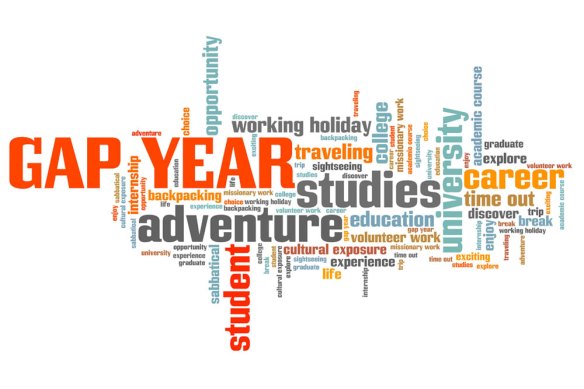
I was recently interviewed for a story about the Future of Work. One of the questions asked how I had arrived at my current portfolio career. As I reflected on the past few years of my working life, I realised that my ongoing journey resembled something of an extended gap year, because of the wide range of interests I have been exploring and the variety of projects I have been working on.

gap-year

Image sourced from Ivy League Admissions Club

During my “original” gap year between school and university, I was a postman, I volunteered at a community law centre, I worked in a bread factory, on a building site and at a law firm, and travelled abroad. My primary goals then were to get some “real” life and work experiences and think about what I might like to do as a career once I graduated. If nothing else, it showed me how to work with other people, develop some resilience and resourcefulness, and discover what I might be passionate about. And while my career went in quite a different direction to the one I had imagined, the gap year experience was an invaluable part of the learning process.

Since my last corporate gig, I have embarked on what feels to be a continuous personal development programme. Aside from undertaking some professional development, participating in hackathons, serving on advisory boards, guest blogging, co-presenting numerous radio shows, developing a prototype HR app, joining various Meetup Groups, and working with a number of startups and entrepreneurs, most recently I have been working in the digital asset space (Bitcoin, Blockchain etc.) and in innovation using design thinking and collaboration models.

As part of my extra-curricular activities, I have continued to explore various digital tools and platforms for composing, recording and distributing my music – I even wrote a piece for Melbourne’s Federation Bells which is on semi-regular rotation – and I have learned some practical skills in picture framing and constructing display boxes out of Perspex.

What this all adds up to is a continuous desire to keep learning, to keep exploring interesting stuff, maintaining a sense of curiosity and not standing still – stagnation is the death of creativity! And while I may not have imagined embarking on such a career path after working in senior corporate roles for many years, the current journey is varied, seldom boring, and frequently rewarding.

For anyone who may feel they are stuck in their current work, or cannot see where there career is going, I would encourage you to think about taking a “gap year” – to explore, experience and experiment with your career options, to challenge your current perceptions, to take yourself out of your comfort zone, and above all to embrace the potential for change. Even if this does not feel like re-inventing yourself, it should be an invigorating and rewarding experience – and I’m more than happy to share some of my own insights if you want to contact me via this blog.

Next week: Spaghetti in the Cloud


Bridging the Digital Divide

Is there still a digital divide in Australia? If so, how do we bridge that gap? If not, how do we address the apparent chasm that is leaving some “digital have-nots” behind? Is it as simple as rolling out the National Broadband Network and equipping every school child with their own tablet device? Or is it also about creating a digital mindset to ensure everyone can take advantage of the educational, social and economic opportunities that the range of digital technologies has to offer?

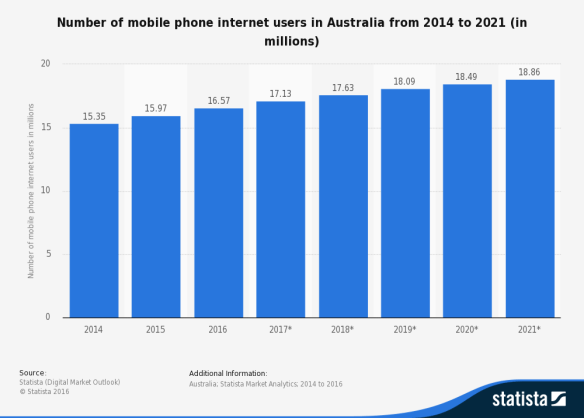
Mobile phone internet usage is projected to keep growing. Source: Statista

Mobile phone internet usage is projected to keep growing. Source: Statista

Based on consumer research, we would appear to be a well-connected country, with a high concentration of PC, smart phone and tablet devices, if data from Roy Morgan is any indicator. However, some recent research by Scott Ewing of Swinburne University based on ABS data has suggested that despite the narrowing of the divide, there is a deeper disconnect among those who do not have internet access.

There are multiple factors contributing to this disconnect: socio-economic, age, location and education. I would expect that within 5-10 years, age will be a far less relevant factor in who does or doesn’t have access to the internet. You could also argue that with more people accessing the internet via mobile devices, and with the increasing number of free WiFi zones across our cities (cafes, shopping centres, office buildings), public institutions (libraries, museums and galleries) and transport infrastructure (plus the reducing price of data and storage), cost may not be as much of an issue either. And once the NBN is complete, the percentage of the population without physical access to the internet should likewise be much smaller.

So that leaves education – according to the ABS-derived data, the more educated you are, the more likely you are to access the internet. Should this infer that we aren’t doing enough to teach digital skills in the classroom? Or are we teaching the wrong set of skills? Or is it a bit like learning English grammar or applied mathematics – unless you use them in your everyday life, you soon forget them, and never remember why it was important to learn them in first place?

Computer science, programming and coding courses are increasingly being taught in schools, either as part of the core syllabus or as extra-curricular activities. Many pupils have to use tablets as an integral part of their school lessons. And some schools are also running hackathons and entrepreneurial projects to help students navigate the new world of work shaped by innovation, digital disruption and the “gig” economy.

The changing nature of work is challenging schools and parents to think about how we should be preparing pupils for the future. It’s not just learning about the technology (important as it is to study data analytics, automation, robotics, AI etc.), it’s also about understanding the context and the potential for what it can do. It’s also increasingly apparent that more and more of today’s students want to do work that is meaningful, rewarding, challenging and which helps connect them to their values and “purpose”.

I like to think that as part of a well-rounded liberal education, today’s pupils will receive:

  • a solid grounding in digital literacy (as important and as vital as the 3 R’s)
  • an awareness of how “digital displacement” (through automation etc.) may impact their chosen career path (even in ways which we cannot yet predict – we must assume it will happen, as no profession, trade or vocation will be totally immune)
  • an appetite for lifelong learning (as one of the ways to cope with the inevitable changes they will face)
  • a set of life skills that instill self-awareness, curiosity, resilience, empathy, flexibility and adaptability.

Finally, if we are to truly grasp why this ability to adapt and change is important, we only need look beyond the digital debate and ask why the National Innovation and Science Agenda is failing to cut through. In large part, the NISA message failed to connect with the general electorate because many people could not identify with it, and therefore it did not resonate with them. Just as “necessity is the parent of invention”, so adversity often needs to be the catalyst for embracing change.

Notwithstanding the economic, environmental and societal challenges we face, there is considerable complacency and acceptance that “she’ll be right” – especially within the political, institutional and corporate elites that claim to lead us. As long as so few of the main actors among these bastions of power and influence decline to change their own culture, behaviours and ways of doing business, then it’s not surprising that the public feels unwilling or unable to change.

So our only real hope is to empower the next generations to shape their own future, not to be constrained by our traditional notions of “job” (in my view, an increasingly outmoded economic unit of value….) and think for themselves as to what change they want to create with all the technology, resources and opportunities at their disposal.

Next week: My Extended Gap Year