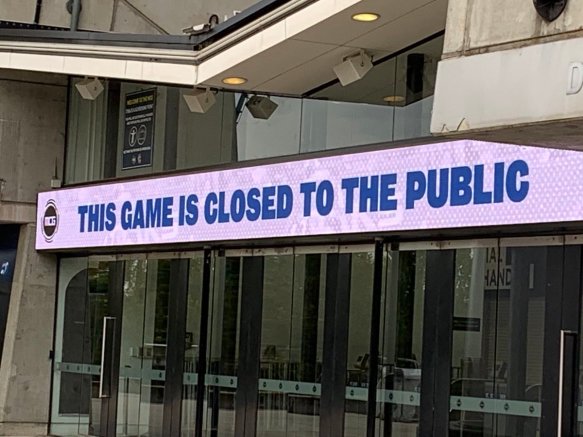
The “new, new normal” post-Covid-19

After the GFC of 2007-8, we were told to get used to the “new normal” – of low/slow/no growth, record-low interest rates, constant tech disruption and market dislocation as economic systems became increasingly decoupled from one another. And just as we had begun to adjust to this new reality, along comes Covid-19 and totally knocks our expectations sideways, backwards and upside down, and with it some negative long-term consequences. Welcome to the “new, new normal”.
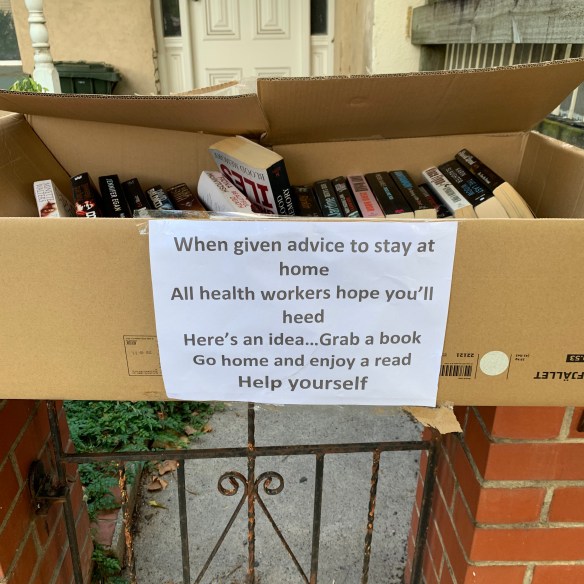
Just what the doctor ordered: “Stay home and read a book!”

In the intervening years since the GFC (and don’t those days seem positively nostalgic from our current vantage point?), we have already seen ever lower interest rates, even faster disruption in business models and services, and a gradual dismantling of the trend towards a global economy. The pre-existing geopolitical landscape has either exacerbated this situation, or has been a prime beneficiary of the dismantling of the established structures of pluralistic, secular, non-sectarian, social-democratic and liberal societies.

First, relations between the Superpowers (USA, Russia and China) have not been this bad since the Cold War. Second, nationalism has not been as rife since the 1930s. Third, political leadership has tended toward the lowest common denominator of populist sloganeering. Not to mention the rise of fundamental religious sects, doomsday cults and tribal separatist movements. Let’s agree that even before the current pandemic, our resistance was already low….

Whatever your favourite conspiracy theory on causes and cures for Covid-19, it’s increasingly apparent that populist leaders of both the left and the right will use the pandemic as vindication of their policies – increased xenophobia and tighter border controls, increased centralisation of power and resources, greater surveillance of their citizens, a heightened intolerance of political dissent, a continued distrust of globalisation, and a growing disregard for subject matter experts and data-driven analysis.
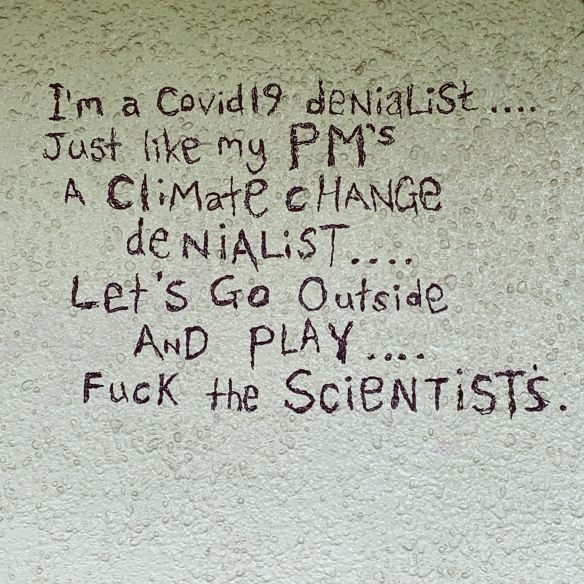
The writing’s on the wall? Message seen in East Melbourne

There are obviously some serious topics up for discussion when we get through this pandemic. Quite apart from making the right economic call (“printing money” in the form of Quantitative Easing seems the main option at the moment…), governments and central banks are going to have to come to grips with:

  • Universal Basic Income – even before Covid-19, the UBI was seen as a way to deal with reduced employment due to automation, robotics and AI – the pandemic has accelerated that debate.
  • Nationalisation – bringing essential services and infrastructure back into public ownership would suggest governments would have the resources they need at their disposal in times of crisis – but at the likely cost of economic waste and productivity inefficiencies that were the hallmark of the 1970s.
  • Inflation – as business productivity and industrial output comes back on-line, the costs of goods and services will likely increase sharply, to overcome the pandemic-induced inertia.
  • Credit Squeeze – banks were already raising lending standards under tighter prudential standards, and post-pandemic defaults will make it even harder for businesses to borrow – so whatever the central cash rates, commercial lenders will have to charge higher lending rates to maintain their minimum risk-adjusted regulatory capital and to cover possible bad debts.
  • Retooling Industry – a lot of legacy systems might not come out of the pandemic in good shape. If we have managed to survive for weeks/months on end without using certain services, or by reducing our consumption of some goods, or by finding workarounds to incumbent solutions, then unless those legacy systems and their capacity can be retooled or redeployed, we may get used to living without their products all together.
  • Communications Technology – government policy and commercial settings on internet access, mobile network capacity and general telco infrastructure will need to be reviewed in light of the work from home and remote-working experience.
  • The Surveillance State – I’m not going to buy into the whole “China-virus” narrative, but you can see how China’s deployment of facial recognition and related technology, along with their social credit system, is a tailor-made solution for enforcing individual and collective quarantine orders.

Another policy concern relates to the rate at which governments decide to relax social-distancing and other measures, ahead of either a reliable cure or a vaccine for Covid-19. Go too early, and risk a surge or second wave of infections and deaths; go too late, and economic recovery will be even further away. Plus, as soon as the lock-downs start to end, what’s the likelihood of people over-compensating after weeks and months of self-isolation, and end up going overboard with post-quarantine celebrations and social gatherings?

Next week: The lighter side of #Rona19
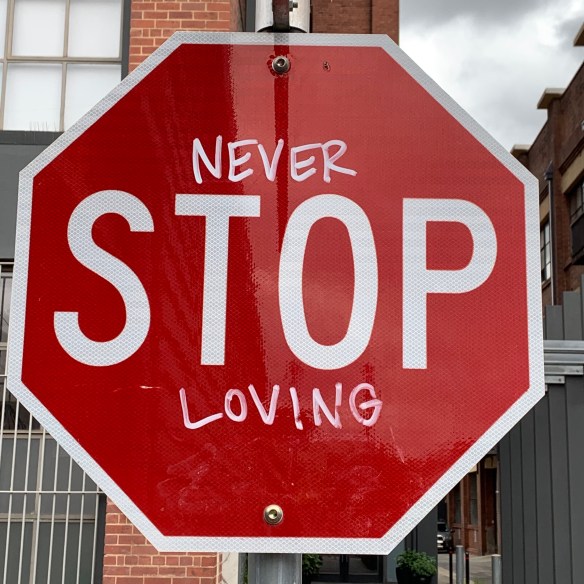
 

#Rona19 – beyond the memes

More commentary on Covid-19 – at the time of writing, Victoria is at Stage 3 restrictions, with Stage 4 possible very soon. Generally, people seem to adapting to if not actually coping with this daily reality (although people are still flouting their quarantine obligations). But there is still some confusion on how to interpret, observe and enforce the social distancing measures, and of course, huge economic uncertainty remains for many people who have seen their working hours evaporate, especially if they are in vulnerable industries, and/or they can’t work from home.

Sign of hope? (Seen on my daily walk)

Meanwhile, the shutdown has prompted a fair number of less serious responses, from toilet paper memes, to “viral” GIFS, from parodies of “My Sharona” and “Bohemian Rhapsody”, to unfortunate examples of the downside of company video conferences while working from home.

But beyond the hashtags, what might we expect once we get through the current pandemic? Here is a somewhat random list of possible outcomes:

  • A renewed appreciation of personal space in public places – will we continue to observe such protocols where and whenever practical, as it becomes a community norm?
  • Greater respect for introverts – possibly better able to handle self-isolation, they are comfortable with their own company and don’t feel the need to seek out crowds  – social distancing does not represent an existential crisis, and they don’t rely on social situations for their personal validation.
  • Passenger airlines and cruise companies are toast – the tourism and travel industries will be hard hit, and may struggle to rebuild in their current form.
  • The online economy will get a boost  – restaurants and providores are already retooling to offer D2C food and meal deliveries (even cutting out the likes of Uber Eats, Deliveroo and Menu Log). Some brick and mortar retail is adapting fast, but will face a reduced share of available discretionary spending.
  • Naturally, digital services will thrive – from communication solutions to virtual classes, from remote working support services to telehealth. But bandwidth capacity and internet down/upload speeds remain a challenge in Australia.
  • The end of physical cash – if retailers prefer contactless payments (less contamination), what use are those notes and coins in your wallet?
  • A higher community standard for the individual duty of care we owe to each other – Covid-19 will certainly test the “duty of care” we owe to neighbours, colleagues, members of the public… if I knowingly infect someone, or act recklessly or negligently, can the victim sue me?
  • Likewise, the corporate social license to operate will be tested and re-cast – in light of monopolistic practices, price gouging, market abuse and disregard for the “new normal”, companies will need to re-assess many of their standard policies.
  • Increased use of facial recognition and other technology for surveillance purposes – if people cannot be trusted to observe their quarantine, self-isolation and social distancing obligations, the authorities will not shy away from further incursions into civil liberties that we currently take for granted.
  • A hybrid of on-site and working from home employment structures – not everyone will want to continue working remotely, nor will everyone be in a rush to head back to the office (or the daily commute), which will likely cause headaches for employers….

More on these themes next week….

Next week: The “new, new normal”


Social Distancing in Victorian Melbourne…

At the time of writing Victorians, like most of Australia, are living under a Covid19 “stay at home and practise social distancing” regime in attempt to “flatten the curve” and reduce the spread of this contagion. I have been working from home for 3 weeks, only going out for essential food shopping and a daily walk for exercise (since my gym is closed). This perambulation has revealed some lesser-seen aspects of Melbourne (apart from the empty streets), including the way the modern city’s 19th century founders went about their approach to urban design – including some examples of built-in social distancing.

The first example is the number of public parks and gardens close to the CBD that were established in the 1800s, and which have managed to survive the onslaught of developers. As we know, public parks, with their trees and green spaces act as the lungs of the city, and provide a place to exercise, relax and get some fresh air. So we need these facilities more than ever in times like these. (Strange why the Victorian Government still insists in allowing vehicles to use the culturally and historically significant Yarra Park as a public car park on so many days, with all the horticultural and environmental damage that this causes…)

Second, the decision to incorporate lane-ways into the grid design of the CBD, as well as throughout the 19th century expansion of the inner city suburbs. While their design was mainly pragmatic (ease of access for night carts, storm drainage), the result is that in densely-built areas such as Richmond, Carlton, East Melbourne, Fitzroy and Collingwood, lane-ways mean even terraced houses can have ample space between them and the next block, allowing for better ventilation, natural light and reduced risk of disease. (For an example of the lane-ways importance to Melbourne’s character and psyche, check out Daniel Crooks’ video, “An Embroidery of Voids”.)

Third, the decision not to build right up to the urban banks of the Yarra River (and the straightening and leveling of the river itself) has left them accessible to the public, both as a means of cycling and walking to/from work, and for recreational purposes. In many cities, riverfront access has largely been blocked off as adjacent land has been appropriated for private, commercial and industrial use.

At a time like this, I truly appreciate the foresight of Melbourne’s Victorian town planners – I just hope we can continue to enjoy their legacy in the coming weeks and months!

Next week: #Rona19 – beyond the memes


My Four Years in Crypto

It’s four years since I began my career in Blockchain, crypto and digital assets. (I can’t claim to be an early adopter, although this blog first mentioned Bitcoin in 2013.) My knowledge on the topic was quite rudimentary at the time, and it was like jumping in at the deep end when I joined the small team at Brave New Coin. Apart from the 3 co-founders, there were 3 other core team members already on-board, so I was lucky 7.

My professional career has mainly been in law, publishing and financial services, plus a range of consulting, contract and freelance roles across various sectors. My point of entry into crypto was my experience with Standard & Poor’s and Thomson Reuters in market data, indices, analytics, content, research and portfolio tools – the basis of Brave New Coin’s business, and therefore an appropriate fit with my experience and skills set.

In the past four years, I have been privileged to witness at close hand the market exuberance of 2017 (fuelled by the ICO phenomenon and the incredible bull market), the regulatory backlash of 2018, the crypto winter of 2018-19, and the stop-start messages coming from regulators, markets, institutional investors, central banks and major corporations.

Getting to grips with some of the technical and other idiosyncrasies has been a steep learning curve – but I have tried to adopt a dual approach to expanding my own understanding. First, focus on the major components before getting to far into the weeds on any particular area of technical detail; second, create a personal framework of analogous concepts, and identify practical metaphors that you can also easily explain to others – self-education is critical to personal survival, but sharing knowledge is the path to wider adoption.

It’s also important to maintain an anchor based on your original point of entry – not only does that become a constant point of reference, it also enables you to build areas of personal expertise and domain knowledge. So, while many early proponents and adopters were drawn to crypto because of their underlying belief in Libertarianism, or their fascination with cryptography, or their distrust of centralised banking systems, my own points of reference continue to be around financial services (asset origination, tokenisation, digital wealth management), market data (indices, industry standards, benchmarks), regulations and analytics. While I am an advocate for Blockchain technology, I am not a hardcore technologist, but I realise that it will take time for issues such as scaling, interoperability and mass adoption to be fully resolved.

At the very least, a great deal of that market experience (especially driven by the decentralized, project-intensive and ICO-related activity of 2016-18) has demonstrated the following truths about Blockchain technolgy:

1. This is a new model of capital formation – just as companies no longer have a monopoly on human capital, banks and traditional intermediaries no longer have a monopoly on raising financial capital

2. This is a new means of asset creation, wealth distribution and market access – backed by Blockchain solutions, crypto is the first asset class that was retail first, in a distributed/decentralized bottom-up approach to issuance

3.This is a new platform for commerce – whether via tokenomics, network incentives, value transfer, smart contracts or programmed scarcity

4. This represents a paradigm shift in governance models – via the use of decentralized, autonomous, trustless, consensus and incentive-based operating structures and decision-making systems

5. This introduces new principles of distribution – assets are consumed closer to the source of value creation (fewer intermediaries and rent seekers)

6. But, it is not (and should never be) the solution for everything

Given what is happening at the moment around the COVID 19 pandemic, Blockchain, crypto and digital assets will prove to be perfect solutions to a number of problems such as: establishing the provenance of medicines; identity verification; managing supply chain logistics; enabling the distribution of assets; computing power for scientific modelling and testing; and providing alternatives to cash.

Next week: Social Distancing in Victorian Melbourne…