Monash University Virtual Demo Day

Last week I was invited to participate in a Virtual Demo Day for students enrolled in the Monash University Boot Camp, for the FinTech, Coding and UX/UI streams. The Demo Day was an opportunity for the students to present the results of their project course work and to get feedback from industry experts.

While not exactly the same as a start up pitch night, each project presented a defined problem scenario, as well as the proposed technical and design solution – and in some cases, a possible commercial model, but this was not the primary focus. Although the format of the Demo Day did not enable external observers to see all of the dozen-plus projects, overall it was very encouraging to see a university offer this type of practical learning experience.

Skills-based and aimed at providing a pathway to a career in ICT, the Boot Camp programme results in a Certificate of Completion – but I hope that undergraduates have similar opportunities as part of their bachelor degree courses. The emphasis on ICT (Cybersecurity and Data Analytics form other streams) is partly in response to government support for relevant skills training, and partly to help meet industry requirements for qualified job candidates.

Industry demand for ICT roles is revealing a shortage of appropriate skills among job applicants, no doubt exacerbated by our closed international borders, and a downturn in overseas students and skilled migration. This shortage is having a direct impact on recruitment and hiring costs, as this recent Tweet by one of my friends starkly reveals: “As someone who is hiring about 130 people right now, I will say this: Salaries in tech in Australia are going up right now at a rate I’ve never seen.” So nice work if you can get it!

As for the Demo Day projects themselves, these embraced technology and topics across Blockchain, two-sided marketplaces, health, sustainability, music, facilities management, career development and social connectivity.

The Monash Boot Camp courses are presented in conjunction with Trilogy Education Services, a US-based training and education provider. From what I can see online, this provider divides opinion as to the quality and/or value for money that their programmes offer – there seems to be a fair number of advocates and detractors. I can’t comment on the course content or delivery, but in terms of engagement, my observation is that the students get good exposure to key tech stacks, learn some very practical skills, and they are encouraged to follow up with the industry participants. I hope all of the students manage to land the type of opportunities they are seeking as a result of completing their course.

Next week: Here We Go Again…
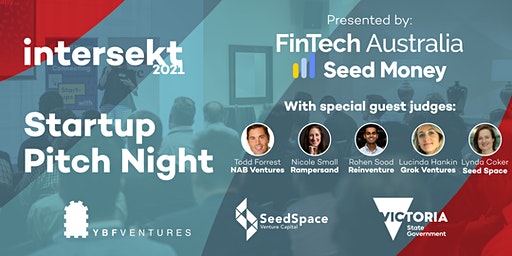
Intersekt FinTech Pitch Night

The opening event of the Intersekt 2021 Australian FinTech Conference was a startup pitch night, organised by FinTech Australia, hosted by YBF Ventures, and sponsored by Seed Money. The esteemed judging panel was drawn from a range of VC funds: Todd Forest (NAB Ventures), Nicole Small (Rampersand), Rohen Sood (Reinventure), Lynda Coker (SpeedSpace) and Lucinda Hankin (Grok Ventures).

The pitches in order of presentation (links are in the names):

Boulevard

A cloud-based share registry management platform for startups, founders and their employees. Designed to to be an exchange for unlisted securities, the platform also offers Investor Relations support and automated compliance solutions. Using Distributed Ledger Technology (which underpins Blockchain), the team are working with ASX DLT Solutions (responsible for the CHESS replacement) and deploying DAML, the programming language for modelling digital assets. They have also developed ASICLink, to automate company filings with the corporate regulator, plan to support corporate actions (including the verification of company financials), and are working with equity crowdfunding platforms. Boulevard has already on-boarded 30 companies, comprising 4,000 shareholders.

COGSflow

Describing itself as “Performance based finance”, this is essentially a merchant service offering cash-flow funding solutions for physical goods. This involves purchasing client inventory, and getting repaid on the sales performance. Using a funding ratio calculation as the basis of its credit risk model, the COGSflow will track sales data from the likes of eBay and Amazon (although both of these platforms, like PayPal, Alibaba etc. already offer SME financing of various forms). COGSflow will also analyze variable marketing and customer acquisition costs as inputs to its lending model, and plans to become a member of the Personal Property Securities Register (PPSR), as well as seeking B Corp certification.

Archa

Archa is solving the challenges many SMEs face when trying to access corporate credit cards – banks generally demand personal guarantees from owners or directors before they issue cards, and when they do the “product is awful”. As the pitch described it, many bank-issued corporate cards are really designed as “a line of credit to acquire air miles”. With a mobile app already in the market, Archa incorporates an administration and expense management solution. A major bug bear for many companies is managing corporate subscriptions – all those SaaS apps that are tied to individual employee cards; consolidating, renewing and cancelling those services can be time-consuming and painful. The account administrator can also manage each card’s credit limit. Archa itself has principal issuer membership with MasterCard. In addition to an equity raise, the team is seeking debt funding to offer lines of credit. Channels to market will include SME lenders, accountants and lawyers.

Sherlok

According to the founders, most people paying too much on their mortgages – based on their home loan rate. Because mortgage brokers have 60% of the market, and rely on trailing commissions, there is little incentive for brokers to help their clients find a better rate or provider. However, 15% of brokers’ clients are leaving each year. Sherlok is an SaaS platform that uses AI to help brokers reprice and refinance their existing mortgage book. Using a broker subscription model, Sherlok is aiming to offer “single click refinancing”, although there was some equivocation about becoming a virtual brokerage itself. The founders feel that mortgage broking is still a relationship based business, and requires a human touch.

Axichain

Axichain is building a blockchain-based agricultural supply chain – a digital trading solution for cross-border commodities trading, with an initial focus on red meat. The founders are addressing three main supply chain pain points – market access, paperwork and payment.
Axichain combines smart contracts, an escrow solution and traceability linked to legal processes. Overall, the platform envisages multiple products and revenue streams. The team are seeking both equity and debt funding, the latter to provide lines of credit lines.

Parpera

The meaning of “Parpera” is “fair wallet”. By that, the founders mean they want to offer a range of banking and related services aimed at SME owners, sole traders and freelances. This could include business registration and set-up, better financial insights, and access to smarter banking products etc. It will include card services, payments and invoicing. The plan is to target customers who are about to set up a business, and to promote the service at the start/end of the financial year, hence the intention to use accountants as a channel to market.

Next week: Monash University Virtual Demo Day

RONE in Geelong

Public art galleries need to attract paying customers if their funding derived from government grants is being cut. To pull in the punters, galleries have to resort to “blockbuster” exhibitions. In these uncertain, post lock-down times, the lack of international tourists means that galleries are forced to focus on local audiences. It’s good to showcase local talent in the shape of conquering heroes returning to their roots.

These may have been some of the arguments behind the Geelong Art Gallery‘s decision to mount a retrospective exhibition featuring the work of street artist Tryone Power (aka RONE). Of course, the planning began long before COVID struck, but otherwise the above assumptions would seem to be valid.

Let’s acknowledge the positives of this show: First, it is certainly pulling in the punters, and helping to bring in visitors and their wallets to the town. Second, it is hopefully creating a platform for future exhibitions, and public engagement with the Gallery itself. Third, it’s nice that a locally-born artist is being recognised (even if he has had to travel afar to make a name for himself at home).

Unfortunately, that’s where it ends, for me. My recent visit was probably the shortest time I have spent in an exhibition which I had paid to see. Overall, I found the work vapid – there was nothing of substance (nor anything challenging) underneath the painted surface, or behind the concept of “beauty and decay”. As a street artist, RONE does not have the wit or depth of a Banksy; as a conceptual/installation artist, he’s no Christo. The main images he creates or imposes on his work are highly stylised and extremely idealised portraits of young women – it’s a very limited exploration of “beauty”. At best, the work reveal something interesting about abandoned and overlooked locations. At worst, the installation reeked of interior decor magazines and displayed a taste for romanticised and sentimental kitsch.

Which is all a great shame, because given RONE’s apparent interest in deserted and decaying structures, there is a deep and rich vein of Australian Gothic he could have tapped into. (In comparison, think of the work of Nick Cave, Peter Weir, Peter Carey, Julia deVille, Rosalie Ham, etc.)

Despite the use of physical objects, this exhibition felt very one-dimensional. Artists as disparate as Helen Chadwick, Paola Rego, Cindy Sherman and Rachel Whiteread have all deployed notions of female beauty, decay, abandonment and destruction to far greater effect and impact.

Next week: Intersekt FinTech Pitch Night

Decay Music

As Melbourne returns to normal post lock-down, I’ve been attending some live music events around the city. The most recent was a performance of contemporary Australian compositions written mainly for percussion, including a piece entitled “When Only The Walls Can Sing” by Mark Pollard, performed by members of the Melbourne Conservatorium.

When introducing his work, the composer referenced the notion of “decay” in music, whereby sound waves continue to reverberate indefinitely, albeit in decreasing magnitudes of volume and resonance. Incorporating recordings of works previously performed by the Conservatorium, this 2020 composition is also a reference to our enforced isolation during the pandemic, when many people only had the four walls of their homes for company.

The concept of “musical decay” appears in many forms. Examples include:

The physical degradation that occurs with each playback of a recording (both analogue and digital), as exemplified by “The Disintegration Loops” by William Basinski

The idea that all sound is potentially infinite – given voice by Gavin Bryars on “The Sinking of the Titanic”….

…. and continues even when no-one can hear it, as suggested by “On Hold” by Photay.

The half-heard music that inspired Brian Eno’s early ambient and tape-loop experiments on “Discreet Music” ….

… and the related “systems” composition of Michael Nyman’s “Decay Music”

For musical archeologists, look no further than Philip Jeck’s epic installation piece (and related albums), “Vinyl Requiem”….

… and compare this to similar works by L.Pierre on his final two albums, “Surface Noise” and “1948”

Given the melancholic nature of “decay”, the “final” word probably goes to the conceptual work by AM/PM, that samples and amalgamates “The Ends” of certain records, to great effect.

Next week: RONE in Geelong