Getting out of town

This week, if all had gone to plan, I would have been reflecting on my latest stay in regional Victoria. Instead, Melbourne is under lock-down #6, and my mini-break out of the city had to be abandoned. But at least I managed to enjoy a great lunch and a walk in the country, before day release came to an end, and I had less than 4 hours’ notice to get back to town ahead of the latest curfew.
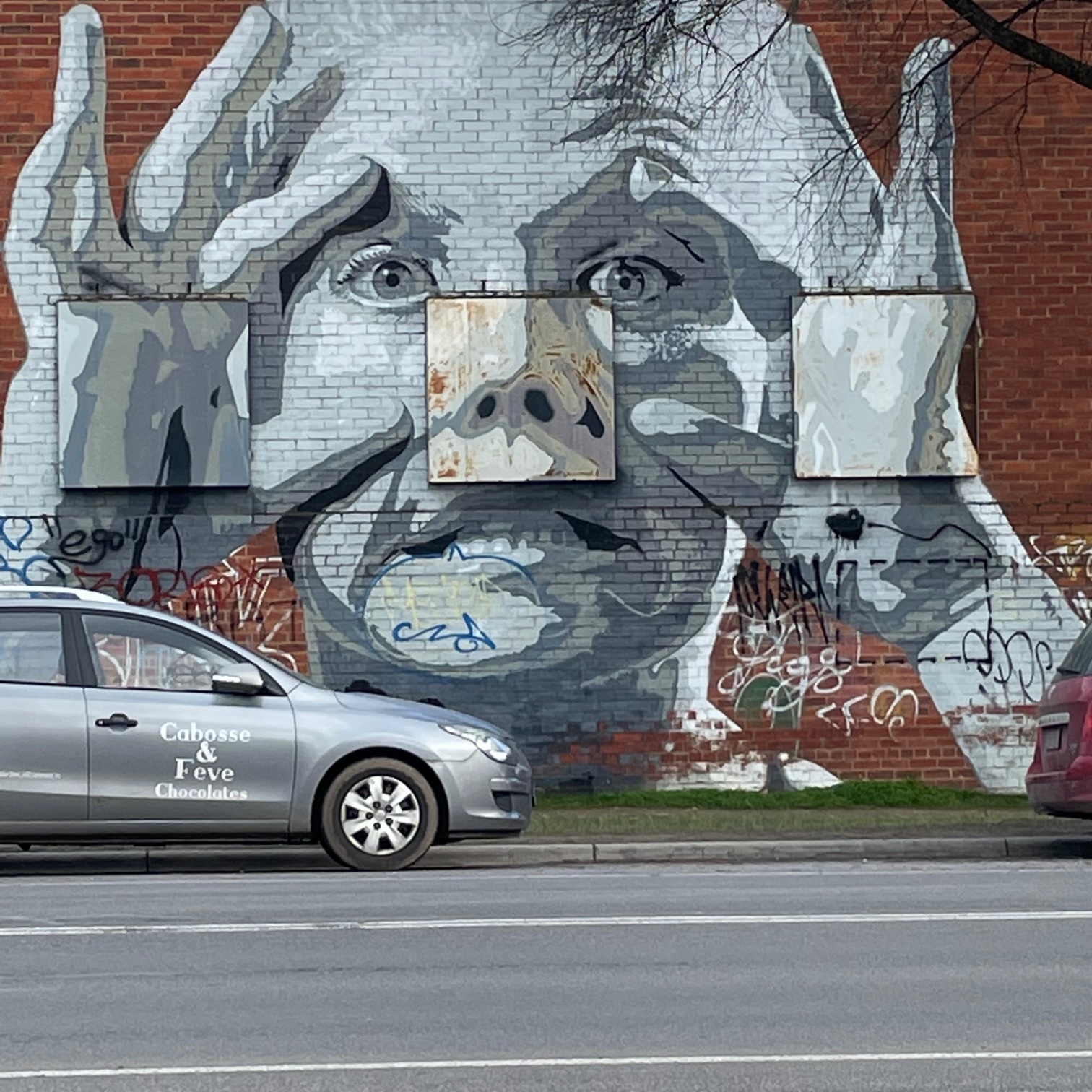
Greetings from Castlemaine – local art for local people….

Despite the abrupt end to my trip, the few hours of freedom were enough to remind me of the benefit (and downside) of living in a regional town.

First, regional and rural towns provide a great sense of belonging. You can experience a form of community in Melbourne’s urban and inner-city areas, but the connections don’t always run as deep, and they can be quite transactional and event-driven – meeting up to watch sport, going to the pub or catching up for dinner. Whereas, regional communities just “are”, and are always there to offer support, especially during challenging times.

Second, people living in regional areas tend to have a very different perspective and outlook on things, with a healthier approach to work/life balance. They have a greater appreciation of the country, nature and the land on which they live – something we can overlook or take for granted in our urban bubbles.

Third, rural and regional towns come with their own individual personalities and identities – something seriously lacking in our sprawling new suburbs with their increasingly cookie-cutter homes, and distinct lack of character.

The recent pandemic has shown that if you can work remotely, and don’t need to meet colleagues or clients face-to-face, regional centres are very attractive locations (even for a temporary tree/sea-change). But while the locals may welcome your city spending power in their shops and cafes, they may not appreciate the impact on property prices.

However, regional towns can take a while to warm to new-comers, and in these edgy pandemic times, strangers are viewed with as much suspicion as they are curiosity. More than once on recent trips I have noticed the locals almost crossing the street to avoid getting too close to the out-of-towners. Not quite dueling banjos (or the country pub scene in “An American Werewolf in London“…), but enough to suggest visitors are not entirely welcome.

Small towns are also notorious for everyone knowing each others’ business, where you can’t even sneeze without the rest of the village knowing about it. It can get to the point of suffocation, along with repressed emotions and dreadful secrets, especially where local traditions are based on very conservative (even regressive) values, beliefs and prejudices. (I was reminded of this recently when watching “The Last Picture Show”.)

In case this reads as overly pessimistic, I should emphasize that I really enjoy visiting regional Victorian towns (lock-down permitting), as they offer a rich variety of scenery and local produce – even if I can’t get there as often as I’d like these days, it’s good to know they are there. (And my wine cellar would be poorer for the lack of choice…)

Next week: More Music for Lock-down

Goya – allegories and reportage for the modern age

Just prior to the latest COVID-related lock down in Melbourne, I managed to visit the exhibition of drawings and prints by Goya at the NGV. Although these works were produced 200 years ago, they are still relevant today.

Goya: Two People Looking into a Luminous Room – Image sourced from NGV

Working at the time of the Enlightenment, and despite his status and reputation as a court painter, Goya still had to navigate the political oppression of both Spanish and French rulers, and the religious persecution in the form of the Inquisition.

His series of drawings and etchings reveal a very personal side to Goya’s work, combining allegory, satire, reportage, surrealism and the sub-conscience. The images provide a commentary on the horrors of war and its aftermath, while his domestic scenes on courtship, gold diggers and hapless suitors would not be out of place on Married at First Sight or The Bachelor… There’s a lot that’s familiar about these images.

The exhibition provide some insights into Goya’s working methods – from his use and development of preparatory drawings, to the different etching techniques he deployed to create the finished prints.

One drawing in particular caught my attention – a red crayon sketch entitled “Two People Looking into a Luminous Room”. It’s a remarkable image on a number of levels. The room of the title does not look like a typical building or structure. It almost resembles the bellows of a giant camera, except that photography had not yet been invented. Perhaps it refers to a type of camera obscura or similar device that Goya had seen? On the other hand, it could be a metaphor for Hell, a glimpse into the white heat of the Inferno. For me, it even suggests Goya’s prescience for the work of James Turrell. It’s a remarkable piece in an absorbing exhibition.

Next week: The Fall – always different, always the same

Where is wage growth going to come from?

How good is the Aussie economy? On the back of the stable outlook on our AAA sovereign credit rating, last week’s employment data showed a better-than-expected post-COVID recovery in terms of the headline unemployment rate and overall workforce participation. This has led to speculation of a potential uplift in wages, due to labour shortages amplified by the current halt on immigration (thanks to closed borders).

But where will this expected wage growth actually come from?

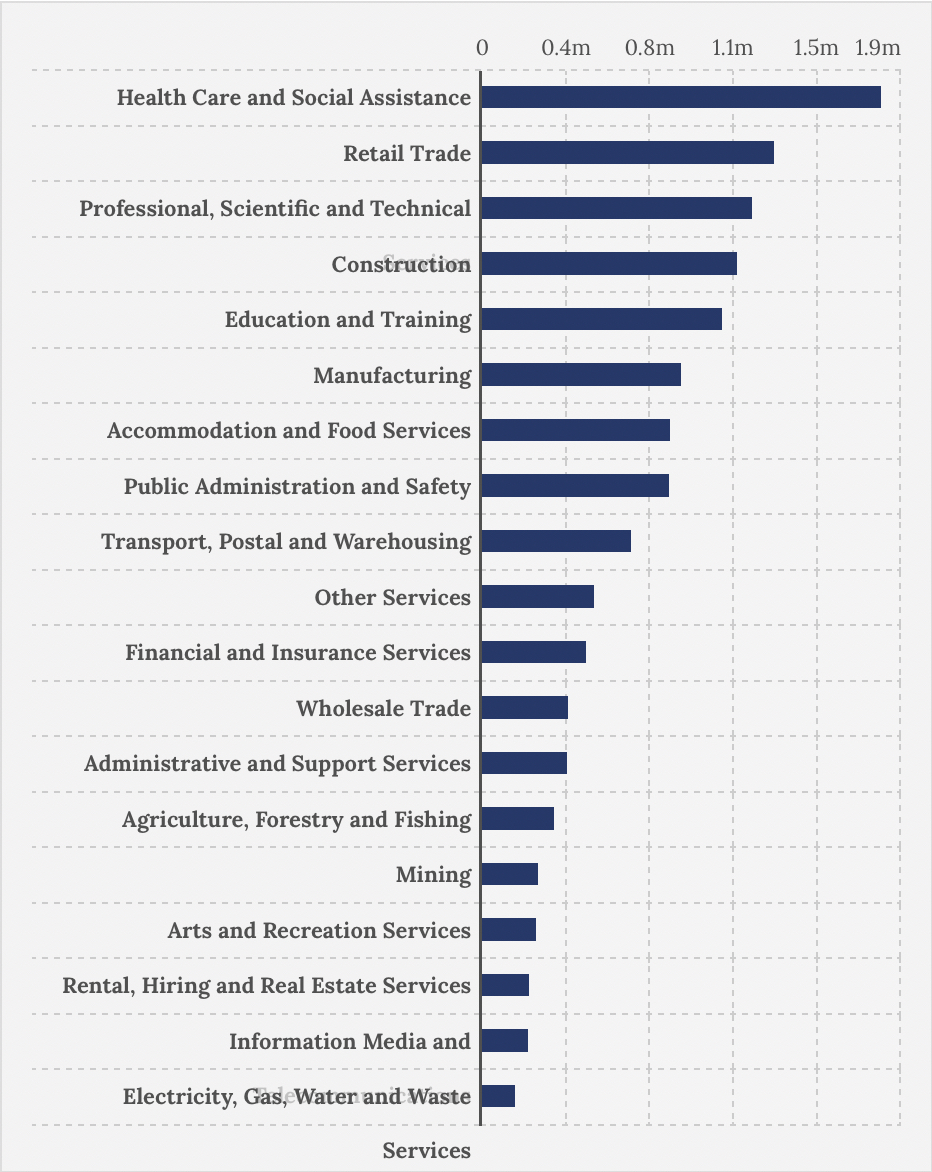
According to ABS data for February 2021, the top 5 industries by number of people employed are: Health Care; Retail Trade; Professional, Scientific and Technical; Construction; and Education. (See above chart.)

Now, contrast this with three other relevant data points: 1) the number of Australian companies by size; 2) the annual change in employment growth/reduction by industry; and 3) the national GDP contribution by industry.

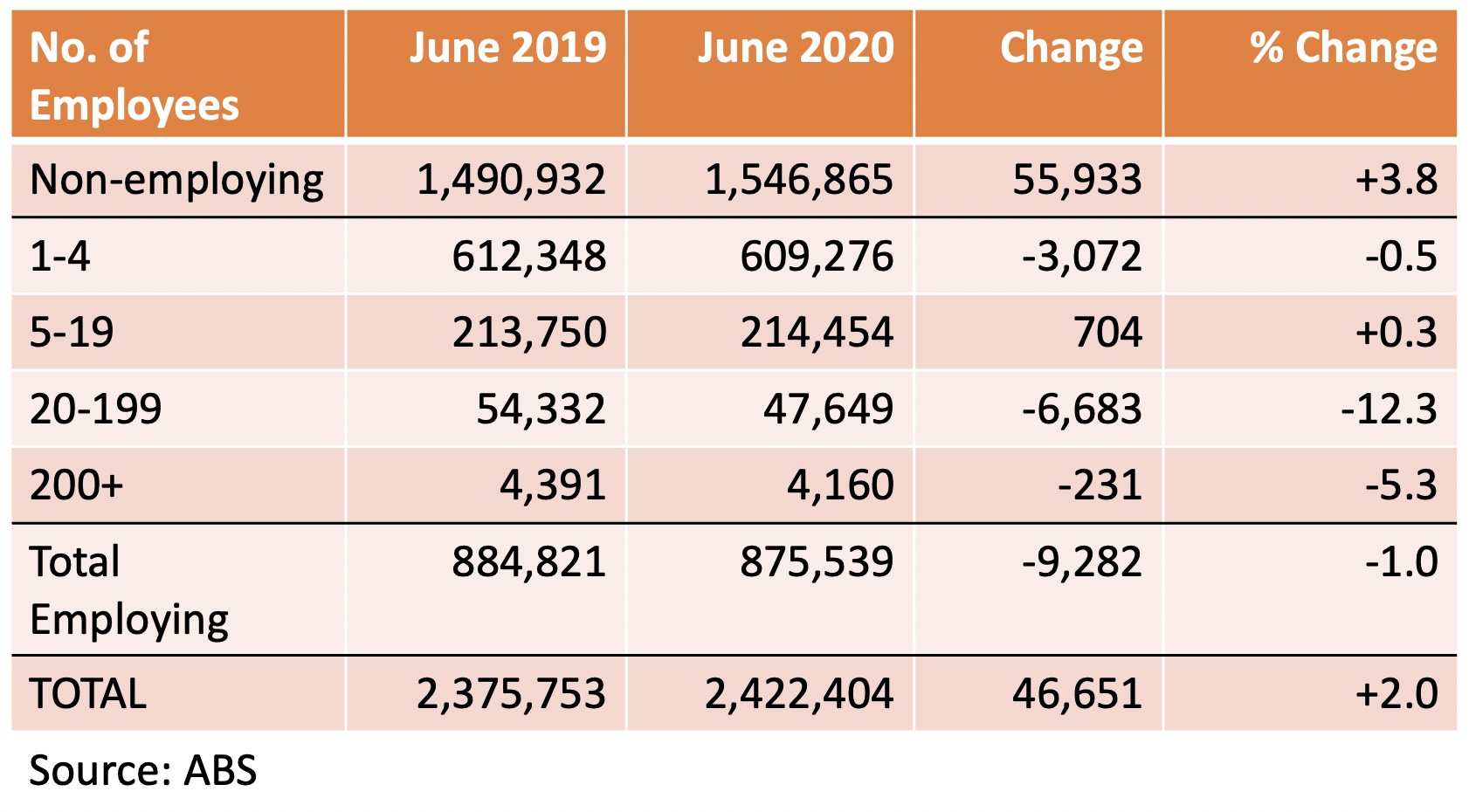
First, there are nearly 2.5m registered business entities, according to ABS data. Over 1.5m of these are designated as “Non-employing” – including sole traders, self-employed, independent contractors or freelances. Over 850 thousand establishments employ fewer than 200 people. Fewer than 5,000 businesses employ more than 200 people. Although there was an overall growth of 2% in the number of registered businesses, the largest increase was in the “sole trader” category, while the largest decreases were among medium-sized companies, and large enterprises. (See table below – the next ABS data is due in August.)

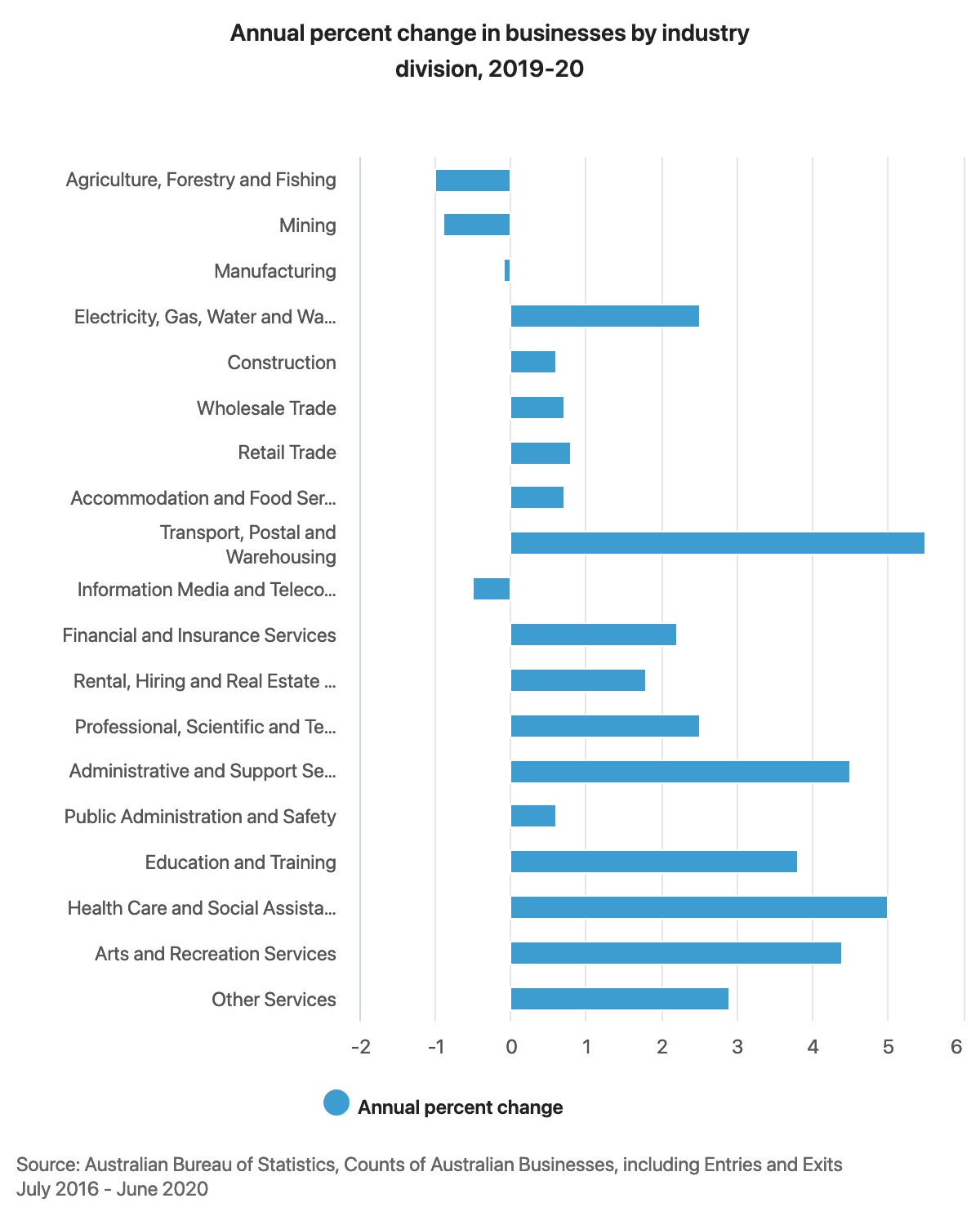
Second, the largest employment growth by industry sector in 2019-20 came from logistics and healthcare – no doubt in large part to the impact of COVID. Primary industries and mining both registered decreases.

Third, the main contributors to output (GDP) are Health and Education (13%), Mining (11%), Finance (9%), Construction (8%) and Manufacturing (6%) – based on a recent RBA Snapshot. But the data is always subject to further examination and clarification – for example, while construction employs over 1.1m people, many of these are engaged as independent tradies or through sub-contractors, and in spite of the huge number of major infrastructure projects (just look at Victoria’s Big Build and all the cranes in Melborne CBD), there was only negligible growth in overall employment within the sector. And while mining is a major contributor to GDP, it does not employ huge numbers of people (it’s actually on a par with the arts…), yet the fewer than 9,000 people who are employed as mining engineers are in the top 10 occupations by salary (according to ATO data analysed by the ABC.)

Some other factors to consider as we ask, “Where will wage growth come from?”:

  • While most people are employed by SME’s, these companies are probably under the greatest strain when it comes to overheads and inputs, as they have relatively high fixed costs, and can ill-afford higher wages in the current trading conditions.
  • On July 1, the Superannuation Guarantee is due to increase from 9.5% to 10% – some commentators suggest employers (especially SMEs) may have to reduce or offset wages to pay for the scheduled increase.
  • We have an apparent choice between an asset-led recovery (inflated house prices – but risks leaving people “asset rich and cash poor” when interest rates go up ); a consumption-led recovery (reliant on higher wages so people feel comfortable to spend money); or an investment-led recovery (businesses need to invest in new equipment and projects to boost productivity, and not just bring forward planned expenditure thanks to tax incentives).
  • The sectors where we need more people (health care, aged care, child care and education) are still among the lowest paid on a per capita basis.
  • What is happening to boost manufacturing, or aren’t we interested in making things anymore?
  • Our IT and technical skills shortages have been exacerbated by the absence of overseas students and graduates – there is anecdotal evidence of wage and hiring pressures in this sector, one which is probably more important to our future economy and sustainability than mining coal or building more roads.
  • One leading economist reckons that household incomes have increased by 30% over the past 10 years. If wages have been stagnant, where has this growth come from? Is it because of tax cuts, low interest rates, quantitative easing, real estate prices (or their crypto holdings)? And do we actually feel any wealthier as a result?

Finally, will inflation and/or interest rates undermine any potential increase in wages?

Next week: Is Federation still working?

How about that AAA rating?

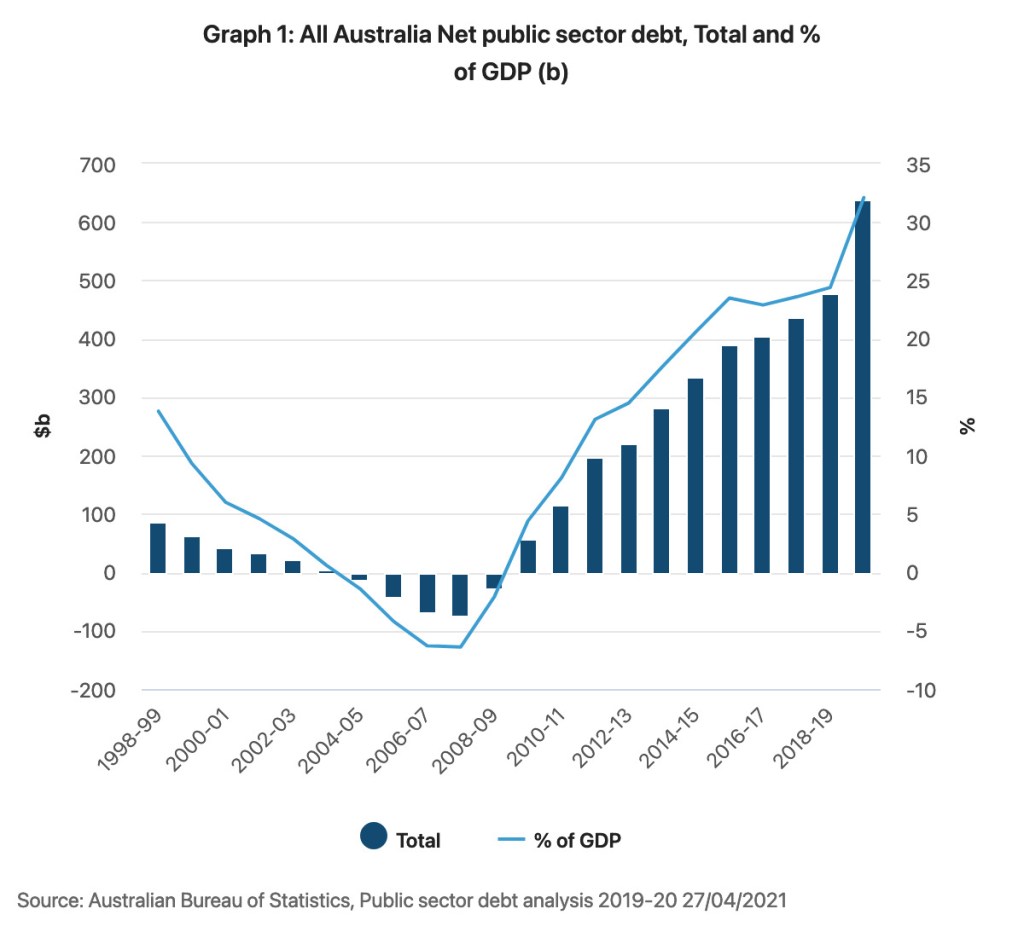
As the State of Victoria weighs up the costs of yet another lock down, you could be forgiven for thinking that the local economy has taken a further beating after the horrendous events of the past 15 months. Across Australia, thousands of companies and individuals accessed various government-sponsored financial aid packages to keep afloat, causing the federal government to borrow more money, at something like 8x the equivalent rate pre-COVID. National public debt is now expected to grow to more than 40% of GDP by the 2024-25 fiscal year – effectively double what it was in 2018-19.

So what has Australia done to retain its coveted AAA sovereign rating from Standard & Poor’s, and have the rating outlook upgraded from negative to stable? According to the ratings agency, and economists such as Westpac’s Bill Evans, there are probably three or four key factors that have warranted this optimistic economic reckoning.

First, while government borrowing (Quantitative Easing) has blown out as a proportion of GDP, the current low interest rates mean that the cost of servicing that debt is manageable.

Second, while the pursuit of QE has destroyed any hope of returning to an overall budget surplus, the deficit will return to similar levels last seen after the GFC, and the current account will continue to return a modest surplus over the coming quarters.

Third, despite the significant economic risks that were identified at the start of the COVID pandemic, the actual impact on the budget has been less than feared, and the economy is recovering faster than expected (as evidenced by latest employment data and consumer sentiment).

Fourth, Australian banks have seen an increase in customer deposits, meaning they are less reliant on more expensive overseas borrowing for their own funding.

Overall, just as with the GFC, Australia has managed to dodge a bullet (the shock to the system was less than anticipated) – in large part thanks to a resurgence in iron ore prices (again).

But weaknesses and disparities remain:

The over-reliance on commodity prices (mainly based on demand from China) hides the true nature of Australia’s balance of payments – we manufacture less than we used to, and our supply chains have been severely tested during the pandemic. And with international borders closed, we won’t see the same levels of GDP growth that resulted from immigration.

Our household savings rate as a percentage of disposable income has come down from its peak of 22% in July 2020, to less than 12% this past quarter, as people held on to their cash for a rainy day (or 3 months lock-down). The savings rate is expected to come down even further as consumers feel more confident and start spending again.

As with the GFC, home owners have chosen to pay down their mortgage debt – but the picture is more complex. Yes, interest rates remain low (and will likely stay so for at least another 18 months), despite commentary from another economist, Stephen Koukoulas suggesting that the RBA will have to raise rates sooner than expected. With property prices expected to increase 5-10% over the next 12 months, home owners will feel wealthier (but asset rich and cash poor?) as mortgage repayments reduce as a percentage of their home’s value. And while analysts at S&P expect banks’ credit loses to remain low while the economy recovers, the fact that two-thirds of banks’ exposures are to highly leveraged residential property could see increased stress when interest rates rise and if wage growth remains sluggish (more on the latter next week).

Australia’s sovereign credit rating is something of a badge of honour, and represents membership of an exclusive club – fewer than a dozen countries are rated AAA; no wonder it’s a big deal, and partly explains why the Prime Minister gets to attend the G7 (albeit as an observer). Comparatively speaking, Australia is doing very well when it comes to managing COVID (although we could be doing a lot better on a number of measures), and has an economy that continues to be the envy of many. Expect more on that AAA rating (“How good was that?”) as we head into the next Federal election…

Next week: Where is wage growth going to come from?