#Rona19 – beyond the memes

More commentary on Covid-19 – at the time of writing, Victoria is at Stage 3 restrictions, with Stage 4 possible very soon. Generally, people seem to adapting to if not actually coping with this daily reality (although people are still flouting their quarantine obligations). But there is still some confusion on how to interpret, observe and enforce the social distancing measures, and of course, huge economic uncertainty remains for many people who have seen their working hours evaporate, especially if they are in vulnerable industries, and/or they can’t work from home.
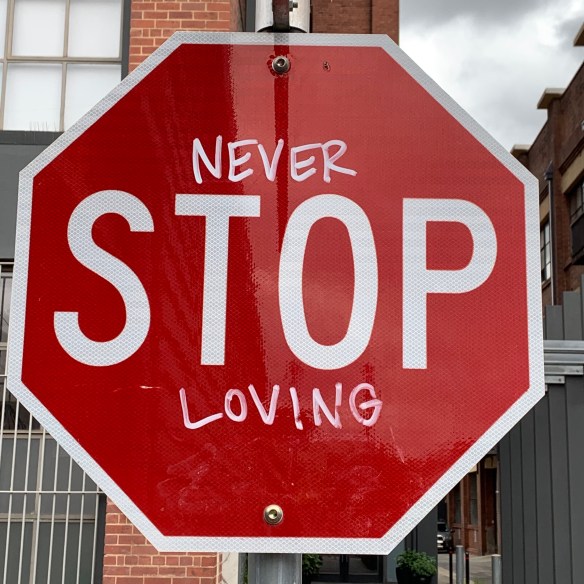
Sign of hope? (Seen on my daily walk)

Meanwhile, the shutdown has prompted a fair number of less serious responses, from toilet paper memes, to “viral” GIFS, from parodies of “My Sharona” and “Bohemian Rhapsody”, to unfortunate examples of the downside of company video conferences while working from home.

But beyond the hashtags, what might we expect once we get through the current pandemic? Here is a somewhat random list of possible outcomes:

  • A renewed appreciation of personal space in public places – will we continue to observe such protocols where and whenever practical, as it becomes a community norm?
  • Greater respect for introverts – possibly better able to handle self-isolation, they are comfortable with their own company and don’t feel the need to seek out crowds  – social distancing does not represent an existential crisis, and they don’t rely on social situations for their personal validation.
  • Passenger airlines and cruise companies are toast – the tourism and travel industries will be hard hit, and may struggle to rebuild in their current form.
  • The online economy will get a boost  – restaurants and providores are already retooling to offer D2C food and meal deliveries (even cutting out the likes of Uber Eats, Deliveroo and Menu Log). Some brick and mortar retail is adapting fast, but will face a reduced share of available discretionary spending.
  • Naturally, digital services will thrive – from communication solutions to virtual classes, from remote working support services to telehealth. But bandwidth capacity and internet down/upload speeds remain a challenge in Australia.
  • The end of physical cash – if retailers prefer contactless payments (less contamination), what use are those notes and coins in your wallet?
  • A higher community standard for the individual duty of care we owe to each other – Covid-19 will certainly test the “duty of care” we owe to neighbours, colleagues, members of the public… if I knowingly infect someone, or act recklessly or negligently, can the victim sue me?
  • Likewise, the corporate social license to operate will be tested and re-cast – in light of monopolistic practices, price gouging, market abuse and disregard for the “new normal”, companies will need to re-assess many of their standard policies.
  • Increased use of facial recognition and other technology for surveillance purposes – if people cannot be trusted to observe their quarantine, self-isolation and social distancing obligations, the authorities will not shy away from further incursions into civil liberties that we currently take for granted.
  • A hybrid of on-site and working from home employment structures – not everyone will want to continue working remotely, nor will everyone be in a rush to head back to the office (or the daily commute), which will likely cause headaches for employers….

More on these themes next week….

Next week: The “new, new normal”
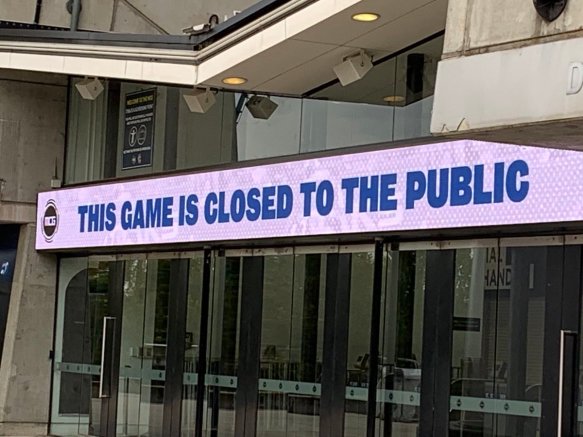


Social Distancing in Victorian Melbourne…

At the time of writing Victorians, like most of Australia, are living under a Covid19 “stay at home and practise social distancing” regime in attempt to “flatten the curve” and reduce the spread of this contagion. I have been working from home for 3 weeks, only going out for essential food shopping and a daily walk for exercise (since my gym is closed). This perambulation has revealed some lesser-seen aspects of Melbourne (apart from the empty streets), including the way the modern city’s 19th century founders went about their approach to urban design – including some examples of built-in social distancing.

The first example is the number of public parks and gardens close to the CBD that were established in the 1800s, and which have managed to survive the onslaught of developers. As we know, public parks, with their trees and green spaces act as the lungs of the city, and provide a place to exercise, relax and get some fresh air. So we need these facilities more than ever in times like these. (Strange why the Victorian Government still insists in allowing vehicles to use the culturally and historically significant Yarra Park as a public car park on so many days, with all the horticultural and environmental damage that this causes…)

Second, the decision to incorporate lane-ways into the grid design of the CBD, as well as throughout the 19th century expansion of the inner city suburbs. While their design was mainly pragmatic (ease of access for night carts, storm drainage), the result is that in densely-built areas such as Richmond, Carlton, East Melbourne, Fitzroy and Collingwood, lane-ways mean even terraced houses can have ample space between them and the next block, allowing for better ventilation, natural light and reduced risk of disease. (For an example of the lane-ways importance to Melbourne’s character and psyche, check out Daniel Crooks’ video, “An Embroidery of Voids”.)

Third, the decision not to build right up to the urban banks of the Yarra River (and the straightening and leveling of the river itself) has left them accessible to the public, both as a means of cycling and walking to/from work, and for recreational purposes. In many cities, riverfront access has largely been blocked off as adjacent land has been appropriated for private, commercial and industrial use.

At a time like this, I truly appreciate the foresight of Melbourne’s Victorian town planners – I just hope we can continue to enjoy their legacy in the coming weeks and months!

Next week: #Rona19 – beyond the memes


Brexit Blues (Part II)

Brexit finally came into effect on January 31, 2020 with a transition period due to end on December 31, 2020. It’s still not clear whether key issues such as the post-Brexit trade agreement between the EU and the UK will be completed by then (a major talking point being imports of American chlorinated chicken….). Nor is it clear which other areas of EU laws and standards will survive post-transition. Both of which continue to cause uncertainty for British businesses and local governments that have to operate within and enforce many of these rules. Add to that the recent UK storms and floods, the post-Brexit air of racism and xenophobia, plus the coronavirus outbreak and the resulting drag on global markets and supply chains, and maybe the UK will run out of more than just pasta, yoghurt and chocolate. Perhaps those promised post-Brexit savings of £350m a week really will need to spent on the National Health Service…..

The “Vote Leave” campaign bus, 2016 (Image sourced from Bloomberg)

The seeds of the Brexit debacle were sown in David Cameron’s speech of January, 23 2013. As I wrote last year, that set in motion a series of flawed processes. Despite the protracted Brexit process, it’s now unlikely that the decision to leave will be reversed, especially as the opposition Labour Party has just been trounced at the polls. Instead, Labour continues to beat itself up over the failure of its outgoing leadership either to make a solid case in support of the Remain vote in the 2016 Referendum, or to establish and maintain a clear and coherent policy on Brexit leading right up to the December 2019 General Election. The Conservative Party under Boris Johnson has a huge Parliamentary majority, a fixed 5-year mandate, and a general disregard for traditional cabinet government and the delineation of roles between political advisors and civil servants. We have already seen that any form of dissent or even an alternative perspective will not be tolerated within government or within the Tory party, let alone from independent and non-partisan quarters.

Since that fateful speech of January, 2013, it’s possible to follow a Brexit-related narrative thread in film, TV and fiction. Not all of these accounts are directly about Brexit itself, but when viewed in a wider context, they touch on associated themes of national identity, democracy, political debate, public discourse, xenophobia, anti-elitism, anti-globalism, and broader popular culture.

The earliest such example I can recall is Brian Aldiss’s final novel, “Comfort Zone”, (published in December 2013), while the first truly “Brexit Novel” is probably Jonathan Coe’s “Middle England” (November 2018). Somewhat to be expected, political thrillers and spy novels have also touched on these themes – Andrew Marr’s “Children of the Master” (September 2015, and probably still essential reading for Labour’s current leadership candidates); John Le Carre’s “A Legacy of Spies” (September 2017); John Simpson’s “Moscow, Midnight” (October 2018); and John Lanchester’s “The Wall” (January, 2019). (For another intriguing and contemporary literary context, I highly recommend William Gibson’s introduction to the May 2013 edition of Kinglsey Amis’s “The Alteration”. Plus there’s an essay on the outgoing Labour leader in Amis junior’s collection of non-fiction, “The Rub of Time” published in October 2017.)*

Elsewhere there have been TV dramatisations to remind us how significant, important and forward-looking it was when the UK joined the EEC in 1973 – most notably the chronicling of the Wilson and Heath governments as portrayed in “The Crown”. Even a film like “The Darkest Hour” reveals the love-hate relationship Britain has had with Europe. More distant historical context can be seen in films like “All is True” and “Peterloo”.

No doubt, Brexit will continue to form a backdrop for many a story-teller and film-maker for years to come. And we will inevitably see recent political events re-told and dramatised in future documentaries and dramas. Hopefully, we will be able to view them objectively and gain some new perspective as a result. Meanwhile, the current reality makes it too depressing to contemplate something like “Boris Johnson – Brexit Belongs to Me!”

*Postcript: hot off the press, of course is “Agency”, Willam Gibson’s own alternative reality (combining elements of the “Time Romance” and “Counterfeit World” referenced in “The Alteration”) – I haven’t read it yet, but looking forward (!) to doing so….

Next week: Joy Division and 40+ years of Post-Punk


Haring vs Basquiat

Following last week’s “compare & contrast” entry, another similar exercise this week, between artists Keith Haring and Jean-Michel Basquiat, the subject of the NGV’s summer blockbuster exhibition.

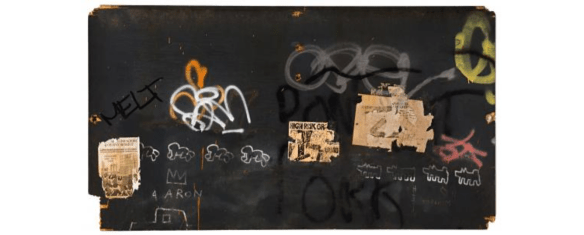
Keith Haring, Jean-Michel Basquiat, Other artists: “Untitled (Symphony No. 1)” c. 1980-83 [image sourced from NGV website]

Given their friendship, collaborations and mutual connections to the New York scene of the 1980s, it was only natural that the NGV went for this double-header retrospective. Since they both gained early recognition for their street art and graffiti-based work, and their images crossed over into the worlds of music, fashion and clubbing, they had a lot in common. They were as likely to be featured in style magazines such as The Face as they were to be found in the arts section (or society pages) of the New York Times.

Both died relatively young, and it’s as if they somehow knew they each had limited time, such is the intense pace at which they worked, as evidenced by their prolific output. If there is one element that really links them is their inner drive – they had to produce art, there was no choice for them, and they threw everything into it.

They each developed their own distinctive visual styles, much imitated and appropriated throughout popular culture, graphic design, video and advertising. Haring is known for his dog motif and cartoon-like figures, Basquiat for his iconic crown and text-based work. They also placed great emphasis on issues of identity, gender, sexuality and broader sociopolitical themes.

Where they perhaps differ is that Haring relied on more simplistic imagery (albeit loaded with meaning and context), using mainly primary colours, flat perspective (no shading or depth), and strong repetition. On the other hand, Basquiat’s paintings reveal confident mark-making, bold colour choices (not always successful), and an implied love of semiotics (even more so than Haring’s almost ubiquitous iconography).

Of course, we’ll never know how their respective work would have developed over the past 30 years – maybe what we now see is all there was ever going to be? As a consequence, there is perhaps a sense that they plowed a relatively narrow field, that they did not develop artistically once they became gallery artists. I’m not suggesting their work is shallow or one-dimensional (even though it can simply be viewed and appreciated “on the surface”), but it would have been interesting to see where their work took them.

Finally, we are still very close to the era in which they were active, and in that regard their true legacy will be in the influence they cast on late 20th century art and beyond.

Next week: Hicks vs Papapetrou