Music streaming is so passé…

Streaming services have changed the way we listen to music, and not just in the way the content is delivered (primarily via mobile devices), or the sheer number of songs available for our listening pleasure (whole catalogues at our fingertips).

These streaming platforms (which have been with us for more then 15 years) have also led to some more negative consequences: the deconstruction of albums into individual tracks (thereby undermining artists’ intention to present their work as a whole, rather than its component parts); shifting the relationship we have with our music collections from “ownership” to “renting”; paying paltry levels of streaming fees compared to royalties on physical sales and downloads; pushing suggested content via opaque algorithms and “recommender engines” rather than allowing listener self-discovery; squashing music into highly compressed audio formats, thus impairing the listening quality; and reducing album cover art work and design into tiny thumbnail images that don’t do justice to the original. (If you can’t appreciate the significance and importance of album art work, this forthcoming documentary may change your mind.)

Of course, streaming is not the only way to consume music – we still have vinyl, CDs and even cassettes in current production. (And let’s not forget radio!) Although optimistic numbers about the vinyl revival of recent years have to be put in the context of the streaming behemoths, there is no doubt that this antique format still has an important role to play, for new releases, the box-set and reissue industry, and the second-hand market.

For myself, I’ve largely given up on Spotify and Apple Music: with the former, I don’t think there is enough transparency on streaming fees (especially those paid to independent artists and for self-released recordings) or how more popular artists and their labels can pay to manipulate the algorithms, plus the “recommendations” are often out of kilter with my listening preferences; with the latter, geo-blocking often means music I am looking for is not available in Australia. (As I am writing, Spotify is playing a track which has been given the wrong title, proving that their curation and editorial quality is not perfect.)

Streaming can also be said to be responsible for a type of content narrowcasting – the more often a song is streamed (especially one that has been sponsored or heavily promoted by a record label) the more often it will appear in suggested playlists. Some recent analysis by Rob Abelow suggests that fewer than 10% of songs on the Spotify billion stream club were released before 2000. This may have something to do with listener demographics (e.g., digital natives), but it also suggests that songs only available as streams (i.e., no download or physical release), or songs heavily marketed by labels wanting to promote particular content to a specific audience, will come to dominate these platforms.

Further evidence of how streaming is skewed towards major artists is a recent post by Damon Krukowski, showing how independent musicians like him are being “encouraged” to be more like megstars such as Ed Sheeran. Never mind the quality of the music, just think about the “pre-saves” and “countdown pages” (tools which are not yet available to every artist on Spotify?).

I’ve been using both Bandcamp and Soundcloud for more than 10 years, to release my own music and to discover new content. I began with Soundcloud, but soon lost my enthusiasm because they kept changing their business model, and they enabled more popular artists to dominate the platform with “premium” services and pay-to-play fees that favour artists and labels with bigger marketing budgets. Whereas Bandcamp appears to be doing a better job of maintaining a more level playing field in regard to artist access, and a more natural way for fans to connect with artists they already know, and to discover new music they may be interested in.

But all of this simply means that streaming has possibly peaked, at least as an emerging format. The industry is facing a number of challenges. Quite apart from ongoing disputes about royalty payments and album integrity, streaming is going to be disrupted by new technologies and business models, thanks to blockchain, cryptocurrencies and non-fungible tokens. These startups are going to improve how artists are remunerated for their work, create better engagement between creators and their audiences, and provide for more transparent content discovery and recommendations. Elsewhere, the European Union is considering ways to preserve cultural diversity, promote economic sustainability within the music industry, remove the harmful effects of payola, make better use of content metadata for things like copyright, creativity and attribution, and provide clear labeling on content that has been created using tools like AI.

Just for the record, I’m not a huge fan of content quotas (a possible outcome from the EU proposals), but I would prefer to see better ways to discover new music, via broadcast and online media, which are not dependent on regimented Top 40 playlists, the restrictive formats of ubiquitous TV talent shows, or record label marketing budgets. Australia’s Radio National used to have a great platform for new and alternative music, called Sound Quality, but that came off air nearly 10 years ago, with nothing to replace it. Elsewhere, I tune into BBC Radio 6 Music’s Freak Zone – not all of it is new music, but there is more variety in each 2 hour programme than a week’s listening on most other radio stations.

Next week: More Cold War Nostalgia
 

Musical Idolatry

As a rebooted version of “Australian Idol” appears on network television, I can’t decide whether programs like this are a result of the current state of the music industry OR are they the cause of the industry’s malaise…?

I’ll admit upfront that I know I’m not the target demographic for these shows (Idol, Voice, Talent…), so I’m not even going to comment on the quality of the musical content or the presentation format.

Before we had recorded music or broadcast radio, the industry relied upon song writers selling sheet music, in the hope their compositions would get performed in theatres and concert halls – and audiences would want to buy copies of the songs to perform at home.

Then, radio largely killed the music hall, and with the advent of the 7″ vinyl record, together they eventually displaced the reliance on sheet music sales. From the early 1960s onwards, we also saw more artists writing, performing and recording their own material, which transformed both music publishing and the record industry itself.

Although record labels still exist as a means to identify, develop and commercialise new talent, only three of the so-called major labels have survived – a process of industry consolidation and M&A activity that began in earnest in the 1980s – ironically, a period now regarded as a “Golden Age” of pop music.

A key legacy of the punk movement of the 1970s was a network of independent music labels, distributors, publishers and retailers – along with a strong DIY ethic of self-released records and independent fanzines, thanks to lower production costs and easier access to manufacturing and distribution.

Now, there is more new music being released than is humanly possible to listen to. It is relatively quick and simple to produce and release your own music – record on a home laptop (even a tablet or smart phone will do), upload the finished mp3 files to user-accessible platforms such as Bandcamp and SoundCloud, and promote yourself on social media. However, without significant marketing dollars to buy an audience, those hoping to become an overnight viral sensation may be disappointed. And even if you do manage to get traction on one of the global streaming platforms, the income from digital plays is a fraction of what artists used to earn from physical sales.

So that’s how the major labels (and some of the larger independents) still manage to dominate the industry: they have the budget to spend on developing new talent, and they have money for marketing campaigns (and possibly to influence those streaming algorithms). Plus, they have access to a huge back catalogue that they can carry on repackaging at a fraction of the original production costs.

It’s also true, however, that the shorter shelf-life of many newer artists means that labels don’t have such an appetite for long-term development plans, where they are willing to nurture a new talent for several years, before expecting a return on their initial investment. Just as with fast fashion, the pop music industry has become hooked on a fast turnover of product, because they know only a fraction of new releases will ever become a hit, and they have to keep feeding the beast with new content.

Which brings me back to programs like Idol. First, it’s one way for the music industry to fast-track their next success. Second, it literally is a popularity contest – the industry gets an idea of what the public likes, so they can pre-determine part of their release schedule. Third, hosting these contests on commercial TV means advertising dollars and sponsorship deals can help defray their A&R and marketing costs (or, at least help them to prioritise where to spend their money).

But let’s not pretend that these singing shows are nothing more than televised karaoke. Performers don’t get to play their own songs, or even play any instruments (as far as I can tell). The program content relies on cover versions – usually songs that are well-known, and therefore already road-tested on the audience. Plus, by choosing to perform a particular song, a contestant may hope to win by association or identification with the successful artist who originally recorded it. But contestants are not free to choose whatever song they like – my understanding is there are only 1,000 (popular) songs to choose from, just like karaoke.

In pretending to discover new talent, in part, the industry is simply hoping to re-release songs in their back catalogue, albeit with a new face on the record. Through the restrictive format of these programs, the industry is not discovering new musicians or finding new song writers and composers, and it’s certainly not forging any new direction in music, because of the reliance upon an existing formula, and dependence on a very specific (and somewhat narrow) strand of pop music.

Next week: Eat The Rich?


I CAN live without my radio…

After posting my last blog on digital vs analog music, I saw the media commentary about the decline in Triple J’s audience numbers. There was a suggestion that younger people no longer listen to the radio, and have shifted to digital formats such as streaming and podcasts. As is often the case, the headline doesn’t necessarily tell the full story – and thanks to Tim Burrowes, we also have a deeper dive into the underlying data.

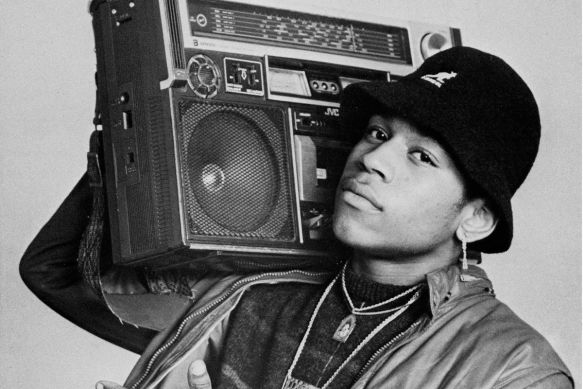
Seems like we CAN live without our radio (especially Triple J…) (Photo of LL Cool J by Janette Beckman, image sourced from Bloomberg)

I’m obviously not part of Triple J’s target demographic (18-24 year-olds), but I find the concept of age-oriented radio (and music) somewhat bizarre. If I was that age again, I’d probably find it highly patronizing that a national broadcaster was trying to force me into a random age bracket, on the assumption that they knew my taste in music, and/or they knew what was good for me. It’s an arrogant, simplistic and reductionist approach to broadcasting. Even now, I may not listen to all the exact same music I liked when I was that age, but my taste in music didn’t suddenly change when I turned 18 (or 24). Humans are much more subtle and idiosyncratic than demographers, marketers and programmers may like to think.

Anyway, it got me thinking about my own experience of listening to the radio, and how it formed my outlook on music. Once I had access to a portable transistor radio, it meant I got to choose which stations I listened to, and what types of music I heard, rather than what my parents or older sisters were listening to in the rest of the house. Although as a young teenager, I still kept an ear out for what was popular, I tuned out of the Top 40 format early on, in favour of pirate stations like Radio Caroline (which played mainly prog rock and psychedelic sounds), and the John Peel show on BBC Radio 1 (during his heyday of 1976-83 – the punk and post-punk era). When I first heard the whole of side 1 of Kraftwerk’s “Autobahn” album played on the radio in 1974 (I was 13 at the time), I realised that the 3 minute, 45 rpm, 7″ vinyl single wasn’t the only option…

Alongside broadcast radio, the UK’s infamous weekly music papers were the major source of information about the industry. With three titles, New Musical Express, Melody Maker, and Sounds, dominating the market in those pre-internet, pre-MTV days of yore, the inkies were the main way to find out about new bands, new releases, upcoming gigs, as well as album and live reviews. Then there were the listing magazines (which covered more than music), and the fanzines that proliferated in the wake of punk.

As I had more access to live music during my teenage years and beyond, music radio became less important. And although my gig attendance is more sporadic these days (no reflection on Melbourne’s excellent live music scene!) the only music radio stations I currently listen to are ABC Jazz, SBS Chill (especially Sunday mornings…) and Stuart Maconie’s Freak Zone on BBC Radio 6. I can’t bear to listen to most commercial radio or so-called popular music stations (age-oriented or otherwise) – it’s not only because of the music they play, it’s the actual production quality, programme format, presentation style and the absence of “space”: everything is crammed into every available piece of bandwidth, compressed within a decibel if its life, and the content lacks variety, depth or subtlety.

When I moved to Melbourne 20 years ago, ABC Radio National had a weekly programme called “Sound Quality”, that featured some of the most varied, interesting and challenging new music around – in fact, it was probably the only place to hear this stuff on national radio. It also encouraged listener-contributed content, and I was fortunate to have several of my own pieces played on air (ok, so I’m biased). Sadly, the programme was decommissioned in 2015, and nothing comprarable has taken its place.

In a further twist, I tend to hear about new (and old) Australian music via my local record stores, particularly the ones that specialise in vinyl, namely RockSteady Records, Northside Records, Dutch Vinyl and The Searchers.

Next week: Reflections on The Kimberley


Synchronicity

I’m not sure I fully subscribe to Jung’s theory of Synchronicity, where causally unrelated events occur at the same time, and seemingly take on a significant meaning; in many cases, a coincidence is just that. But recently I have been forced to consider the possibility that maybe Jung was right.

Over the past few months, I have been reading the 12 novels that comprise Anthony Powell’s “A Dance to the Music of Time”. Although I had never read them before, the books were familiar to me through a BBC Radio adaptation broadcast between 1979 and 1982, and a UK television mini-series from 1997.

Last weekend, and quite unrelated, a friend posted some music on-line – recordings made by the band we were in during the early 1980s. One of the tracks was a song I had written at that time, and whose title had been inspired by Powell’s magnum opus. But I hadn’t listened to or thought about this song for nearly 40 years.

Separately, and also by coincidence, in the last couple of days I have been listening to “The New Anatomy of Melancholy”, another BBC Radio series that draws its inspiration (and title) from Robert Burton’s 17th century tract on mood disorders. This series was first broadcast in May 2020 – no doubt prompted by the onset of the global pandemic, with its lock-downs, self-isolation and increased anxiety. And now the programme is being repeated, exactly 400 years after the publication of Burton’s original treatise – and at a time when we need his sage advice more than ever.

Until now, I hadn’t appreciated how self-absorbed (obsessed?) Powell’s narrator, Nicholas Jenkins, is by Burton – he even ends up publishing an academic text about this prescient Elizabethan writer. On one level, Jenkins is a proxy for his literary hero (as well as being Powell’s alter ego), and much of the 12-novel sequence is a response to Burton’s analysis on the causes of, and cures for, melancholia.

All of which may or may not prove Jung’s theory, but there is for me something of a personal thread between Powell, a song I wrote, and the BBC’s recent update on Burton.

Next week: The Last Half-Mile