Transition – post-pandemic career moves

Even before the latest lock-down v3.0 in Melbourne, one of the other members of my co-working space in the CBD decided they’d already had enough of being confined to a 5km radius, working from home, and other lock-down related restrictions. Having had their interstate travel curtailed over the past 12 months, and suffering from cabin fever, they have opted to spend the next few months living in and working from various Airbnb locations around regional Victoria. Even though they are used to WFH, recent experience has shown that they don’t need to be confined to one place. And this post-COVID shift in our work/life patterns (already being disrupted and enabled by remote working) is only increasing.

Likewise, a client I spoke to in the USA last week informed me that they had just settled into a new location on the west coast, and was “living the dream” of a nomadic existence.

More extreme is the recent example of a Guardian employee who, having had to travel from Sydney to the UK for a family funeral last year, then took several months to get back home (due to flight cancellations), but managed to keep working remotely from various European locations as he moved around to stay ahead of border closures.

Prior to this past weekend, and despite the city being out of Stage 4 lock-down for 3 months, private offices in Melbourne’s CBD have only been allowed to operate at 50% of capacity – the proposed move to 75% capacity has been put back. It means, for example, that even on a really good day, my local coffee shop is still only doing 60% of its pre-COVID business.

It’s my guess that the combination of office restrictions and many retail and hospitality businesses simply not bothering to re-open at all means the CBD is barely operating at 40-50%. It’s deceptive – some activities (e.g., construction) have continued pretty much unabated (even expanding while there is less traffic on the roads); while others have been shut down altogether (e.g., entertainment). Certainly food delivery services are still in demand, while some retail has been doing a bit better as customers appreciate the novelty of shopping in-person.

Monday to Friday in the CBD is like a bell-curve distribution – Mondays and Fridays are much quieter, as people choose to WFH part of the week. Which is challenging for employers, as they try to revert to “normal”. But assuming a mix of remote and on-site working continues, it probably means less overall demand for office space. (It’s also difficult to assess the impact of the CBD exodus on suburban hubs.)

So all that construction work suggests we will have an over-supply of commercial premises (offices, shops, restaurants and hotels).

Residential property is a similar story – student accommodation is far from full, as overseas students aren’t returning; and more inner-city apartment buildings are still going up, but there is something of an exodus from the city to regional and rural locations.

The latter tree- and sea-changes are being fueled by a number of factors: a desire to leave the city (which is more prone to lock-downs); low interest rates (so, cash out the equity in your suburban home and move to the country where your money buys you more); increased opportunity to WFH (see, 5G and the NBN have their benefits!); and a broader wish for a different work/life balance.

Unfortunately, this shift is also putting pressure on local housing supply – average property prices are going up faster in some regional centres than in the capital cities; and more nomadic lifestyles are driving up demand for short-stay accommodation. The combined effect is higher rental costs and reduced supply, tending to squeeze out the locals.

Ironically, we’ve heard farmers and primary producers in rural and regional Australia complain that they can’t get seasonal workers due to COVID restrictions on international visitors (especially students, back-packers and experienced fruit pickers). Conversely, we’re told that 90% of jobs lost after March last year have now been recovered – although this apparent rebound is mainly in part-time roles, not full-time positions. It would be interesting to see a detailed breakdown by industry, as some sectors (tourism, aviation, universities) are still struggling.

The hiatus (and disruption) brought about by COVID and subsequent lock-downs has no doubt prompted many people to reassess their careers: where do I want to live/work? what type of work do I want to do? which industries or companies are hiring? and for what roles? As part of a wider re- and up-skilling initiative, the Federal and State governments are offering a range of free vocational courses (mostly Cert I to IV programmes), as well as some enhanced “pathways” to trade apprenticeships.

While this is to be applauded, I can’t help feeling the effort is at least 5-10 years too late to address the technological, demographic and societal changes that began at the end of the last century, with the advent of the internet, cheaper technology, an ageing population, increased globalisation, inefficient taxation and tariff systems, and general economic restructuring. If nothing else, COVID has demonstrated the need for more resilience in the domestic economy, (and a reduced reliance on overseas imports and supply chains) such as smart manufacturing and food security.

Meanwhile, a friend of mine recently related that a nephew of his had dropped out of college (like many of his peers in the USA and elsewhere) and decided to become a self-taught expert in DeFi, as there is more chance of financial success (and career satisfaction) than obtaining an “off the shelf” bachelor degree….

Next week: Corporate Art
The Day That Can’t Be Named…

Today’s date, January 26th, has developed a deep identity crisis, much like the Australian psyche: who are we, how did we get here, and what does this day actually mean? A celebration of colonialism – or a day of indigenous mourning?

Leading up to this year’s public holiday, there has been: a muted response to suggested changes to the current National Anthem; a bewildering comment by the Prime Minister about finding equivalence in the circumstances of people sailing on the First Fleet and the impact those arrivals had on the indigenous population; constant bickering between the State and Federal governments about pandemic-related border controls (hardly an advertisement for Federation); renewed angst about the Australian cricket team (always a measure of the public mood); and an apparent drop in public support for an Australian Republic.

And there lies the nub of the issue. For some time now, it has felt that progress on a number of constitutional and cultural reforms has been hampered by the fact that Australia still hasn’t reached the maturity of declaring itself a Republic. The impediment to moving forward is the adherence to the post-colonial model of a Federation retaining the British Crown as the Head of State. The fact that we don’t formally recognise or celebrate Federation is in itself very telling.

Lack of maturity is endemic – from the habitual need to shorten words and phrases verging at times on baby talk (why on earth do the Prime Minister and the Leader of the Opposition choose to refer to themselves by their nicknames, “Scomo” and “Albo”?); to the suspicion of anything subtle, sophisticated or successful (the tall poppy syndrome).

Another foil to constitutional progression is the disproportionate influence (and position of privilege) that religious institutions retain in what is supposed to be a secular society.

Then there is the inability or reluctance to celebrate national success (apart from on the sporting field). Yes, Australia does “punch above its weight” in many areas, but there is so much inherent conservatism (small “c”) built into the system. The combination of 2-party politics, 3-tiers of government, cosy commercial duopolies, complex taxation, rigid regulatory frameworks, the laggardly trade union movement (not to say timid public policies on the environment, science, technology, education and the arts) inhibits innovation and experimentation. This institutional inertia (or conspiracy) all adds up to on overwhelming sense of acceptance, complacency and “she’ll be right”.

What if we had to work from the basis of some alternative histories? How would that change our views about January 26th? For example, what if either the French, Dutch, Spanish or Portuguese had colonised this land in the 17th or 18th century instead of the British arrived? What if the First Nations of Australia had developed metal tools and had fought back and won? What if Chinese fishing fleets or Indian trading vessels had established control of Australian waters and harbours long before the Europeans arrived? What if Indonesian or Malay tribes had settled here even further back than that? What if Japan had won the Pacific War?

This is not to excuse or justify the actions of the British in colonising the many nations that already existed in Australia, and all that followed from that. After all, the British Isles themselves had been invaded and conquered on many occasions over the centuries, so the First Fleet could be seen as a logical extension of that sequence of events. But perhaps this perspective can provide some additional context, helping us to reflect on the events and circumstances that have brought us to this point, and hopefully point to a way forward.

Next week: The Return of Cultural Cringe

Is the Party over?

In the wake of allegations and revelations concerning election shenanigans, branch stacking, dodgy donations, and other improper behaviour by MPs, our trust in the democratic process is being severely challenged.

At the heart of the democratic process are the core principles of universal suffrage, and the open nomination and free election of individual candidates. However, in reality, it’s the party system that gets people elected, even though political parties are not mentioned in the Australian Constitution.

Thanks to factional disputes, evidence of corruption and general party machinations, I don’t believe voters are being well-served by their elected representatives. The highly partisan nature of party politics is making it increasingly difficult to build consensus or build inclusive, progressive and sustainable policy outcomes – even within the same party!

At the risk of making a huge generalisation, the problem I have with most politicians is that they have to play the party game in order to get selected, elected and re-elected. Thus they are overly beholden to the party that “backs” them (factional elements and all) rather than the electorates they purport to represent.

Look what happened to both Kevin Rudd and Malcolm Turnbull during their (brief) terms as Prime Minister: neither had a sufficient power base in their respective parties that they could rely on for support. (Both essentially came unstuck on energy and climate policies. And interesting to note that despite their differences whilst in office, they seem to have found a modicum of mutuality around media ownership – and I’m sure they agree on a whole lot more, they just aren’t allowed to admit it in public.)

Also, it’s a paradox that once elected (especially to leadership roles) most politicians seem to lose the power of natural speech. Instead, they feel compelled to use tortuous and convoluted verbiage to avoid saying what they actually think, because the internal logic and policy constraints of party-think over-rules common sense.

Over the years, I’ve heard various politicians speaking at first hand at non-party and non-Parliamentary events, including Keating, Hockey, Tanner, Turnbull, and Morrison. As a general observation, they are far more engaging, authentic and sincere when they are away from the hustings, pressers or dispatch boxes. It seems as if they all appear to lose a huge part of their humanity as a result of elected office, and the strictures of the party machine.

So has the political party had its day? Increasingly, that feels to be the case. Which is a dangerous thought, given the fundamental requirement to build policy platforms to take to the electorate, and the essential nature of Parliamentary democracy to have a functioning opposition to hold the Government accountable. Plus, we need a healthy democracy to ensure a pluralistic, inclusive, secular and liberal (small ‘L’) society. Dictatorships thrive in one party states, theocracies and autocracies alike.

Unfortunately, the media finds itself having to pander to the increasingly shrill, strident and destructive discourse of party politics. The press has to play along with “gallery briefings” and “doorstops” (i.e., selected disclosure at best, selected leaking at worst). I also hate the whole process of policy testing via party focus group soundbites rather than considered debate in Parliament.

I have seen some recent suggestions that political parties should be banned (dangerous precedents there…) or that election candidates shouldn’t reveal in advance their party affiliation. Whilst the latter idea has some appeal, how would we know where their backing comes from if they don’t disclose their party membership? Perhaps we should also ban all political donations, campaign funding and paid-for ads (and/or introduce stringent “truth in advertising” laws). Or, what if every candidate can only spend an equal amount, whose budget is drawn from Government funds, and only once they have secured the minimum amount of voter support to stand for election in the first place?

I don’t have the answers, and even with “non-party affiliation”, candidates would self-identify or be tagged as belonging to a particular vested interest. But the party system looks increasingly broken, and the nature of binary politics is not helping us to address or solve the enduring problems of our age.

Next week: Coming out of our shells

Are we there yet?

A couple of weekends ago in Melbourne, the question on many peoples’ minds was, “Are we there yet?” Namely, had the rate of new Covid-19 cases slowed down to the point where we could start to emerge from one of the longest and strictest lock-downs in the world? The answer was, “Yes, but not to the satisfaction of the government and their public health advisers.” So the opening up was pushed back again, having been brought forward by the very same government. It felt like the goal posts had been moved, and despite the huge sacrifices made by the general population, we were being asked to take a “cautious pause”.

No wonder some people got a bit uptight, and it took some tedious questioning from the media to establish what the Premier could have said at the outset of his umpteenth daily press conference. Yes, the Premier was tired, and he had been up late the night before, and he’d done over 100 pressers on the trot by that point. But you could hear and see the exasperation in his voice and in his body language as he realised how he’d managed to miscommunicate what should have been positive news – i.e., “We’re very close, everyone, and thank you all for your efforts, but just to be absolutely sure, please give me a couple of days more before I can confirm the decisions the government have already made.”

At the time of writing, people in Melbourne are still under pandemic restrictions, some of which have been in place since March:

  • If you can work from home, you must work from home
  • There is a limit on the number of people who can come to your home
  • There is also a limit on the size of gatherings in public
  • You can’t travel more than 25km from home
  • You can’t travel outside the Greater Melbourne area
  • Retail and hospitality are only allowed to open under strict conditions
  • Everyone must wear a face mask in public

And while there are some exceptions to each of the above, under the current State of Emergency, the government can rescind or reimpose each and every condition, or add new ones as they deem appropriate – including re-introduction of the overnight curfew, which seems to have been a political decision as much as one made on grounds of public health or public order.

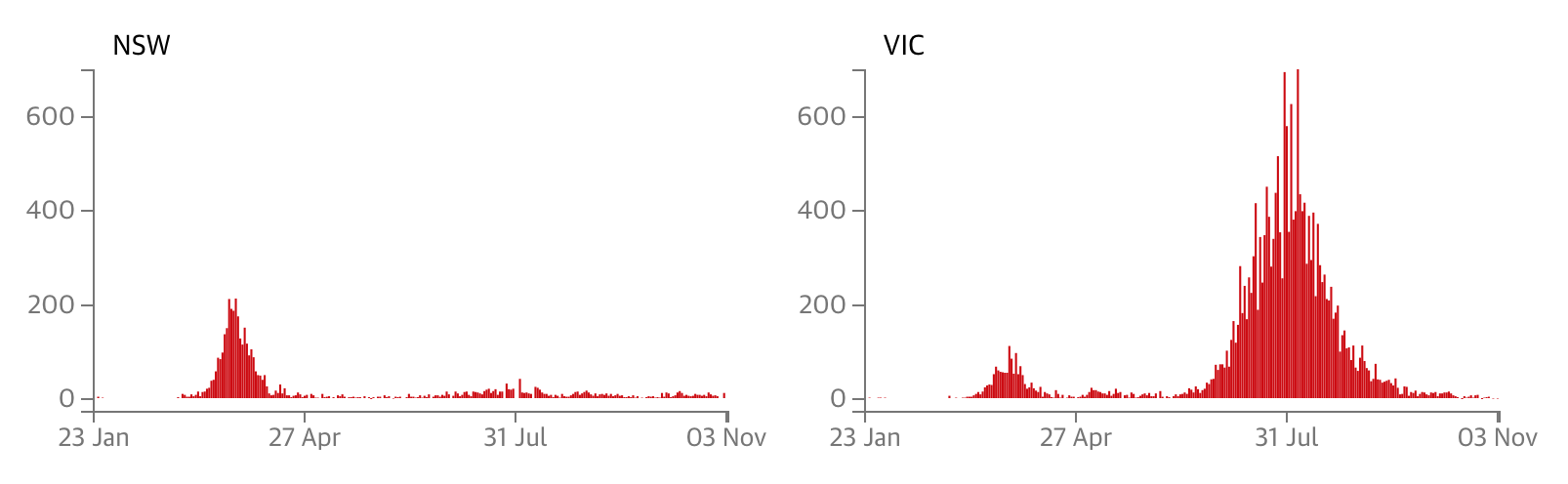
I should say that I was in favour of the first lock-down in Victoria. In fact, I was actually glad that the Victorian Premier took a more conservative approach than some of his counterparts, which meant that during lock-down #1, Victoria appeared to be doing a much better job than NSW in containing the spread of the virus, when comparing the daily number of new cases in March and April. But I think the Victorian government should have gone harder when they had the chance, to nip it in the bud:

Charts sourced from The Guardian

However, masks weren’t made compulsory until much later during the so-called second wave, and lock-down #2. There could be several reasons for this:

  • Medical opinion was divided as to the efficacy of masks
  • The government wanted to reserve supplies for medical and other front line workers
  • There was inadequate public supply, partly because stocks had been diverted to regions impacted by the summer bush fires (and, initially, some local stocks had been donated to aid projects and sent overseas to China)
  • There were already too many other social behaviour changes that were needed, and which were deemed a higher priority

I’m not sure why there is still so much local resistance to wearing masks in public. Many people think it’s an infringement of their civil liberties, or they question the science, or they simply don’t like being told what to do. For men, I wonder if they feel that wearing a mask somehow emasculates them? For women, does it make them feel even more invisible than they already are in society? And for the ardent civil libbers, don’t any of them understand the concept of the mutual duty of care we each owe to our fellow citizens (even the self-styled, self-sovereign ones)? Having spent a lot of time in Asia, where social norms mean it is quite common to see people wearing masks in public, I guess I am less resistant to the idea. So much so, that I started wearing them in Melbourne before they became mandatory.

Of course, over 90% of locally-acquired cases which caused the second wave of new infections were directly the result of the failed hotel quarantine programme in two Melbourne hotels. I’ve commented on this fiasco before, and now the recent Board of Inquiry set up to investigate what happened has asked for an extension before delivering its verdict, owing to the late submission of evidence by key witnesses, including civil servants, public officials and elected representatives. As I wrote previously, the decision to engage private security to manage the quarantine programme is not the issue – it’s the decision-making process itself (referred to as “creeping assumptions”), and the oversight of the programme once it was established.

At this stage, we still don’t know who made the decision to hire private security companies; it’s not entirely clear which government department had oversight of the programme, as there was confusion and poor communication between departments; it’s also not clear whether the chosen security companies were on existing lists of Commonwealth- or State- approved contractors – and if they weren’t, what criteria were applied to employ them? And how did the other states manage to avoid the same level of community transmission that could have come from their own quarantine measures?

Anyone who has worked in or around government procurement will know how difficult it is to get on a contractor “panel”, and even then, the tendering process can be arduous and opaque. From my own experience, governments often use RFI/RFP/RFQ processes to glean as much intelligence as they can (with a view to keeping the project in-house), or to simply drive down the price, rather than to get the most qualified supplier at the best and most appropriate commercial rate. (And of course, there are examples of ex-civil servants forming their own businusses in order to tender for work they used to allocate – using their insider knowledge to the detriment of other bidders. In some cases, the civil servants don’t even wait to leave office….)

I appreciate there is a widely-held view that the breakdown in the hotel quarantine programme was not the only or direct cause of the second wave in Melbourne; but even if it were, it was the failure of the Commonwealth government to manage properly the private aged care facilities under their jurisdiction, which in turn revealed huge vulnerabilities in that sector, leading to the death of around 800 elderly Victorian residents from Covid-19. While I don’t doubt the inadequacies in aged care “settings”, I would have more sympathy with this argument if we had seen the same level of infections in aged care facilities in other states, particularly NSW, given that each state is under the same regime. The “mishaps” of the hotel quarantine programme sit front and centre as the root causes of the second wave, leading to the much severer lock-down #2.

Meanwhile, although the Premier likes to thank everyone for “doing the right thing” during the lock-down, he and his administration had a highly subjective attitude towards those members of the public who clearly weren’t doing the right thing. At times the rhetoric was merely ambivalent; other times it was highly ambiguous; occasionally it was disingenuous (if not wrong). This inconsistency and selective admonishment helped create further confusion among the public about how/when the various lock-down restrictions would be enforced. Worse, it sowed the seeds of growing discontent and underlying resentment in many parts of the community. And not helped by the apparent assertion that community cases among health care workers were all acquired in domestic “settings”, rather than in workplace “settings”.

Some of the other factors that may have contributed to Victoria’s second wave (and which have inter-state and national implications going forward as the domestic borders begin to re-open) include:

  • A highly centralised public health system (the current Premier was formerly the state Minister for Health, so no doubt he will have some views on that)
  • Inadequate PPE supplied to front-line medical staff and health workers in hospitals and clinics
  • Poor inter-departmental and inter-agency communication and co-ordination (plus those “creeping assumptions”)
  • A poor culture of “managing up” within ministerial offices (oh, and those “creeping assumptions”)
  • Confusion over respective roles and responsibilities, for example, as between the Chief Health Officer, the Chief Medical Officer and the Chief Preventive Health Officer
  • “Track and trace” systems not fit for purpose
  • Lack of common definitions across the country – e.g., hot spot, complex case, mystery case, locally acquired case, quarantine and isolation periods, close contact, etc.
  • Lack of common IT systems for “track and trace” – so without inter-state interoperability, how is that going to work as people start traveling around the country again?

One “common” definition that definitely needs to be established is what constitutes a “household”? I’m not sure if there is a practical legal definition – maybe the Census form is one point of reference? (Perhaps another “test” is the supermarket offer, which usually says “only 1 per household”?) I would have said that a “household” is defined as a group of people who ordinarily live in the same dwelling or residence (whether a house, apartment, unit, rooming house, care home or hostel), regardless of whether they are related to one another, and regardless of whether they consider themselves as “living together”. Conversely “household” does not automatically mean everyone in your immediate or extended family. Where the lines have become blurred is when family members are frequently in each other’s homes for the purposes of sharing meals, care-giving or child-minding. The issue is not one of mere semantics – as we have seen, it is critical both in terms of preventing community transmission, and in enforcing quarantine and isolation measures.

Finally, I should also stress that I am very grateful to be living in Australia at present during this global pandemic, especially given the situation in many other countries. But at the risk of sounding parochial, I really would like to understand why Victoria got it so wrong (and has had to endure a second and onerous lock-down), and how NSW (so far) appears to have got it just about right.

Next week: From Brussels With Love (Revisited)