Bringing Back Banter

Last week I watched “The Trip To Spain”, the latest in the “Trip” franchise. For anyone who has not yet seen these films (or the TV series from which they are compiled), the narratives revolve around a pair of actors playing fictional versions of themselves, as they embark on road trips to sample some of the best restaurants, hotels and historic locations. The semi-improvised dialogue between the two main characters is classic banter – as in “the playful and friendly exchange of teasing remarks“.

The gentle art of banter is at the heart of “The Trip To Spain” – Image sourced from British Comedy Guide

Sadly, just as the public discourse has become much uglier in recent years (despite various calls for a “kinder, gentler politics”), it seems there is something of a backlash against neo-banter (or “bantaaaaaaah!” as some would have it). Maybe there is a connection?

If our political leaders cannot engage in the natural ebb and flow of an ideological discussion shaped as informed conversation (rather than embarking on all out verbal warfare), then don’t be surprised if this is the same boorish, belligerent and bellicose tone adopted by protagonists in social media, op eds and parliamentary “debates”. (And I am not defending anyone who uses the term “banter” to excuse/explain the inappropriate.)

Banter can help to explore hypothetical scenarios, suggest alternative opinions, and take a discussion in different directions, without participants being hidebound by the first thing they say. Plus, if done really well, it allows us to see the ultimate absurdity of untenable positions.

Next week: Supersense – Festival of the Ecstatic


Bitcoin – to fork or not to fork?

Anyone following the crypto-currency markets this past two weeks will be fully aware that this has been a turbulent time for Bitcoin and other blockchain assets. First, the SEC published its Report on the DAO.  Second, there was a significant arrest in connection with the Mt Gox failure. And third, Bitcoin underwent a fork which has resulted in a new version, known as Bitcoin Cash. Meanwhile, at the time of writing, the price of Bitcoin itself is testing renewed highs, and continues to enjoy a 3-month long rally.

What implications do each of these developments have for the digital asset industry?

Photo by Andre Chinn – Image sourced from Flickr under Creative Commons

The Mt Gox-related arrest came as Japanese authorities began separate criminal proceedings against the former head of the failed exchange. These developments underscore two things: 1) as with any complex financial fraud investigation, bringing the culprits to justice takes time. 2) exploiting the financial system for ill-gotten gain is not exclusive to crypto-currencies – just ask investors in Australia’s CBA bank how they feel about losing nearly 4 per cent of the value of their shares in one day on the back of a money laundering scandal.

It also means that as regulators play catch-up, exchanges, brokers and other participants in the crypto-currency markets will need to ensure that they are updating their security and privacy systems (to prevent future hacks) while ensuring they comply with AML/KYC/CTF provisions. No bad thing, to instil confidence and trust in this emerging asset class, which is entering a new phase of maturity.

The SEC Report on the DAO, meanwhile, has put ICO’s (Initial Coin Offering) and TGE’s (Token Generation Event) on notice that in some cases, these products will be treated as securities, and will be subject to the same regulation as public offers of shares etc. As a result, token issuance programs will need to structure their sale processes to be either fully compliant with, or exempt from, the regulations; at the very least, they must remove any suggestion that these tokens are capable of creating security interests in financial or dividend-bearing assets, unless that is the express intention. (In some cases, these tokens are sold as membership services, software and IP licenses, or as network access permits. Any “return” to the buyer comes from the network value effects, service discounts or user rewards, similar to frequent flyer schemes and customer loyalty programs.)

Again, this suggests a coming of age for digital assets, and a growing maturity in the way token sales can be used as an alternative to VC funding and other traditional sources of raising operating capital and project financing.

The Bitcoin fork was hugely anticipated, with a mix of fear and excitement – fear because of the unknown consequences, excitement at the prospect of Bitcoin holders getting “free money” in the form of “Bitcoin cash“, via a 1:1 issue. Without getting into the technical details, the fork was prompted by the need to increase Bitcoin’s blockchain processing speed and transaction capacity; and while nearly everyone connected to Bitcoin’s infrastructure agreed on the need to accelerate block performance, there was a schism as to how this should be achieved. Some exchanges said they would not recognise the new currency, and only some Bitcoin miners said they would engage with it (especially as the cost of mining the new asset was more expensive than Bitcoin core). In addition, most exchanges were advising their customers not to attempt performing any Bitcoin transactions for several days, before and after the fork, until the system settles down again.

In the aftermath of the fork, at least one more exchanges has said it will probably offer some support Bitcoin cash; while due to the nature of the fork, Bitcoin cash’s own block processing time was something like 6 hours – meaning transactions could not be confirmed, and holders of the new asset could not easily transfer or sell it, even if they wanted to. It feels like a combination of a liquidity squeeze, a trading halt, and a stock split resulting from a very complex corporate action.

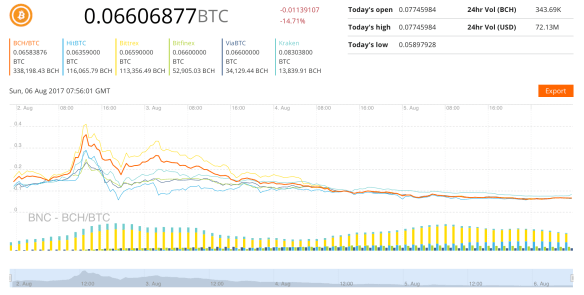
So far, the value of Bitcoin has held up, while the value of Bitcoin cash has steadily declined (despite an early spike), almost flat-lining to less than one-tenth of the value of Bitcoin:

Relative value of Bitcoin cash (BCH) to Bitcoin (BTC) – Market Data Chart sourced from Brave New Coin

I’m not a “Bitcoin absolutist“, as I think different currency designs and technical solutions will continue to emerge based on specific use cases. These products will continue to co-exist as markets come to understand and appreciate the different attributes and functionality of these digital assets.

As a consequence of recent events, some new token projects are refining the design of their issuance programs, more legal opinions are being commissioned, and raise targets are being adjusted in light of the current climate. But the number of new projects coming to market shows no sign of abating, and the better projects will have successful and sustainable sales. The total market cap of all digital assets is now well over $100bn (although the data reveals something of an 80:20 scenario – the top few assets account for the bulk of that value); and more institutional investors and asset managers are taking a greater interest in this new asset class.

NOTE: The comments above are made in a purely personal capacity, and do not purport to represent the views of Brave New Coin or any other organisations I work with. These comments are intended as opinion only and should not construed be as financial advice.

Next week: Bringing Back Banter   


ASIC updates – Sandbox and Crowdfunding (plus #FinTech Hub)

In recent weeks, ASIC Commissioner, John Price and his team have been making presentations to the FinTech community on two key topics: the ASIC Regulatory Sandbox, and the forthcoming Equity Crowdfunding legislation.

Image by TeeKay, sourced from Wikimedia

blogged about the sandbox when it was announced last year, and at the time, the proposed safe harbour provisions for FinTech startups were seen as being key to fostering innovation within the sector. However, at the time of the presentation I attended (June 13), there was only one confirmed participant in the sandbox scheme. According to the Commissioner, the low take-up was probably due to the timing of the regulations, being so close to summer holidays.

On the other hand, the sandbox has such a limited application, that the Government is proposing to expand its scope to include the provision of products (not just distribution), the provision of credit services, and to extend the current 12-month license waiver period to two years.

The Commissioner also mentioned the consultation process on RegTech combined with a hackathon event to be held later this year, as evidence of the direction the ASIC Innovation Hub is taking. Let’s just hope they can keep up with how fast the FinTech community (especially in blockchain and crypto-currency) is evolving, since regulation usually lags innovation.

At a separate series of FinTech and startup briefings, Mr Price discussed the new equity crowdfunding provisions, due to take effect on September 29. Currently undertaking a consultation process on the detailed regulations, the legislation applies only to ordinary shares issued by companies with a maximum of $25m in assets and annual turnover, and which become public companies once the legislation comes into force.

Eligible crowd-sourced funding companies (CSF’s) can raise a maximum of $5m per annum, and investors can invest a maximum of $10,000 per company each year. CSF’s cannot invest in other businesses or securities, and cannot have simultaneous multiple offers on participating crowdfunding platforms.

The Commissioner spoke about the temporary reporting and corporate governance concessions under the scheme: eligible public companies don’t need to have Annual Public Meetings or audited accounts for a period of 5 years; and the offer documents do not have to be as detailed as a full IPO prospectus. Whether these concessions will be enough to attract issuers, or whether the limitations prove more of a deterrent, it will be interesting to see if the new legislation meets the expectations of government, ASIC, issuers and investors.

Meanwhile, things are getting interesting for anyone following the FinTech hub story, and the perennial Melbourne-Sydney startup rivalry:

First, the Victorian government has issued an RFP for a Melbourne FinTech Hub (submissions close tomorrow…). The state government has also announced its partnership with Fintech Australia and others to host the intersekt festival, following last year’s Collab / Collide event.

Second, Melbourne’s York Butter Factory has recently announced plans to expand into Sydney. While not purely a FinTech hub, this new venture will feature the Commonwealth Bank as an anchor tenant. With former ANZ CEO Mike Smith as its Chair, YBF might also be expected to make a submission to the Victorian RFP.

Third, Sydney’s Stone & Chalk has just announced it will be opening a new FinTech hub in Melbourne. Given that a number of key Melbourne-based financial institutions (such as ANZ, NAB, AustralianSuper, Findex, Genworth and Liberty Financial) are backing this new venture, could it suggest they can’t wait for the Victorian RFP process to finish?

Next week: StartupVic’s Machine Learning / AI pitch night


Law and Technology – when AI meets Smart Contracts…

Among the various ‘X’-Tech start-up themes (e.g., FinTech, EdTech, MedTech, InsurTech) one of the really interesting areas is LegTech (aka LawTech), and its close cousin, RegTech. While it’s probably some time before we see a fully automated justice system, where cases are decided by AI and judgments are delivered by robots, there are signs that legal technology is finally coming into its own. Here’s a very personal perspective on law and technology:

Photo by Lonpicman via Wikimedia Commons

1. Why are lawyers often seen as technophobes or laggards, yet in the 1980s and 1990s, they were at the vanguard of new technology adoption?

In the 1970s, law firms invested in Telex and document exchange (remember DX?) to communicate and to share information peer-to-peer. Then came the first online legal research databases (Lexis and Westlaw) which later gave rise to “public access” platforms such as AustLII and its international counterparts.

Lawyers were also among the first professional service firms to invest in Word Processing (for managing and drafting precedents) and e-mail (for productivity). Digitization meant that huge print libraries of reference materials (statutes and case-law) could be reduced to a single CD-ROM. Law firms were early adopters of case, practise, document and knowledge management tools – e.g., virtual document discovery rooms, precedent banks, drafting tools.

2. But, conversely, why did the legal profession seem to adopt less-optimal technology?

The trouble with being early adopters can mean you don’t make the right choices. For example, law firms in the 80s and 90s seemed to demonstrate a preference for Lotus Notes (not Outlook), Wang Computers and WordStar (not IBM machines or MS Office Word), and DOS-based interfaces (rather than GUIs).

Some of the first CD-ROM publications for lawyers were hampered by the need to render bound volumes as exact facsimiles of the printed texts (partly so lawyers and judges could refer to the same page/paragraph in open court). There was a missed opportunity to use the technology to its full potential.

3. On the plus side, legal technology is having a significant a role to play…

…in law creation (e.g., parliamentary drafting and statute consolidation), the administration of law (delivery of justice, court room evidence platforms, live transcripts, etc.), legal practice (practice management tools) and legal education (research, teaching, assessment, accreditation). Plus, decision support systems combining rules-based logic, precedent and machine learning, especially in the application of alternative dispute resolution.

4. Where next?

In recent years, we have seen a growing number of “virtual” law firms, that use low-cost operating models to deliver custom legal advice through a mix of freelance, part-time and remote lawyers who mainly engage with their clients online.

Blockchain solutions are being designed to register and track assets for the purposes of wills and trusts, linked to crypto-currency tokens and ID management for streamlining the transfer of title. Governments and local authorities are exploring the use of distributed ledger technology to manage land title registration, vehicle and driver registration, fishing permits and the notion of “digital citizenship”.

We are seeing the use of smart contracts powered by oracles on the Ethereum blockchain to run a range of decision-making, transactional, financial, and micro-payment applications. (Although as one of my colleagues likes to quip, “smart contracts are neither smart nor legal”.)

Artificial Intelligence (AI) is being explored to “test” legal cases before they come to trial, and more knowledge management and collaboration tools will continue to lower the cost of legal advice (although I doubt we will see lawyers being totally disintermediated by robots, but their role will certainly change).

There is further opportunity to take some of the friction and costs out of the legal system to improve access to justice.

Finally, and this feels both exciting and scary, is the notion of “crowd-sourcing policy“; some governments are already experimenting with hackathons to develop policy-making models, and even the policies themselves. But this does sound like we would be moving closer and closer to government by mini-plebiscites, rather than by parliamentary democracy.

Next week: Digital currencies are the new portals