Sakamoto – Opus

Live concert films are mostly formulaic. The audience filing into the venue. The performers warming up backstage. The band close ups, the cutaways to the wings, then zooming out to the ecstatic crowd. The sweaty and exhausted atmosphere in the dressing room afterwards. Sometimes the live footage is inter-cut with interviews, location footage, and the “making of” narrative. Occasionally, there will be scenes shot on the road, revealing the inevitable tedium and monotony of live touring.

A few notable exceptions have tried to break with this format, to present something more dramatic, more mystical, even mythical – think of Pink Floyd’s “Live in Pompeii” (knowingly echoed by Melbourne’s own Mildlife), Talking Head’s “Stop Making Sense”, and David Bowie’s “Ziggy Stardust And The Spiders From Mars”.

Often, the concert film becomes a souvenir. For those who were there, it enables them to relive the experience. For those who weren’t, they may get some vicarious thrill, but they won’t get to experience the performance as it was fully intended. These films can make us feel we missed out on an historic event, but they can also remind us why we are glad not to have been there at all (the Rolling Stones at Altamont?).

Many concerts these days (and the accompanying Blu-Ray discs) are all about the spectacle, sometimes at the expense of the actual music. Choreographed to within an inch of their lives, these shows leave very little to chance or the unexpected, with their troupes of dancers, video backdrops, somersaults and acrobatics, multiple costume changes, “forced” audience participation, and the “surprise” guest appearances during the encores….

So the footage of the final live performance by the late Ryuichi Sakamoto goes against this trend. Filmed alone, on piano, in stark black and white, and with no audience, no voice-overs and no talking heads, “Opus” is not strictly speaking a concert. Due to his failing health, Sakamoto was unable either to withstand the rigours of touring or to perform a single concert. Instead, these performances were shot in stages, and edited together to form a seamless programme, with nothing but Sakamoto, a piano, and the music, plus some very subtle lighting and framing. The sound recording is brilliant, and the content covers most aspects of Sakamoto’s illustrious and prolific career. It’s a fitting tribute, and a perfect counterpoint to “Coda”, the documentary he made when he had just come through an earlier health scare.

Sometimes, less is more.

Next week: Severance….
AI vs IP

Can Artificial Intelligence software claim copyright in any work that was created using their algorithms?

The short answer is “no”, since only humans can establish copyright in original creative works. Copyright can be assigned to a company or trust, or it can be created under various forms of creative commons, but there still needs to be a human author behind the copyright material. While copyright may lapse over time, it then becomes part of the public domain.

However, the extent to which a human author can claim copyright in a work that has been created with the help of AI is now being challenged. A recent case in the USA has determined that the author of a graphic novel, which included images created using Midjouney, cannot claim copyright in those images. While it was accepted that the author devised the text and other prompts that the software used as the generative inputs, the output images themselves could not be the subject of copyright protection – meaning they are either in the public domain, or they fall under some category of creative commons? This case also indicates that, in the USA at least, failing to declare the use of AI tools in a work when applying for copyright registration may result in a rejected application.

Does this decision mean that the people who write AI programmes could claim copyright in works created using their software? Probably not – as this would imply that Microsoft could establish copyright in every novel written using Word, especially its grammar and spelling tools.

On the other hand, programmers and software developers who use copyright material to train their models may need to obtain relevant permission from the copyright holders (as would anyone using the AI tools and who uses copyright content as prompts), unless they could claim exemptions under “fair dealing” or “fair use” provisions.

We’re still early in the lengthy process whereby copyright and other intellectual property laws are tested and re-calibrated in the wake of AI. Maybe the outcomes of future copyright cases will depend on whether you are Ed Sheeran or Robin Thicke….

Next week: Customer Experience vs Process Design


Eat The Rich?

There has recently been a spate of satirical films and TV series that take aim at the vanity, self-indulgence and sense of entitlement of the uber-rich. I’m thinking in particular of “The Menu”, “The Triangle of Sadness”, “Glass Onion” and “White Lotus”.  You could also include “Succession” on that list (especially in light of the latest revelations from the House of Murdoch), but this is more of a traditional drama than the others, both in terms of format and content.

Nothing radically new in these stories, their themes or the way they plot their narratives. What is perhaps surprising is the fact that these are not small, independent, art-house productions. They have substantial budgets, exotic locations, stylish design, creative cinematography, and some big names in the credits.

Plus, they receive major theatrical releases, or are luring audiences to premium streaming services. So, they are generally commercial. Best of all, they are attracting awards and nominations – which should hopefully encourage studios to invest in more projects like these (rather than green-lighting yet another sequel in the never-ending round of comic book and super hero franchises).

Of course, these particular stories could simply represent a sign of the times, reflecting current world events, and holding up a mirror to our social-media obsessed age. They also resonate with audiences who are looking for some escapism in the form of critiques of the upper classes, the filthy rich, the social elites, the global power brokers, and those hangers-on who hover and follow in their wake.

I wouldn’t suggest these productions are waging a form of class war, but they represent a kind of morality play: why would anyone want to feel jealous of, let alone become, these people?

Next week: A Journey Through England


William Kentridge – Modern Polymath

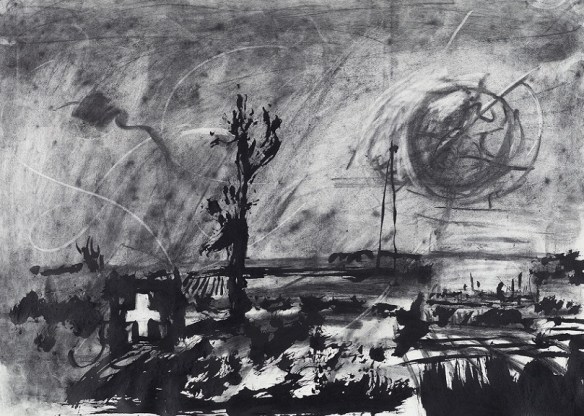
For the next couple of weeks, an exhibition of work by William Kentridge is showing at Australian Galleries in Melbourne – and I highly recommend it. If you are familiar with his art, you’ll know what to expect; but if the name is new to you, then hopefully you will be curious enough to give it a go. Kentridge is both prolific, and proficient, across many media – this current exhibition includes prints, drawings, sculptures, tapestries and films.

William Kentridge – “Untitled (Drawing from Wozzeck 2)” (2016) – Image sourced from Australian Galleries

I think I first became aware of Kentridge’s work via his multimedia installation, “What Will Come (has already come)” when it was shown at the Städel Museum, Frankfurt in 2007. Thanks to his distinctive style and use of recurring motifs, once you see one of his prints or drawings, you can easily recognise other pieces by him. Using a graphic-based visual language and free-flowing lines in his mark-making, he also incorporates polemic and performance into his work. In addition to his stage design and production, his films and stop-motion animations portray the artist as actor, literally sketching out his lines across paper, wall and screen. Images of coffee pots, oil rigs, megaphones, tripods and windmills feature in many of his works, and he is also drawn to three key texts: Mozart’s “The Magic Flute”, Alfred Jarry’s “Ubu Roi”, and Nikolai Gogol’s “The Nose”.

Since that first encounter in 2007, I have been fortunate to see a few of Kentridge’s key exhibitions, most notably “Five Themes” (2010) at MoMA, New York (which later came to ACMI, Melbourne), and “Thick Time” (2016) at Whitechapel Gallery, London (and later at The Whitworth, Manchester). I also hope to see his major retrospective at London’s Royal Academy later this year.

All of which makes this exhibition at Australian Galleries a remarkable achievement for a local commercial space. If there is one piece that could sum up Kentridge’s artistic CV, it would have to be “Black Box/Chambre Noire” (2005) – this YouTube video does a pretty good job, but you need to see this mix of installation, automata, video, sculpture and audio in the flesh to appreciate the full effect. Luckily, there is a related video, “Preparing the Flute” (2004), based on a similar installation work, in the current show in Melbourne.

Next week: Lightscape