AI and the Human Factor

Earlier this month, I went to the Melbourne premiere of “Eno”, a documentary by Gary Hustwit, which is described as the world’s first generative feature film. Each time the film is shown, the choice and sequencing of scenes is different – no two versions are ever the same. Some content may never be screened at all.

I’ll leave readers to explore the director’s rationale for this approach (and the implications for film-making, cinema and streaming). But during a Q&A following the screening, Hustwit was at pains to explain that this is NOT a film generated by AI. He was also guarded and refrained from revealing too much about the proprietary software and hardware system he co-developed to compile and present the film.

However, the director did want to stress that he didn’t simply tell an AI bot to scour the internet, scrape any content by, about or featuring Brian Eno, and then assemble it into a compilation of clips. This documentary is presented according to a series of rules-based algorithms, and is a content-led venture curated by its creator. Yes, he had to review hours and hours of archive footage from which to draw key themes, but he also had to shoot new interview footage of Eno, that would help to frame the context and support the narrative, while avoiding a banal biopic or series of talking heads. The result is a skillful balance between linear story telling, intriguing juxtaposition, traditional interviews, critical analysis, and deep exploration of the subject. The point is, for all its powerful capabilities, AI could not have created this film. It needed to start with human elements: innate curiosity on the part of the director; intelligent and empathetic interaction between film maker and subject; and expert judgement in editing the content – as a well as an element of risk-taking in allowing the algorithm to make the final choices when it comes to each screened version.

That the subject of this documentary is Eno should not be surprising, either. He has a reputation for being a modern polymath, interested in science and technology as well as art. His use of Oblique Strategies in his creative work, his fascination with systems, his development of generative music, and his adoption of technology all point to someone who resists categorisation, and for whom work is play (and vice versa). In fact, imagination and play are the two key activities that define what it is to be human, as Eno explored in an essay for the BBC a few years ago. Again, AI does not yet have the power of imagination (and probably has no sense of play).

Sure, AI can conjure up all sorts of text, images, video, sound, music and other outputs. But in truth, it can only regurgitate what it has been trained on, even when extrapolating from data with which it has been supplied, and the human prompts it is given. This process of creation is more akin to plagiarism – taking source materials created by other people, blending and configuring them into some sort of “new” artefact, and passing the results off as the AI’s own work.

Plagiarism is neither new, nor is it exclusive to AI, of course. In fact, it’s a very natural human response to our environment: we all copy and transform images and sounds around us, as a form of tribute, hommage, mimicry, creative engagement, pastiche, parody, satire, criticism, acknowledgement or denouncement. Leaving aside issues of attribution, permitted use, fair comment, IP rights, (mis)appropriation and deep fakes, some would argue that it is inevitable (and even a duty) for artists and creatives to “steal” ideas from their sources of inspiration. Notably, Robert Shore in his book about “originality”. The music industry is especially adept at all forms of “copying” – sampling, interpolation, remixes, mash-ups, cover versions – something that AI has been capable of for many years. See for example this (limited) app from Google released a few years ago. Whether the results could be regarded as the works of J.S.Bach or the creation of Google’s algorithm trained on Bach’s music would be a question for Bach scholars, musicologists, IP lawyers and software analysts.

Finally, for the last word on AI and the human condition, I refer you to the closing scene from John Carpenter’s cult SciFi film, “Dark Star”, where an “intelligent” bomb outsmarts its human interlocutor. Enjoy!

Next week: AI hallucinations and the law


The Five Ws of Journalism

The importance of a free press within a democratic society cannot be overstated: without the Fourth Estate who will “speak truth unto power”? The role of the printing press was critical to the Reformation, the Enlightenment, and the great political reforms in nineteenth century Britain.

But lapses in journalistic behaviour and a decline in editorial standards over the past few decades have brought the press and broadcast media into increasing disrepute – to the point that mainstream media (MSM) has become a pejorative term, and social media (SoMe) claims to be the last bastion of free speech.

I think the truth lies somewhere between those two positions – I don’t believe that the MSM is totally devoid of ethics, nor do I believe that SoMe will displace formal journalism (and it certainly isn’t without its own ethical challenges when it comes to dis/misinformation and hate speech).

But what do I mean by “formal journalism”? After all, we have seen a raft of platforms giving rise to “citizen journalism” and other services which rely heavily on community sourced content, but few of these platforms appear to operate to the same professional standards of traditional reportage, fact-checking, investigative journalism or news dissemination. It also remains to be seen whether these new media channels can displace traditional print (and online) news media as “papers of record”.

As part of a career transition, I took a night class in journalism and sub-editing, with a view to becoming a writer or editor. Although I did work as an editor for many years, it was in the field of legal publishing, and not for a newspaper or magazine. Even though the course I completed was not a traditional degree in journalism, communications or media studies, I was still taught some of the key tenets of serious journalism, principally the Five W’s – the “who, what, where, when and why” of any news event (with the “how” also being an important component of any credible story).

This foundational approach to news reporting underpinned many of the most significant pieces of investigative journalism in the late 20th century, some of which changed laws and government policies, as well as influencing public opinion. Think of the role of the press in breaking the thalidomide story, publishing the Pentagon Papers, or exposing the Watergate cover-up. Even the Panama Papers relied on the collaboration of traditional news media outlets to bring the story to public attention. More recently, the work of Private Eye in helping to bring the UK’s post office miscarriage of justice to light is a prime example of the power of journalistic persistence in search of the truth.

On the other hand, a raft of tabloid scandals have dented the public trust in the traditional press, in particular the phone hacking exploits within the British media. Here in Australia, a recent high profile defamation case prompted the judge to put TV journalism under the microscope – and neither broadcaster involved in the case came away covered in glory. In particular, the court questioned whether the journalists involved had breached their own industry code of practice, by failing to check their facts and by inadequately testing the credibility of their witnesses. The grubby practice of cheque book journalism also came under renewed scrutiny, as did an ill-advised speech on TV by one of the parties that could have been prejudicial to a criminal case. More significantly, one media organisation displayed a willingness to believe (and even assert) that there had been a political conspiracy to suppress an alleged crime, when no such evidence of a cover-up had been established. This case (and its associated claims and counterclaims) still has a fair way to go, and has already embroiled senior politicians (some of whom have been accused of lying about what they knew, when and how), civil servants, political staffers, public prosecutors, multiple police forces, so-called “fixers” and “influencers” with their insidious “back grounding” and a number of TV producers who will probably never work in the industry again.

Added to this sh!t show has been the misnaming of a suspected murderer by one of the above-mentioned TV news channels. This major and latest faux-pas is believed to have been the result of “reporting” some false, misleading or mischievous commentary circulating on social media.

Apart from undertaking more rigorous fact-checking, and enforcing the established journalistic practice of getting actual confirmation of events from at least two credible sources, the news media also needs to make a greater distinction between the facts themselves on the one hand, and conjecture, speculation, opinion, analysis and commentary on the other.

Next week: Is it OK to take selfies in the gym?


Renzo Piano & the Centro Botín

In March this year, the Victorian Government unveiled the winning concept design for the NGV Contemporary, a new centre for art and design, forming part of the planned revamp of the Arts Precinct on Melbourne’s Southbank. Due to open in 2028, The Fox: NGV Contemporary (to give it’s full name, thanks to the benevolence of trucking magnate and close acquaintance of Premier Daniel Andrews, Lindsay Fox) is being heralded as an iconic, nation-defining statement in support of Melbourne’s claim to be the cultural centre of Australia. So far, so good – but I can’t help feeling the design competition has been conducted with some undue haste: Expressions of Interest were sought in March 2021, with a one-week registration deadline. The competition for Stage One of the project closed in August 2021, and Stage Two in November 2021, with the winning team announced in March 2022, barely 12 months from the EOI. Why the hurry (especially as Melbourne was in lockdown for much of that time), and up to now, there does not appear to have been any public consultation in the design process.

The Centro Botín, Santander, designed by Renzo Piano (image sourced from Wikimedia)

Contrast this with the design of the Centro Botín in Santander, Spain, by Italian architect Renzo Piano, whose story is told in an absorbing documentary, “Renzo Piano: The Architect of Light”. First, neither the architect nor the sponsoring Botín Foundation had any aspirations of creating an “iconic building”; instead, the goal was to have as minimal physical impact as possible, while reclaiming an area of land and returning it to public use. Second, there was a public consultation process, to overcome concerns expressed by some nearby residents. Third, while the documentary has no doubt been artfully edited, it does provide extensive “behind the scenes” access to the design and construction process over its 7-year development, which included a 3-year delay in completion. The fact that this was a private commission rather than a competition may account for this approach, but there was still a great deal of negotiation with municipal and community stakeholders.

The documentary itself is notable not only for the degree of transparency (we observe meetings between architect, client and project managers throughout the process), but also for the simplicity of its narrative, and the wise decision to dispense with any voiceover commentary – the subjects are allowed to speak for themselves. There are also references to cultural icons such as novelist Italo Calvino and film-maker Roberto Rossellini. The use of Mahler’s ‘Symphony No. 5’ in the soundtrack underlines Renzo Piano’s fascination with light as a construction material, as important to him as glass, concrete and steel – the music is most famously associated with the film of ‘Death in Venice’, a city renowned for its light.

If the primary inspiration for the design of the Centro Botín is light (and lightness of construction), I’m struggling, based on the available evidence, to see what the inspiration is for the NGV Contemporary. Despite being a statement about “art and design”, I fear that this project is as much about political statements and lasting personal legacies. Much has been made about the potential job creation during its construction, but much less about the design principles and aesthetic objectives. I hope this project does not turn into a municipal white elephant.

The original NGV (now referred to as NGV International) is a landmark building and one of the most popular destinations in Melbourne. I have known it most of my life, having first visited it aged 10, when it left an indelible impression on me. Having lived in Melbourne the past 20 years, I have been a regular visitor since it was extensively refurbished in 2003. As part of the Arts Precinct, the NGV is a focal point for the city’s cultural activities, and is a major draw card for local and international visitors. Any enhancement of the NGV and the surrounding facilities is generally to be welcomed, and certainly there are parts of the precinct that could do with upgrading. However, I’m not sure the design for the NGV Contemporary is the right decision.

Aside from the hastiness shown by the NGV Contemporary’s design phase, I’m surprised that the winning design team, Angelo Candalepas and Associates, do not appear to have built any comparable projects, despite winning multiple awards for their past work. The Candalepas studio has designed many residential buildings (and I lived very happily in one of their first competition successes, ‘The Point’ in Sydney’s inner city suburb of Pyrmont), but as far as I can see, nothing on the scale, significance or importance as NGV Contemporary. The proposed design looks very “blocky”, notwithstanding the internal “spherical hall”, which is highly reminiscent of New York’s Guggenheim Museum. It’s also not clear what the spacial relationship will be with the existing NGV and other neighbouring buildings, nor whether any of them will need to be remodelled or demolished to make way for this latest addition. I’ve tried, without success, to find a map or ground plan of the proposed development, or any details on how the NGV Contemporary will be accessed from adjacent streets, other than via a new garden that appears to envelop the NGV International – so what existing land will this garden occupy, and what current facilities might be lost in the process?

In conclusion, since its opening in 2017, the Centro Botín appears to have been enthusiastically embraced by the residents of Santander, and manages to be both utterly modern and easily accessible, unlike so many other examples of “statement” architecture. I hope we will see a similar outcome for NGV Contemporary.

Next week: Mopping up after the LNP

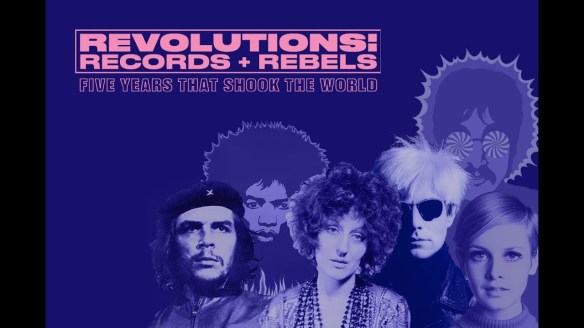
You said you wanted a revolution?

In terms of popular music and the “revolutionary” counter-culture, the Hippie Dream was born during the Summer of Love in 1967 (Haight-Ashbury to be precise) and died in December 1969 (The Rolling Stones’ concert at Altamont). The tipping point was probably The Beatles’ “White Album” released in 1968, featuring “Helter Skelter” and “Revolution 9”. Along the way, we had the “14 Hour Technicolour Dream (April 1967); the Monterey Pop Festival (June 1967); the first Isle of Wight Festival (August 1968); the Miami Pop Festivals (May and December 1968); Stones In The Park (July 1969); oh, and Woodstock (August 1969). From visiting the current “Revolutions: Records + Rebels” exhibition at Melbourne Musuem, the most significant outcome from this era was Woodstock, even though it came close to being a self-inflicted human, environmental and logistical disaster. It was only saved by a combination of the emergency services, the military, local residents – and sheer luck.

This ambitious and uneven exhibition spans the years from 1966 (The Beatles’ “Revolver”, The Beach Boys’ “Pet Sounds”, and Bob Dylan’s “Blonde on Blonde”) to 1970 (Deep Purple’s “Deep Purple in Rock”, Black Sabbath’s “Paranoid”, and The Stooges’ “Fun House”). Despite covering the peak psychedelic era of “Sergeant Pepper”, “Their Satanic Majesties Request” and “The Piper At The Gates Of Dawn”, the exhibition leaves you with the impression that Woodstock is the only enduring musical or cultural event from this time. Yet, the music portrayed in Woodstock is far from revolutionary – being mostly a bland collection of highly-derivative (and by then, almost passé) rock, blues and folk.

It almost feels like the curators of this exhibition set themselves up for failure. By trying to cover such a broad spectrum of political, social, economic and cultural themes, and then view them primarily through the rather narrow lens of popular music, the net effect is a grab bag of museum artifacts assembled with little coherence, all accompanied by a rather insipid soundtrack selection.

I’m not doubting the importance and lasting significance of the topics included (civil rights, peace movement, feminism, class war and gay liberation) – but the attempt to tack on some Australian relevance almost backfires. Let’s not forget that homosexuality was not decriminalised in Tasmania until 1997, and abortion is still not decriminalised in NSW. In fact, Australia was possibly more progressive on some issues in the early 1970s (anti-Vietnam War, ecology, feminism) than it is today with the current resurgence of populism, nationalism and religious conservatism.

Anyway, back to those “Records + Rebels”. I was surprised there was nothing about the radical developments in jazz or improvised music by the likes of Miles Davis (“In A Silent Way, “Bitches Brew”), The Art Ensemble of Chicago and Ornette Coleman, or labels like ESP, BYG and ECM. Absent also was any reference to the mod and early skinhead movements that were the antidote to hippiedom, embracing soul, r’n’b and reggae music. No mention of Soft Machine (who were contemporaries and colleagues of both Pink Floyd and Jimi Hendrix). Very little significance given to The Velvet Underground (probably the most influential band of the era in terms of inspiring the music that came after the hippie dream dissipated). And where were the likes of Can, Tangerine Dream, and Kraftwerk (their first album came out in 1970….) to represent the German rejection of traditional Anglo-American rock and roll?

On a somewhat depressing note, apart from Woodstock, two of the other enduring “brands” of this era that were on display were Richard Branson’s Virgin empire, and Time Out magazine…. So much for the Children of the Revolution.

Next week: Top 10 Gigs – revisited.