The General Taxonomy for Cryptographic Assets

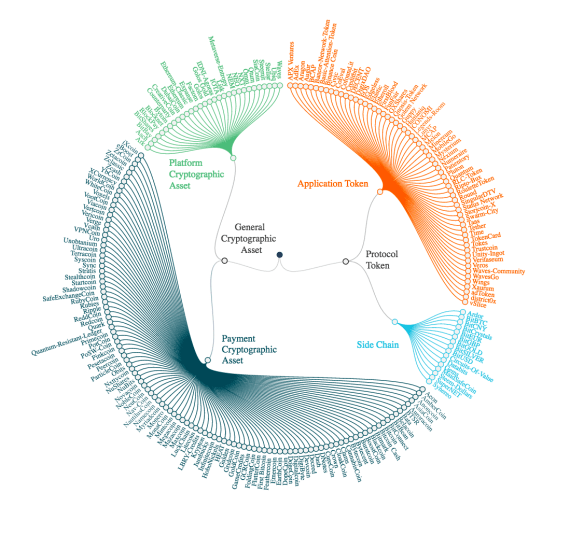
It’s not often I get to shamelessly plug a project I have been involved with – so please indulge me in the case of Brave New Coin’s recent publication, “The General Taxonomy for Cryptographic Assets”. It’s a significant piece of work, designed to bring some structure to the classification of this new asset class.

In particular, it aims to help market participants (traders, brokers, investors, fund managers, asset managers, portfolio managers, regulators etc.) make sense of the growing list of digital currencies, as not all tokens are the same. Each one has a specific use case that needs to be understood in the context of Blockchain applications, whether decentralized protocols, or trust-less payment solutions.

Currently capturing around 60 data points and metrics on around 700 tokens, in the coming months the underlying database will double in size, and constantly maintained thereafter to keep current with the most significant assets.

Useful for portfolio screening, construction and diversification, the Taxonomy methodology and underlying database, when combined with Brave New Coin’s aggregated market data and indices will provide a 360-degree view of each asset, combining key elements of a CUSIP or ISIN record, a company directory profile and a regulatory filing.

The significance of having access to robust market data and reference data tools cannot be underestimated, given the price volatility and emerging nature of this new asset class. The Taxonomy will be presented at various Blockchain and Crypto events over the coming weeks, but for further information, the authors can be contacted at: contact@bravenewcoin.com

Next week: APAC Blockchain Conference

Startup Vic’s Professional Services Pitch Night

For the first of Startup Vic’s monthly pitch nights for 2018, professional services were put under the spotlight. There is a public dialogue on the types and numbers of roles that will disappear due to automation (the professions are no different) and here were four startups seeking to engage in that conversation. Assuming that every industry and every occupation is vulnerable to disruption (and should be alert to the potential opportunities that presents), why should accountants and lawyers feel left out?

Image sourced from Startup Vic Meetup page

Myaccountant

With the promise of enabling users to lodge their BAS return from a smart phone, this app is aimed at micro businesses that struggle with bookkeeping and accounting tasks. Since accounting software packages do not support direct BAS lodgement (although expect this to change…), the app charges $39 per BAS, with no bookkeeping or accounting fees, and shares the fee with the accountants who do the lodgement.

The app is able to extract data from vendor APIs such as Expert360, Airtasker, Uber, etc., and connect to users’ bank accounts. Since launching in January, the app has generated 200 sign ups, with very little direct marketing or paid acquisition so far. The app is also aiming to achieve ISO 27000 (information security).

The panel of judges would have liked to have heard more about the acquisition strategy, and how the app deals with income and expense categorisation, different tax rates, zero rated items, and export sales etc. They also wondered about the competition, and overseas markets

Contractprobe

Developed by Neural Contract, this product uses machine learning to review contracts in 60 seconds. Using a scoring model, it rates documents according to established best practice and bench-marking, suggest sample text for missing clauses, and identifies problems found.

The service is available for ad hoc use, under a monthly subscription, or as custom packages.

According to the founders, the service can save 40% of the time usually spent on contract reviews. It offers a high level of privacy – the uploaded contract, report and transaction ID is deleted upon completion (although it wasn’t clear what records are retained for the purposes of clause analysis, data and analytics – including client profiling and user context.)

To reassure any lawyers in the audience, the product stills relies on human input to apply judgment to the choice of clauses, for example. However, a clear value of the review process is ensuring that phrases and key words are properly defined in the contract.

The judges wondered where this product fits in with open source documentation and pre-drafted documents, whether there are specific verticals more suited to this service, and what trust and liability issues might arise. Is it more of a “clause-spotter” rather than an expert system? How does it address statutory clauses, and the question of whether clauses are actually enforceable?

The service has about 40 clients, including law firms, and is now moving into corporate clients.

Businest

This product is designed to help with cashflow management, which the founders describe as an “iceberg” issue. They point to data that suggests 87% of SMEs have issues with cashflow.

Claiming to use AI to coach SMEs and accountants, the goal is to allow business owners to focus on what they do best, and move accountants from “compliance to advisory”. Applying its own algorithm to cashflow analysis, the service also provides training content to advisors.

Offering both SME and advisor pricing models, the founders have launched a pilot with MYOB. They also point to market research and commentary (CEDR, AFR, CPA, CA…) that indicates the market wants it.

The judges felt that the banks won’t rush to endorse the service (although under the open banking data protocol, they won’t be able to prevent customers linking their accounts) because they are used to the interest they charge on overdraft facilities and credit cards.

Brandollo

This is a marketing tech start-up, aimed at SMEs that struggle to access tailored advice. Targeting B2B clients, in the professional services sector,  with less than 80 staff.

Briefly referring to the use of AI and ML, the service claims to reduce marketing costs by 80%. It offers a brand gap analysis and makes recommendations, that can be implemented without external help. The process looks at execution issues, content requirements, and actual solutions.

Aiming for 200,000 clients in 5 years (currently standing at 200+), the main competitor is Benchmarketing. Brandello offers a freemium model, with a 3-tier paid-for service. They can connect clients to experts, provide a quote to execute and then take a commission on the resulting solution.


Based on the judges’ verdict, the winner was Myaccountant. While the people’s choice was a tie between Myaccountant and Contractprobe.

Next week: The General Taxonomy for Cryptographic Assets
Blockchain, or Schmockchain?

About a year ago, I was having dinner with family and friends, explaining the work I am doing in blockchain and cryptocurrency at Brave New Coin. My mother, in her mid 80s, asked if she should be buying Bitcoin as part of her retirement savings – I suggested she talk to her financial adviser first….

The BLX: Bitcoin Liquid Index (Source: Brave New Coin)

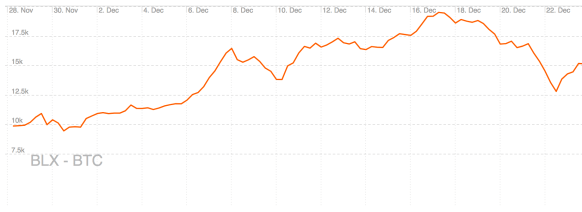
Then, late last year, the  Wall Street Journal made a splash with a front page headline: Bitcoin Mania: Even Grandma Wants In on the Action. This was just after the price of Bitcoin broke through US$10,000 for the first time, as part of its year-end rally after a year-long bull run. Of course, since late November, Bitcoin has gone from $10k to $16k, back down to $13k, back up to nearly $20k, then back to around $10k, before falling further to as low as $6k, while recently “stabilising” between $9k and $11k.

It wasn’t just cryptocurrencies (or even CryptoKitties) that were getting the hype and the headlines. An American soft drink company saw its stock price soar when it changed its name to Long Island Blockchain Company, and announced plans to invest in cryptocurrency mining technology. Amid some backlash (and SEC action against similarly motivated name changes), those plans have since been modified.

Just last week, I received an e-mail from a financial planner in regional Australia:

“I’m a 30-year veteran of the financial industry. I’ve just returned from the Annual Self Managed Superannuation Fund conference where it was evident the industry is treating crypto like a new little toy. Most wish to sound intelligent about what it is, but over 98% have no idea. When asked, the speaker from ASIC fobbed it off as a high risk area, and moved the topic to Investment property….”

He went on to explain how he didn’t just want to help his clients understand how to invest in this new asset class; he also wanted to leverage the underlying blockchain technology to improve his financial services practice, and offer better solutions to his clients.

If blockchain technology is good enough for the ASX, then it should be good enough for the individual investors whose share portfolios are traded, cleared and settled (either through their brokers, or via their superannuation funds) on the ASX itself.

Which was a key point made by Rick Klink, founder of OpenMarkets, during a presentation at a recent Startup Grind event: why shouldn’t his business take advantage of this new technology, and the new assets it is creating, to reduce customer transaction fees, streamline trading processes, and enable portfolio diversification.

Once you cut through the noise, there are examples of companies bringing scalable and real-world blockchain solutions to market that benefit a range of industry sectors, from supply chain logistics to biotech research, from agri-product provenance to IP registration and tracking. 2018 could be the year when the hype becomes reality.

Next week: Startup Vic’s Professional Services Pitch Night


Box Set Culture

I was first introduced to the box set phenomenon in 1974, when I received a collection of novels by J G Ballard for my birthday. This led to an on-off interest in sci-fi (Asimov, Aldis, Bradbury, Dick, Spinrad, Crichton et al). It also made me aware that curators (like librarians) have an enormous influence on the cultural content we consume, and the way we consume it. Even more so nowadays with streaming and on-demand services. Welcome to the binge society.

Welcome to box set culture (Image sourced from Unsubscriber)

With network TV being so rubbish (who needs more “reality” shows, formulaic sit-coms or re-hashed police procedurals?) I am slowly being drawn back into the Siren-like charms of Netflix. More on that in a  moment.

Box set culture has been especially prevalent in the music industry, despite or even because of downloading and streaming services. It’s possible to buy the complete works of particular artists, or curated compilations of entire record labels, music genres or defining eras of music. It’s a niche, but growing, business. In recent times, I have been lured into buying extensive box set retrospectives of major artists (notably Bowie, Pink Floyd, The Fall, Kraftwerk), as well as extended editions of classic albums (Beatles, Beach Boys), and first time releases of exhumed and near-mythical “lost” albums (Big Star, Brian Eno, Beach Boys again). I like to justify these acquisitions on the basis that they are significant works in the canon of contemporary music. But only die-hard fans would attempt to embrace the monumental box set put out recently by King Crimson – comprising a 27-disc compilation of just TWO(!) years in the band’s history.

Death (and/or lapsed copyright) has become a fertile ground for box set curators and re-issue compilers, whether in literature, film or TV, as well as music. I’m sure there are publishers and editors maintaining lists of their dream compilations, waiting for the right moment to release them (a bit like the TV stations and newspapers who keep their updated obituaries of the Queen on standby). Sadly, in the case of Mark E Smith of The Fall, his death was immediately preceded by a significant box set release (tempting fate?). And as for Bowie, he had no doubt planned his legacy (and now posthumous) retrospectives prior to his own demise.

On the other hand, streaming services create the false impression we are in control of what we listen to or watch. Unless we meticulously search, select and curate our own individual playlists, we are at the mercy of algorithms that are based on crowd-sourced behaviours that are imposed upon our own personal preferences. These algorithms are based on what is merely popular, or what the service providers are being paid to promote. And while it is possible to be pleasantly surprised by these semi-autonomous choices, too often they result in the lowest common denominator of what constitutes popular taste.

And so to Netflix, and the recent resurgence in pay TV drama. Binge watching (and box set culture in general) has apparently heralded a golden age of television (warning: plug for Sky TV). But depending on your viewpoint, binge watching is either a boon to shared culture (the normally stoical New Statesman) or results in half-baked content(the usually culturally progressive Guardian). Typically, the Independent is on the fence, acknowledging that binge viewing has changed the way TV is made (and watched) but at what price? Not to be left out, even Readers Digest has published some handy health tips for binge-TV addicts. Meanwhile, Netflix itself has released some research on how binge-watching informs our viewing habits (and presumably, our related consumer behaviours). And not everyone thinks this obsession with binge watching is healthy, or even good for business – presumably because it is not sustainable, as consumers will continue to expect/demand more and more at lower and lower subscription fees.

Meanwhile, for a totally different pace of binge-watching, SBS recently tested audience interest in “slow TV”. The free-to-air network screened a 3 hour, non-stop and ad-free documentary (with neither a voice-over narrative nor a musical soundtrack) featuring a journey on Australia’s Ghan railway. So successful was the experiment, not only did the train company’s website crash as viewers tried to find out about tickets, but SBS broadcast a 17 hour version just days later.

Next week: Infrastructure – too precious to be left to the pollies…