Brexit Blues (Part II)

Brexit finally came into effect on January 31, 2020 with a transition period due to end on December 31, 2020. It’s still not clear whether key issues such as the post-Brexit trade agreement between the EU and the UK will be completed by then (a major talking point being imports of American chlorinated chicken….). Nor is it clear which other areas of EU laws and standards will survive post-transition. Both of which continue to cause uncertainty for British businesses and local governments that have to operate within and enforce many of these rules. Add to that the recent UK storms and floods, the post-Brexit air of racism and xenophobia, plus the coronavirus outbreak and the resulting drag on global markets and supply chains, and maybe the UK will run out of more than just pasta, yoghurt and chocolate. Perhaps those promised post-Brexit savings of £350m a week really will need to spent on the National Health Service…..

The “Vote Leave” campaign bus, 2016 (Image sourced from Bloomberg)

The seeds of the Brexit debacle were sown in David Cameron’s speech of January, 23 2013. As I wrote last year, that set in motion a series of flawed processes. Despite the protracted Brexit process, it’s now unlikely that the decision to leave will be reversed, especially as the opposition Labour Party has just been trounced at the polls. Instead, Labour continues to beat itself up over the failure of its outgoing leadership either to make a solid case in support of the Remain vote in the 2016 Referendum, or to establish and maintain a clear and coherent policy on Brexit leading right up to the December 2019 General Election. The Conservative Party under Boris Johnson has a huge Parliamentary majority, a fixed 5-year mandate, and a general disregard for traditional cabinet government and the delineation of roles between political advisors and civil servants. We have already seen that any form of dissent or even an alternative perspective will not be tolerated within government or within the Tory party, let alone from independent and non-partisan quarters.

Since that fateful speech of January, 2013, it’s possible to follow a Brexit-related narrative thread in film, TV and fiction. Not all of these accounts are directly about Brexit itself, but when viewed in a wider context, they touch on associated themes of national identity, democracy, political debate, public discourse, xenophobia, anti-elitism, anti-globalism, and broader popular culture.

The earliest such example I can recall is Brian Aldiss’s final novel, “Comfort Zone”, (published in December 2013), while the first truly “Brexit Novel” is probably Jonathan Coe’s “Middle England” (November 2018). Somewhat to be expected, political thrillers and spy novels have also touched on these themes – Andrew Marr’s “Children of the Master” (September 2015, and probably still essential reading for Labour’s current leadership candidates); John Le Carre’s “A Legacy of Spies” (September 2017); John Simpson’s “Moscow, Midnight” (October 2018); and John Lanchester’s “The Wall” (January, 2019). (For another intriguing and contemporary literary context, I highly recommend William Gibson’s introduction to the May 2013 edition of Kinglsey Amis’s “The Alteration”. Plus there’s an essay on the outgoing Labour leader in Amis junior’s collection of non-fiction, “The Rub of Time” published in October 2017.)*

Elsewhere there have been TV dramatisations to remind us how significant, important and forward-looking it was when the UK joined the EEC in 1973 – most notably the chronicling of the Wilson and Heath governments as portrayed in “The Crown”. Even a film like “The Darkest Hour” reveals the love-hate relationship Britain has had with Europe. More distant historical context can be seen in films like “All is True” and “Peterloo”.

No doubt, Brexit will continue to form a backdrop for many a story-teller and film-maker for years to come. And we will inevitably see recent political events re-told and dramatised in future documentaries and dramas. Hopefully, we will be able to view them objectively and gain some new perspective as a result. Meanwhile, the current reality makes it too depressing to contemplate something like “Boris Johnson – Brexit Belongs to Me!”

*Postcript: hot off the press, of course is “Agency”, Willam Gibson’s own alternative reality (combining elements of the “Time Romance” and “Counterfeit World” referenced in “The Alteration”) – I haven’t read it yet, but looking forward (!) to doing so….

Next week: Joy Division and 40+ years of Post-Punk


The Current State of Popular Music

Over the holidays, during a family get-together, two younger relatives mentioned what their favourite pop song was. I did not know the song by title or artist, and until very recently I actually I thought it was an advertising jingle. I now understand that the combination of the song’s novelty factor and its ubiquitous appearance had helped to make it very popular. I can see why it may appeal to kids – but I doubt it will become an evergreen classic….

The song they mentioned incorporates a number of musical tropes very prevalent in many current pop songs, especially as regards the vocal styling and lyrical phrasing. But like much of the music being produced these days, it will likely be forgotten within a couple of years at most. The inherent “novelty” of the vocal could render the song a one-hit wonder, and the artist a one-trick pony.

I have nothing wrong with pop music per se, but if “we are what we eat”, surely we can become what we listen to. An unending and unvarying diet of mainstream pop music (as defined by commercial radio playlists, as measured by self-serving charts compiled by streaming services, and as financed by major record label marketing budgets and promotional tie-ins) is the equivalent of eating nothing but fast food and processed snacks.

So, at the risk of being labelled a grumpy old man, here is a list of things that are mostly wrong with contemporary pop music:

1. Vocals that feature one (or more) of the following:

  • the sound of cutesy chipmunks on helium
  • forced falsettos, cracked breathlessness and over-emoting warbling
  • singing from the back of the throat (as if constipated)
  • singing through the nose (as if congested)
  • whining, strained upper registers  (as made infamous by a certain tantric pop star)
  • auto-tune effects (especially those in search of a melody…)
  • shouting in place of projection
  • turning vowels into consonants, and consonants into vowels
  • adding syllables that don’t exist, and leaving out ones that do
  • over-stressed sibilants

2. Lyrical phrasing, scansion and rhyming schemes courtesy of Dr. Seuss,

3. Slogans, nursery rhymes and shouty phrases in place of lyrics

4. Drum and percussion tracks either programmed by ADHD, or inflicted with St. Vitus’s Dance

5. Boring, boxy and plodding 4/4 rhythms, with no syncopation or variation

6. Same set of production techniques and sound effects as used by every other producer or DJ

7. Samples based on the nastiest ringtones available (or programmed on the cheapest synths around)

8. Never mind a lack of key changes, or an absence of chord progressions, songs that revel in one-note vocal lines

9. An absence of interesting melodic or harmonic structures

10. Sound compressed into the smallest available bandwidth so it is easier to stream, but which ends up sounding flat and claustrophobic, and with exactly the same sound dynamics as every other song

11. No space to let the music breathe – every available beat and bar has to be filled up, especially with vocalese stylings

12. Too many cooks – songs by “X feat. Y with Z” are usually contrived concoctions dreamed up by the record company (“hey, we can flog this song to fans of all three of them!”) that end up as filler tracks on their respective solo albums

13. Kitchen sink productions (as in everything BUT the…) – you can almost imagine the producer in the studio shouting, “cue flamenco guitar, cue rapping, cue 80’s sample, cue metronomic rimshot, cue call and response vocals, cue detuned kick drum….!”

Part of the problem is that with the cheaper costs of recording, and the wider access to the means of production, anyone can make music, and release it direct to the public online. Meaning there is just so much more new music to listen to. However, the major record labels and their media partners still control most of the marketing budgets and distribution costs, that largely decide the songs we tend to hear, and that ultimately determine which songs become “hits”. By default, this process prescribes much of what is deemed “popular taste”. With the increased use of algorithms and other techniques, artists, producers, labels and media platforms can increasingly predict what songs will be successful, in a self-fulfilling prophesy of what will “sell”. it’s like punk never happened….

Next week: Sola.io – changing the way renewable energy is financed

Hicks vs Papapetrou

Another compare and contrast this week, and like last week, based on a current NGV exhibition – this time, head-to-head retrospectives of two Australian photographers, Petrina Hicks and Polixeni Papapetrou.

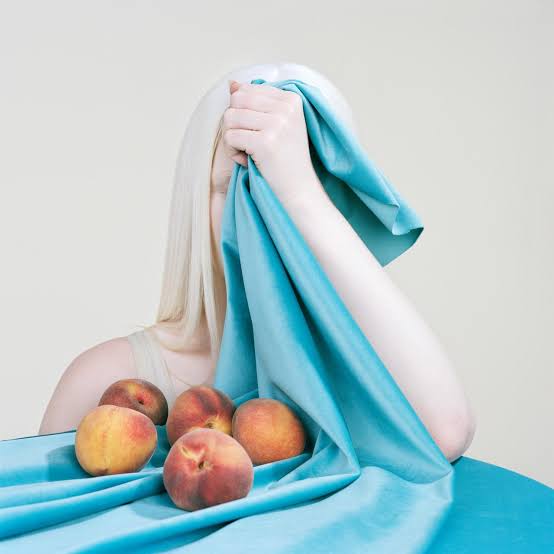
Petrina Hickson – “Peaches and velvet” (2018) – image sourced from NGV

The challenge for contemporary photographers is the ubiquity of the medium. Anyone with a smart phone can be a “photographer”. At a basic level, the technology to capture photographic images is accessible to all, and no special skill is required. Add to this the impact that advertising, magazines, fashion, portraiture, reportage and social media have had on the way we view images, and there is a risk that audiences detect no difference between what they see on a billboard poster, in an on-line news article, on Facebook/Tumblr/Instagram/Twitter or in an art gallery or museum.

In these two particular shows, I think the NGV is trying to re-establish a platform for contemporary photography as an art form, and not merely as a technical means of capturing and creating images. (Selfies, holiday snaps and wedding photos are all very well, but they ain’t necessarily art.) It’s an admirable ambition, but I’m not sure these collections are the best examples on which to build such a thesis.

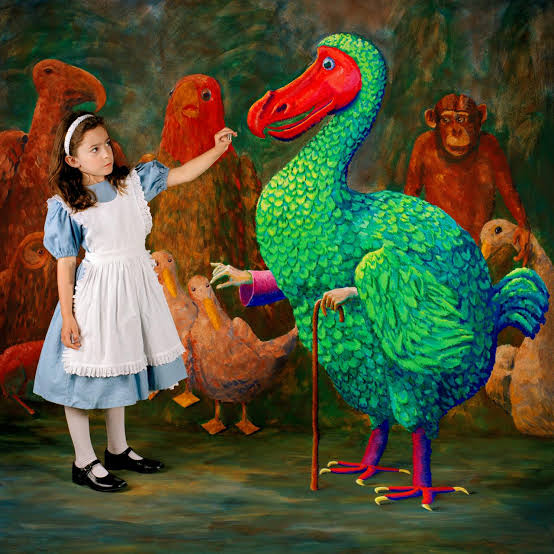
Polixeni Papapetrou – “Prize Thimble” (2004) – image sourced from NGV

Both photographers produce highly stylized, almost trademark images, which reveal a very methodical and deliberate approach to their work. Everything is highly choreographed, deliberately posed and meticulously arranged – nothing is left to chance, giving an overwhelming sense of artifice. These photographs are hyperreal yet also quite literal – what you see is what you get. This is not to say they lack formal narrative or even additional meaning, but despite their obvious visual appeal, it’s hard to see much beyond the images themselves.

In Hicks’ case, as well as recurring images, arrangements and visual motifs, the works on display reveal a very defined (even limited) colour palette, especially as many tones appear washed out, almost over-exposed. While Papapetrou’s work mostly feature her own daughter, in various staged settings, some of which allude to well-known fictional stories,  historical events, myths, legends and fairy tales. Despite both these exhibitions being retrospectives, based on these selections you would be hard-pressed to say there was much in the way of artistic development – there’s a sameness to both sets of images.

Despite each photographer having a distinctive style, there are also echoes of many other photographers – notably Julia Margaret Cameron, Madame Yevonde, Claude Cahun, Meret Oppenheim, Cyndi Sherman and Polly Borland among them.

Next week: The Current State of Popular Music


Haring vs Basquiat

Following last week’s “compare & contrast” entry, another similar exercise this week, between artists Keith Haring and Jean-Michel Basquiat, the subject of the NGV’s summer blockbuster exhibition.

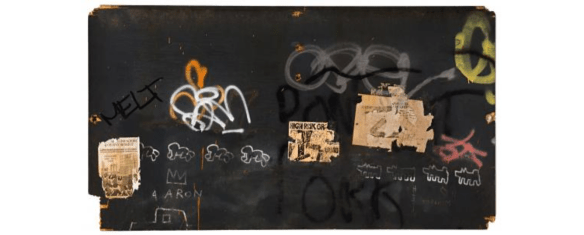
Keith Haring, Jean-Michel Basquiat, Other artists: “Untitled (Symphony No. 1)” c. 1980-83 [image sourced from NGV website]

Given their friendship, collaborations and mutual connections to the New York scene of the 1980s, it was only natural that the NGV went for this double-header retrospective. Since they both gained early recognition for their street art and graffiti-based work, and their images crossed over into the worlds of music, fashion and clubbing, they had a lot in common. They were as likely to be featured in style magazines such as The Face as they were to be found in the arts section (or society pages) of the New York Times.

Both died relatively young, and it’s as if they somehow knew they each had limited time, such is the intense pace at which they worked, as evidenced by their prolific output. If there is one element that really links them is their inner drive – they had to produce art, there was no choice for them, and they threw everything into it.

They each developed their own distinctive visual styles, much imitated and appropriated throughout popular culture, graphic design, video and advertising. Haring is known for his dog motif and cartoon-like figures, Basquiat for his iconic crown and text-based work. They also placed great emphasis on issues of identity, gender, sexuality and broader sociopolitical themes.

Where they perhaps differ is that Haring relied on more simplistic imagery (albeit loaded with meaning and context), using mainly primary colours, flat perspective (no shading or depth), and strong repetition. On the other hand, Basquiat’s paintings reveal confident mark-making, bold colour choices (not always successful), and an implied love of semiotics (even more so than Haring’s almost ubiquitous iconography).

Of course, we’ll never know how their respective work would have developed over the past 30 years – maybe what we now see is all there was ever going to be? As a consequence, there is perhaps a sense that they plowed a relatively narrow field, that they did not develop artistically once they became gallery artists. I’m not suggesting their work is shallow or one-dimensional (even though it can simply be viewed and appreciated “on the surface”), but it would have been interesting to see where their work took them.

Finally, we are still very close to the era in which they were active, and in that regard their true legacy will be in the influence they cast on late 20th century art and beyond.

Next week: Hicks vs Papapetrou