Whose IP is it anyway?

Why should we claim ownership of our IP? This was the topic up for discussion at the recent Slow School dinner on Collaborative Debating presented by Margaret Hepworth. I won’t reveal how a collaborative debate works (I recommend you sign up the next time Slow School runs this class…), but I do want to share some of the issues and insights that were aired. In particular, the notion that shared knowledge is the basis for greater prosperity.

The use of Creative Commons means knowledge becomes easier to share (Photo by Kristina Alexanderson, image sourced from flickr(

The use of Creative Commons means knowledge becomes easier to share (Photo by
Kristina Alexanderson, image sourced from flickr)

First, the discussion centred on IP issues relating to ideas, content, knowledge, creative concepts and theoretical models. Not surprising, as the participants were all independent professionals, consultants, bloggers, creatives, facilitators, teachers and instructors. So we didn’t address the areas of patents, registered designs or trade marks.

Second, as someone who has worked in the publishing, data and information industries for nearly 30 years, I believe it is essential that authors, artists, academics, musicians, designers, architects, photographers, programmers, etc. should be allowed both to claim copyright in their work, and to derive economic benefit from these assets. However, I also recognize that copyright material may often be created in the course of employment, or under a commercial commission or as part of a collaborative project. In which case, there will be limitations on individual copyright claims.

Third, the increasing use of Open Source and Creative Commons means that developers, authors and end users have more options for how they can share knowledge, access resources and foster collaboration through additive processes and “common good” outcomes. A vital component of these schemes is mutual respect for IP, primarily through acknowledgment and attribution. Equally, an online reputation can be established (or destroyed) according to our own use of others’ material, especially if we are found to be inauthentic.

Leaving aside the legal definitions of IP and how copyright laws work in practice, the discussion explored the purpose and intention of both authors (as “copyright creators”, narrowly defined) and end users (as “licensees”, broadly defined). There was general agreement that sharing our content is a good thing, because we recognise the wider benefits that this is likely to generate.

But there is a risk: merely acknowledging someone else’s authorship or copyright is not the same as accurately representing it. Obviously, plagiarism and passing off someone else’s ideas as your own are both copyright infringements that can give rise to legal action. Even with the “fair use” provisions of copyright law, a critic or even an acolyte can mis-interpret the content or attribute a meaning that the author did not intend or even anticipate. As one participant noted, “Copyright is not just concerned with what we claim ownership over, but what others may claim as their own.” Not for nothing have we developed “moral rights” in respect to authorship of copyright material.

Although we did not discuss specific issues of copyright remuneration (e.g., through royalties, licensing fees or financial consideration for copyright assignment), there was a proposition that establishing copyright protection can lead to social, intellectual and even economic limitations. The understandable, but often misguided need to protect our copyright (as a form of security) is driven by fear, underpinned by scarcity models. Whereas, a more generous approach to copyright can actually lead to greater shared prosperity, based on the notion of the abundance of ideas and knowledge. And since, as one speaker put it, “there is no such thing as an original concept because all ideas build on previous knowledge”, the inherent value in IP is in how we contribute to its nurturing and propagation.

At the end of the discussion, and reflecting on my own recent experiences with copyright infringement and geo-blocking, I found I had shifted my position – from one that tends to take a more absolute view on copyright ownership, to one that identifies the need for some further modification to the current copyright regime, along the lines of the following:

  • Copyright ownership should not entitle the owner to abuse those rights – if anything, the copyright holder ought to be placed in a position equivalent to a trustee or custodian, to ensure that they act in the best interests of the IP asset itself, not merely their own interests. That should not preclude the owner from being compensated for their work or being allowed to commercialize it, otherwise, why would anyone bother trying to create new ideas or content?
  • Establishing copyright in ideas and creative concepts needs to be supported by a notion of “intent” or “purpose” (a bit like mens rea in criminal law). For example, if the intent is to merely prevent anyone else using or sharing the idea, then any copyright protection might be limited to a much shorter duration than the usual “life of author plus XX years” model.
  • Equally, under a “use it or lose it” provision, if copyright owners (and/or their publishers, distributors and license holders) elect to take their content out of circulation from a market where it had been widely available, then they would need to establish good cause as to why the copyright should not be open to anyone else to use and even commercialize (subject to reasonable royalty arrangements).
  • If we accept that all knowledge is additive, and that the proliferation of collaboration and co-creation is because of the need to share and build on what we and others have already created, how can we ensure the integrity and mutual benefits of open source and creative commons initiatives? One analogy might be found in the use of blockchain technology to foster contribution (adding to and developing an existing idea, concept, model or platform) and to support authentication (to validate each idea extension).

Perhaps what we need is a better IP model that both incentivizes us to share our ideas (rather than rewards us for restricting access to our content), and encourages us to keep contributing to the furtherance of those ideas (because we generate mutual and ongoing benefits from being part of the collective knowledge). I’ve no idea what that model should look like, but surely we can agree on its desirability?

Next week: Finding purpose through self-reflection

Is this The Conversation we should be having?

Here’s a barbecue topic for Australia Day: What is happening to the quality of public discourse? Over the holidays, I read The Conversation’s 2015 yearbook, “Politics, policy & the chance of change”. It’s a collection of individual articles from the past 12 months, grouped into broad themes, covering key issues of the day, at least among the academic and chattering classes. As a summary of the year in Australian political, economic, cultural and social reportage, it’s not a bad effort. With “news” increasingly bifurcated between a dominant commercial duopoly and a disintermediated social media maelstrom, The Conversation can offer a calm rational voice and an objective alternative.

Screen Shot 2016-01-24 at 6.43.50 PMThe title promises a new direction in political debate, and I went to the book’s Melbourne launch at the start of the summer, where Michelle Grattan, The Conversation’s Chief Political Correspondent held court in an audience Q&A. I was looking forward to the event, because part of The Conversation’s remit is to foster informed debate that is more than tabloid headlines, news soundbites and party room gossip. It has also positioned itself as a non-partisan, independent and authoritative source of news analysis.

I was hoping the Q&A would provide a considered discussion on some of the key policy issues facing the country – long-term tax reform, addressing climate change, updating Federation, dealing with the post-mining boom economy, improving the quality and efficiency of our education, health and infrastructure systems, etc.

Instead, the first three questions from the audience concerned Mal Brough, Ian Macfarlane and Tony Abbot. How demoralising. Haven’t we moved on from this cult of personality? Haven’t we learnt anything from the past 10 years or so? If the same event had been held during Julia Gillard’s term as PM, the names would have been different (Craig Thomson, Peter Slipper, Kevin Rudd?) – and for quite separate reasons, I hasten to add – but the context and implication would have been very similar: “Never mind policies, what’s the chance of (another) leadership spill? How are the numbers stacking up in Parliament? When’s the court case?”

Although I admire the aims of The Conversation, and I understand why it exists, I have some concerns about the type of discourse that The Conversation is actually fostering among its audience. As with many public institutions, I appreciate that it’s there (even though I am not a frequent reader), but like other news media, it risks confirming the bias and prejudices of its audience. It can also feel as if it is serving only the vested interests of its contributors, partners and sponsors.

So much of Australia’s recent political history has been dominated by self-delusional egos, nefarious party factions, insidious vested interests and character assassination (which I blame for giving us five prime ministers in as many years).

When it was my turn to ask a question, it concerned the recent bipartisan compromise between the Coalition and The Greens to publish the tax records of companies generating more than $200m in revenue (as a step towards tackling corporate tax avoidance). I asked, “Should we expect to see more of this seemingly new approach to politics?” Although Ms Grattan gave a detailed (and somewhat technical) explanation for this particular Parliamentary outcome and its likely implications, I felt that most of the audience were not interested. They would probably have preferred to be talking about the ins and outs of the party rooms. For me, this does not bode well for the level and quality of public debate we are having on (non-party) political issues that really matter.

I also have a few other niggles about The Conversation and the 2015 Yearbook:

  1. By only sourcing content from “recognised” academic experts and policy wonks, I think this overlooks contributions from commercial and industry experts which are just as valid. As long as such authors also declare any interests, it should ensure balanced commentary – but to exclude them from the debate just because they don’t have academic, public or research tenure is self-limiting.
  2. The site as a whole (and the book in particular) is rather thin on actual data references, and when research data is included in articles, there are rarely any charts, tables or infographics. I think this is a shame and a missed opportunity.
  3. The book hardly mentions the critical issue of tax reform (which barely merits half a dozen pages). Whereas, reform of the education system (including academic research funding) gets around 40 pages – which rather smacks of self-interest (and bias?) on the part of the academic authors

Finally, The Conversation provides a valuable (and from what I have seen, an impartial) service via its factcheck section, which in tandem with the ABC’s Fact Check is doing a sterling job of trying to keep our pollies honest (at least in Parliament…). More power to it.

Next week: David Bowie Was – “It’s a god-awful small affair”


“Why? Because we’ve always done it this way…”

A couple of blogs ago, one of my regular correspondents kindly laid down a challenge. He suggested that part of the answer to the problem I was writing about (i.e., how to manage data overload) could be found within Simon Sinek’s “Start With Why”.

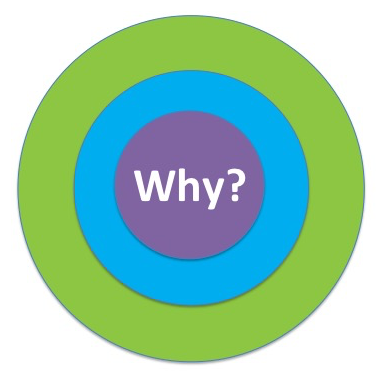
Why?I’m quite familiar with Sinek’s investigation of “Why?”, but I wasn’t sure it was applicable in the context of my topic. Don’t get me wrong – the “Golden Circle” is a great tool for getting leadership teams to explore and articulate their purpose, and it can help individual business owners to re-connect with the reasons they do what they do.

It can even facilitate new product and service development.

But, I believe it’s harder to apply at an operational or processing level, where the sorts of decisions I was referring to in my blog are typically being made: what tools to use, what systems to adopt, what software to deploy etc.

There are several reasons why organisations do things the way they do them. When undertaking a business process review, I frequently ask the question, “Why are you doing this?”

Here are some typical responses I’ve received (and my conclusions in parentheses):

  • “Because we have to” (compliance)
  • “Because we’ve been told to” (command and control)
  • “Because we’ve always done it like this” (inertia)
  • “Because everyone else is doing it” (cheap/easy/popular)
  • “Because our consultants recommended it” (cop-out)

In one experience, I had to implement a process change within a publishing team, comprising experts (writers) and technicians (editors). The problem was, that even though the content was published on-line, most of the production processes were done on hard copy, before the final versions were uploaded via a content management system. The inefficiencies in the process were compounded by a near-adversarial relationship between writers and editors, at times bordering on a war of attrition.

When I asked the team why they worked this way, their responses were mainly along the lines of “command and control” and “inertia”. Behaviours were reinforced by some self-imposed demarcation.

The writers felt it was their role as experts to demonstrate everything they knew about the topic (without necessarily saying what they actually thought); while the editors felt they were required to work within a rigid house style (to the point of pedantry), maintain writing quality (at the expense of timeliness), and to maintain content structure and format (over context and insight).

  • Both sides felt they were meeting the organisation’s purpose: to deliver quality information to their customers to help them make informed decisions.
  • Both believed they were following clear operational guidelines, such as production, technical, and compliance.
  • Both were passionate about what they did, and took great pride in their work.

Unfortunately, the procedures which they had each been told to follow were inefficient, at times contradictory, and increasingly out of step with what customers actually wanted.

Based on market feedback clients told us they:

  • favoured timeliness over 100% perfection;
  • preferred insights over data dumps; and
  • really wanted “little and often” in terms of content updates

Thankfully, the voice of the customer prevailed, and the introduction of more timely content management processes resulted in frequent updating (via regular bulletins) backed by the “traditional” in-depth analysis.

When starting a change management project, conducting a process review, or undertaking a root-cause analysis, if asking “Why?” doesn’t get you very far in getting to the bottom of a problem, I find that it can help to pose another question: “What would your customers think about this?” For example, if customers knew how many times a piece of data was handed back and forth before their order/request/enquiry was processed, what impression might that give about an organisation?

For most companies, their sense of purpose is driven by a strong or underlying desire to serve their customers better – it’s as simple as that.

Next week: The 3L’s that kill #data projects

Publishers’ Choice: Be a Victim, or Join the Vanguard?

I recently posted a blog about saving the Australian publishing industry, prompted by some research I was doing on government-sponsored initiatives, notably EPICS and BISG. This generated a couple of (indirect) responses, one from the Department of Industry itself, the other from a long-time colleague in the industry. More on these later.

The future of publishing - circa 2000....

The future of publishing – circa 2000….

But first, some more industrial archeology, by way of demonstrating that book publishers are not shy about new technology – remember the first electronic ink? When I was working at the Thomson Corporation in the late 1990s, we were given access to a prototype version of what we would now recognise as an e-reader. It was about the size and thickness of a mouse pad but less flexible, and could only hold a small amount of data in its memory (content was uploaded via an ethernet cable). It was described as the future of book publishing, and was predicated on the idea of portability (it could be rolled up like a newspaper if the screen was thin and pliable enough), and updating it with new content whenever it was (physically) connected to a computer or the internet.

However, whatever their apparent appetite for new technology, publishers struggle to adapt their business models accordingly, or they are fixated on “old” ways of monetizing content, and locked into traditional supply chains, archaic market territories (geo-blocking), restrictive copyright practices and arcane licensing agreements; and unlike other content providers (notably music, TV and newspapers which have shifted their thinking, albeit reluctantly) the transition to digital is still tied to specific platforms and devices, unit-based pricing and margins, and territorial restrictions.

Anyway, back to the future. In response to my enquiry about the outcome of the BISG initiative, and the creation of the Book Industry Collaborative Council (BICC), the Department of Industry offered the following:

“A key outcome of the BICC process was to have been the establishment of a Book Industry Council of Australia, an industry-led body based on the residual BICC membership that would come to be a single point of policy communication with government, though following its own reform agenda in the identified areas and unsupported by any taxpayer funding. Terms of Reference and so forth were drawn up but as nearly as we can ascertain from media monitoring and contacts, the BICA was never formed. It appears the industry is waiting to ascertain what the current government’s policy priorities might be, as expressed in the outcomes of the current Commission of Audit and Budget, before possibly resurrecting the BICA concept and/or the policy issues identified in the BICC report.” (emphasis added)

My read on this is that the industry won’t take any initiatives itself until it knows what the government might do (i.e., let’s wait to see if there are any handouts, and if not, we can plead a special case about the lack of subsidies/protection and the threat of extinction…).

This defeatist attitude is not just confined to Australia – my former colleague recently attended the 2014 Digital Book World Conference in New York. He commented:

“I was disappointed to see the general negativity of the publishing industry and the “victim” like mentality – also the focus on the arch-enemy – AMAZON! I see great opportunities for content – but companies have to get their head around smaller micro transactions and a freemium model. Big publishers are “holding on” to margins – it’s a recipe for disaster – [but] I think we can become small giants these days.”

There are some signs that the industry is taking the initiative, and even grounds for optimism such as embracing digital distribution in Australia, moving to a direct-to-consumer (“D2C”) model in the USA, and new approaches to copyright and licensing in the UK.

The choice facing the publishing industry is clear: continue to see itself as a victim (leading to a self-fulfilling prophecy of doom and extinction), or become part of the vanguard in developing leading-edge products and services for the digital age.