Another #pitch night in Melbourne…

If there is one basic theme emerging from Startup Victoria‘s monthly pitch nights, it is this: whatever market you are in, regardless of your business model, and however disruptive you are trying to be, if you don’t know how to engage or reach your customers your idea is far less likely to succeed. This message came across loud and clear during last week’s event where four startup hopefuls pitched their business ideas to a panel of judges in front of a packed audience.

Picture sourced from Startup Victoria Meetup page

Picture sourced from Startup Victoria Meetup page

So let’s look at this specific issue in respect to each of the pitches:

First came JobPokes, an online recruitment service designed to help candidates match job opportunities to their career preferences. Because it claims to be addressing the hidden job market, candidates aren’t applying for specific roles – instead, it’s a form of reverse enquiry, where recruiters target potential applicants via their registered profiles. I applaud the focus on the non-advertised job market, but while it may well offer an additional channel for recruiters, I’m not sure there was a clear strategy to reach job candidates who need to create a user account, and who are probably already using platforms like LinkedIn and Seek.

Next was Airly, which is sort of “Uber for private aircraft”. The business model involves signing up a minimum number of customers (who pay a monthly subscription fee, entitling them to unlimited flights), and securing sufficient seat capacity via scheduled charter contracts. There is no doubt that the idea of flight flexibility, and an element of passenger exclusivity met with audience approval (Airly took out the people’s choice vote on the night). Also, the PR around Airly has generated in-bound enquiries, suggesting there is demand. But how does this market interest convert to individual customers, when many corporate travel policies rely on wholesale and bulk-purchase models (i.e., aggregation, consolidation, vendor discounts, agency rebates, preferred airlines) rather than catering for individual travel needs or preferences? Unless the target customers are business travelers that manage and pay for their own tickets?

If Airly was about the Uberisation of air travel, RagRaider revealed another aspect of the shared economy model. Squarely aimed at fashion- and budget-conscious women, RagRaider offers a peer-to-peer service whereby customers can hire clothes for one-time use. No doubt there is a market (high school formal, spring carnival, wedding reception…) but the question is how to connect with actual lenders and hirers? We know that the per customer cost of acquisition for 2-sided markets is a key metric, and it wasn’t clear how the founders were addressing this, other than a pre-launch website and some social media. As one observer has commented, the “model is focusing on the ‘product’ part first which is the reverse of how it should be”, and another commented that despite a defined market, the barriers to entry are considerable. The judges also questioned some of the proposed pricing, commission rates and logistics.

Finally, Rounded is another FinTech startup looking to service the SME sector, specifically sole traders, freelancers, sub-contractors and tradies. Another spin on the invoice solution when suppliers need to get paid efficiently, Rounded does not claim to be a full-service accounting software – but, as one attendee commented, key to success will be reaching and educating the end-user market.  Also, they are entering a competitive space, where a new entrant like Xero has already disrupted incumbents like QuickBooks, Reckon and MYOB. I wasn’t able to stay for the pitch, but I did have the opportunity to speak with the founders beforehand. Clearly driven by their own experience and needs, there is a solid but simple idea here – but as Xero and others are increasingly able to serve similar customers, Rounded will find it really difficult to compete.

If anything, these latest pitches showed how hard it is to compare apples with oranges, although the voting criteria (market traction, product viability, team composition, pitch presentation, and responses to judges’ questions) are designed to deliver a consistent evaluation. It was also apparent that these pitches divided audience opinion more so than previous contestants – which is probably a good thing as variety is the spice of life….

Acknowledgments: thanks to Graphican, Marlene M., Cornell and Dale G. for their input.

Next week: Re-Imagining Human-led #Innovation

 

ASIC’s new regulatory sandbox for #FinTech #startups

Last week, ASIC published its eagerly awaited public consultation paper on the so-called FinTech regulatory sandbox. ASIC Commissioner, John Price and his colleague Mark Adams launched the paper at a special meeting of the FinTech Melbourne group, hosted by KPMG. There was also participation by FinTech Australia represented by its new CEO, Danielle Szetho, and by the Digital Finance Advisory Committee, represented by Deborah Ralston.

sandbox-295256The Commissioner was at pains to stress that, notwithstanding the developments within FinTech, and ASIC’s contribution via the Innovation Hub, the primary focus of the regulator is to “promote confident and informed consumers and investors, and to promote fair, transparent, orderly and efficient markets”.

To reiterate the point, Mr Price stressed that while the Innovation Hub is designed to help FinTech startups navigate the regulatory system, as well as reducing red tape, there should
be no compromise in ASIC’s fundamental regulatory and licensing regime.

ASIC will continue to adopt what it calls a modular approach to licensing and regulatory oversight, that includes: the ability to operate as a representative of an existing licensee; a focus on organisational competence; and the use of waivers and the “no-action” policy and decisions.

However, ASIC recognises the issues and barriers to entry that face some FinTech startups such as speed to market (a function of technology outpacing compliance?) and organisational competence (do firms need to hire in these skills and/or provide specific undertakings to that effect, or can they make use of third-party resources?). In ASIC’s view, by helping firms to reduce the time to market and to enhance their organisational competence, FinTech startups will be able to overcome the further barrier of access to capital. But there still needs to be acceptable consumer and investor outcomes, and efficient markets.

The proposals include additional guidance and discretion on organisational competence, and a limited license model that makes use of third parties as an alternative to establishing in-house organisational competence from day 1 (e.g., using an accounting firm as an external reviewer or sign-off), and limited exemptions during a defined test phase, yet still subject to some constraints to maintain a balance.

To clarify, ASIC currently exercises its discretion when assessing organisational competence based on the nature of the financial services and financial products to be offered, and the collective knowledge and skills of the people in the business. Under the proposals, the limited license will offer some additional flexibility to heavily automated business services and models, whereby the business can rely on professional third-party sign-off for compliance plans.

The sandbox exemptions will only be available to new Australian entities (to focus on startups) and only for a 6-month duration. It will be confined to certain financial services only – such as providing advice and arranging transactions. It will not include market making, and consumer protection will remain paramount. Once the limited license has expired, companies will either be instructed to cease operations, become an authorised representative of an existing licensee, or submit a full license application.

Other restrictions on the sandbox exemptions mean that applicants must be advising or dealing in liquid products (equities, managed funds and deposits), so not superannuation, insurance or derivatives. There will also be a cap on the number of investors (e.g., 100 retail clients), and on individual exposures (e.g., $10,000 per client), with an overall cap of $5m (but possibly unlimited in respect to wholesale clients?).

Participants must demonstrate they have adequate compensation arrangements, such as holding appropriate professional indemnity insurance and participating in an external dispute resolution process. They must also operate under core conduct and disclosure principles (e.g., disclosing trailing commissions).

There is some thought that sandbox participation could be “sponsored”, by third-party advisers, startup hubs or venture capital funds. This would operate on a “no liability” basis, and would primarily offer a preliminary health check of the FinTech applicant’s proposed business model. Above all, there will need to be adequate notification and reporting requirements, including a feedback process.

When comparing these proposals to what some international regulators are doing, ASIC believes they are more progressive than their counterparts. The UK is adopting a restricted licensing model, the US is using a “No action” process (more focused on credit providers?), and Singapore has recently announced a hybrid sandbox proposal.

During the Q&A session, the following issues were aired:

  • Is ASIC in favour of mandatory client recording? No, it will continue to rely on industry best practice
  • Is general insurance included in the sandbox? No, ASIC is not looking at risk-management products to be part of the exemptions.
  • If incubators and/or VC’s are able to be sandbox “sponsors”, how will ASIC deal with potential bias? ASIC says it is alert to practices such as unreasonable “fees”.
  • Would a new entity or product from an existing authorised representative be able to access the sandbox? It wasn’t clear whether this would be covered, but presumably not if it did not meet the “new business” requirement?
  • Would the sandbox be available to non-financial services co-creating products for existing AFSL holders? Again, it wasn’t clear – but if it was a new business applicant, presumably it would. (This also raised the issue of “mature” businesses using disruptive or outsourced services as a way to access the sandbox.)
  • ASIC will encourage companies to apply for a full license prior to end of the six month test, to ensure timely compliance
  • What will happen as a result of people playing in the sandbox? Clearly, ASIC has a vested self-interest in learning about and getting exposure to innovation, but it needs to demonstrate a pro-active and efficient approach.
  • What are the key criteria for the sandbox exemption? ASIC does not have a prescriptive approach (subject to the sandbox restrictions), so it will look at each application on its merits (e.g., short vs long-dated products, simple vs complex, retail clients vs wholesale), and focus on the financials, the organisational competence, and the business model. And obviously, experience counts.
  • Timing of the sandbox? ASIC hope to see it operating by the end of September (Responses to the CP260 are due in by July 22).

Subject to the consultation feedback, there seems to be general industry consensus that the sandbox proposals are to be welcomed. But there are still some grey areas, as evidenced by the Q&A, and nowhere did I here anything specifically relating to the new emerging class of programmable currencies and other digital assets, many of which are pushing the regulatory boundaries, as well as disrupting traditional markets. And with current equity crowdfunding proposals stuck in Parliament, nothing happening there either.

(For some other responses to Consultation Paper CP260, check the following articles:

http://m.smh.com.au/business/banking-and-finance/asic-to-build-fintech-startups-a-regulatory-sandbox-to-test-ideas-20160608-gpe4l7.html

http://www.financialobserver.com.au/articles/fintechs-welcome-regulatory-sandbox-proposal

http://www.fintechaustralia.org.au/#!Why-the-Fintech-Regulatory-Sandbox-is-a-Game-Changer/ll9ed/5757cd8f0cf245cf71a32089)

Next week: Customer service revisited

More on #FinTech, #Bitcoin and #Blockchain in Melbourne

The Melbourne FinTech community brought together a bunch of interested parties recently to find out what’s happening locally in Bitcoin and Blockchain. Organised by the Melbourne Bitcoin, FinTech and Silicon Beach Meetups, and hosted by the Melbourne Bitcoin Technology Centre (MBTC), the evening was part open house, part info sharing, and part pitch night.

BitcoinThe MBTC is now a recognised hub for Bitcoin and Blockchain activities, and currently hosts around a dozen startups within its co-working space. Offering a “full service” facility (it even has a Bitcoin miner on site), complete with staffed reception, meeting rooms, event space, a pod cast studio and an outdoor barbecue area, it’s something of a hidden gem in Melbourne’s Southbank. Regulars also get to attend Bitcoin “swap meets”…..

Last week’s event also featured a number of micro-pitches from Bitcoin and Blockchain startups, a few of the MBTC staff and tenants, and a couple of student projects from RMIT.

Given this was almost “speed pitching“, it’s probably not appropriate to go into too much detail:

  • Toodles – a dating app on a decentralized network, using a Blockchain solution for additional security and privacy
  • Blockfreight – the Blockchain for global freight, enabling cargo containers to be shipped around the world with minimal legacy documentation, based on smart contracts, RFID and Blockfreight tokens
  • blockTRAIN – a training provider and consultancy on Blockchain, smart contracts and digital currencies
  • Bitcoin Buskers v2 – sort of MySpace/Bandcamp/SoundCloud for Buskers, to promote their merchandise and to secure international festival bookings, all powered by Bitcoin
  • ACX – Australian Crypto Exchange, offering the largest single Bitcoin order book in Australia
  • Bitcoin Group – explaining that most Bitcoin mining is currently done in China due to cheaper electricity
  • Antstand – portable laptop stand (which you can buy with Bitcoin!)
  • Think Bitcoin – providing consulting and education services, particularly in schools
  • Lyra – an app to track and reduce your personal environmental impact, sort of Fitbit and Smart Meter combined
  • ImagineNation – innovation consultancy, backed by training and coaching, and featuring a 2-day startup game to help organisations transform cultural mindsets around agile, lean, design thinking, UX and incubator/accelerator concepts
  • Brave New Coin – the “Bloomberg for Bitcoin”, providing market data (prices, rates, indices, news) for Bitcoin and other digital currencies*

With the next Bitcoin halving due soon, and a significant uptick in FinTech, Blockchain and Digital Asset investments announced during Q2, this sector is going to look very interesting for some time to come, and it’s good to know that Melbourne, whose fortunes were founded on gold, is staking a claim in these new asset classes.

* Declaration of Interest: I have recently joined the team at Brave New Coin as Head of Business Development – more news to follow….

Next week: University Challenge – Startup Victoria’s Student Pitch Night

#FinTech Melbourne’s latest #pitch event

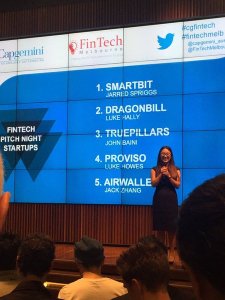
The latest FinTech Melbourne meetup event was the second of their pitch nights. Co-hosted by NAB (at their Docklands Arena venue) and Capgemini (who were promoting the World Retail Banking Report 2016), the pitches were preceded by a panel discussion on a regulatory sandbox for Fintech startups.

The list of contenders.... (Photo By Andrew Lai, sourced from Meetup)

The list of contenders…. (Photo By Andrew Lai, sourced from Meetup)

The panel was composed of Ben Heap from H2 Ventures, Deborah Ralston from the Australian Centre for Financial Services (who is also the inaugural Chair of ASIC’s Digital Finance Advisory Committee), Sudhir Pai (CTO at Capgemini), and NAB’s Todd Reichmann. This is a topic that FinTech Melbourne has aired before, but it seems despite much industry anticipation and some cautiously positive noises from government, bureaucrats and regulators, there are still, to date, no concrete developments or proposals.

I fully understand the need for formal regulation in financial services, and FinTech in particular, to support investor protection, foster market confidence and maintain industry stability. But the cost or burden of compliance can act as an inhibitor for innovation and entrepreneurship. And of course, regulation and compliance are no guarantees that nothing will ever go wrong, even among our established and highly regulated financial institutions. The debate needs to move on to some practical solutions – such as ring-fencing FinTech startups so that they can trial new products and services in the market, within a limited, defined and narrowly permitted scope and range of activity, under some sort of provisional permit prior to obtaining fully licensed status.

Some members of the panel were in favour of a principles-based regulatory framework (e.g., focus on outcomes and intentions, rather than a reductive model, where nothing is allowed unless it is expressly permitted). The problem with this is that the industry already has to work within a very broad definition of what constitutes “financial advice” that is subject to regulation. So there needs to be a further re-think about what “financial advice” means, especially as between retail, sophisticated and institutional investors; and in turn, I see an opportunity for a more variegated approach to licensing or regulating different advice models: e.g., face-to-face and custom financial planning; scaled and personalised robo-advice; or broader, generalised “class” or “category” advice (by product, platform or service type). (Analagous models to draw on already exist in the areas of therapeutic goods licensing and food labelling measures.)

The panel also thought that partnerships between FinTech startups and established licensees offer one way to navigate the regulatory regime. And I can see that the right type of roboadvice could bring truly independent and objective financial advice on product and brand selection.

There was also a suggestion that the sandbox model could act as an umbrella entity for FinTech innovation. While there may be some merit in the idea (e.g., for regulating the API’s that provide access to customer financial data and credit history – although these should already be adequately covered by data protection and privacy requirements), I am sceptical of regulators’ ability to innovate. Plus, the key retail investor failures during the GFC were about investor ignorance, not just “poor”advice; so the need for financial literacy cannot be overstated.

On to the pitches themselves, which were judged by Ben Heap, Deborah Ralston and Rohen Sood from Reinventure:

Smartbit

Offering an automated finance layer for the Internet of Things, Smartbit has already built a secure, Blockchain-backed price index. The goal is to enable automated, real-time payments, between any two devices connected to the internet. They see themselves as the “Blockchain of Things”, and proceeded to give a cute (if somewhat pointless?) live demo of switching on a LIFX bulb with a Bitcoin payment token.

The judges were curious to know what the actual use case was (apart from turning on light bulbs…). In reply, they were told that Smartbit can deliver real-time settlement (unlike the 15 minutes delay of an US competitor), and is designed to support micropayments. Personally, I think the technology is already proven, but the need less so, at least from a B2C perspective. The fact that so many banks, exchanges and clearing houses are exploring Blockchain solutions means that it’s day will soon come when it is not just a “Bitcoin thing”, but will be an integral part of financial services, data solutions and digital asset management.*

Dragonbill

This is a smart payments platform to reduce cashflow stress. The main benefit is to shorten the time SME’s have to wait before they get paid. It offers both a secured payment facility (escrow), and an express payment option (e.g., a tradie can get paid as soon as they finish a job).

The chosen paths to market are social media, accountants, business advisors and mentors, and (unusually?) sports clubs. But it becomes clearer when you consider that clubs need to manage multiple, small membership payments; and many members of sports clubs are SME owners, independent tradies and sole proprietors. Dragonbill are also setting up a partnership with Xero accounting software.

The main questions from the judges concerned the ability to scale the business, and whether Dragonbill generates interest on amounts in escrow.

Truepillars

Another version of the peer-to-peer lending platform for SME borrowers, the business model is based on an online auction system where, for as little as a $50 bid, investors can bid on specific loan requests, with risk-adjusted interest rates, that are also determined by the number and amount of competing bids.

Access to traditional SME loans under $500k is increasingly limited as banks need to allocate more risk-weighted regulatory capital to cover their SME exposures, making them an inefficient and expensive use of bank capital.

The Truepillars platform offers borrower and investor dashboards for tracking and portfolio reporting, but the panel were worried that it wasn’t a unique proposition. However, unlike some of their competitors, Truepillars offers loan terms out to 5 years. It would also be interesting if investors (lenders) could build proper fixed income portfolios (by loan duration, yield curve, exposure type, recourse/rollover etc.), and if borrowers could cap the number of, and limit their exposure to, individual bids or lenders/borrowers.

Proviso

Claiming to be transforming lending, Proviso work with lenders to streamline the submission of borrowers’ financial data and bank statements in support of their loan applications. The prospective borrower logs into their account and gives permission for the lender to access their banking information, but Proviso does not “see”, hold or store the customer data – it merely acts as a pass-through. The goal is to reduce borrower application abandonment, and the service is already being used by 180 financial institutions – generating 60,000 requests per month. The business is being driven by enhanced customer experience, and ASIC directives on more prudent lending processes. In short, they claim to offer better, faster data.

The judges wanted to know how Proviso compares to Yodlee: “we’re local, and less painful to use” was the response – meaning that proximity offers speed and local market knowledge. Finding a market among non-conforming customers, Proviso is also looking at providing validation services. But in my mind, there is a risk that Proviso could be displaced by an industry-owned or regulatory mandated platform or utility (such as the creation of PEXA for real estate conveyancing and settlement.)

Airwallex

With a tag line, “cross-border payments made easy“, this another solution aiming to  transfer money between people, regardless of location, bank, currency, etc. Currently, Airwallex is focussing on Asia Pacific, and is the only Australian holder of a cross-border license to transact in Chinese RMB. It has also integrated with the three largest payment platforms in China – AliPay, WeChatPay and UnionPay, and built an API for e-commerce solutions. Airwallex claims to be faster, cheaper and simpler than the competition, using real-time FX rates.

The panel was naturally curious about how the platform is addressing anti-money laundering concerns and complying with counter-terrorism legislation. In order to offer lower fees than PayPal, and by only taking fees from the FX spreads, Airwallex has to automate the transaction process to achieve mid-market prices – but does the increased automation heighten the risk that the platform can be used for nefarious purposes?

After their deliberations, the judges declared Proviso as the winner – hard to argue with that sort of market traction.

*Note: Declaration of interest – I have recently joined the team at Brave New Coin, a FinTech building market data and infrastructure solutions for Bitcoin and Blockchain.

Next week: #StartupVic showcases the next batch of startup hopefuls