The incoming Labor government in Australia is currently enjoying a post-election honeymoon period. And while the new Prime Minister has spent about as much time overseas as he has been at home, there is sense that domestically, something has changed under Mr Albanase.
First, the strident, discordant and caustic tone of federal politics is subtly being dialled down, even if much of the same partisan rhetoric remains. Second, it has been suggested that Mr Albanese is seeking to evoke the spirit of Bob Hawke rather than looking for inspiration from either of his immediate ALP predecessors. Both Kevin Rudd and Julia Gillard were technocrats (rather than being natural politicians) and neither of them enjoyed a solid or stable power base within their own party (hence, they were both rolled while in office). Third, there does not appear to be any radical departure from the previous LNP administration, apart from a commitment to an indigenous voice in Parliament, a plan to establish a federal anti-corruption commission, and a greater focus on renewable energy.
Of course, the new administration faces a number of challenges in the budget deficit and in key areas of economic activity, most of which they have inherited from the outgoing LNP government. Federal largesse (in the form of industry subsidies, public grants, welfare payments and pandemic handouts) is under pressure. The era of “cheap money” is coming to end as we witness higher inflation, lower unemployment, skills shortages, and a very mixed set of economic results. Interest rates are on the way up to try and prevent parts of the economy overheating, and are designed to reduce both borrowing and retail spending. But there is a risk that higher interest rates will result in a decline in house prices and an increase in mortgage stress; and reduced discretionary consumer spending may dent employee expectations of wage growth. Despite the low level of unemployment, there can be no reasonable hope of higher wages without an accompanying increase in productivity. Perhaps the issue is that too many people have fewer hours of employment than they want or need, while those already in full-time employment seek to maximise the amount of work they have. Or productivity gains are difficult to achieve in sectors where wages are the biggest input cost, or where operating margins are already very thin, or where investment in technology has been lacking.
Despite the increase in domestic travel and tourism during and since the height of the pandemic in 2019-21, we should remember that domestic borders were also closed for extended periods. As a result, local tourism was hit hard, and even as things started to open up again, the hospitality industry struggled to find staff or was unable to operate economically due to capacity limits – and a lot of small operators haven’t come back.
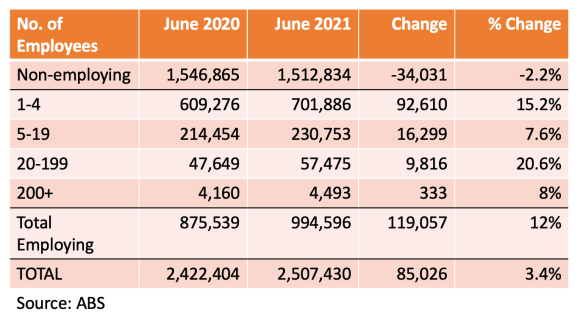
I would expect to see bankruptcy numbers to rise – especially among sole-proprietors and SMEs (the latter of whom, in aggregate, account for the bulk of employment by headcount). This is always a lag economic indicator, given the time it takes for insolvencies and liquidations to work through the system. Despite the overall increase in the number of business in 2020-21 (see table below), 93.0% of businesses had turnover of less than $2 million, and 28.7% of businesses had turnover of less than $50,000. There was a 12.5% increase in businesses with turnover of less than $50,000, and only a 0.5% increase in businesses with turnover of $5 million to $10 million and $10 million or more. Given that 81.7% of exiting businesses had turnover of less than $200,000, there is a likelihood that more businesses will go under. This period is going to be especially challenging for sole traders and SME owners who typically mortgage their principal home to fund their business. The next ABS business entry/exit report in August will be very interesting.
 Past stimulus packages have been spent on household goods (computers, mobile phones, HDTVs, etc.) that aren’t manufactured in Australia; or put towards the mortgage; or saved for a rainy day – and it’s highly likely a similar pattern emerged with the recent pandemic-related measures. All of which means their net effect on the domestic economy and the balance of payments was probably negligible. Sure, during the pandemic some consumer spending was diverted from things like overseas travel towards domestic purchases, but recent data suggests consumers are cancelling their internet streaming services and curbing their on-line shopping (in part because they are no longer working from home).
During the federal election campaign, one of the few areas of economic “policy” that both ALP and LNP ventured was the promise of financial incentives for first-time home buyers. The idea being, I suppose, helping people onto the property ladder enables them to establish long-term household wealth, while taking some pressure off the rental market. Although there has been a softening in city house prices, price increases in some regional areas have more than compensated for those recent declines (thanks to an urban exodus from cities like Melbourne and Sydney). If you’ve just paid at the top of those regional markets, and now face interest rate hikes (as well as coming off introductory fixed mortgage rates), I’m sure this will bring a new layer of mortgage stress.
Finally, it’s still not clear where the wage growth will come from (apart from a lift in the minimum wage?). Businesses (especially SMEs) that struggled during lock-down won’t easily be able to afford pay rises, and the skills shortages are in many areas where there is a lack of local talent, so increased skilled immigration quotas may actually depress salaries. Something of a vicious circle.
Next week: Literary triggers


 Content in Context