Notes from Hong Kong

My personal relationship with Hong Kong stretches back 30 years – to the time I moved there from London in 1994. I arrived on a 1-2 year contract, and ended up living in the city for 6 years. Since then, I have continued to visit at least once a year, and my latest trip earlier this month was the fifth since hotel quarantine was lifted in October 2022, following the global pandemic.

Despite the significant political, demographic, social and economic upheavals of recent years, in many ways Hong Kong remains the same. It still acts as a fulcrum between East and West, and an important trading entrepôt for mainland China and the rest of the world. There are still the evident paradoxes represented by Hong Kong’s ancient traditions and modern values, combining spiritual beliefs with materialistic tastes, and vertiginous high-rises set against mountainous backdrops and waterfront vistas.

From an economic standpoint, Hong Kong remains in something of a lull. People I spoke to commented that the SAR government needs to find new sources of income, especially as the property market (a cornerstone of the local stock exchange) remains patchy, and visitor numbers are only about 50% of pre-pandemic levels.

As I have mentioned in a previous blog, Hong Kong is usually resilient and adept at reinventing its financial fortunes.

For these reasons, the Hong Kong administration is pursuing a fairly aggressive policy of promoting itself as an attractive global venue for the digital asset industry in part to reinvigorate the local capital markets, in part to outpace its regional neighbour and rival, Singapore. (Plus, the SAR acts as something of a test bed for the rest of the PRC.) According to people I spoke with, there is some difference of opinion as to how many digital asset exchanges are actively pursuing a Virtual Asset Service Provider (VASP) license, given that only two licenses have been granted so far, while a number of applications have been withdrawn, refused or rejected for being incomplete.

During my visit, I was granted a 1:1 interview for Brave New Coin with Yat Siu, co-founder and Chairman of Animoca Brands, a leading player in web3.0, NFTs, the metaverse and, potentially, stablecoin issuance. A major advocate of digital property rights, Siu is a very influential figure within the fintech scene, and I expect to see many more announcements from his company leading up to, and during, major events such as Token2049 and Hong Kong Fintech Week. I also met with clients and contacts across crypto exchanges, hedge funds, VCs, brokers and tech providers. All remain suitably bullish on the digital asset sector, although some considered that there needs to be some industry consolidation, to soak up excess infrastructure and to stabilise the entry of institutional fund managers.

Finaly, I found time for some contemporary art exhibitions, confirming that Hong Kong continues to establish its profile in the arena of global culture. There was Bruce Nauman at the JC Contemporary in Tai Kwun, I.M.Pei and Henry Steiner at M+, and even Banksy and Damien Hirst at Sotheby’s Maison at Chater House. Of course, this being Hong Kong, the displays in Sotheby’s showrooms are not too dissimilar to the luxury goods on sale in the surrounding malls.

Next week: Postcript on Tarantino vs Ritchie
 

AI and the Human Factor

Earlier this month, I went to the Melbourne premiere of “Eno”, a documentary by Gary Hustwit, which is described as the world’s first generative feature film. Each time the film is shown, the choice and sequencing of scenes is different – no two versions are ever the same. Some content may never be screened at all.

I’ll leave readers to explore the director’s rationale for this approach (and the implications for film-making, cinema and streaming). But during a Q&A following the screening, Hustwit was at pains to explain that this is NOT a film generated by AI. He was also guarded and refrained from revealing too much about the proprietary software and hardware system he co-developed to compile and present the film.

However, the director did want to stress that he didn’t simply tell an AI bot to scour the internet, scrape any content by, about or featuring Brian Eno, and then assemble it into a compilation of clips. This documentary is presented according to a series of rules-based algorithms, and is a content-led venture curated by its creator. Yes, he had to review hours and hours of archive footage from which to draw key themes, but he also had to shoot new interview footage of Eno, that would help to frame the context and support the narrative, while avoiding a banal biopic or series of talking heads. The result is a skillful balance between linear story telling, intriguing juxtaposition, traditional interviews, critical analysis, and deep exploration of the subject. The point is, for all its powerful capabilities, AI could not have created this film. It needed to start with human elements: innate curiosity on the part of the director; intelligent and empathetic interaction between film maker and subject; and expert judgement in editing the content – as a well as an element of risk-taking in allowing the algorithm to make the final choices when it comes to each screened version.

That the subject of this documentary is Eno should not be surprising, either. He has a reputation for being a modern polymath, interested in science and technology as well as art. His use of Oblique Strategies in his creative work, his fascination with systems, his development of generative music, and his adoption of technology all point to someone who resists categorisation, and for whom work is play (and vice versa). In fact, imagination and play are the two key activities that define what it is to be human, as Eno explored in an essay for the BBC a few years ago. Again, AI does not yet have the power of imagination (and probably has no sense of play).

Sure, AI can conjure up all sorts of text, images, video, sound, music and other outputs. But in truth, it can only regurgitate what it has been trained on, even when extrapolating from data with which it has been supplied, and the human prompts it is given. This process of creation is more akin to plagiarism – taking source materials created by other people, blending and configuring them into some sort of “new” artefact, and passing the results off as the AI’s own work.

Plagiarism is neither new, nor is it exclusive to AI, of course. In fact, it’s a very natural human response to our environment: we all copy and transform images and sounds around us, as a form of tribute, hommage, mimicry, creative engagement, pastiche, parody, satire, criticism, acknowledgement or denouncement. Leaving aside issues of attribution, permitted use, fair comment, IP rights, (mis)appropriation and deep fakes, some would argue that it is inevitable (and even a duty) for artists and creatives to “steal” ideas from their sources of inspiration. Notably, Robert Shore in his book about “originality”. The music industry is especially adept at all forms of “copying” – sampling, interpolation, remixes, mash-ups, cover versions – something that AI has been capable of for many years. See for example this (limited) app from Google released a few years ago. Whether the results could be regarded as the works of J.S.Bach or the creation of Google’s algorithm trained on Bach’s music would be a question for Bach scholars, musicologists, IP lawyers and software analysts.

Finally, for the last word on AI and the human condition, I refer you to the closing scene from John Carpenter’s cult SciFi film, “Dark Star”, where an “intelligent” bomb outsmarts its human interlocutor. Enjoy!

Next week: AI hallucinations and the law


American Art Tour

A list of art galleries and museums visited on my recent trip to the USA, and all of which come highly recommended:

Denver Art Museum

Clyfford Still Museum

Georgia O’Keeffe Museum

New Mexico Museum of Art

Meow Wolf Santa Fe

New Mexico Capitol Art Collection

Santa Fe SITE

De Young Museum

San Francisco Museum of Modern Art

Next week: The Social License to Operate

Picasso and his circle

The problem with a prodigious talent like Pablo Picasso is: how or where do you begin to make any sort of meaningful assessment of his work? He lived to a ripe old age; he was extremely prolific across multiple media; he befriended so many artists and writers; and he had numerous wives and mistresses, his personal life is a rich subject all on its own. Every few years, a new insight comes into focus, via major retrospectives or academic studies. The closest we have to an official biography extends to 4 volumes, and has so far only reached 1943 (Picasso died in 1973). Then there are the record-breaking art auctions

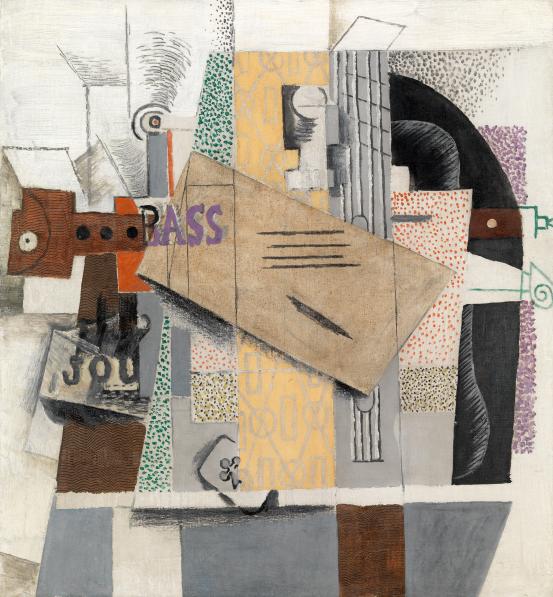
Pablo Picasso: “The violin (Le violin)” (1914) by Pablo Picasso © Succession Picasso/Copyright Agency, 2022; Photo: © Centre Pompidou, MNAM-CCI/Georges Meguerditchian/Dist. RNM-GP; Image sourced from NGV

So it must be with some trepidation that visitors approach the latest example of “making sense of” Picasso – the NGV’s current blockbuster exhibition, ominously titled “The Picasso Century”. The sheer volume of his output, the breadth of techniques and the range of styles can be overwhelming. This major exhibition (drawing mainly on the collections held in the Centre Pompidou and at the Picasso Museum, Paris) is arranged fairly conventionally, in chronological order, and reflecting the major periods of Picasso’s work.

There are glimpses of the post-impressionist Blue Period, the flirtation with Primitivism and Fauvism (which sparked a life-long rivalry with Matisse), and his dominance of Cubism (although both Braque and Gris gave him a run for his money). Plus the importance of people like Gertrude Stein who, initially through her brother, became an early admirer, friend and collector.

Then there is his association with the Surrealists, although I’ve never felt he fully embodied their movement. Sure, he was instrumental in furthering their aims, he counted many of its practitioners as close friends and associates, and he participated in many of their exhibitions, manifestos, happenings and publications. But Picasso did not really pursue the juxtaposition and sub-conscious of major Surrealists such as Dali, Magritte or Ernst. That’s not to say Picasso didn’t reveal his sense of humour or his liking for fantasy – but unlike some of his peers, he was always in control, nothing was left to chance, and even his re-telling of ancient myths and legends was self-serving and relatively orthodox.

First and foremost, Picasso was an excellent draftsman, and his lines and mark-making were always deliberate, distinctive and revealing – as seen in some of the archive footage of Picasso at work in his studio. (I think the dismissive argument that “any 3 year old could have drawn that” has long been debunked.)

Of course, when there are so many works to choose from, the curators are spoiled for choice, and narrowing down this selection must have been challenging – even though they stick gamely to their particular narrative(s), resulting in a balanced and consistent presentation. There are a couple of insights which I did find refreshing – Picasso’s association with Wilfredo Lam, and his dabbling in political themes (mainly stemming from his membership of the Communist Party in France). The one weakness in this exhibition is the extensive display of ceramic plates from Picasso’s later years. I’ve never been a fan of these pieces, as I don’t think they add much to his body of work. There is a sense that he would make these almost on demand, and had them at hand for when visitors and souvenir hunters tracked him down to his studio.

Nonetheless, this exhibition is highly recommended, and provides yet another excuse to admire the work of Picasso’s peak artistic years, from 1909 to 1949. Prior to that period, he was still finding his artistic voice (and creating his own myth); and after that, he found himself having to live up to (and even exaggerating) the myth he had built up for and around himself. Whatever else this exhibition may reveal about his life, the work is still what counts.

Next week: An AI Origin Story