Bitcoin – to fork or not to fork?

Anyone following the crypto-currency markets this past two weeks will be fully aware that this has been a turbulent time for Bitcoin and other blockchain assets. First, the SEC published its Report on the DAO.  Second, there was a significant arrest in connection with the Mt Gox failure. And third, Bitcoin underwent a fork which has resulted in a new version, known as Bitcoin Cash. Meanwhile, at the time of writing, the price of Bitcoin itself is testing renewed highs, and continues to enjoy a 3-month long rally.

What implications do each of these developments have for the digital asset industry?

Photo by Andre Chinn – Image sourced from Flickr under Creative Commons

The Mt Gox-related arrest came as Japanese authorities began separate criminal proceedings against the former head of the failed exchange. These developments underscore two things: 1) as with any complex financial fraud investigation, bringing the culprits to justice takes time. 2) exploiting the financial system for ill-gotten gain is not exclusive to crypto-currencies – just ask investors in Australia’s CBA bank how they feel about losing nearly 4 per cent of the value of their shares in one day on the back of a money laundering scandal.

It also means that as regulators play catch-up, exchanges, brokers and other participants in the crypto-currency markets will need to ensure that they are updating their security and privacy systems (to prevent future hacks) while ensuring they comply with AML/KYC/CTF provisions. No bad thing, to instil confidence and trust in this emerging asset class, which is entering a new phase of maturity.

The SEC Report on the DAO, meanwhile, has put ICO’s (Initial Coin Offering) and TGE’s (Token Generation Event) on notice that in some cases, these products will be treated as securities, and will be subject to the same regulation as public offers of shares etc. As a result, token issuance programs will need to structure their sale processes to be either fully compliant with, or exempt from, the regulations; at the very least, they must remove any suggestion that these tokens are capable of creating security interests in financial or dividend-bearing assets, unless that is the express intention. (In some cases, these tokens are sold as membership services, software and IP licenses, or as network access permits. Any “return” to the buyer comes from the network value effects, service discounts or user rewards, similar to frequent flyer schemes and customer loyalty programs.)

Again, this suggests a coming of age for digital assets, and a growing maturity in the way token sales can be used as an alternative to VC funding and other traditional sources of raising operating capital and project financing.

The Bitcoin fork was hugely anticipated, with a mix of fear and excitement – fear because of the unknown consequences, excitement at the prospect of Bitcoin holders getting “free money” in the form of “Bitcoin cash“, via a 1:1 issue. Without getting into the technical details, the fork was prompted by the need to increase Bitcoin’s blockchain processing speed and transaction capacity; and while nearly everyone connected to Bitcoin’s infrastructure agreed on the need to accelerate block performance, there was a schism as to how this should be achieved. Some exchanges said they would not recognise the new currency, and only some Bitcoin miners said they would engage with it (especially as the cost of mining the new asset was more expensive than Bitcoin core). In addition, most exchanges were advising their customers not to attempt performing any Bitcoin transactions for several days, before and after the fork, until the system settles down again.

In the aftermath of the fork, at least one more exchanges has said it will probably offer some support Bitcoin cash; while due to the nature of the fork, Bitcoin cash’s own block processing time was something like 6 hours – meaning transactions could not be confirmed, and holders of the new asset could not easily transfer or sell it, even if they wanted to. It feels like a combination of a liquidity squeeze, a trading halt, and a stock split resulting from a very complex corporate action.

So far, the value of Bitcoin has held up, while the value of Bitcoin cash has steadily declined (despite an early spike), almost flat-lining to less than one-tenth of the value of Bitcoin:
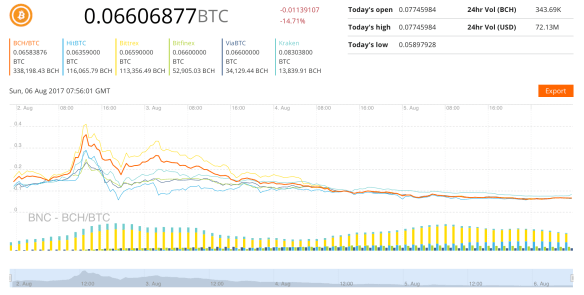
Relative value of Bitcoin cash (BCH) to Bitcoin (BTC) – Market Data Chart sourced from Brave New Coin

I’m not a “Bitcoin absolutist“, as I think different currency designs and technical solutions will continue to emerge based on specific use cases. These products will continue to co-exist as markets come to understand and appreciate the different attributes and functionality of these digital assets.

As a consequence of recent events, some new token projects are refining the design of their issuance programs, more legal opinions are being commissioned, and raise targets are being adjusted in light of the current climate. But the number of new projects coming to market shows no sign of abating, and the better projects will have successful and sustainable sales. The total market cap of all digital assets is now well over $100bn (although the data reveals something of an 80:20 scenario – the top few assets account for the bulk of that value); and more institutional investors and asset managers are taking a greater interest in this new asset class.

NOTE: The comments above are made in a purely personal capacity, and do not purport to represent the views of Brave New Coin or any other organisations I work with. These comments are intended as opinion only and should not construed be as financial advice.

Next week: Bringing Back Banter   



StartupVic’s Machine Learning / AI pitch night

Machine Learning and AI are such hot topics, that I was really intrigued by the prospect of this particular StartupVic pitch night. First, this was a chance to visit inspire9‘s recently established Dream Factory – a tech co-working facility, maker space, and VR lab in Melbourne’s western suburb of Footscray. Second, the Dream Factory, housed in a landmark building owned by Impact Investment Group, was a major beneficiary of LaunchVic funding, and this event could be seen as a showcase for Melbourne’s tech startup sector. Third, with so many buzzwords circling AI, it offered a great opportunity to help demystify some of the jargon and provide some practical insights.

Image sourced from StartupVic

Instead, the pitches felt underdone – probably not helped by the building’s acoustics, the poor PA system, and the inability of many of the audience to be able to read the presenters’ slides. I wasn’t expecting the founders to reveal the “secret sauce” of their algorithms, or to explain in detail how they program or train their “smart” applications. But I had hoped to hear some concrete evidence of how these emerging platforms actually work and how the resulting data is specifically analyzed and applied to client solutions.

Amelie.ai

With a tag line of “powering the future of mental health” the team at Amelie.ai are hoping to have a positive impact in helping to reduce suicide rates. Unfortunately, judging by the way some key statistics are presented on their home page, the data (and the methodology) are not as clear as the core message.

Using technology to help scale the provision of mental health and well-being services, combined with mixed delivery methods, the solution aims to offer continuity of care. Picking up on user dialogue and providing some semi-automated and curated intervention, the presentation was big on phrases like “triage packages”, “customer journey”, “technical architecture”, “chatbots” and of course, “AI” itself, but I would have like a bit more explanation on how it worked.

I understand that the platform is designed to integrate with third-party providers, but how does this happen in practice?

Only when asked by the judges about their competitive advantage (as there are similar tools out there – see Limbr from a previous pitch night) did the presenters refer to their proprietary language models, developed with and based on user trials. This provides  a structured taxonomy, which is currently English-only, but it can be translated.

There were also questions about data privacy (not fully explained?) and sales channels – which may include workplace EAPs and health insurers.

Businest

According to the founder, “dashboards and KPIs only diagnose pain, Businest fixes it“. In short, this is intelligence business analysis for SMEs.

With a focus on tracking working capital and cashflow, as far as I can tell, Businest applies some AI on top of existing third-party accounting software. It identifies key metrics for a specific business, then provides coaching and videos to change business behaviour and improve financial performance. There is a patent pending in the US for the underlying algorithm, which prioritizes the KPIs.

Again, I was not totally clear how the desired results are achieved. For example, are SMEs benchmarked against their peers (e.g., by size/industry/geography/maturity/risk profile)? Do clients know what incremental benefits they should be able to generate over a given time period? How does the financial spreadsheet analysis assist with improving structural or operational efficiencies that are outside the realm of financial accounting?

Available under a freemium SaaS model, Businest is sold direct and via accountants and bookkeepers. A key to success will be how fast the product can scale – via partnering and its integration with Xero, MYOB and QuickBooks.

AiHello

I must admit, I was initially curious, and then totally bemused, by this pitch. It started by asking some major philosophical and existentialist questions:

Q: How do we define “intelligence”?
Q: Are we alone? Or not alone?

No, this is not IBM’s Watson trained on the works of John-Paul Sartre (cf. Dark Star and the struggle with Cartesian Logic). Instead, it is an analytical and predictive app for Amazon sellers. It claims to know what products will sell, where and when. And with trading volumes worth $2.5m of goods per month, it must be doing something right. Serving Amazon sellers in the US and India (and Australia, once Amazon goes live here), AiHello charges fees based on fixed licences and transaction values. The apparent benefits to retailers are speed and savings.

Asked where the trading data is coming from, the presenter referred to existing trading platform APIs, and “big data and deep learning”. It also uses Amazon product IDs to make specific predictions – currently delivering 60% accuracy, but aiming for 90%. According to the founder, “Amazon focuses on buyers, we focus on sellers”. (Compare this, perhaps, to the approach by Etsy.)

C-SIGHT

A new service from the team at Pax Republic, this latest iteration is designed to avoid some of the policy and reputation issues involved with managing, supporting and protecting whistleblowers. Understanding that whistleblowers can pose an internal threat to brand value, and present a significant human risk, C-SIGHT provides a psychologically safe environment for the Board, C-suite and workforce alike, and can act as an early warning system before problems get out of hand.

Sold under a SaaS model, C-SIGHT analyses text-based and anonymous dialogue, with “real-time data sent to different AI apps”. I understood that C-SIGHT combines human and robot facilitation, while preserving anonymity, and also deploys natural language processing – but I didn’t fully understand how.

In one client use case, with the College of Surgeons, there were 1,000 “contributions” – again, it was not clear to me how this input was generated, captured, processed or analysed. Client pricing is based on the number of invitations sent and the number of these “contributions” – what the presenter referred to as an “instance” model (presumably he meant instance-based learning?).

Asked about privacy, C-SIGHT de-identifies contributions (to what degree was not clear), and operates outside the firewall. There was also a question from the judges about the use and analysis of idiom and the vernacular – I don’t believe this addressed in much detail, although the presenter did suggest that the platform could be used as a way to drive “citizen engagement”.

Overall, I was rather underwhelmed by these presentations, although each of them revealed a kernel of a good idea – while in the case of AiHello (which was the winner on the night), sales traction is very promising; and in the case of Businest, industry recognition, especially in the US, has opened up some key opportunities.

Next week: Bitcoin – to fork or not to fork?

ASIC updates – Sandbox and Crowdfunding (plus #FinTech Hub)

In recent weeks, ASIC Commissioner, John Price and his team have been making presentations to the FinTech community on two key topics: the ASIC Regulatory Sandbox, and the forthcoming Equity Crowdfunding legislation.

Image by TeeKay, sourced from Wikimedia

blogged about the sandbox when it was announced last year, and at the time, the proposed safe harbour provisions for FinTech startups were seen as being key to fostering innovation within the sector. However, at the time of the presentation I attended (June 13), there was only one confirmed participant in the sandbox scheme. According to the Commissioner, the low take-up was probably due to the timing of the regulations, being so close to summer holidays.

On the other hand, the sandbox has such a limited application, that the Government is proposing to expand its scope to include the provision of products (not just distribution), the provision of credit services, and to extend the current 12-month license waiver period to two years.

The Commissioner also mentioned the consultation process on RegTech combined with a hackathon event to be held later this year, as evidence of the direction the ASIC Innovation Hub is taking. Let’s just hope they can keep up with how fast the FinTech community (especially in blockchain and crypto-currency) is evolving, since regulation usually lags innovation.

At a separate series of FinTech and startup briefings, Mr Price discussed the new equity crowdfunding provisions, due to take effect on September 29. Currently undertaking a consultation process on the detailed regulations, the legislation applies only to ordinary shares issued by companies with a maximum of $25m in assets and annual turnover, and which become public companies once the legislation comes into force.

Eligible crowd-sourced funding companies (CSF’s) can raise a maximum of $5m per annum, and investors can invest a maximum of $10,000 per company each year. CSF’s cannot invest in other businesses or securities, and cannot have simultaneous multiple offers on participating crowdfunding platforms.

The Commissioner spoke about the temporary reporting and corporate governance concessions under the scheme: eligible public companies don’t need to have Annual Public Meetings or audited accounts for a period of 5 years; and the offer documents do not have to be as detailed as a full IPO prospectus. Whether these concessions will be enough to attract issuers, or whether the limitations prove more of a deterrent, it will be interesting to see if the new legislation meets the expectations of government, ASIC, issuers and investors.

Meanwhile, things are getting interesting for anyone following the FinTech hub story, and the perennial Melbourne-Sydney startup rivalry:

First, the Victorian government has issued an RFP for a Melbourne FinTech Hub (submissions close tomorrow…). The state government has also announced its partnership with Fintech Australia and others to host the intersekt festival, following last year’s Collab / Collide event.

Second, Melbourne’s York Butter Factory has recently announced plans to expand into Sydney. While not purely a FinTech hub, this new venture will feature the Commonwealth Bank as an anchor tenant. With former ANZ CEO Mike Smith as its Chair, YBF might also be expected to make a submission to the Victorian RFP.

Third, Sydney’s Stone & Chalk has just announced it will be opening a new FinTech hub in Melbourne. Given that a number of key Melbourne-based financial institutions (such as ANZ, NAB, AustralianSuper, Findex, Genworth and Liberty Financial) are backing this new venture, could it suggest they can’t wait for the Victorian RFP process to finish?

Next week: StartupVic’s Machine Learning / AI pitch night


Agtech Pitch Night at SproutX

Judging by some of the news coverage, last week’s pitch night showcasing successful applicants to the SproutX agtech accelerator suggests that this will be a program worth watching. (Look out for the demo day later in the year…) With an initial cohort of 11 participants, this recent addition to Melbourne’s startup scene is showing there is an audience and a market for smart farming solutions. Founded by Findex and the National Farmers Federation, SproutX also enjoys support from Ruralco and Artesian, as well as the Victorian Government.

Given the number of pitches, my comments on each startup presentation are necessarily short:

AgriLedger

This project is driving social impact by focusing on farmers in the developing world. It offers a smart phone app that helps deliver products and services direct to farmers, such as solar power facilities and micro loans, and enables them to plan better and to share equipment with other local farmers. Currently active in Papua New Guinea, Kenya and Myanmar, AgriLedger has been supported by some high-profile NGOs and attracted some impressive backers and advocates.

However, the judges felt that the pitch didn’t contain enough of the story, or explain how it actually works.

Applant

With a tag line of “aTree in your home”, Applant has come up with a novel design for a vertical gardening system that uses aeroponics. The idea is to help people “grow more with less”, and to grow food where we live, work, eat and even play. With an underlying concept for modular food systems, Applant is about to launch a Kickstarter campaign.

The judges had hoped to learn more about the customer demand and the proposed
customer subscription model.

Bloomboxco

Delivering locally sourced and farm-fresh cut flowers direct to customers, my immediate thought was “flower miles”. Launching just recently with a monthly subscription model, Bloomboxco has already attracted around 35k followers on social media (mostly Pinterest). By its own admission, the service appeals mainly to women who enjoy contemporary design and lifestyle trends.

But the judges wanted to know what makes this business different: given that the current supply model for cut flowers is built on margin, how does Bloomboxco aim to compete?

Farmgate MSU

With their mobile slaughter unit (MSU), the team from Farmgate want to “open the gate to on-farm abattoirs”. Many farms do not have access to an abattoir thanks to industry consolidation and contraction. The MSU is designed to cut production costs, minimize animal stress, and reduce waste. While still relying on central butchery services, the MSU has the potential to add value, especially for premium products, as it can operate at smaller scale. Farmgate also benefits from having a team drawn from across the meat supply chain.

For the judges, the pitch could have done more to demonstrate the capability, and to explain what happens to waste and by-products.

Farmapp

Farmapp has developed a digitized and integrated pest management solution for greenhouse crops. Using data collected from various sensors and stored in the cloud, Farmapp uses visual analysis, helping farmers to reduce their use of pesticides and increase productivity. It is currently installed in 1200 greenhouses (mainly Columbia and Kenya).

The judges wondered about the competition, as they were aware of a number of other similar solutions.

iotag

This “fitbit for cattle” uses long-range GPS monitoring to track and manage livestock health. In addition to the setup costs for network base sensors, there is a monthly subscription fee to manage data.

There were no comments from the judges, apart from the representative from the farming community, who claimed to hate subscription services.

Smart-Bait

Smart-Bait uses sensors, cognitive APIs and programmed alerts to track feral animals. Current solutions (baiting, fencing, shooting) are either unreliable, inefficient, or non-selective. Instead, Smart-Bait is leveraging IoT and AI, and can be used offline giving further flexibility. Currently conducting farm trials, the founders say that there is government interest in the data.

For their part, the judges wanted to know if there were other applications for this technology – but more importantly, they wanted to know how it actually works.

Snaptrap

This product enables remote pest monitoring and control, especially fruit fly. It retrofits to existing systems, and has established a successful proof of concept. Snaptrap is targeting research, government and industry users, appealing to both growers and the bio-security market. Another subscription-based product, the founders claim there are many use cases, and the solution is scalable.

The judges asked about the data (what happens to it), and our farm rep again queried the use of a subscription model.

Thingc

With the goal of producing “intelligent orchestrated things”, Thingc aims to reduce the number of manual tasks and alleviate animal stress in livestock management. Using the notion of precision management, it takes data from monitoring sources and applies it yield forecasting.

The judges wanted to know “where’s the tech?”, who is the competition?, and what exactly is the end game?

TieUp Farming

TieUp uses an algo-based solution to compensate for the lack of data available for yield forecasting in horticulture. The data is being made available to farmers, industry and banks, using an aggregation of different technologies. The founders claim it to be both practical and customizable, while they see significant opportunities in South East Asia.

The judges wanted to know how it actually works, and to what degree it can support traceability of produce?

Water Save

As the name suggest, Water Save is designed to reduce water and power consumption on farms. With increased concerns about water efficiency and environmental impact of run-off on the Great Barrier Reef, Water Save uses existing irrigation monitoring systems (micro weather stations, sensors) and connects them into an integrated and networked solution. The system involves set up costs, hardware costs, and subscription fees, but a key goal is to reduce the use of fertilizers – creating both economic and environmental savings.

The judges wanted to know more about the solution for linking individual sensors, and whether it has the capability to monitor nitrates.


For most of these 3-minute pitches, the challenge was to tell enough of the “story” while still explaining how it works – and there was a sense that the audience understood the context as well as the problem, and probably didn’t need too much background explanation. Instead, they would have appreciated learning more about the technology and the potential to succeed – i.e, “why you?”.

Farmgate MSU was declared the winner by the judges, and voted the people’s choice by the audience.

Next week: ASIC updates – Sandbox and Crowdfunding (plus #FinTech hub)