Who fact-checks the fact-checkers?

The recent stoush between POTUS and Twitter on fact-checking and his alleged use of violent invective has rekindled the debate on whether, and how, social media should be regulated. It’s a potential quagmire (especially the issue of free speech), but it also comes at a time when here in Australia, social media is fighting twin legal battles – on defamation and fees for news content.

First, the issue of fact-checking on social media. Public commentary was divided – some argued that fact-checking is a form of censorship, and others posed the question “Quis custodiet ipsos custodes?” (who fact-checks the fact-checkers?) Others suggested that fact-checking in this context was a form of public service to ensure that political debate is well-informed, obvious errors are corrected, and that blatant lies (untruths, falsehoods, fibs, deceptions, mis-statements, alternative facts….) are called out for what they are. Notably, in this case, the “fact” was not edited, but flagged as a warning to the audience. (In case anyone hadn’t noticed (or remembered), earlier this year Facebook announced that it would engage Reuters to provide certain fact-check services.) Given the current level of discourse in the political arena, traditional and social media, and the court of public opinion, I’m often reminded of an article I read many years ago in the China Daily, which said something to the effect that “it is important to separate the truth from the facts”.

Second, the NSW Court of Appeal recently ruled that media companies can be held responsible for defamatory comments posted under stories they publish on social media. While this specific ruling did not render Facebook liable for the defamatory posts (although like other content platforms, social media is subject to general defamation laws), it was clear that the media organisations are deemed to be “publishing” content on their social media pages. And even though they have no way of controlling or moderating the Facebook comments before they are made public, for these purposes, their Facebook pages are no different to their own websites.

Third, the Australian Government is going to force companies like Facebook and Google to pay for news content via revenue share from ad sales. The Federal Treasurer was quoted as saying, “It is only fair that the search ­engines and social media giants pay for the original news content that they use to drive traffic to their sites.” If Australia succeeds, this may set an uncomfortable precedent in other jurisdictions.

For me, much of the above debate goes to the heart of how to treat social media platforms – are they like traditional newspapers and broadcast media? are they like non-fiction publishers? are they communications services (like telcos)? are they documents of record? The topic is not new – remember when Mark Zuckerberg declared that he wanted Facebook to be the “world’s newspaper”? Be careful what you wish for…

Next week: Fact v Fiction in Public Discourse

“There’s a gap in the market, but is there a market in the gap?”

As a follow up to last week’s post on business strategy, this week’s theme is product development – in particular, the perennial debate over “product-market fit” that start-up businesses and incumbents both struggle with.

Launch it and they will drink it….. (image sourced from Adelaide Remember When via Facebook)

The link between business strategy and product development is two-fold: first, the business strategy defines what markets you are in (industry sectors, customer segments, geographic locations etc.), and therefore what products and services you offer; second, to engage target customers, you need to provide them with the solutions they want and are willing to pay for.

The “product-market fit” is a core challenge that many start-ups struggle to solve or articulate. A great product concept is worth nothing unless there are customers who want it, in the way that you intend to offer it, and which aligns with your go-to-market strategy.

I appreciate that there is an element of chicken and egg involved in product development – unless you can show customers an actual product it can be difficult to engage them; and unless you can engage them, how can they tell you what they want (assuming they already know the answer to that question)? How often do customers really say, “I didn’t know I needed that until I saw it”? (Mind you, a quick scan across various crowd-funding platforms, or TV shopping channels, can reveal thousands of amazing products you didn’t know you couldn’t live without!) Of course, if your product development team can successfully anticipate unmet or unforeseen needs, then they should be on to a winner every time! In fact, being ahead of the curve, and understanding or even predicting the market direction is a key aspect of business strategy and product development for medium and long-term planning and forecasting.

Then there is the “build it and they will come” strategy. A bold move in most cases, as it involves upfront deployment of capital and resources before a single customer walks through the door. The image above is the only visual record I can find of a soft drink marketed in South Australia during the late 1960s and early 1970s. And you read the label correctly – a chocolate flavoured carbonated beverage (not a chocolate milk or soy concoction). It was introduced when the local manufacturer faced strong competition from international soft drink brands. No doubt it was designed to “corner the market” in a hitherto under-served category and to diversify against the competitor strongholds over other product lines. Likewise, is was launched on the assumption that people like fizzy drinks and people like chocolate, so hey presto, we have a winning combination! It was short-lived, of course, but ironically this was also around the time that soft drink company Schweppes merged with confectionery business Cadbury, and commentators joked that they would launch a chocolate soda, or a fizzy bar of chocolate….

With data analysis and market research, it may be possible to predict likely successes, based on past experience (sales history), customer feedback (solicited and unsolicited) and market scans (what are the social, business and technology trends). But obviously, past performance is no guarantee of future returns. In my early days as a product manager in publishing, we had monthly commissioning committees where we each presented our proposals for front list titles. Financial forecasts for the new products were largely based on sales of relevant back catalogue, and customer surveys. As product managers, we got very good at how to “read” the data, and presenting the facts that best suited our proposals. In fact, the Chairman used to say we were almost too convincing, that it became difficult to second guess our predictions. With limited production capacity, it nevertheless became imperative to prioritise resources and even reject some titles, however “convincing” they seemed.

Then there is the need to have a constant pipeline of new products, to refresh the range, retire under-performing products, and to respond to changing market conditions and tastes. In the heyday of the popular music industry from the 1960s to the late 1990s, the major record labels reckoned they needed to release 20 new song titles for every hit recording. And of course, being able to identify those 20 releases in the first place was a work of art in itself. For many software companies, the pipeline is now based on scheduled releases and regular updates to existing products, including additional features and new enhancements (particularly subscription services).

An important role of product managers is knowing when to retire an existing service, especially in the face of declining or flat sales. Usually, this involves migrating existing customers to a new or improved platform, with the expectation of generating new revenue and/or improving margins. But convincing your colleagues to give up an established product (and potentially upset current customers) can sometimes be challenging, leading to reluctance, uncertainty and indecision. In a previous role, I was tasked with retiring a long-established product, and move the existing clients to a better (but more expensive) platform. Despite the naysayers, our team managed to retire the legacy product (resulting in substantial cost savings), and although some clients chose not to migrate, the overall revenue (and margin) increased.

Finally, reduced costs of technology and the abundance of data analytics means it should be easier to market test new prototypes, running proofs-of-concept or A/B testing different business models. But what that can mean for some start-ups is that they end up trying to replicate a winning formula, simply in order to capture market share (and therefore raise capital), and in pursuit of customers, they sacrifice revenue and profit.

Next week: Who fact-checks the fact-checkers?


“How do I become a business strategist?”

I was recently asked for some career advice, specifically on how to move from a technical role to a more business strategy role, within a corporate environment. Like a lot of the questions I receive regarding career development (especially on LinkedIn….), the initial question was quite broad, a little bit vague, so I needed to frame it before responding.

At the outset, I should stress that I am neither a qualified career counselor (although I have done some related coaching work), nor an organisational behaviorist/industrial psychologist (but I have some formal experience of using personality profiling tools, and trained as a counselor very early in my career). Plus I have had a varied career path and some in-depth corporate experience to draw on!

I have never worked in a full-time Business Strategy role – rather, Business Strategy has been integral to the whole of my corporate and consulting career, whether I have been working in product management, market expansion, business development or start-up roles. So while Business Strategy can be defined (and practiced) as a specific discipline, from my experience it’s just another management component or business tool everyone needs to understand and apply, especially on a practical level.

First, my exposure to business strategy really began when I was in a product management role. So I it was part technical (requiring some formal qualification and subject matter expertise), part production (understanding the design and manufacturing processes), part strategic (managing the commercial, financial and market dynamics). That framework continues to inform my approach to business strategy, even in my consulting work – and helps in understanding my clients’ business.

Second, business and management tools come and go; some are mere passing fads, others are the result of changing technology or market conditions – so there is little point in trying to grapple with each and every one, or whatever happens to be in current fashion. Rather, I believe that we should each identify some core models and frameworks that work for us, which can also be adapted to different situations either organically or by analogy. For example, even the over-used Johari window and SWOT analysis can be useful techniques for mapping out markets, customer segments, or growth options. And having some basic accounting, legal and risk management ability is really useful!

Third, a key personal skill is being curious, and remaining open to possibilities. Simply asking the right questions (Q “Why do we do it this way?” A “Because we’ve always done it this way”) can uncover opportunities for improvement or alternative solutions. Without being a perpetual rebel, it is possible to constructively challenge the status quo, to find ways to do things better, more efficiently, more ethically, more environmentally friendly etc.

Fourth, if there was one thing I had understood better before entering the corporate world and management roles, it is the function of teams, the role of team dynamics, and the importance of open communications, pro-active stakeholder engagement, and bringing people on the journey with you. Never underestimate how stubborn, stupid, wilful or malicious some people can be – but often, they are acting out of a position of fear, ignorance or weakness. It’s rarely personal (it’s just business, right?), but it can feel that way. So, whether you are managing up, down or sideways, be prepared to overcome objections, present solutions (not just problems), and get buy-in early on. Making the team collectively and individually responsible for decisions means that they are personally invested in the outcomes. It’s also a way of empowering people.

Fifth, this leads me to the whole issue of decision-making. Companies will always make some poor decisions – but worse is sub-optimal decision-making. Partly this comes from not having appropriate systems and oversight (proper matrix processes, clearly delegated authorities, well-defined mandates, strong governance frameworks, transparent and accessible policies, and documented audit trails, etc). Partly this is a lack of cognitive skills (empathy, self-awareness, communication). And partly it is an absence of informed decision-making (e.g., understanding any inter-dependencies), and the misalignment of goals and incentives.

As a follow-up question, I was asked about some of the tools I have found useful for being successful in my strategy roles. Personally, I think the jury is still out on the value of an MBA vs gaining hands-on experience, or learning as you grow into a role. MBAs have their place, but they are not the Be all and End all of a corporate career.

I’ve also been dipping into a few of the “leading” business text books of their day, that were recommended to me over the past 15-20 years or so (Blue Ocean Strategy, the Long Tail of markets, defining Metanational companies, etc.). While they all provide some insights, and even some practical examples, they feel very dated in terms of current technology, business models, and market environment. Hence my comment above on passing fads…

Even though I worked for major multinationals for over 20 years, I think I’ve learned a lot more from working with and for startups and entrepreneurs over the past 10 years – and to me, that’s where a lot of the more interesting stuff is happening, notwithstanding the challenges of founding a new business. But I realize it’s not for everyone as a career choice.

Finally, no doubt there will be huge lessons for business and corporate strategy as we come out of lock down and it’s how we apply those lessons that will determine the next generation of success stories.

Next week: “There’s a gap in the market, but is there a market in the gap?”


The Bitcoin halving – what happened?

Last Monday, May 11, at around 19:23 UTC, the third Bitcoin halving occurred. This event is currently scheduled to happen approximately every four years, and is a core mechanism in Bitcoin’s protocol. In short, combined with the finite supply of bitcoin (BTC), the halving acts as an anti-inflationary measure by reducing the number of BTC payable to the miners who confirm each block of transactions, and maintain the integrity of the blockchain ledger. By using dedicated, high-powered computers to solve Bitcoin’s complex algorithms, the miners earn BTC as rewards for their efforts (and to help recoup their energy costs). As a result, the halving is an integral component in measuring key metrics in BTC’s performance, including pricing, supply and mining profitability. What happened around the time of the halving provides for some interesting analysis before and after the event.

BTC price dropped dramatically just prior to the latest halving event – the above graph is plotted using the hourly closing value of Brave New Coin’s Bitcoin Liquid Index.

The halving is programmed to occur after every 210,000 blocks, which themselves are “mined” approximately every 10 minutes. Last week’s third halving was triggered when block number 629,999 was confirmed – from block 630,000 onward, the block reward reduced from 12.5 BTC to 6.25 BTC per block, and is designed to continue halving until the block reward reaches 1 Satoshi (0.00000001 BTC).

Usually, financial markets have already priced in events such as the halving, so traders don’t expect the event itself to have an immediate impact on price. (Think of the halving as just one type of “corporate action” that is peculiar to cryptocurrencies and digital assets. Others might include hard forks, coin burns, and token lock ups.) As with company results and profit announcements, traders and analysts are usually prepared for the best (or worst).

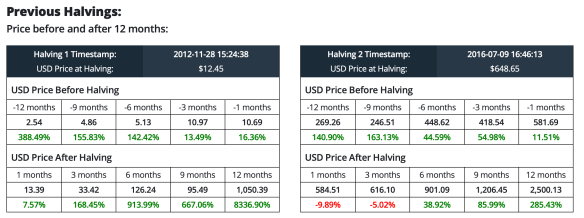
However, leading up to the latest halving, BTC briefly touched a 3-month high of US$10k, before going through an almost typical “market correction” of a 20% decline immediately prior to the halving event. BTC has since recovered some of those losses, and in any case, the price performance before and after each halving event has become yet another indicator of long-term price movement, as the following chart illustrates:

Other metrics to watch include: “hash rate” (the degree of difficulty, and therefore the amount of computing power, to solve the algorithms and mine each block); transaction fees (if miners can’t earn as much from mining activity, they are expected to start increasing their network fees); the price of electricity (as an input cost to mining); and even the cost of computing power itself (as older machines become less efficient and therefore less profitable, while newer, more powerful and more expensive processors come to market).

Indeed, different scenarios used to predict the exact date of the next halving are largely based on the hash rate, which has been relatively volatile before and since the halving, and transaction fees likewise escalated (and then settled down again) around the time of the halving. Key data to track as part of halving analysis and forecasting can be seen in the table below from Brave New Coin:

Other interesting developments around the time of this latest halving include a legendary hedge fund manager reported to be buying BTC as a hedge against inflation; an increase in open interest on CME’s BTC futures contracts (assumed to be coming from institutional clients); and an intriguing message attached to block 629,999 (“NYTimes 09/Apr/2020 With $2.3T Injection, Fed’s Plan Far Exceeds 2008 Rescue”). Given the recent quantitative easing measures pursued by many governments and central banks in response to the Covid-19 pandemic, this choice of headline echoed the message attached to the genesis or very first Bitcoin block, mined in 2009, soon after the GFC (“The Times 03/Jan/2009 Chancellor on brink of second bailout for banks”).

Finally, as more data and analysis attaches to the halving events, they form the basis of a fundamental aspect of understanding how financial instruments perform over time – giving rise to the BTC equivalent of a 1, 5 or 10 year yield curve, which in turn will create more sophisticated derivatives and hedging tools, and another level of comfort for traditional and institutional investors.

(My thanks to friends and colleagues at Brave New Coin and Apollo Capital.)

Next week: “How do I become a business strategist?”