Amazon finally comes to Australia; local retailers still want government action on sales tax

A short (and seasonal) post this week, as everyone starts easing off for the holidays.

It may just be coincidence, but about the same time Amazon launched their new Australian website local retailers renewed their campaign to lower the $1,000 sales-tax exemption for online purchases from overseas retailers. And both events came at the start of the Christmas shopping season….

Obviously too early to say which way this will go, but here are a few personal observations:

First, the local Amazon site is limited to e-books, games and Android apps. So, no access to music, television or film content (digital or physical), no sales of print books and no Amazon marketplace. For these products and services, customers are directed to the US site. (Previously, the dormant Amazon.com.au domain name referred customers to the UK site.)

[Note: neither the US nor the UK sites allow overseas customers to buy mp3 content, but they can download digital music via Amazon’s AutoRip service when purchasing physical goods – confused? Me too….]

Second, prices for e-books on Amazon’s Australian site appear to be comparable to the US store, and presumably include local sales tax (GST) to keep on-side of the local real world and online retailers (as well as the ATO, of course).

Third, the general consensus is that if the $1,000 threshold was lowered or even abolished, the amount of sales tax to be collected would be more than outweighed by the additional costs of processing, administration and remittance (which would likely be passed on to local consumers at a “cost-plus” rate by overseas online retailers).

Fourth, many local retailers who voice their opposition to the $1,000 tax-free exemption fail to understand some of the reasons why local shoppers prefer to buy from overseas online retailers:

1. Price – even if overseas sales attract the 10% GST, in some cases this would still be cheaper than buying locally (especially so when the A$ was above parity with the US$). For example, from time to time, Amazon’s UK store offers free shipping on physical goods to Australia….

2. Choice – many products available from overseas online stores just aren’t available in Australia. This is primarily due to geo-blocking, confusion over local distribution rights, and simple lack of interest in stocking some items for the local market

3. Service – from recent personal experience, buying from a local online retailer took much longer than buying the same product from an overseas site, because the supply chain logistics were woefully inept.

[Note: As a separate but related example, I recently ordered a new iPhone 5S direct from Apple’s local website, and received it within 3 days, including a weekend; whereas my telco provider – which prides itself on its on-line business model and customer service standards – took more than 2 weeks to send me a new nano SIM card….. I had also been told by a couple of local Apple re-sellers that it would take 3-4 weeks to order the new phone, unless I took out a new mobile plan with them – which may say more about Apple’s trading policies than the resellers’ business operations.]

My advice to local bricks and mortar and even some online retailers is to look at their own limitations before insisting that the government amend the GST-free threshold on overseas online purchases.

As for Amazon, I wish them well in developing their local service. Much has been made of the stated intention to focus on Australian titles, and the opportunity for local authors to self-publish via Amazon. But already there have been some rumblings that this new site may cannibalize Kindle sales made via some of Amazon’s local retail channel partners.

Will Social Media Eat Itself?

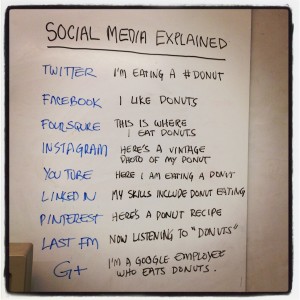
The Internet has shortened the use-by date of most content. Even our attention spans are getting shorter, in inverse proportion to the amount of content we consume and length of time we spend engaging in Social Media and other platforms. Paradoxically, some stuff grabs our attention, and goes viral as everyone posts, shares, likes, blogs and Tweets the same content. Which brings me to this infamous “infographic” on donuts as a signifier for Social Media:

Donuts_SocialMedia_ThreeShipsMedia

Content by Three Ships Media – Photo by Doug Ray

Recently, I saw this image appear as a status update and a “like” by the person posting it. There was no obvious acknowledgement, giving the impression it was an original piece of work. But I recalled having seen it before (more of which later), so I was intrigued as to the true source and provenance. On closer inspection, there was a reference to a third-party website, but this was a dead-end leading to an anonymous blog post.

After a brief search, I located what I believe is the original source for the infographic, Three Ships Media, as well as the photographer who captured the image, Doug Ray. Not that difficult to uncover, given that the post has been “liked” and Tweeted about well over 100,000 times, and written up in Three Ship Media’s own blog (about how this innocuous image had gone viral….).

Now, I don’t believe that the person who posted this image was trying to claim the content as their own work. And I doubt they were deliberately seeking to violate anyone’s intellectual property rights. Yet, the failure to acknowledge our sources (regardless of whether we are exploiting them for personal commercial gain or simply invoking the fair use provisions) threatens to undermine our credibility as commentators, critics and thought leaders. If we keep recycling other people’s work without attribution, the risk is that social media will simply implode as it chases itself in ever-diminishing circles.

Ironically, I realised that I had first seen this infographic at a seminar on the legal and practical aspects of Social Media. It was used by a lawyer to introduce his presentation on copyright issues and the Internet. All very well, except that he insinuated that he had come up with the infographic, and he certainly didn’t cite the original source….

Footnote: The title of this blog was inspired by the writer, David Quantick who coined the phrase “pop will eat itself” in the mid-1980’s, to describe the way modern music is self-referencing itself into oblivion.

Demo Day for MAP’s Class of 2013 Startups

The Melbourne Accelerator Program (MAP) supported by University of Melbourne’s School of Engineering and Faculty of Business and Economics is only in its second year, but already shows signs of becoming a leading incubator of new and emerging entrepreneurial talent in the burgeoning Melbourne startup community.

Last week was Demo Day (a.k.a. pitch night) for the 6 successful teams who were selected from over 50 applications submitted for the 2013 program. Presenting to an audience of fellow entrepreneurs, potential investors, program mentors and “interlopers” (a term used by Dr Charlie Day in his introduction), each team was invited to present the fruits of their labours from the 3-month accelerator program.

To kick things off, there was a quick update on the Class of 2012, including the team behind the new Omny audio app, which offers curated audio content.

From the Class of 2013, first up was 2Mar Robotics, who are developing a remote-controlled robotic arm, aimed at helping people with quadriplegia or with restricted arm movement and control. An earlier, voice-operated prototype proved unstable due to interference from background noise, but the team, led by Young Australian of the Year 2012, Marita Cheng (and founder of Robogals) have already secured a number of pre-orders for the latest version, which they hope to ship in early 2014. While it is understandable that the team would want to keep key commercial aspects of their project confidential, the less-than-open responses to audience questions about product costs and market pricing created the impression that the team are still developing their business case.

The next project, also healthcare-related, was from Cortera Neurotechnologies, who specialise in remote monitoring sensors for epilepsy patients. The team’s goal, using highly developed neural interface technology, is to significantly reduce the risk of infection caused by major invasive surgery for the 30% of epilepsy sufferers who are unable to take medication. Despite some theoretical discourse and good-natured banter with the audience about cyborgs and mind control interfaces, the team (which is divided between Melbourne Uni and UC Berkeley) is well on its way to securing prototype funding.

Client Catalyst offers digital marketing services for SMEs, via mobile websites and integrated search solutions. Given that nearly half of all mobile searches are for local services, the solution has targeted the trade vertical (plumbers, builders, electricians, etc.) which accounts for about 25% of the SME market. Claiming much lower customer acquisition costs for their clients (compared to traditional classified directories), and a very high client conversion rate, the team has established a solid subscription business that more than covers their primary input cost of paid search terms.

By using highly intuitive data visualisation and enhanced search, the team behind The Price Geek claim to have established a major competitive edge over other price comparison sites, in their bid to help you “find out the market price for anything” (although currently, it really only covers tech devices, sneakers, and Tiger Woods memorabilia…). They have built affiliate programs with multiple merchants, giving them more market sources, more contributed content, and more data analytics. The site has already picked up some strong media coverage, and in future, The Price Geek plans to offer price comparison for cars.

Before commenting on Ebla, a self-publishing platform for lawyers, I should declare an interest: I previously worked for the legal information division of Thomson Reuters, including the Westlaw online service. So, IMHO, anyone who is attempting to bring a new technology solution to informed legal commentary and analysis deserves a lot of credit, especially if, as intended, the service empowers individual lawyers to showcase their expertise in a collaborative and adductive environment. Contrary to some popular misconception, the legal profession (along with financial services) was one of the first industries to embrace the digital age*. Yet consider this: the sheer volume of legislation, case-law and commentary; the complexity of the material and its many idiosyncrasies (e.g., case citation systems); the proprietary nature of much document drafting; and the “knowledge is power” approach to researching obscure precedents before facing your opponent in court – all these factors tend to work against the notion of knowledge sharing and collaboration among lawyers. (I have heard of some law firms that embed deliberate mistakes in their commercial drafting templates, to deter plagiarism by their competitors if the originals were to fall into the wrong hands.) Access to the site, which is still in Beta, is by invitation only, and will offer a freemium subscription model.

The last team to present was SwatchMate, with a Bluetooth-enabled reader that helps users to “capture the color of any surface” (or “Shazam for color”). I have to say that when I first saw this team present at a Lean Startup Melbourne event earlier this year, I was somewhat sceptical about the product, as they seemed to be focussing on the paint market (both trade and DIY customers), yet didn’t appear to realise that most people only paint their home once every 5-7 years. However, I am pleased to report that SwatchMate have since lifted their game, by identifying strong opportunities among designers and creatives, brand managers, the cosmetics industry, and even TV and monitor calibration. With linkages to major design software, as well as to leading colour and paint catalogues, SwatchMate will offer an integrated solution once they go into production. Meanwhile, they are planning to launch on Kickstarter, and are a finalist at next week’s Melbourne Design Awards (plus shortlisted for the Sydney and Brisbane Design Awards)**.

Applications for MAP 2014 close on April 24, and there are also opportunities to participate as a mentor (full details not yet available).

* Lawyers love their technology: The Wang word processing system was eagerly adopted by law firms in the 1970s and 1980s, for its ability to support complex document formatting. Online legal research tools like Westlaw and Lexis-Nexis were launched in the 1970s. Some of the first CD-ROM and web-based law publications in the 1990s deployed specialised html coding and Boolean logic designed for legal search and retrieval purposes. Many law firms use sophisticated knowledge management systems to capture the in-house expertise of their lawyers. Court reporting and litigation support tools have been using advanced voice recognition, extensive text parsing and real-time data capture and processing for many years.

** Declaration of interest: I am currently involved with the Design Awards, although I have no say in the selection of shortlisted entries or finalists.

Has web-traffic analysis just got better or worse thanks to Google search encryption?

Last month, WordPress informed its customers that Google has expanded search encryption to cover any search except for clicks on ads. The impact will mean less detail about which keyword searches are driving traffic to your website. Debate among industry observers suggested that this was done either in response to security-related issues, or simply to maximise ad revenue.

I’ll leave you to decide what the real motive is, and to determine what your own response should be around SEO strategies. My sense is that content owners and social marketers will sharpen their use of keywords, and devise new tactics to maximise the value of web traffic analytics. As one commentator has observed, Google has a near monopoly on search – but in the end, it’s their platform and they’ll do what they want with it.

From my own analysis here at Content in Context, the number of “unknown search terms” far outweighs precise keyword or search strings, but thanks to the WordPress stats, I am still able to get a reasonably informed sense of what drives traffic to this blog:

  • Social networks (Twitter, LinkedIn, Facebook, etc.) account for about half of all referrals to Content in Context (including 10% from Reddit, even though I do not actively participate on that platform)
  • Search engines comprise about one-third of referrals (with Google Search accounting for over 90%)
  • Meetup is an increasingly important source of referrals
  • Embedded links (used selectively) can also be a useful source of referrals

I have found some interesting citations to my blog (including undergraduate study forums), and I figure I must be doing something right when third parties approach me to write about their products or to include advertorial content in my blog – and of course, I would declare any such interest when it arises!

Even though I do not pay for Google ad words, or undertake any paid-for SEO, this blog comes up 2nd (after paid results) when using Google search for “Content in Context”.

One outcome from Google search encryption will undoubtedly be a renewed focus on providers offering contextual search solutions, because keyword search relies primarily on frequency, proximity and assumed relevance of search terms, rather than actual contextual meaning.

So, in some ways Google’s decision to encrypt all search will make everyone else lift their game, which can only be positive.