Pop in Perpetuity

Exactly a year ago, I blogged about ageing rockers and their propensity to continue touring and recording. This past weekend I experienced two events that provided almost polar opposites as to how musicians will perpetuate their “live” legacy. (Of course, in theory, their recordings will last forever, in physical, digital and streaming formats – as long as the equipment, technology and platforms survive…)

On the one hand, there was the Sun Ra Arkestra, who since their founder’s death in 1993, have continued to play the music of Sun Ra, respecting the sound, format and spirit of the original band formed in the 1950s. Some of the current band members played with Sun Ra himself, so there is a thread of continuity that connects us back to the past. But even as these surviving members depart this world, the music of Sun Ra will live on in concert form through subsequent generations of players. This type of perpetuity is not uncommon among bands of the 60s, 70s and 80s, although in many cases, there is usually at least one original band member performing, or members who overlapped with the band founders. (Some notable exceptions: Soft Machine, who continue performing and recording, but whose remaining original member left nearly 50 years ago; and Faust, who split into at least two separate bands that still tour and record under the same name.)

On the other hand, there was the high-tech concert presentation by the late composer and performer Ryuichi Sakamoto, entitled KAGAMI. This involved the use of AR headsets and a 3D avatar of Sakamoto, captured in sound and vision performing a selection of his music, sat at a grand piano. The audience, initially seated in a circle around the virtual performance area in order to acclimatise to what they were seeing, was invited to move around the avatar, and even peer into the open grand piano. Two things were striking: first, the 360 degree image was very impressive in the level of detail; second, even if someone was standing between the viewer and the avatar zone, the headset still presented the image of Sakamoto sat at the keyboard. The technology not only captures a digital visualisation of the pianist in action, it also replicates the notes he played as well as the tonal expression and the timbres, resonances and acoustics of the physical instrument. While the audio HiFi was superior to the atavistic CGI, the latter will no doubt improve; as will the slightly clunky and heavy headsets – the 50 minute duration is probably the most I could have endured.

Neither format of the above concerts is better or superior to the other. Both are authentic in their own way, and true to the artistry of musicians they celebrate. Of course, if we end up using AI to compose “new” music by Sakamoto, that may undermine that authenticity. But given Sun Ra’s origin story, I wouldn’t be surprised if he started beaming his new works from Saturn.


Pitch X’s Winter Solstice

The latest Pitch X event, organised by Academy Xi and hosted by YBF Ventures, was held a few days before the (Southern hemisphere) mid-winter – there may not have been any mulled wine, but there was still a warm atmosphere on a cold and wet Melbourne evening. The judging panel was drawn from YBF, Melbourne Angels, Linfox and Clearpoint Ventures.

The usual format applied: 11 startups were each given 90 seconds to pitch, followed by a 90 second Q&A with the judges. The top three were then brought back for a 5-minute pitch, and 4 minutes of Q&A.

The pitches, in order of presentation were (links in the names where available):

Startup 101

A self-styled online startup school, targeting university students and recent graduates. The core premise is that entrepreneurship is not being taught to undergraduates. The judges asked about the MVP, which was not clear, nor was there a breakeven forecast based on the number of students. The founder is offering a freemium model, based on memberships and services. Looking $500k for software development and marketing in China (a key demographic for this business).

Studio Ninja

This is a cloud and mobile PaaS solution for professional photographers. I first covered Studio Ninja in late 2016, when they pitched at a StartupVic event – and it’s great to see that they have managed to bootstrap themselves this far.

Professional photography is competitive, but margins are low. Studio Ninja offers an end-to-end platform for scheduling, contracts, payments etc. They have now integrated with Xero, QuickBoooks, Google, PayPal and Stripe, and have built a community via their chat app, Facebook group and Instagram account. At a basic $29.95 per month, they now have 4,000 paying subscribers, mainly in Australia, UK and US. but need to reinvest in product development, scaling and building further efficiencies. Users are offered a 30-day free trial, with an average 25% conversion rate, thanks to the hook of discounts for early sign-ups, plus a referral program.

RoamingDuck

Calling itself the “Uber of travel”, RoamingDuck offers travelers access to curated itineraries, based on their personal preferences. Using freelance resources (along the lines of Upwork and Airtaskr), the service uses a travel planning dashboard on which the customer and the curator can collaborate. With a quick turnaround, RoamingDuck can help customers build and review an itinerary within 12 hours. With the ability to consolidate and share, the content is easily accessible to users, who can plan anything – even supporting “self-plan” users with a search function.

Freelance curators come from the ranks of existing travel bloggers and services like Travelo, and are subject to a vetting process. There is also an escrow system, so freelances only get paid when the customer is satisfied. Normal travel agents are quite restricted on what they can access or offer, and services like Skyscanner are great for searching individual fares – RoamingDuck is solving the planning issue, and building the itinerary. Asked whether RoamingDuck can support actual bookings, the founder will likely implement this via APIs.

Wastr

According to the founder, households waste about 20% of the food they buy. Wastr is an AI-powered app that is designed to help consumers use what they purchase, rather than letting to go to waste. The solution allows subscribers to scan their grocery receipts, and in return they will receive recipes, notifications on expiry dates, plus other reminders. The app is offered under a freemium model, with a paid service starting at $2 per month.

VRWalker

Described as “VR for your foot” (or the “mouse” for VR), this is a motorised shoe device that allows wearers to experience”walking” within VR applications, without actually moving.
It’s an idea that has been around for a while, but the founder claims to have filed key patents. The shoes work on the concept of intuitive locomotion (linked to the dantian, or our centre of gravity), and are intended to be much cheaper and much more convenient than existing treadmill-based solutions. The founder hopes to have a working prototype by the end of this year. Likely customers will come from areas like construction, engineering and gaming. The judges asked about how insurance would be handled, and the device could be bundled with existing VR headset devices.

The Nurture Project

The Nurture Project is designed to teach life skills to deal with anxiety issues, which according to the founder, affect 30% of the population. Unlike other solutions, this treats the causes as well as the symptoms, using a well-being model built on 5 core pillars, and delivered via a 12-week online program. It is currently aimed at women in their 30s and 40s.

Natural MedTech

Designed to boost the immune, hormone and nervous system naturally, this has come out of a CSIRO project, with a scientific basis that has been peer-reviewed.

Magicast

This is a decentralised online podcast recording and editing service. Existing podcast software is either too complex, or too expensive. Instead, Magicast uses web-based programme development, publication and distribution, offering a two-sided marketplace for content, sound effects, music etc. The judges asked about international competitors, given that podcasting is very much a cottage industry, with relatively few barriers to entry.

Turtle

Something akin to an Uber courier service, Turtle enables customers to obtain goods from overseas that are not available where they live. Targeting expat and diaspora populations, the platform has an escrow function to provide a level of trust. It was not clear who would be responsible for tax, customs and quarantine issues.

Young Shaman Foundation

Having run a number of leadership development retreats on country for women in indigenous communities, the founder is now seeking funding to develop and extend the program she currently offers.

SecureStack

Helping companies to secure the cloud, with a focus on cyber security, the founder pointed out that key problems are caused by “cloud sprawl” – the uncontrolled proliferation of content, services and applications hosted and running on cloud-based servers. Using a proprietary cloud infrastructure security design, the startup has already secured two clients and $100k in revenues. Now looking to raise $2m, for an 18-month runway, in order to gain 100 clients. The solution is agnostic as to which cloud service clients use. Traditional cloud management and compliance is saturated, whereas SecureStack’s value proposition is in the security layers.

After much deliberation, the winners were:

1. StudioNinja
2. RoamingDuck
3. VR Walker

Next week: The Metaphorical Glass Jaw

Gaming/VR/AR pitch night at Startup Victoria

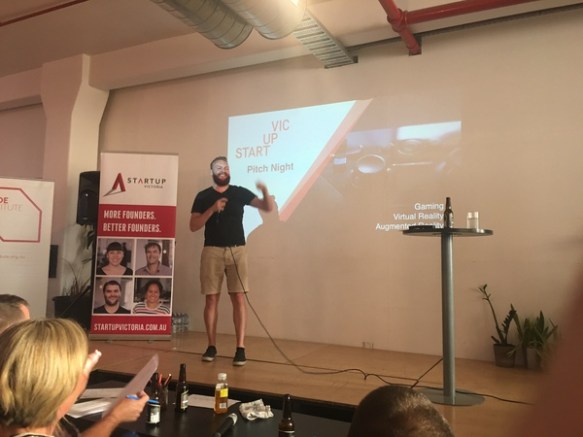
Building on the successful format that has been the mainstay of Startup Vic‘s regular meetups for the past few years, February’s pitch night kicked off a scheduled programme of thematic events for 2017. First up was Gaming, VR and AR.

Photo by Daniel C, sourced from the Startup Victoria Meetup page

Hosted as usual by inspire9, the event drew a packed crowd, no doubt helped by the impressive panel of judges assembled by the organisers:

Dr Anna Newberry, responsible for driver-assistance technologies at Ford Australia; Stefani Adams, Innovation Partner at the Australia Post Accelerator; Tim Ruse, CEO of Zero Latency; Rupert Deans, Founder and CEO of Plattar; Samantha Hurley, Co-Founder and Director of Marketing Entourage; Gerry Sakkas, CEO of PlaySide Studios; and Joe Barber, a Commercialisation Advisor to the Department of Industry and Science, a Mentor at the Melbourne Accelerator Program (MAP), and angel investor.

Maintaining the tradition of this blog, I will comment on each startup pitch in the order in which they presented.

Metavents

This niche business offers an event planning app for festivals. At its heart is a tool that allows users to build a 3-D simulation of proposed events, combined with an AI capability to simulate risk management, logistics and team communications, plus a digital time capsule where event attendees can upload photos and other content.

Once licensed to event planners and organisers, the platform charges clients $1 per ticket sale, plus a 2.5% fee on donations and fees for other content and services such as the digital time capsule. In addition, Metavents is building strategic partnerships, and announced a relationship with the Vihara Foundation and its Rock Against Poverty programme from 2018.

All good so far. Then, things got a bit confusing. For example, in addition to festival and event logistics, Metavents claims to offer humanitarian support services in response to natural disasters, and emergency management capabilities for smart cities. There was also talk of a global network (linked to the UN?), and an impact investment fund.

I’m sure I wasn’t alone in thinking that the pitch was a bit disjointed and suffered from a lack of focus. But the pitch did reveal something of the founders’ core passion, and incorporated some impressive graphics – it just felt like a case of form over substance.

Second Sight

Second Sight is a game analytics service that “unlocks the secrets in player data”, by enriching existing big data sources with social media interactions. It does this by profiling players based on their behaviours, and providing this feedback and insights to game developers and product managers. Focusing on the mobile game market, Second Sight is initially targeting independent developers, and will then move on to corporate game businesses.

Second Sight’s own development path is to build automation tools first, then create a library of tasks and insights. With an estimated 1 million users (based on game statistics), 3 paying clients and another 27 beta clients, this startup is showing some promising market traction. However, there are a number of established competitors, including Omniata (which is more of a general user analytics engine, like Mixpanel or Flurry), GameAnalytics, deltaDNA and Xsolla, some of which offer free user services.

In response to the “ask”, ($500k in seed funding in return for 20% equity), the judges suggested that Second Sight might want to address the needs of a specific game sector.

Dark Shadow Studio

This presentation featured an application called Drone Legion, that merges drone experience with VR. Part simulation game, part training software, it was nice to see a demo of the app running in the background, without detracting from the pitch itself.

A key point made by the presentation is that the Civil Aviation Safety Authority (CASA), which is responsible for regulating drones in Australia, is in danger of falling behind other countries. For example, Drone Legion could be adapted to provide user training, testing and licensing before a customer buys a physical drone.

Although there are drone simulators available via Steam, they are not aimed at the general public. Drone Legion is also compatible with a range of gaming consoles.

The judges suggested that this pitch was more an individual game, rather than a business, so it was suggested that the founders should try to get funding from HTC or Oculus to build their first game. And given that one of the judges works for Australia Post (ostensibly a logistics company with a growing interest in drone technology….), there was the offer of a personal introduction.

Phoria

Phoria describes itself as an “immersive media business”, offering rapid 3-D visualisation (especially for the property development sector and the built environment),  and other services such as digital preservation.

But tonight, the pitch was about a plan to use “VR for social good”. Under the moniker “Dreamed”, Phoria is developing a niche health care solution, designing “patient experiences” to help them get out of their current care or treatment environment.

Predicated on an immersive therapy platform, Dreamed will offer a distribution service for cloud-based content, designed to be used alongside other, related assisted therapies that feature Animals, Nature and Music as stimulants for patient engagement and therapeutic outcomes. While not exactly a MedTech solution, Phoria’s “IP special sauce” is the use of VR as a constant dynamic feedback loop, which presumably learns from and adapts to user interaction and monitoring of appropriate patient diagnostics.

So, who pays for the service? Hopefully, hospitals will, especially if they can demonstrate reduced therapy costs and patient treatment times. (Maybe there will also be a consumer market alongside existing meditation apps?) But with some early-stage and potentially high-profile research underway via the Murdoch Childrens Research Institute, Phoria and Dreamed look to be making steady progress, notwithstanding the normally slow pace of medical research. Key to the research outcomes will be user acceptance and ease of service and content delivery, although a large number of unknowns remain in the context of the medical benefits. Meanwhile, Phoria continues to serve its core property market.

Finally, something which I found somewhat surprising, according to the presentation, there is no VR content licensing model currently available. Sounds like a job for a decentralized digital asset management and licensing registry (such as MyBit?).

On the night, and based on the judges’ votes, Phoria took out first place honours.

Next week: The Future of Work = Creativity + Autonomy

 

Update on the New #Conglomerates

My blog on the New Conglomerates has proven to be one of the most popular I have written. I’d been contemplating an update for a while, even before I heard this week’s announcement that Verizon is buying the bulk of Yahoo!. Talk about being prescient…. So, just over two years later, it feels very timely to return to the topic.

Image sourced from dc.wikia.com

Image sourced from dc.wikia.com

Of the so-called FANG tech stocks, when I was writing back in May 2014, Facebook had recently acquired WhatsApp and Oculus VR. However, apart from merging Beats Music into its own music service, Apple has not made any big name deals, but has made a number of strategic tech acquisitions. Meanwhile, Amazon has attempted to consolidate its investment in delivery company, Colis Privé, but got knocked back by the French competition regulators. Netflix finally launched in Australia in March 2015, and within 9 months had 2.7 million customers, a growth rate of 30% per month. Finally, Google has since renamed itself Alphabet, and purchased AI business Deep Mind.

Over the same period, Microsoft appears to have reinvigorated its strategy: back in May 2014, Microsoft had just completed its acquisition of Nokia. Since then, Microsoft has announced it is buying LinkedIn (following the latter’s purchase of Lynda.com in 2015), but has also shut down Yammer, which it had only bought in 2012. The acquisition of LinkedIn has been framed as a way to embed corporate, business and professional customers for its desktop and cloud-based productivity tools (and maybe give a boost to its hybrid tablet/laptop PCs). On the other hand, Microsoft has a terrible track record with content-based products and services, as evidenced by the Encarta fiasco, and the fact that Bing is an also-ran search engine. I think the jury is still out on what this transaction will really mean for LinkedIn’s paying customers.

So, what are the big tech themes, and where are the New Conglomerates competing with each other?

First, despite being the “next big thing”, VR/AR is still some way off being fully mainstream (although Pokémon GO may change that….). Apple and Google will continue to go head-to-head in this space.

Second, content streaming is not yet the new “rivers of gold” for publishing (and the sale of Yahoo! might confirm that there’s still gold in those advertising hills….). But music streaming (Apple, Spotify, Amazon and Google – plus niche services such as Bandcamp and Mixcloud) is gaining traction, and Amazon is building more content for SVOD (to compete with Netflix, Apple and Google). But quality public broadcasters such as BBC, ABC and NPR are making great strides into audio streaming (via native apps and platforms like TuneIn) and podcasting. One issue that remains is the fact that digital downloads and streaming still suffer from geo-blocking, and erratic pricing models.

Third, Amazon continues to build out its on-line retail empire, even launching private label groceries. Amazon will also put more of a squeeze on eBay, which does not offer fulfillment, distribution or logistics and is a less attractive platform for local used-goods sellers compared to say, Gumtree.

Fourth, Amazon is making a play for the Internet of Things (which, for this discussion, includes drones), but both Apple and Google, via their hardware devices, OS capabilities and cloud services, will doubtless give Amazon a run for its money. Also, watch for how Blockchain will impact this sector.

Finally, payments, AI, robotics, analytics and location-based services all continue to bubble along – driven by, for example, crypto-currencies, medtech, fintech, big data and sentiment-based predictive tools.

Next week: Another #pitch night in Melbourne…