Musical Idolatry

As a rebooted version of “Australian Idol” appears on network television, I can’t decide whether programs like this are a result of the current state of the music industry OR are they the cause of the industry’s malaise…?

I’ll admit upfront that I know I’m not the target demographic for these shows (Idol, Voice, Talent…), so I’m not even going to comment on the quality of the musical content or the presentation format.

Before we had recorded music or broadcast radio, the industry relied upon song writers selling sheet music, in the hope their compositions would get performed in theatres and concert halls – and audiences would want to buy copies of the songs to perform at home.

Then, radio largely killed the music hall, and with the advent of the 7″ vinyl record, together they eventually displaced the reliance on sheet music sales. From the early 1960s onwards, we also saw more artists writing, performing and recording their own material, which transformed both music publishing and the record industry itself.

Although record labels still exist as a means to identify, develop and commercialise new talent, only three of the so-called major labels have survived – a process of industry consolidation and M&A activity that began in earnest in the 1980s – ironically, a period now regarded as a “Golden Age” of pop music.

A key legacy of the punk movement of the 1970s was a network of independent music labels, distributors, publishers and retailers – along with a strong DIY ethic of self-released records and independent fanzines, thanks to lower production costs and easier access to manufacturing and distribution.

Now, there is more new music being released than is humanly possible to listen to. It is relatively quick and simple to produce and release your own music – record on a home laptop (even a tablet or smart phone will do), upload the finished mp3 files to user-accessible platforms such as Bandcamp and SoundCloud, and promote yourself on social media. However, without significant marketing dollars to buy an audience, those hoping to become an overnight viral sensation may be disappointed. And even if you do manage to get traction on one of the global streaming platforms, the income from digital plays is a fraction of what artists used to earn from physical sales.

So that’s how the major labels (and some of the larger independents) still manage to dominate the industry: they have the budget to spend on developing new talent, and they have money for marketing campaigns (and possibly to influence those streaming algorithms). Plus, they have access to a huge back catalogue that they can carry on repackaging at a fraction of the original production costs.

It’s also true, however, that the shorter shelf-life of many newer artists means that labels don’t have such an appetite for long-term development plans, where they are willing to nurture a new talent for several years, before expecting a return on their initial investment. Just as with fast fashion, the pop music industry has become hooked on a fast turnover of product, because they know only a fraction of new releases will ever become a hit, and they have to keep feeding the beast with new content.

Which brings me back to programs like Idol. First, it’s one way for the music industry to fast-track their next success. Second, it literally is a popularity contest – the industry gets an idea of what the public likes, so they can pre-determine part of their release schedule. Third, hosting these contests on commercial TV means advertising dollars and sponsorship deals can help defray their A&R and marketing costs (or, at least help them to prioritise where to spend their money).

But let’s not pretend that these singing shows are nothing more than televised karaoke. Performers don’t get to play their own songs, or even play any instruments (as far as I can tell). The program content relies on cover versions – usually songs that are well-known, and therefore already road-tested on the audience. Plus, by choosing to perform a particular song, a contestant may hope to win by association or identification with the successful artist who originally recorded it. But contestants are not free to choose whatever song they like – my understanding is there are only 1,000 (popular) songs to choose from, just like karaoke.

In pretending to discover new talent, in part, the industry is simply hoping to re-release songs in their back catalogue, albeit with a new face on the record. Through the restrictive format of these programs, the industry is not discovering new musicians or finding new song writers and composers, and it’s certainly not forging any new direction in music, because of the reliance upon an existing formula, and dependence on a very specific (and somewhat narrow) strand of pop music.

Next week: Eat The Rich?
 

My love/hate relationship with Science Fiction

Watching the latest installment of “The Matrix”, I was reminded of my love/hate relationship with Science Fiction. I wouldn’t count myself as a huge SF fan, but I dip my toe in from time to time, and occasionally find a sub-genre, eco-system or franchise that draws me in deeper, whether via television, film or literature. Unfortunately, while the original “Matrix” movie (and maybe the first sequel) managed to be original, entertaining and engaging, by the time of “The Matrix Revolutions” both the plot and the characterisation had run thin. When I saw the trailers and the pre-launch campaign for “The Matrix Resurrections”, I was sufficiently intrigued to want to see it, especially in light of recent geo-political events. Sadly, it was a huge waste of time: the plot was banal, and the story-line disjointed; there were awkward flashbacks to the previous films (in large part to remind us of the actors who originally played the current characters?); and there were far too many retrospective explanations to justify the present “narrative”. The whole thing felt like another Keanu Reeves character had stumbled into a dystopian Lewis Carroll landscape – “Wick in Wonderland” would have been a more suitable title.

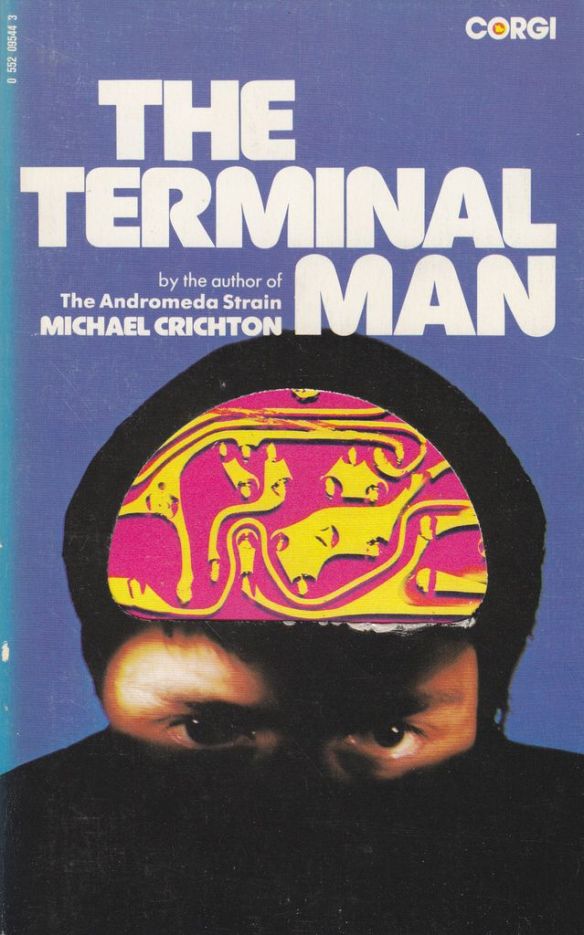
“The Terminal Man” by Michael Crichton (image sourced from the author’s website)

Growing up in the UK in the 1960s, my school friends and I avidly watched a bunch of TV programmes that found a young and eager audience for SF. These productions also spawned multiple re-boots, spin-offs and imitators, as well as giving rise to the franchise phenomenon that dominates much of today’s cinema. Those early shows included “Star Trek”, “Lost in Space”, “Planet of the Apes” and “Land of the Giants”. All of these programmes were American, which I suppose made them seem even more exotic, and therefore more appealing, to our impressionable minds.

By contrast, British television had produced the “Quatermass” TV series back in the 1950s, and “Dr Who” (launched in 1963), both of which pre-dated their US counterparts by several years. But in my mind these domestic efforts were firmly rooted in Gothic horror – more H.G.Wells and Jules Verne than Isaac Asimov and Philip K. Dick? – and therefore they felt less futuristic, especially when we were witnessing the real-life events of the Space Race on the evening news. Which is probably why even Gerry Anderson’s puppet creations such as “Fireball XL5”, “Thunderbirds” and “Captain Scarlet” resonated with me more than Daleks and Cybermen. So to me, British television was more successful in producing psycho-dramas founded upon stories of espionage set against backdrop of the Cold War, with programmes such as “Danger Man”, “The Avengers”, “The Champions” and “The Prisoner” being far more evocative of contemporary themes and fashions, notwithstanding some creaky plot lines.

Later, I would watch classic SF films of the 1950s, such as “The Day the Earth Stood Still”, “The Blob” and “Forbidden Planet” which, despite their technical limitations, are still key reference points for fans of the genre; they also convey elements of Cold War paranoia, and the perennial fear of “the other”. Then, as a young teenager, I found myself reading SF novels, including works by Asimov, John Wyndham, Aldous Huxley, Michael Crichton, Norman Spinrad, Brian Aldiss and J.G.Ballard. Ballard, of course, preferred to explore “inner space” rather than outer space, and this means his writing contains universal themes that are not constrained by contemporary accounts of futuristic technology. In fact, this theme of “inner space” probably underpins my preferences within the SF genre, as evidenced by 1960s movies I managed to see when I was older, such as “Seconds”, “Alphaville”, and “Fahrenheit 451”.

Despite an aversion for SF that is over-reliant upon technology as a plot technique, I have enjoyed some recent novels that engage with emerging technology such as AI and robotics – great examples would include William Gibson’s “Agency”, Ian McEwan’s “Machines Like Me”, and Jeanette Winterson’s “Frankissstein”.

However, if I was to delineate my personal likes/dislikes of SF in film and on TV, I would probably list them as follows:

  • As a child, I loved the original “Star Trek”, but I’ve never seen a “Star Trek” film or any of the newer TV series
  • I’ve never seen a “Star Wars” film, and have no desire to
  • “Moon” was great, and “Source Code” wasn’t bad either
  • I really enjoyed “Close Encounters of the Third Kind”, and I appreciated “Contact”, “Arrival”, “Interstellar” and “The Martian”
  • “Gravity” was somehow plausible, whereas “Elysium” was a stretch
  • “2001: A Space Odyssey” is in a class of its own
  • Same with “The Man Who Fell To Earth”
  • I loved the first four “Alien” movies, but I disliked the so-called prequels, and I’ve avoided the “Predator” cross-overs
  • The original “Terminator” film was great, but the sequels prove the law of diminishing returns
  • I really enjoyed “Looper” and in a somewhat similar vein, “Inception”
  • I couldn’t ever get into the “X-files” – but I was hooked on “Twin Peaks”
  • The original “Westworld” movie was fine, but I have no interest in the recent TV series
  • Similarly, I love the original film versions of “Blade Runner” and “Total Recall”, but see no point in the later remakes
  • And while I used to watch re-runs of the original “Twilight Zone” series, I’ve not seen the later re-boot; however, “Black Mirror” got my attention
  • “Donnie Darko” yes, “Stranger Things” no
  • Overall, I tend to avoid SF that is more firmly rooted in the sub-genres of horror, fantasy, magic, super heroes (with super powers), space westerns, superstition, disaster themes and most tales of the supernatural (and anything with Kevin Costner….)

Finally, there is room for humour in SF, if done well – such as “Dark Star”, “Mars Attacks!”, and “Tremors”; even the first “Men in Black” effort is head and shoulders above “Wild Wild West”….

Next week: Smart Contracts… or Dumb Software

Eileen Agar – My Brush With Surrealism

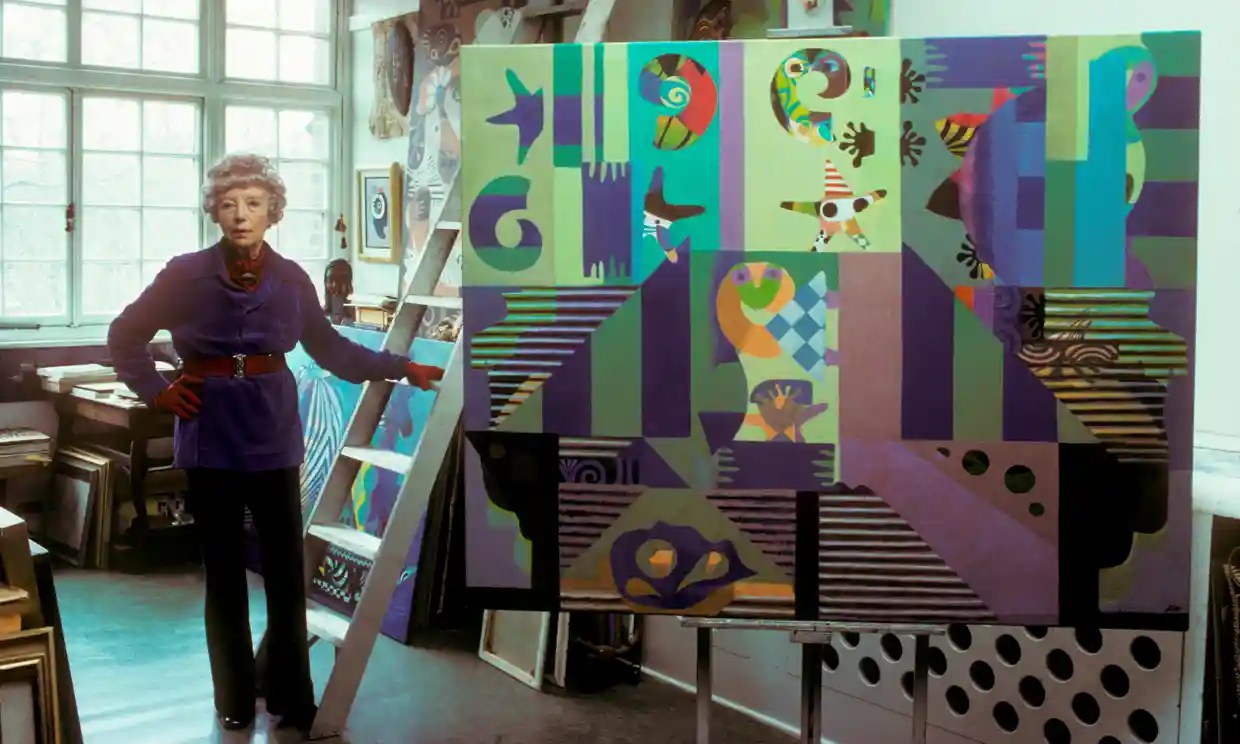
When I was a teenager, I kept a scrapbook of newspaper and magazine clippings, mostly relating to art, film, music and design. There was no particular theme, other than images that caught my eye. Sometimes, choices were triggered by things I had watched on TV, heard on the radio or seen at exhibitions. But there was one photograph which I cut out for no other reason than it mentioned Surrealism, featuring the artist Eileen Agar standing next to one of her paintings.

Eileen Agar in her studio, 1977 (Photo by David Reed) – Image sourced from The Guardian)

Although I had been interested in surrealist art for a while (probably thanks to ubiquitous reproductions of Dali and Magritte), I don’t think I had heard the name Eileen Agar, nor was I aware of having seen her work. That changed, somewhat, the following year, when I visited the major retrospective of Dada and Surrealism art at London’s Hayward Gallery, where she had several pieces on display. Yet, with such a huge exhibition, I don’t recall registering the name, nor making the immediate connection with the photo I had seen some months earlier.

A few years later, I was working for Kensington & Chelsea Council, where part of my role was to assist local residents with their housing problems. One day, I received a call from a woman who was concerned about her neighbour, whom she described as the “well-known artist, Eileen Agar”. The caller thought that Ms Agar needed some assistance with her accommodation, perhaps even relocating to somewhere more suitable. Following up the call, I duly contacted Ms Agar, but when asked about her housing situation, she replied “I’m fine, thank you, as long as I have enough light to paint by.” So I respected her wish not to be bothered or troubled by the Council.

By now, the penny had dropped, and I made the connection between the name Eileen Agar, her comment about “enough light to paint by” and the photo in my scrapbook – with its enormous studio window behind her.

Soon after, I was talking to some friends who were looking for ideas that would make good subjects for TV documentaries. I suggested a couple of topics, and happened to mention Eileen Agar, who by then was probably the last surviving surrealist artist who had been directly connected to figures like Picasso, Moore, Dali, Eluard, Breton, Man Ray, Penrose et al. Certainly, she was one of the few women included in the International Surrealist Exhibition of 1936.

Eventually, that idea turned into a documentary, called “Colour of Dreams” directed by Susanna White, originally broadcast in 1989. It formed part of Channel 4’s series “Five Women Painters”, with an accompanying book of the same name. Ms Agar was the only artist of the five still living at the time, and was guest of honour at the preview screening I was fortunate enough to attend.

Ironically, despite not receiving the same level of recognition that most of her male counterparts did during their lifetimes, Ms Agar attracted quite a lot of attention in her final years. Apart from being included in the TV series, she was the subject of a significant retrospective exhibition, and published her autobiography, before she passed away in 1991.

On my first visit to Auckland Art Gallery a few years ago, I was reminded again of that tangential connection, when I saw Ms Agar’s mixed media collage called “Tree of Knowledge”. Within the context of a modest collection of European surrealism, this was a significant work, and immediately recalled that original cutting.

(Sadly, unless it tours Australia, I won’t get to see the current Whitechapel show, “Angel of Anarchy”.)

Next week: Getting out of town

Synchronicity

I’m not sure I fully subscribe to Jung’s theory of Synchronicity, where causally unrelated events occur at the same time, and seemingly take on a significant meaning; in many cases, a coincidence is just that. But recently I have been forced to consider the possibility that maybe Jung was right.

Over the past few months, I have been reading the 12 novels that comprise Anthony Powell’s “A Dance to the Music of Time”. Although I had never read them before, the books were familiar to me through a BBC Radio adaptation broadcast between 1979 and 1982, and a UK television mini-series from 1997.

Last weekend, and quite unrelated, a friend posted some music on-line – recordings made by the band we were in during the early 1980s. One of the tracks was a song I had written at that time, and whose title had been inspired by Powell’s magnum opus. But I hadn’t listened to or thought about this song for nearly 40 years.

Separately, and also by coincidence, in the last couple of days I have been listening to “The New Anatomy of Melancholy”, another BBC Radio series that draws its inspiration (and title) from Robert Burton’s 17th century tract on mood disorders. This series was first broadcast in May 2020 – no doubt prompted by the onset of the global pandemic, with its lock-downs, self-isolation and increased anxiety. And now the programme is being repeated, exactly 400 years after the publication of Burton’s original treatise – and at a time when we need his sage advice more than ever.

Until now, I hadn’t appreciated how self-absorbed (obsessed?) Powell’s narrator, Nicholas Jenkins, is by Burton – he even ends up publishing an academic text about this prescient Elizabethan writer. On one level, Jenkins is a proxy for his literary hero (as well as being Powell’s alter ego), and much of the 12-novel sequence is a response to Burton’s analysis on the causes of, and cures for, melancholia.

All of which may or may not prove Jung’s theory, but there is for me something of a personal thread between Powell, a song I wrote, and the BBC’s recent update on Burton.

Next week: The Last Half-Mile