No-code product development

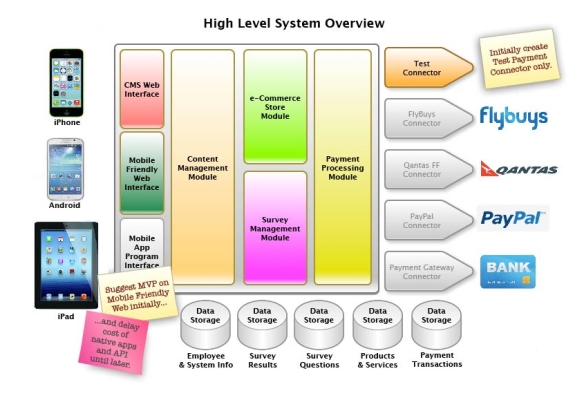
Anyone familiar with product development should recognise the image below. It’s a schematic for a start-up idea I was working on several years ago – for an employee engagement, reward and recognition app. It was the result of a number of workshops with a digital agency covering problem statements, user scenarios, workflow solutions, personas, UX/UI design and back-end architecture frameworks.

At the time, the cost quoted to build the MVP was easily 5-6 figures – and even to get to that point still required a load of work on story boards, wire frames and clickable prototypes….

Now, I would expect the developers to use something like a combination of open-source and low-cost software applications to manage the middle-ware functions, dial-up a basic cloud server to host the database and connect to external APIs, and commission a web designer to build a dedicated front-end. (I’m not a developer, programmer or coder, so apologies for any glaring errors in my assumptions…)

The growth in self-serve SaaS platforms, public APIs and low-cost hosting solutions (plus the plethora of design marketplaces) should mean that a developer can build an MVP for a tenth of the cost we were quoted.

Hence the interest in “low-code/no-code” product development, and the use of modular components or stack to build a range of repetitive, automated and small scale applications. (For a dev’s perspective check out Martin Slaney’s article, and for a list of useful resources see Ellen Merryweather’s post from earlier this year.)

There are obvious limitations to this approach: anything too complex, too custom, or which needs to scale quickly may break the model. Equally, stringing together a set of black boxes/off-the-shelf solutions might not work, if there are unforeseen incompatibilities or programming conflicts – especially if one component is upgraded, and there are unknown inter-dependencies that impact the other links in the chain. Which means the product development process will need to ensure a layer of code audits and test environments before deploying into production.

I was reflecting on the benefits and challenges of hermetically sealed operating systems and software programs over the weekend. In trying to downgrade my operating system (so that I could run some legacy third-party applications that no longer work thanks to some recent systems and software “upgrades”), I encountered various challenges, and it took several attempts and a couple of workarounds. The biggest problem was the lack of anything to guide me in advance – that by making certain changes to the system settings, or configuring the software a certain way, either this app or that function wouldn’t work. Also, because each component (the operating system, the software program and the third party applications) wants to defend its own turf within my device, they don’t always play nicely together in a way that the end user wants to deploy them in a single environment.

App interoperability is something that continues to frustrate when it comes to so-called systems or software upgrades. It feels like there needs to be a specialist area of product development that can better identify, mitigate and resolve potential tech debt, as well as navigate the product development maintenance schedule in anticipation of future upgrades and their likely impact, or understand the opportunities for retrofitting and keeping legacy apps current. I see too many app developers abandoning their projects because it’s just too hard to reconfigure for the latest system changes.

Next week: Telstar!


Antler Virtual Demo Day

As with other virtual demo days I have attended this year, it was remarkable to hear how far the teams in Antler’s Sydney Cohort #3 had progressed in light of the current pandemic and associated lock-down restrictions.

Each participating team was categorised into an industry sector:

Consumer Tech

Remote Social is designed to connect remote and hybrid teams. The ethos is that with the shift in working patterns (heightened by the current pandemic) corporate culture and organisational engagement are “at risk”. The solution aims to foster socialisation and build culture through curated games and activities. Claiming to have generated over 200 organic signups, including team members at big tech brands, the founders are adopting a “bottom, land and expand” customer acquisition strategy. In addition to a seat-based subscription model, the platform will also offer a revenue share for marketplace providers.

Coder One claims to be “the home for AI sports”. The team describe their project as an API platform for AI games, with unique combination of AI and e-sports. The goal is to make AI and programming more accessible via an AI Sports League, where bots compete, programmed by developers. With more than 250 registrations for an upcoming competition, the team are also looking to secure sponsorship deals. The commercial model has three components: free access to programs for developers, individual subscription fees to access games/tournaments, and corporate fees to access talent for potential recruitment.

Feather is an online platform which enables instructors and creators to deliver and monetise their digital services. According to the founders, existing tools are not fit for purpose, complex or clunky. Initially targeting yoga teachers, the solution will sell tiered subscriptions, plus take a small revenue share. The team also see themselves as part of the “creator economy”, but I was confused by the name – is it a deliberate attempt to suggest a link to Dumbo Feather magazine? Plus, there was some feedback that the platform may be vulnerable once tools like Zoom start putting up more pay walls.

Tactiq is a tool to “capture valuable insights from remote meetings”. The founders claim it can be used with any conferencing software, and is platform agnostic (although currently limited to a Google Meet via a Chrome Extension). The product, essentially “speech to text plus”, also generates AI assisted summaries, and the team has attracted over 100,000 users from around 4,500 organisations. Pricing is $9 per user per month, plus $20 per month to access team functionality. While the team appears to know and understand their target users, they were questioned about privacy and security issues. Although the transcription content is not stored on the platform, my experience of other similar tools is that once they are integrated, they have a tendency to “take over” and insert themselves, unprompted, into e-mail and calendar applications – “you seem to have a meeting now – would you like me to record it?”

SaaS

Upflowy wants to help B2B companies improve their customer conversion rates. Intended to be a “no-code” sign-up engine, the team explained that from their experience, in-house developers tend to focus on product features, rather than improving the sign-up experience. Typically, in-house sign-up optimisation is slow, expensive or totally non-existent – the key issues being scaleability and reliability. Essentially a form builder, the solution enables A/B testing, and claims to deliver a 40% improvement in conversion rates (compared to 17% improvement achieved with other optimization tools).

Flow of Work Co is positioning itself as the “Future of Work SaaS”. With a mission to help companies to retain the best people, it is HR tech using AI in the form of a smart matching engine to identify in-house talent, based on proprietary ontology. It also helps employees to find development resources, as well as to match projects with in-house talent. According to the founders, talented staff leave because they are bored or lack career development. With an initial focus on software companies, the team then plans to tackle the financial services sector. The team was asked about integration with existing HR tech stacks, and how they ensure objective assessment of competing project candidates – but it wasn’t so clear how they achieve either.

Portant is an end-to-end project reporting tool, designed to be a “consolidated single source of truth”. Asked why existing project management tools don’t work, the founders identified a number of factors: teams are using different tools, the process is often repetitive and/or highly manual, or project tracking typically relies on data from different sources. The team have launched an MVP on Google Workspace Marketplace, and will soon launch on Microsoft AppSource (and appears to use AWS Comprehend as the analytical tool?). There is an SaaS pricing model, and content privacy is ensured via end-to-end encryption plus the use of private keys.

StackGo helps clients achieve stronger B2B sales via SaaS marketplaces, rather than relying on direct sales. However, the initial setup costs and effort required to connect to existing SaaS marketplaces can be daunting. With an approach based on “build once, deploy many”, StackGo enables users to connect to multiple SaaS marketplaces via a single solution. However, the team, did not explain what the setup costs are for StackGo nor were they very specific about the price range or typical sales value their clients achieve – “free to hundreds of dollars per month”.

EdTech

GradVantage wants to reduce the cost of getting graduates job ready, and reckons it can save employers $30k per new hire. Offering a personalised learning experience for each user, the founders have adopted a “Slack” model – team first, then enterprise sale. Acknowledging that the EdTech sector is crowded, the team think their point of differentiation is the fact that they are a career-entry solution, and not in the K-12 market. The focus is on tech talent and SaaS vendors. Employers pay per learner, and the platform saves time and reduces on-boarding costs. Typically, 30% of program content is about tech applications, and 70% on how to use the tech. A more fundamental issue is the huge gap between university courses and actual job requirements.

HealthTech

eQALY is an integrated tech platform that enables the elderly to achieve a higher quality of life in their own home, by predicting their individual needs in advance, and identifying the right Home Care Package funding (which can be worth up to $26k). Using 360 degree data inputs, a risk model, and a proactive care plan, the product takes into account client needs as well as family concerns, plus financial considerations. Although the aged care industry is regarded as being slow to adopt new technology, the founders plan to focus on aged care organisations, who will then distribute predictive data and analytics to care providers and managers. The platform is tech agnostic but IoT devices, AI tools and virtual assistants can be integrated, plus new voice analysis technology is emerging that can monitor client well-being, and
all of the activity monitoring tech is passive. meaning the end user does not have to worry about learning new applications.

Retail and E-Commerce

The One Two is a very specific, and very targeted, D2C solution offering a hyperpersonalised service for fitting and buying bras. According to the founders, current customer experience suffers from ill-fitting products, poor product design, bad materials, and inadequate size configurations. As a result, customers feel overwhelmed and give up. The basic product IP has been tested, along with an on-line measuring and fitting tool, combining to provide better customer diagnosis and product tips. The team have already secured a startup partnership with a global lingerie manufacturer and distributor.

m8buy did not make much sense to me. Maybe I’m the wring demographic, but why would anyone want to “shop online with [their] friends”? Describing itself as “a social layer on any e-commerce store”, it feels like this is aimed at the “buy now, pay later” audience.
According to the founders, merchants will only pay a commission (“low single digit %”?) on successful sales. But it’s not clear whether this is a group buying service, a discount marketplace, or a loyalty programme, nor how it will be differentiated within the Shopify marketplace.

PropTech

Sync Technologies is a digital solution for construction industry – with the tag line of “turning data into insights”. The problem being addressed can be summarised as follows: 1) Building
sites are fragmented and complex 2) Progress reporting and bottleneck identification is poorly done 3) 12% of a typical job has to be reworked 4) 80% of projects are late and/or run over budget. Using a digital twin concept, the solution aims to provide a “single source of truth”, and the team are already working with some key firms, and have 2021 forecast revenue of $2m.
Key obstacles to overcome are entrenched on-site behaviours, and slow the tech adoption across so many stakeholders in the construction industry. The founders claim to have identified the solution via their Construction Assistance System which offers better project and status visualisation via the digital twin.

Next week: Version / Aversion
Blockchain and the Limits of Trust

Last week I was privileged to be a guest on This Is Imminent, a new form of Web TV hosted by Simon Waller. The given topic was Blockchain and the Limitations of Trust.

For a replay of the Web TV event go here

As regular readers will know, I have been immersed in the world of Blockchain, cryptocurrency and digital assets for over four years – and while I am not a technologist, I think know enough to understand some of the potential impact and implications of Blockchain on distributed networks, decentralization, governance, disintermediation, digital disruption, programmable money, tokenization, and for the purposes of last week’s discussion, human trust.

The point of the discussion was to explore how Blockchain might provide a solution to the absence of trust we currently experience in many areas of our daily lives. Even better, how Blockchain could enhance or expand our existing trusted relationships, especially across remote networks. The complete event can be viewed here, but be warned that it’s not a technical discussion (and wasn’t intended to be), although Simon did find a very amusing video that tries to explain Blockchain with the aid of Spam (the luncheon meat, not the unwanted e-mail).

At a time when our trust in public institutions is being tested all the time, it’s more important than ever to understand the nature of trust (especially trust placed in any new technology), and to navigate how we establish, build and maintain trust in increasingly peer-to-peer, fractured, fragmented, open and remote networks.

To frame the conversation, I think it’s important to lay down a few guiding principles.

First, a network is only as strong as its weakest point of connection.

Second, there are three main components to maintaining the integrity of a “trusted” network:

  • how are network participants verified?
  • how secure is the network against malicious actors?
  • what are the penalties or sanctions for breaking that trust?

Third, “trust” in the context of networks is a proxy for “risk” – how much or how far are we willing to trust a network, and everyone connected to it?

For example, if you and I know each other personally and I trust you as a friend, colleague or acquaintance, does that mean I should automatically trust everyone else you know? (Probably not.) Equally, should I trust you just because you know all the same people as me? (Again, probably not.) Each relationship (or connection) in that type of network has to be evaluated on its own merits. Although we can do a certain amount of due diligence and triangulation, as each network becomes larger, it’s increasingly difficult for us to “know” each and every connection.

Let’s suppose that the verification process is set appropriately high, that the network is maintained securely, and that there are adequate sanctions for abusing the network trust –  then it is possible for each connection to “know” each other, because the network has created the minimum degree of trust for the network to be viable. Consequently, we might conclude that only trustworthy people would want to join a network based on trust where each transaction is observable and traceable (albeit in the case of Blockchain, pseudonymously).

When it comes to trust and risk assessment, it still amazes me the amount of personal (and private) information people are willing to share on social media platforms, just to get a “free” account. We seem to be very comfortable placing an inordinate amount of trust in these highly centralized services both to protect our data and to manage our relationships – which to me is something of an unfair bargain.

Statistically we know we are more likely to be killed in a car accident than in a plane crash – but we attach far more risk to flying than to driving. Whenever we take our vehicle out on to the road, we automatically assume that every other driver is licensed, insured, and competent to drive, and that their car is taxed and roadworthy. We cannot verify this information ourselves, so we have to trust in both the centralized systems (that regulate drivers, cars and roads), and in each and every individual driver – but we know there are so many weak points in that structure.

Blockchain has the ability to verify each and every participant and transaction on the network, enabling all users to trust in the security and reliability of network transactions. In addition, once verified, participants do not have to keep providing verification each time they want to access the network, because the network “knows” enough about each participant that it can create a mutual level of trust without everyone having to have direct knowledge of each other.

In the asymmetric relationships we have created with centralized platforms such as social media, we find ourselves in a very binary situation – once we have provided our e-mail address, date of birth, gender and whatever else is required, we cannot be confident that the platform “forgets” that information when it no longer needs it. It’s a case of “all or nothing” as the price of network entry. Whereas, if we operated under a system of self-sovereign digital identity (which technology like Blockchain can facilitate), then I can be sure that such platforms only have access to the specific personal data points that I am willing to share with them, for the specific purpose I determine, and only for as long as I decide.

Finally, taking control of, and being responsible for managing our own personal information (such as a private key for a digital wallet) is perhaps a step too far for some people. They might not feel they have enough confidence in their own ability to be trusted with this data, so they would rather delegate this responsibility to centralized systems.

Next week: Always Look On The Bright Side…


The Limits of Technology

As part of my home entertainment during lock-down, I have been enjoying a series of Web TV programmes called This Is Imminent hosted by Simon Waller, and whose broad theme asks “how are we learning to live with new technology?” – in short, the good, the bad and the ugly of AI, robotics, computers, productivity tools etc.

Niska robots are designed to serve ice cream…. image sourced from Weekend Notes

Despite the challenges of Zoom overload, choked internet capacity, and constant screen-time, the lock-down has shown how reliant we are upon tech for communications, e-commerce, streaming services and working from home. Without them, many of us would not have been able to cope with the restrictions imposed by the pandemic.

The value of Simon’s interactive webinars is two-fold – as the audience, we get to hear from experts in their respective fields, and gain exposure to new ideas; and we have the opportunity to explore ways in which technology impacts our own lives and experience – and in a totally non-judgmental way. What’s particularly interesting is the non-binary nature of the discussion. It’s not “this tech good, that tech bad”, nor is it about taking absolute positions – it thrives in the margins and in the grey areas, where we are uncertain, unsure, or just undecided.

In parallel with these programmes, I have been reading a number of novels that discuss different aspects of AI. These books seem to be both enamoured with, and in awe of, the potential of AI – William Gibson’s “Agency”, Ian McEwan’s “Machines Like Me”, and Jeanette Winterson’s “Frankissstein” – although they take quite different approaches to the pros and cons of the subject and the technology itself. (When added to my recent reading list of Jonathan Coe’s “Middle England” and John Lanchester’s “The Wall”, you can see what fun and games I’m having during lock-down….)

What this viewing and reading suggests to me is that we quickly run into the limitations of any new technology. Either it never delivers what it promises, or we become bored with it. We over-invest and place too much hope in it, then take it for granted (or worse, come to resent it). What the above novelists identify is our inability to trust ourselves when confronted with the opportunity for human advancement. Largely because the same leaps in technology also induce existential angst or challenge our very existence itself – not least because they are highly disruptive as well as innovative.

On the other hand, despite a general shift towards open source protocols and platforms, we still see age-old format wars whenever any new tech comes along. For example, this means most apps lack interoperability, tying us into rigid and vertically integrated ecosystems. The plethora of apps launched for mobile devices can mean premature obsolescence (built-in or otherwise), as developers can’t be bothered to maintain and upgrade them (or the app stores focus on the more popular products, and gradually weed out anything that doesn’t fit their distribution model or operating system). Worse, newer apps are not retrofitted to run on older platforms, or older software programs and content suffer digital decay and degradation. (Developers will also tell you about tech debt – the eventual higher costs of upgrading products that were built using “quick and cheap” short-term solutions, rather than taking a longer-term perspective.)

Consequently, new technology tends to over-engineer a solution, or create niche, hard-coded products (robots serving ice cream?). In the former, it can make existing tasks even harder; in the latter, it can create tech dead ends and generate waste. Rather than aiming for giant leaps forward within narrow applications, perhaps we need more modular and accretive solutions that are adaptable, interchangeable, easier to maintain, and cheaper to upgrade.

Next week: Distractions during Lock-down