The cost of AI

A variant on Moore’s law is the observation that the financial capital required to launch a new business decreases exponentially as technology gets cheaper.

Pre-internet, and using a notional geometric scale for the purposes of illustration, you might have needed $5m to found and build a new venture. The World Wide Web probably reduced that to $500k, while cloud computing brought it down to $50k. With the expansion of SaaS and API solutions, that cost might have been $5k to get going. Now, vibe coding and $500 of AI prompts can probably launch a new website, build a back end database, implement an e-commerce solution and deploy agentic AI bots to go and find your first customers.

This is a great outcome if measured by a lower barrier to market entry. It also enables founders to “fail fast, fail cheap”, and incentivises innovation by financially de-risking the process.

But even though the cost of AI tools is extraordinarily cheap in terms of the computing and processing power they deliver, there is a huge cost to our rapid adoption of AI that needs to be accounted for.

First, we are seeing corporate lay-offs among tech firms and parts of the service industry that no longer need as many human bodies and minds to operate at scale. So there is a human, economic and societal cost of increased un(der)employment.

Second, traditional skills and expertise are being hugely reduced in perceived value – why pay a graphic artist to design an image when I can use dall-e for free?

Third, as more and more creative tasks are being outsourced or delegated to AI (“create a short story about an F1 race in the style of Ernest Hemingway”) we risk losing our own innate creativity (that comes with experimentation, curiosity, play and reflection). This in turn devalues the creative process itself (thanks to cheaper, AI-enabled production).

Fourth, AI (and the Large Language Models on which it is trained) has no great respect for intellectual property. It doesn’t recognise boundaries between copyright material, content that is subject to creative commons, content that is in the public domain, and content which is publicly available. Again, if copyright owners and original content creators are not recognised or compensated for their work, why would anyone aspire to creating anything original?

Finally, there is the cost of resources (energy, water, rare earth metals) needed to maintain huge AI processing plants and data centres. (But at least this demand is accelerating the development of renewable energy.)

A few years ago, I posted a blog about the importance of the human factor, in the face of technological progress brought by automation and AI. I still remain cautiously optimistic that AI will bring huge benefits, despite the rampant growth of AI in the three years since I wrote that piece. But we are currently in an awkward and comfortable transition phase. If more jobs are lost to AI, and if human-led output is increasingly devalued, perhaps we will need to revisit the debate about Universal Basic Income and other policies to facilitate this transition.

Next week: Music, music everywhere…. and none of it very memorable 
No-code product development

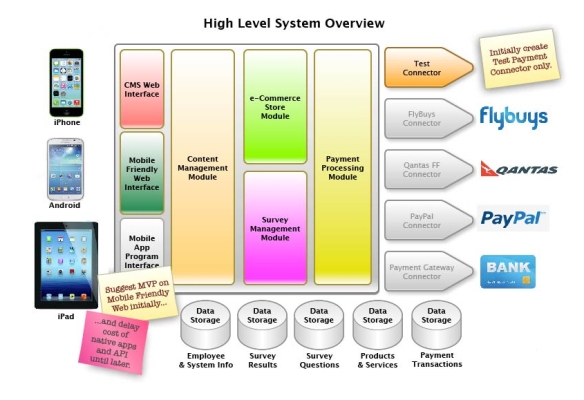
Anyone familiar with product development should recognise the image below. It’s a schematic for a start-up idea I was working on several years ago – for an employee engagement, reward and recognition app. It was the result of a number of workshops with a digital agency covering problem statements, user scenarios, workflow solutions, personas, UX/UI design and back-end architecture frameworks.

At the time, the cost quoted to build the MVP was easily 5-6 figures – and even to get to that point still required a load of work on story boards, wire frames and clickable prototypes….

Now, I would expect the developers to use something like a combination of open-source and low-cost software applications to manage the middle-ware functions, dial-up a basic cloud server to host the database and connect to external APIs, and commission a web designer to build a dedicated front-end. (I’m not a developer, programmer or coder, so apologies for any glaring errors in my assumptions…)

The growth in self-serve SaaS platforms, public APIs and low-cost hosting solutions (plus the plethora of design marketplaces) should mean that a developer can build an MVP for a tenth of the cost we were quoted.

Hence the interest in “low-code/no-code” product development, and the use of modular components or stack to build a range of repetitive, automated and small scale applications. (For a dev’s perspective check out Martin Slaney’s article, and for a list of useful resources see Ellen Merryweather’s post from earlier this year.)

There are obvious limitations to this approach: anything too complex, too custom, or which needs to scale quickly may break the model. Equally, stringing together a set of black boxes/off-the-shelf solutions might not work, if there are unforeseen incompatibilities or programming conflicts – especially if one component is upgraded, and there are unknown inter-dependencies that impact the other links in the chain. Which means the product development process will need to ensure a layer of code audits and test environments before deploying into production.

I was reflecting on the benefits and challenges of hermetically sealed operating systems and software programs over the weekend. In trying to downgrade my operating system (so that I could run some legacy third-party applications that no longer work thanks to some recent systems and software “upgrades”), I encountered various challenges, and it took several attempts and a couple of workarounds. The biggest problem was the lack of anything to guide me in advance – that by making certain changes to the system settings, or configuring the software a certain way, either this app or that function wouldn’t work. Also, because each component (the operating system, the software program and the third party applications) wants to defend its own turf within my device, they don’t always play nicely together in a way that the end user wants to deploy them in a single environment.

App interoperability is something that continues to frustrate when it comes to so-called systems or software upgrades. It feels like there needs to be a specialist area of product development that can better identify, mitigate and resolve potential tech debt, as well as navigate the product development maintenance schedule in anticipation of future upgrades and their likely impact, or understand the opportunities for retrofitting and keeping legacy apps current. I see too many app developers abandoning their projects because it’s just too hard to reconfigure for the latest system changes.

Next week: Telstar!