The Startup of You v2.0

Through my blogs on startups, meetups and portfolio careers, I was recently interviewed by Peter Judd from News Corp., who is trying to bring the discussion on entrepreneurship, startups and innovation to a wider audience, particularly people who may be looking at a career change. (We both agree that the National Innovation and Science Agenda is not cutting through to the general public.)  Apart from being an advocate for portfolio careers, I also pointed out that entrepreneurship or working with startups is not for everyone. Instead, it may be possible to change your current role to the one you want. Alternatively, taking a new look at your current circumstances can provide some fresh perspective on finding your dream career.

Francis Kenna: The Unbearable Lightness of Seeing (2016) [Photo by Rory Manchee]

Francis Kenna: The Unbearable Lightness of Seeing (2016) [Photo by Rory Manchee]

The impetus following the 2012 publication of “The Startup of You” has done much to fuel the current entrepreneurial phenomenon, combined with lean startup business models and agile product development processes. The drive for innovation in response to digital disruption and lowering technology costs also means that launching your own venture can be increasingly de-risked.

For example, I recently saw some data by Ian Gardner from Amazon Web Services, that showed the “cost of failure” has come down from $5m to $5k, in just 15 years. This is based on a comparison between what it typically cost to launch a new business at the height of the dot.com boom/bust in 2000, and what it costs today. With a mix of open source tools, cloud computing, APIs, SDKs and social media platforms, launching a new business has never been cheaper or easier.

Of course, there is a paradox here: if an increasing number of people, especially younger graduates and new entrants to the workforce, are more interested in doing their own thing and less interested in joining large or established organisations, it’s going to get harder for employers to attract and retain the best talent; on the other hand, without appropriate experience, on-the-job training and personal development, how do these aspiring entrepreneurs acquire the necessary business, technical and leadership skills to succeed in their own ventures?

For some people, it may be appropriate to take their entrepreneurial spirit of adventure into a “traditional” role to test some of their ideas, as well as build networks and get some practical experience. Equally, I can see a huge opportunity for companies to create the right opportunities to engage employees for flexible roles aligned with specific projects or objectives (rather than plugging them into org charts). Companies are also finding new ways of tapping into their existing workforce to identify hitherto hidden and unknown skills and knowledge. Many employers also recognise that leadership roles will increasingly be filled by people who are comfortable with rapid change, increasing complexity and heightened uncertainty, as well as having enhanced soft skills. (There’s even some current thinking that utilising “rebel talent” is a good thing.)

Whether you are starting out on your entrepreneurial journey, looking to reboot your career, or searching for meaningful work that aligns with your values and purpose, there are numerous opportunities (via meetups, hackathons, pitch nights and networking forums) to explore your options before you make a decision. And for companies looking to re-invigorate your workforce and unleash hidden talent, there are many ways to experiment through taking informed risks, by building in-house innovation hubs, running consultative and collaborative workshops, and inviting ideas and inspiration from your existing people, who are familiar with the challenges you face.

Next week: Banksy – an artist for our times?
StartupVic’s #Pitch Night for October

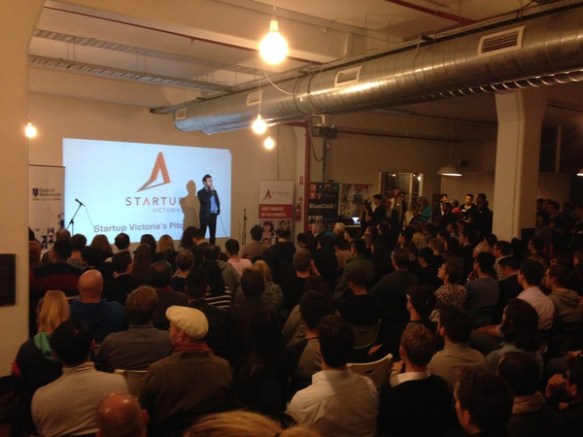
The crowds are getting bigger, the list of sponsors is getting longer, there’s a new logo, and they’ve even managed to (sort of) fix the PA system. The Startup Victoria monthly pitch night is now a firm fixture on Melbourne’s Meetup calendar…

Image sourced from Startup Vic's Meetup page (Photo by Daniel)

Image sourced from Startup Vic’s Meetup page (Photo by Daniel)

As usual, there were 4 startup pitches, and I’ll comment on each in order of their presentations:

Next Address

This Ballarat-based startup has built a P2P website that offers “direct to market” property sales, removing the need for traditional estate agents. Recognising that the real estate sector is still ripe for some digital disruption, Next Address is challenging the commission-based fees and cost++ price markup on services that many estate agents charge their clients.

They have established an affiliate programme, and generated some positive media coverage, but have yet to complete any sales. Charging a fee of around $549 to vendors (there is a sliding scale), compared to similar competitors priced at between $800 and $2,000, Next Address is also offering a Facebook package.

I think it’s fair to say that this pitch did not come across as one of the strongest or most compelling presentations at these pitch nights (possibly due to some stage nerves?). There were also questions among people I spoke to about market traction, the customer acquisition model and the conversion process.

Given that there is a lot of competition within real estate listings and aggregation (often backed by major media companies), and given that many vendors still prefer to use the auction process, it was difficult to see how Next Address can cut through, unless they focus on a point of differentiation: geographic market, property type, price range, marketing support or add-on services.

However, the founders must be doing something right, as on the night they managed to attract the attention of a senior executive from a well-known real estate listings website.

DragonBill

DragonBill is an invoicing and remittance solution aimed at sole traders and micro businesses, which has featured in this blog before. The focus is on helping clients manage their cashflow and providing them with a level of financial literacy and education.

Since launching, DragonBill has found a substantial niche market among sporting clubs and associations, in large part because 50% of club members are also SME owners. They are continuing to build partnerships with accountants and are now starting to market themselves via co-working spaces.

Further ahead, there are plans to build some sort of superannuation offering, given that many SME owners and sole traders may not be making sufficient contributions to their personal funds. There are also regulatory changes in payroll administration following the roll out of SuperStream by the ATO.

The judges were interested to know what plans DragonBill has for international growth, and whether the platform can output financial and tax reporting for accounting purposes – both of which are under consideration. Meanwhile, DragonBill was recently shortlisted for an award by VISA.

Spee3d

In short, this business supports “3-D printing of metals at production speeds“. Using a proprietary “Lightspee3d” technology, the goal is to offer a low-cost, high-speed solution for full-scale production output, not just prototypes and medical devices. Primarily manufacturing in copper and aluminium 6061, current output is 100g/minute ( expecting to soon reach 250g/minute), and the maximum size is 300mm x 300mm x 300mm.

For the technically minded, the additive process is described as something like “bugs hitting a windshield”. It does not use any gasses, and deploys a “line of sight” process, meaning that some hollow objects are possible. The business has picked up a Bosch Venture Award.

Targeting products traditionally fabricated by sand casting, Spee3d is working with clients who have a preference for low-cost powders, initially within the university market, then the auto industry. They are also aiming at new products, and not parts manufactured from existing casts that have associated sunk costs. There was quite a lot of excitement around this pitch, judging by the number of questions it prompted.

Foddies

This startup is launching a fructose friendly food business, offering products, recipes and outlets (shops, cafes, catering) that can also appeal to people with other food allergies and dietary requirements. If, like me, you were unaware of the “Low FODMAP” diet,
it was researched and created in Melbourne (Monash Uni), and from my initial reading, it has some similarities with diets designed for people needing gluten-free, lactose free and low GI solutions.

Admittedly not the first to market, Foddies claims to be the first to develop a holistic solution, which includes a wholesale strategy for ready-made meals, a cafe franchise and an online store. Next, they plan to work with airlines and hospitals. Although building on their social media engagement, the biggest challenge, when asked by the judges, was the lack of public awareness or education on the Low FODMAP model.

From a personal perspective, I appreciate the importance of helping people with food allergies or intolerance to manage their condition through appropriate diet. But I can’t be alone in thinking that the higher reported incidence of these complaints may be due to multiple factors such as the increased use of chemicals in the environment (especially food production), the lower resistance in our immune systems caused by too many antibiotics, and our over-reliance on certain strains and varieties of crops. More research is called for.

So, after a very mixed bag of startup pitches, the winner was Spee3d, based on the audience and panel voting.

Next week: Richmond 3121

A Tale of Two #FinTech Cities – Part 2

It feels like the inter-city #FinTech and startup rivalry between Melbourne and Sydney is starting to get personal. The blow-up between Victorian Small Business Minister, Philip Dalidakis and Freelancer CEO, Matt Barrie over StartCon is perhaps the most strident example, but other discontent is bubbling underneath the service.

screen-shot-2016-10-05-at-10-51-49-amLet’s take a look at what’s actually been happening around #FinTech in Melbourne, and try to understand what might be the cause of this apparent disquiet:

First, the recently announced LaunchVic grants have been met with a mix of gratitude, bewilderment and some sour grapes, based on the people I have talked to in the start-up community. There was a sense of “jobs for the boys”, “usual suspects”, “who?”, and “yeah, good on ya”. Nothing new there, then, when public money is being handed out. High-profile beneficiaries of the initial A$6.5m of grants include FinTech Australia (as part of a major FinTech Conference to be held in Melbourne), FinTech Melbourne (which is now the largest group of its kind outside the US and UK), inspire9, Startup Victoria and Collective Campus.

Second, Stripe‘s CEO, John Collison was in town to celebrate their 2nd birthday in Melbourne. (This is the 3rd time in 2 years Collison has been in Australia – he must love what we are doing here? Or maybe it’s the Victorian government incentives that attracted Stripe to set up in Melbourne: see below.) This time around, there were some major announcements among the celebrations, including:

  • 25% of Australians have paid for something online using Stripe
  • Stripe is launching “Connect” in Australia – making it easier for local businesses to roll out payment solutions in multiple markets overseas
  • Stripe continues to keep its APIs as simple and streamlined as possible – they even support Amazon’s Alexa voice recognition system

There was also a panel discussion with some of Stripe’s local clients, and a Q&A with Collison himself:

  • Andre Eikmeier from Vinomofo commented that payment solutions (like all technology) should be invisible, and just work in the background
  • Ben Styles from Xero explained that integration with Xero’s own APIs is critical, and that they have co-developed some products
  • Nicole Brolan from SEEK said that thanks to Stripe, her business is finally allowing clients to pay invoices on-line

Asked about innovation, Collison argued that mobile phone technology was the spur for services like Uber. However, he’s not especially engaged with Blockchain, as he does not see the use case. He thinks the next major innovation will be in medtech (telemetrics & wearables), and machine learning (speech and image recognition). As he said, “driverless cars are not just about the sensors but what the data is telling you. We know more about the health of your car than your own body.” He also had some words of advice to aspiring local entrepreneurs and startup founders:

  • Having a global or international perspective is determined by your markets, your competition, and access to specific talent pools.
  • It’s probably wrong to aspire to be like Atlassian – you need to understand WHY Atlassian has been successful, not WHAT it did or HOW it did it – which means getting back to core values and core purpose.

Third, as the Stripe celebrations started to kick off, across town FinTech Melbourne hosted an event starring Alex Scandurra, from Sydney’s Stone & Chalk FinTech hub. This was billed as a “pre-launch” for Stone & Chalk’s planned foray into Melbourne, and was part information session, part FinTech love fest, and part fan-boy hangout. Scandurra’s presentation was quick to point out that the “plan is not to bring Stone & Chalk to Melbourne, but to create Melbourne’s own Stone & Chalk”. (Spot the subtle difference?)

To its credit, Stone & Chalk is home to 300 people and 75 startups, has helped start 21 companies and create 150 jobs, and participants have collectively raised $100m in funding, although Stone & Chalk does not take equity. Scandurra also commented that FinTech is not an industry in itself – it is a horizontal that serves all industries.

There seems to be a lot of local clamouring for a FinTech hub in Melbourne. However, unlike the NSW government which has directly partnered with Stone & Chalk, I understand that the Victorian government is not prepared or able to “invest” in such a project – and certainly not before there is some private sector funding on the table.

Meanwhile, the founder of a rival payment system expressed his frustration that the Victorian government “sponsored” Stripe to come to Australia, but won’t offer similar support to local startups. Another FinTech CEO I spoke to was irked that Stone & Chalk would appear to be breaching its own mandate if it set up shop outside NSW.

In fact, could be argued that Stone & Chalk was established in Sydney to directly compete with Melbourne’s startup ecosystem. In large part, this is thanks to the huge success that the Victorian government continues to have in luring major tech companies and global startups to come to Melbourne. Names such as Zendesk, Eventbrite, Slack, Square, Stripe and now Cognizant.

If the debate over Stone & Chalk coming to Melbourne is about creating a local FinTech hub (whether or not the Victorian government tips in some money), we have to examine the need for such a hub. For example, is it simply a question of real estate, so that all the FinTech startups can be co-located in one place? If so, I would have thought that was easy to resolve: there’s a lot of empty office space, and Melbourne rents are cheaper than Sydney; also, a growing number of office landlords recognise the mutual benefits and knock-on effects of hosting co-working venues in their buildings.

We also have to consider if Melbourne’s existing FinTech startup eco-system/infrastructure is willing to come together to underpin such a hub. If so, what is the hub going to do? What is its purpose? What is the missing piece that the hub is designed to fill? And who/what/where is best placed to fill that need/gap?

Looking back, Melbourne has been the home of a number of FinTech businesses, that are now global public enterprises – IRESS, Computershare, Touchcorp, Novatti, for example – so there is obviously something in the local water (or coffee). For me, however, a key barrier for FinTech specifically, and startups more generally, is the inability to connect to institutional funds and investors (Clover being a notable exception?). Other obstacles include the stodgy procurement processes used by the public sector and many large corporations, which make it more difficult for startups to compete for work, and the reluctance by enterprise clients to try a local product or service unless it has been tested and proven elsewhere.

Finally, on a more positive note, it was very interesting to see that founders from Atlassian and Vinomofo are backing Spaceship, a new superannuation fund appealing to a younger, tech-savvy audience.

Next week: Bridging the Digital Divide

Food for thought at #StartupVic’s #pitch night

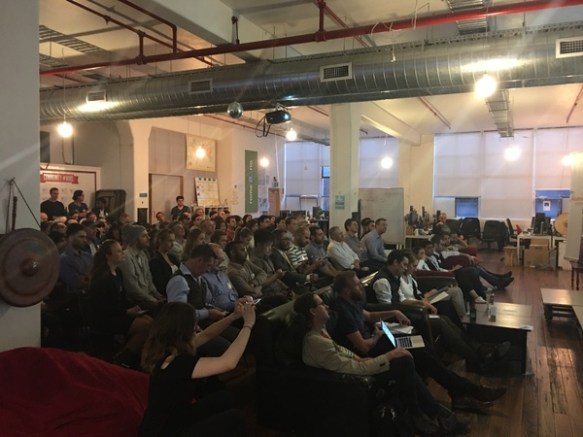
There was something of a different flavour at Startup Victoria‘s pitch night for September – including the new beverage sponsors! – which may have been helped by the large crowd, and the more polished presentations (judging by the feedback).

startupvic

Image sourced from Startup Vic’s Meetup page

I will comment on each pitch in order of appearance:

Studio Ninja

Studio Ninja is described as Client Management software for professional photographers. Aimed at the wedding industry, it also holds some appeal for other event planners, DJs, musicians, make-up artists, hairdressers, caterers and florists. But the primary focus is on weddings, and the specific needs of studio photographers, whose workflow is very particular (according to the founders).

Regular attendees at these pitch nights will recall similar CRM/project management tools for other sectors, such as architects and management consultants – which raises questions about how unique each profession really is?

In essence, the software handles lead management, invoicing and cashflow reporting. It is available via subscription, and integrates with payment systems such as Stripe and PayPal, and other service providers such as Uber, and will soon integrate with Xero.

With a reported 40 new sign-ups per day, and around 2,000 members (of which only 300 are currently paid subscriptions), the Studio Ninja team are aiming to grow to 10,000 users and revenue of $4m. Growth is being driven by strong SEO and organic discovery among photographers, and word of mouth referrals.

The panel of judges were interested to know how the software could be sold via peak bodies and professional associations, under a SaaS or white-labelling model, and what potential there is to integrate lead generation and referral solutions. The judges also thought that camera and photography equipment brands could offer a significant sales channel opportunity.

Deliciou

Something of a different pitch came from this bacon flavoured seasoning, which is actually bacon-free. (I should confess that I was once a vegetarian, but when I started to dream about bacon sandwiches, I realised I was missing out… Maybe if this product had been around all those years ago, things would have turned out different. But I digress.)

There was certainly no lack of passion in this pitch, and the founder had even made sure there were free samples to go around, so strongly does he feel about his product. With a 9% conversion rate from website visits, and 2,000 bottles sold this year, there is obviously a niche in the flavourings market for a “guilt-free” bacon experience.

A graduate of the Melbourne Accelerator Program, the founder has cleverly chosen to use a pop-up popcorn stall to generate market awareness, solicit customer feedback, and create visibility for a product that comes in a small jar, and will compete for valuable shelf space in supermarkets.

The business is seeking $100k in seed funding to expand the range of seasonings,
expand overseas, and to resolve issues with production lead times and logistics. But given the challenges in building consumer brands, especially in the food and beverage category, a better option might be to tie up with another snack food or convenience food brand, and use that vehicle for distribution and market reach.

Reground

Reground is another food-related startup, but this is all about recycling coffee grounds. The business turns coffee waste – which otherwise goes into landfill – into sustainable uses, thereby reducing the amount of methane gas released into the atmosphere.

With a waiting list of cafes who want to access the service (because cafe owners already pay their local council to take away the waste), Reground will divert part of those waste collection fees and can even help cafes save money. Reground also supplies community gardens with free material for their compost. Other uses for the coffee waste include mushroom production.

As well as offering waste assessment services and potential cost savings, Reground runs a newsletter and provides certification for participating cafes. There is also potential for this Melbourne-based business to go national and even to the USA.

They are also offering a customer app to support logistics around collection, and they operate their own van as there are council limitations on more waste trucks on our streets. Asked by the judges about scaling their business, the founders are considering to build their own waste processing plant. (After the event, I did a quick search, and found a similarly-named business in Canada.)

Allume Energy

Finally, Allume Energy, another sustainability business, this time in solar energy distribution. Or, in their own words, “Democratising access to renewable energy”.

As a social enterprise, Allume offers tenants easier access to cheaper solar energy. Basically, Allume contracts with the property landlord to provide initial funding to install and set up a solar system, and then tenants pay for their energy via a contract licensing system. In addition to working with community and social housing projects in remote locations, Allume also offers a shared system for apartment blocks.

Claiming to provide a 30-50% saving to tenants, Allume requires landlords to commit to a 15 year contract, with a 50% break fee (based on the initial installation and set up costs). Given some of the current challenges in renewable energy (weather events, phasing out of government rebates, and reduction in feed-in tariffs), this scheme to implement very local solar systems will no doubt appeal to landlords and bodies corporate.

And on the night, Reground was the people’s choice – probably because it was a simple but effective proposition, and it appealed to Melbourne’s environmentalists and coffee lovers alike!

Next week: A Tale of Two #FinTech Cities – Part 2