Every social media and digital publishing platform is engaged in a continuous battle to acquire content, in order to attract audiences and bolster advertising revenues.
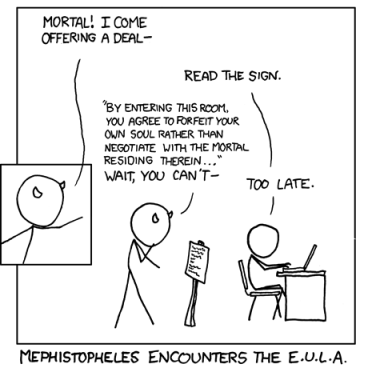
Content ownership is becoming increasingly contentious, and I wonder if we truly appreciate the near-Faustian pact we have entered into as we willingly contribute original material and our personal data in return for continued “free” access to Facebook, YouTube, Google, Flickr, LinkedIn, Pinterest, Twitter, MySpace, etc.
Even if we knowingly surrender legal rights over our own content because this is the acceptable price to pay for using social media, are we actually getting a fair deal in return? The fact is that more users and more content means more advertisers – but are we being adequately compensated for the privilege of posting our stuff on-line? Even if we are prepared to go along with the deal, are our rights being adequately protected and respected?
In late 2012, Instagram faced intense public backlash against suggestions it would embark upon the commercial exploitation of users’ photographs. While appearing to backtrack, and conceding that users retain copyright in their photographs, there is nothing to say that Instagram and others won’t seek to amend their end-user license agreements in future to claim certain rights over contributed content. For example, while users might retain copyright in their individual content, social media platforms may assert other intellectual property rights over derived content (e.g., compiling directories of aggregated data, licensing the metadata associated with user content, or controlling the embedded design features associated with the way content is rendered and arranged).
Even if a social media site is “free” to use (and as we all know, we “pay” for it by allowing ourselves to be used as advertising and marketing bait), I would still expect to retain full ownership, control and use of my own content – otherwise, in some ways it’s rather like a typesetter or printer trying to claim ownership of an author’s work….
The Instagram issue has resurfaced in recent months, with the UK’s Enterprise and Regulatory Reform Act. The Act amends UK copyright law in a number of ways, most contentiously around the treatment of “orphan” works (i.e., copyright content – photos, recordings, text – where the original author or owner cannot be identified). The stated intent of the Act is to bring orphan works into a formal copyright administration system, and similar reforms are under consideration in Australia.
Under the new UK legislation, a licensing and collection regime will be established to enable the commercial exploitation of orphan works, provided that the publisher has made a “diligent” effort to locate the copyright holder, and agrees to pay an appropriate license fee once permission to publish has been granted by the scheme’s administrator.
Such has been the outcry (especially among photographers), that the legislation has been referred to as “the Instagram Act”, and the UK government’s own Intellectual Property Office was moved to issue a clarification factsheet to mollify public concerns. However, those concerns continue to surface: in particular, the definition of “diligent” in this context; and the practice of some social media platforms to remove metadata from photos, making it harder to identify the owner or the original source.
Meanwhile, the long-running Google book scanning copyright lawsuit has taken another unexpected twist in the US courts. From the outset, Google tried to suggest it was providing some sort of public service in making long-out-of-print books available in the digital age. Others claim that it was part of a strategy to challenge Amazon.
Despite an earlier unfavourable ruling, a recent appeal has helped Google’s case in two ways: first, the previous decision to establish a class action comprising disgruntled authors and publishers has been set aside (on what looks like a technicality); second, the courts must now consider whether Google can claim its scanning activities (involving an estimated 20 million titles) constitute “fair use”, one of the few defences to allegations of breach of copyright.
Personally, I don’t think the “fair use” provisions were designed to cater for mass commercialization on the scale of Google, despite the latter saying it will restrict the amount of free content from each book that will be displayed in search results – ultimately, Google wants to generate a new revenue stream from 3rd party content that it neither owns nor originated, so let’s call it for what it is and if authors and publishers wish to grant Google permission to digitize their content, let them negotiate equitable licensing terms and royalties.
Finally, the upcoming release of Apple’s iOS7 has created consternation of its own. Certain developers with access to the beta version are concerned that Apple will force mobile device users to install app upgrades automatically. If this is true, then basically Apple is telling its customers they now have even less control over the devices and content that they pay for.

 Content in Context