#Rona19 – beyond the memes

More commentary on Covid-19 – at the time of writing, Victoria is at Stage 3 restrictions, with Stage 4 possible very soon. Generally, people seem to adapting to if not actually coping with this daily reality (although people are still flouting their quarantine obligations). But there is still some confusion on how to interpret, observe and enforce the social distancing measures, and of course, huge economic uncertainty remains for many people who have seen their working hours evaporate, especially if they are in vulnerable industries, and/or they can’t work from home.

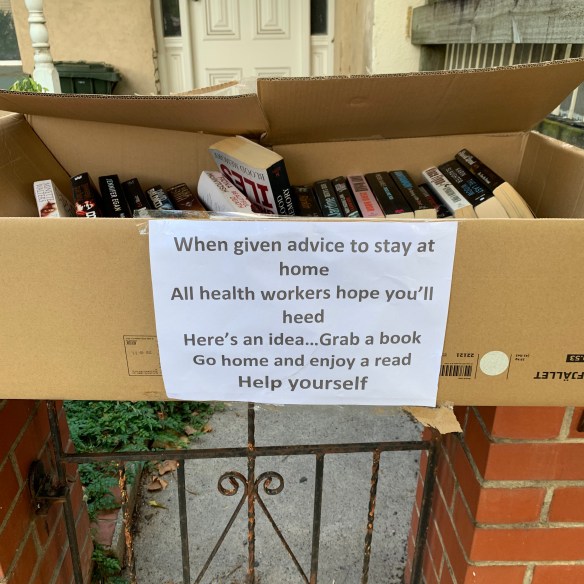
Sign of hope? (Seen on my daily walk)

Meanwhile, the shutdown has prompted a fair number of less serious responses, from toilet paper memes, to “viral” GIFS, from parodies of “My Sharona” and “Bohemian Rhapsody”, to unfortunate examples of the downside of company video conferences while working from home.

But beyond the hashtags, what might we expect once we get through the current pandemic? Here is a somewhat random list of possible outcomes:

  • A renewed appreciation of personal space in public places – will we continue to observe such protocols where and whenever practical, as it becomes a community norm?
  • Greater respect for introverts – possibly better able to handle self-isolation, they are comfortable with their own company and don’t feel the need to seek out crowds  – social distancing does not represent an existential crisis, and they don’t rely on social situations for their personal validation.
  • Passenger airlines and cruise companies are toast – the tourism and travel industries will be hard hit, and may struggle to rebuild in their current form.
  • The online economy will get a boost  – restaurants and providores are already retooling to offer D2C food and meal deliveries (even cutting out the likes of Uber Eats, Deliveroo and Menu Log). Some brick and mortar retail is adapting fast, but will face a reduced share of available discretionary spending.
  • Naturally, digital services will thrive – from communication solutions to virtual classes, from remote working support services to telehealth. But bandwidth capacity and internet down/upload speeds remain a challenge in Australia.
  • The end of physical cash – if retailers prefer contactless payments (less contamination), what use are those notes and coins in your wallet?
  • A higher community standard for the individual duty of care we owe to each other – Covid-19 will certainly test the “duty of care” we owe to neighbours, colleagues, members of the public… if I knowingly infect someone, or act recklessly or negligently, can the victim sue me?
  • Likewise, the corporate social license to operate will be tested and re-cast – in light of monopolistic practices, price gouging, market abuse and disregard for the “new normal”, companies will need to re-assess many of their standard policies.
  • Increased use of facial recognition and other technology for surveillance purposes – if people cannot be trusted to observe their quarantine, self-isolation and social distancing obligations, the authorities will not shy away from further incursions into civil liberties that we currently take for granted.
  • A hybrid of on-site and working from home employment structures – not everyone will want to continue working remotely, nor will everyone be in a rush to head back to the office (or the daily commute), which will likely cause headaches for employers….

More on these themes next week….

Next week: The “new, new normal”


Social Distancing in Victorian Melbourne…

At the time of writing Victorians, like most of Australia, are living under a Covid19 “stay at home and practise social distancing” regime in attempt to “flatten the curve” and reduce the spread of this contagion. I have been working from home for 3 weeks, only going out for essential food shopping and a daily walk for exercise (since my gym is closed). This perambulation has revealed some lesser-seen aspects of Melbourne (apart from the empty streets), including the way the modern city’s 19th century founders went about their approach to urban design – including some examples of built-in social distancing.

The first example is the number of public parks and gardens close to the CBD that were established in the 1800s, and which have managed to survive the onslaught of developers. As we know, public parks, with their trees and green spaces act as the lungs of the city, and provide a place to exercise, relax and get some fresh air. So we need these facilities more than ever in times like these. (Strange why the Victorian Government still insists in allowing vehicles to use the culturally and historically significant Yarra Park as a public car park on so many days, with all the horticultural and environmental damage that this causes…)

Second, the decision to incorporate lane-ways into the grid design of the CBD, as well as throughout the 19th century expansion of the inner city suburbs. While their design was mainly pragmatic (ease of access for night carts, storm drainage), the result is that in densely-built areas such as Richmond, Carlton, East Melbourne, Fitzroy and Collingwood, lane-ways mean even terraced houses can have ample space between them and the next block, allowing for better ventilation, natural light and reduced risk of disease. (For an example of the lane-ways importance to Melbourne’s character and psyche, check out Daniel Crooks’ video, “An Embroidery of Voids”.)

Third, the decision not to build right up to the urban banks of the Yarra River (and the straightening and leveling of the river itself) has left them accessible to the public, both as a means of cycling and walking to/from work, and for recreational purposes. In many cities, riverfront access has largely been blocked off as adjacent land has been appropriated for private, commercial and industrial use.

At a time like this, I truly appreciate the foresight of Melbourne’s Victorian town planners – I just hope we can continue to enjoy their legacy in the coming weeks and months!

Next week: #Rona19 – beyond the memes


Australia’s Blockchain Roadmap

The Australian Government recently published its National Blockchain Roadmap – less than 12 months after announcing this initiative. While it’s an admirable development (and generally, to be encouraged), it feels largely aspirational and tends towards the more theoretical rather than the practical or concrete.

First, it references the US Department of Homeland Security, to define the use case for Blockchain. According to these criteria, if a project or application displays three of the four following requirements, then Blockchain technology may offer a suitable solution:

  • data redundancy
  • information transparency
  • data immutability
  • a consensus mechanism

In a recent podcast for The Crypto Conversation, Bram Cohen, the inventor of the BitTorrent peer-to-peer file sharing protocol, defined the primary use case for Blockchain as a “secure decentralized/distributed database”. On the one hand, he describes this as a “total oxymoron; on the other, he acknowledges that Blockchain provides a solution to the twin problems of having to have trusted third parties to verify transactions, and preventing double-spend on the network. This solution lies in having to have consensus on the state of the database.

Second, the Roadmap speaks of adopting a “principles based but technology-neutral” approach when it comes to policy, regulation and standards. Experience tells us that striking a balance between encouraging innovation and regulating a new technology is never easy. Take the example of VOIP: at the time, this new technology (itself built on the newish technology of the internet) was threatened by incumbent telephone companies and existing communications legislation. If the monopolistic telcos had managed to get their way, maybe the Post Office would then have wanted to start charging us for sending e-mails?

With social media (another internet-enabled technology), we continue to see considerable tension as to how such platforms should be regulated in relation to news, broadcasting, publishing, political advertising, copyright, financial services and privacy. In the music and film industries, content owners have attempted to own and control the means of production, manufacture and distribution, not just the content – hence the format wars of the past in videotape, compact discs and digital file protocols. (A recurring theme within  Blockchain commentary is the need for cross-chain interoperability.)

Third, the Roadmap mentions the Government support for Standards Australia in leading the ISO’s Technical Committee 307 on Blockchain and DLT Standards. While such support is to be welcomed, the technology is outpacing both regulation and standards. TC 307 only published its First Technical Report on Smart Contracts in September 2019 – three years after its creation. In other areas, regulation is still trying to catch up with the technology that enables Initial Coin Offerings, Security Token Offerings and Decentralized Autonomous Organizations.

If the ICO phenomenon of 2016-18 demonstrated anything, it revealed that within traditional corporate and market structures, companies no longer have a monopoly on financial capital (issuance was largely subscribed via crowdfunding and informal syndication); human capital (ICO teams were largely self-forming, self-sufficient and self-directed); or networks and markets (decentralized, peer-to-peer and trustless became catch words of the ICO movement). Extend this to DAOs, and the very existence of, and need for traditional boards and shareholders gets called into question.

Fourth, the Roadmap makes reference to some existing government-related projects and initiatives in the area of Blockchain and cryptocurrencies. One is the Digital Transformation Agency’s “Trusted Digital Identity Framework”; another is AUSTRAC’s “Digital Currency Exchange” regulation and registration framework. With the former, a more universal commercial and government solution lies in self-sovereign identity – for example, if I have achieved a 100 point identity check with Bank A, then surely I should be able to “passport” that same ID verification to Bank B, without having to go through a whole new 100 point process? And with the latter, as far as I have been able to ascertain, AUSTRAC does not publish a list of those digital currency exchanges that have registered, and exchanges are not required to publish their registration number on their websites.

Fifth, the need for relevant training is evident from the Roadmap. However, as we know from computer coding and software engineering courses, students often end up learning “yesterday’s language”, rather than acquiring flexible and adaptable coding skills and core building blocks in software development. It’s equally evident that many of today’s developers are increasingly self-taught, especially in Blockchain and related technologies – largely because it is a new and rapidly-evolving landscape.

Finally, the Roadmap has identified three “showcase” examples of where Blockchain can deliver significant outcomes. One is in agricultural supply chains (to track the provenance of wine exports), one is in education and training (to enable trusted credentialing), and one is in financial services (to streamline KYC checks). I think that while each of these is of interest, they are probably just scratching the surface of what is possible.

Next week: Brexit Blues (Part II)


Climate Change and Personal Choices

Melbourne has recently seen a number of protest events linked to the Extinction Rebellion. At the same time, the pro-life lobby were conducting their annual protest against the Victorian Government’s Abortion Law.

It’s quite ironic to see some people advocating for a response to climate change, while others are effectively campaigning for population growth. Yet we also understand that the current global rate of population growth is probably unsustainable; and increased human activity is a major contributing factor to greenhouse gases.

An article from a couple of years ago suggested that having fewer children and living car free were two of the most effective individual choices we can make to reducing our carbon footprint. Of course, some argued that such individual choices were “nonsense”, and would likely undermine the effort for political action on climate change.

For myself, I don’t have children (and don’t plan to), and I don’t own a car (although I sometimes use ride share services). I don’t have an exclusively plant-based diet, although I tend to eat less meat than I used to (side note – if we were meant to be vegan, why do honey and yoghurt taste so good, especially together?). I do travel overseas fairly regularly, but if household water and energy consumption is anything to go by, I think I am well below average.

I don’t think that making appropriate and voluntary individual choices to reduce our carbon footprint negates the responsibility of governments to implement collective change. Nor should individual decisions be seen to be undermining political action on abating the effects of global warming. But policy makers and climate activists alike should recognise and acknowledge that some people are willing (and yes, in some cases, able) to make individual choices that contribute to reducing greenhouse gases.

As for the pro-life lobby, I wonder what they made of the film “Capernaum”? In it, a child sues his parents for the “crime” of giving him life. What astonishes him is their general neglect and disregard (bordering on abuse) for him and his siblings. He can’t understand why any responsible adult would willingly and knowingly expose their children to the life they lead. There is an implication that the parents see their offspring as economic bargaining chips, and of course, there are religious, societal and cultural “norms” that underpin many of the parents’ decisions. With so many unwanted and unloved children brought into the world, and sometimes to parents who may end up mistreating them or worse, I guess the thing that frustrates me with the pro-lifers is their apparent unwillingness to accept that not everyone is fit or able to be parents. We need a license to get married or drive a car, but we don’t need a license to procreate…. Equally, not everyone chooses to be parents, and therefore pro-choice is not so much about the right to “murder” unborn children, it’s about the right to plan our lives and to ensure we are able to meet our personal obligations.

Next week: Notes from Auckland