Perfect Days – and the Analogue Life

Last week I watched “Perfect Days”, Wim Wenders’ lyrical film about a gentle soul who diligently goes about his daily labour accompanied by a soundtrack of classic songs. Most of the featured music is 50-60 years old, and all of it heard via cassette tapes – no radio stations or internet streaming services were harmed in the making of this film!

Not only does our hero cling to cassettes, we never see him use the internet, e-mail or a smart phone. We don’t even know how he accesses his money – presumably he gets a weekly wage packet containing cash, so no need to visit an ATM or pay with a credit card. To cap it all, he doesn’t own a TV, and his hobbies include reading second hand paperback books, taking photos with a 35mm film camera, and cultivating plants from cuttings he finds in the course of his daily routine.

We don’t really need to know his backstory, although we get the occasional glimpse. What we are presented with is someone who is living an outwardly simple life, almost exclusively analogue, and with very little technology involved. (In fact, the public toilets he cleans for a living are far more hi-tech than anything in his personal world.) I suspect for many people, our empathy for the character’s disposition may easily become envy at how stripped down and uncluttered a life he leads. The fact that he doesn’t appear to have any family or other obligations (and doesn’t have to spend hours in pointless team meetings or on endless Zoom call) no doubt help facilitate this state of being – yet we suspect there is a lot going on in the inside.

But it is certainly a parable in favour of all things analogue.

In fact, as I write this I am listening to a recent album by Tarotplane on a cassette player. He is one of many contemporary musicians who choose to release their work in this format, and along with the recent vinyl revival, they are helping to keep analogue alive. It’s a trend we can see in events like Record Store Day (and it’s younger sibling, Cassette Store Day), books by Damon Krukowski and Robert Hassan, and symbolic vinyl moments in recent film and TV shows such as “Leave the World Behind” and “Ripley”. In the former, the absence of internet and streaming brings a turntable into play; in the latter, a clutch of 7″ records (in picture sleeves!) are among the few possessions the eponymous hero chooses to take with him. Elsewhere, Lomography continues to find new fans of film photography, and on a recent visit to Hong Kong, I was surprised at the huge display of Polaroid cameras and film at Log-On department store.

Not all this fascination with analogue is about nostalgia, fashion, or fadism (or even fetishism). In some quarters, people are becoming concerned that their favourite films, TV programmes, music and video games may disappear from hosting services and streaming platforms, or their cloud storage may get wiped. So they are keeping analogue versions and hard copies as a back-up.

Finally, and picking up a thread from “Perfect Days” itself, I’m not entirely convinced that a 1975 Patti Smith cassette is worth $100, but I do own an original copy of a very rare cassette that has sold for as much as $180… probably because it has never been reissued, is not available to stream or download, and is a great example of early, DIY electronic music made on basic synths in the early 1980s. You couldn’t imagine an mp3 ever commanding that sort of price, unless it was in the form of an NFT, of course.

Next week: False Economies – if it’s cheap, there must be a reason!

Sakamoto – Coda and Muzak

Contemporary music documentaries tend to fall into one of two categories: the track-by-track “making of” account, in support of a new album; and the “behind the scenes” artifact of a live concert tour (often in support of that new album).* Both can be fine in their own way, but ultimately they are there to plug product. The recent documentary “Coda”, featuring Ryuichi Sakamoto clearly bucks that trend.As a recording artist, Sakamoto is one of the most prolific composers of his era. As a performer, he has maintained a regular schedule of live concerts and collaborations. That is until he was diagnosed with cancer a few years ago, and was forced to temporarily abandon his work. Fortunately, he has come through that recent health scare, even completing a major film score for “The Revenant” before he had fully recovered.

“Coda” started out as an account of Sakamoto’s anti-nuclear activism, but ended up providing an insight into his creative process, an examination of the role of sound and music in film, and a discourse on the aesthetics of minimalism.

There are two images in the film which provide a link between the “craft” of the composer and the “art” inherent in any form of creativity. The first is a close-up of Sakamoto’s working tools – the pencils he uses to write out his scores. The second is a shot of some immaculate cooking utensils – arranged in a similar fashion to his perfectly sharpened pencils. This is someone for whom both process and form serve the purpose of creativity, and which combine to determine the artistic outcome of the resulting content.

As a regular soundtrack composer, Sakamoto has been likened to a film-maker, although he is neither director nor cinematographer. He has an acute sense of the use of sound (not just music) in film, and in fact for his most recent album, “Async”, Sakamoto invited film-makers to submit short films to accompanying each of the tracks. An astounding 675 films were considered for the competition.

Ever sensitive to his environment, it was perhaps no surprise that Sakamoto chose to change the music played at one of his favourite restaurants, rather than eat elsewhere. And ever the non-egoist, none of the tracks on his restaurant playlist was his own.

The forthcoming performance by Sakamoto and long-time collaborator Alva Noto at the Melbourne International Arts Festival promises to be something special.

Next week: Revolving Doors At The Lodge

* An honourable exception in recent years was “The Go-Betweens: Right Here”

Blockchain and Crypto Updates

Courtesy of Techemy and Brave New Coin, I’ve just been on another whistle-stop global tour: 5 cities, 4 countries, 3 continents in two and a half weeks….. Along the way, I caught up on some of the latest market and regulatory developments in Blockchain and cryptocurrency.

Giant billboard in Tokyo’s Ginza district

First, there was no hiding the fact that the past six-month “correction” in crypto markets has had an impact on trading volumes, investor appetite and institutional enthusiasm – as well as generating some regulatory noises. More on the latter below. At the same time, many of the first wave of Blockchain projects that attracted funding over the past 4 years are still at the development or test net stage, or only just launching their MVPs. Hence some investor caution on new token issuance.

Second, there are probably far too many Blockchain and crypto conferences – or rather, volume is diluting the quality of content, meaning too many sub-par events. There is no shortage of interesting topics and informed speakers, but the format and delivery of so many panel discussions and plenary sessions end up sounding tired and lacklustre.

Third, expect a crypto-backed ETF to be listed on a major exchange very soon. I even think it will come out of Europe, rather than the US, but that’s just a personal view. Such a product is going to help with investor diversification and will eventually enable retail investors to get exposure to this new asset class, even within their personal pension plans, without the same level of risk and volatility than direct holdings or spot trading.

Fourth, institutional investors are still looking for institutional products and services: proper custody solutions, robust benchmarks, hedging instruments, portfolio tools and risk analytics. One challenge is that the market is still trying to define crypto fundamentals – the sorts of analysis we take for granted in other asset classes (earnings per share, p/e ratio, yields, Sharp ratio, credit risk, etc.).

Fifth, Japan feels like a case of “two steps forward, one step back”. Just over a year ago, cryptocurrencies were formally recognised as a legal form of payment. Then in late 2017, the FSA issued the first batch of crypto licenses to qualifying exchanges. Japan continues to represent a significant portion of crypto trading (partly a legacy of retail FX trading, partly a result of regulatory restriction in other markets). But yet another exchange hack earlier this year prompted the regulator to put the industry on notice to smarten up, or face the consequences. Exchanges are subject to monthly monitoring, and the self-regulating industry body is undergoing a few changes. Plus, exchanges are no longer able to list privacy coins.

Finally, with the lack of legal clarity or regulatory detail around initial coin offerings (aside from blanket statements that “all ICOs are securities until proven otherwise”), there is still a lot of regulatory arbitrage. Certain jurisdictions are actively attracting new issuance projects to their shores, and positioning themselves as being “ICO friendly”. Ironically, even though the SEC in the USA has been particularly vocal about ICOs that may actually be deemed securities, it has not defined what constitutes a utility token (or made any announcement on the new category of security tokens). However, there have been some recent announcements out of the SEC suggesting that neither Ethereum nor Bitcoin are in fact securities. More interestingly, the State of Wyoming is looking to make Blockchain and associated crypto assets a major pillar of its economy.

NOTE: The comments above are made in a purely personal capacity, and do not purport to represent the views of Techemy or Brave New Coin, their clients or any other organisation I work with. These comments are intended as opinion only and should not be construed as financial advice.

Next week: Bad sports

Beyond Blocks, Tokyo

Thanks to my work with Techemy and Brave New Coin, Content in Context is currently on the road, attending various Blockchain and crypto events in Tokyo, Vienna, NYC and Chicago. The next few blogs will attempt to capture notes from the field.

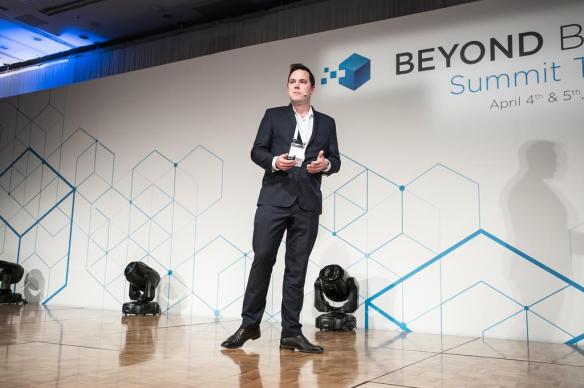
Techemy CEO, Fran Strajnar presents on the new asset class of digital value

In Tokyo, the Beyond Blocks Summit was a stellar affair, with marquee blockchain projects and major investors presenting on stage, alongside cosplay characters, light shows, upbeat music and a crowd of crypto fanatics.

Given the significant developments in Japan’s regulatory framework for crypto-currency trading, there was a lot of interest in the presentations by bitFlyer, Quoine and Smart Contract Inc.

As with the recent APAC Blockchain Conference in Melbourne, there was a strong representation from China’s growing base of Blockchain projects (but not ICOs, of course), keen to demonstrate their infrastructure projects.

There was much debate about regulatory developments across Asia, made all the more interesting by the announcement that Monex is acquiring Coincheck, despite (or because of?) the recent hack on NEM tokens held on the local exchange.

Among international key speakers were Patrick Byrne from Overstock and tZERO, John Burbank of Passport Capital, and Techemy’s own Fran Strajnar – all looking to the future of this new asset class, especially so-called security tokens.

Interspersed throughout the two days were panel discussions and presentations on scaling, infrastructure, decentralized exchanges, stable coins and the future of ICOs.

Although this was only their second event of this kind, the Beyond Blocks team have quickly established themselves on the conference circuit.

Next week: Token Investment Summit, Vienna