My recent blog on Unstructured Hours has generated a fair amount of interest, especially on LinkedIn (where, contrary to popular belief, people still go to talk about career development and work/life balance). One former colleague I spoke to expressed some relief at having been made redundant, because they wouldn’t have to join any more early morning or late night conference calls (at least, not until the next corporate gig….).
Is it possible to separate “work” from “life”? (image sourced from IMDB)
The continued debate about “getting back to the office” suggests that employers are having to bribe and coerce staff to turn up in person. It reminds me of the 1980s, working in London, when some firms were offering free breakfast to ensure employees came in early. It was also a time when Friday drinks took on a social and cultural significance all of their own (until the lawsuits started rolling in).
When thinking about the desire to establish boundaries between our work hours and our non-work hours, I can’t help think about the TV series, “Severance”. Leaving aside the science fiction narrative, the basic premise is that it is possible to hermetically seal our working hours from the rest of our lives.
The irony is that when in the office, the staff of “Severance” are often (and inevitably) thinking about their “outies” (their external, outside selves from whose memory they are “detached” for 8 hours a day). And when outside, they may reflect upon their office “self” (and ponder on what type of work they actually do – I think we’d all like to know that!).
While some logistical considerations have been factored in (like, knowing whom to phone when taking sick leave), this hard delineation means that it must be very difficult to schedule your external social life, or attend to other personal tasks such as on-line banking, home shopping, booking holidays or the myriad of other needs we navigate during our working hours. (Again, I’m reminded of the 1980s, when we were allowed 15 minutes a week to go to the bank!)
On the hand, the ability to disconnect completely when you walk out of the office and leave your work behind you feels very appealing!
Since I left my last corporate role more than 10 years ago, I have not had a full-time, permanent job; instead, I have worked as a freelance, independent consultant and contractor, for a variety of organisations, and in multiple roles. I’ve not had a “regular” 9 to 5, Monday to Friday job, so it’s meant some adjustments and compromises: I don’t get a regular salary, or sick leave, or holiday pay, or employer pension contributions; but I have flexibility as to where/when/how I work, who I work for, and what projects I take on.
Talking to a business associate recently, who is in a similar position, he defined his current status as “unstructured hours”. I think this applies to my own situation, and it made me think that more and more people are in the same boat, but for different reasons.
First, the gig economy has flourished in the last 10 to 15 years (a trend that began well before ride share and food delivery services came along), with the growth of tech-based freelance work in the software industry and creative services, thanks to on-line market places and accessible productivity tools. So, people are less likely to have fixed hours.
Second, the pandemic and associated lock downs revealed a significant divide between those who are able to work from home (WFH), and those who can’t. For those employees who continue to WFH, the separation of work and non-working hours has become increasingly blurred, with the proliferation of remote working and accompanying tech that means we are “always on”. Add to this the global nature of remote working (and “work from anywhere” policies) it means that even different time zones are no longer a barrier to cross-border employment and collaboration.
On the other hand, WFH has meant that some employees have become more efficient and/or productive, especially when commuting time is reduced. More companies are experimenting with remote working, hybrid working (a mix of WFH and on-site), and even a shorter working week. Parkinson’s law states that a given task expands to fill the time available – something that can become pervasive with enforced on-site office hours, so if employees are effectively choosing the hours they work, they may be incentivised to work smarter, and free up their time for other pursuits.
Third, for employees who still need to attend their place of work to perform their duties in person (health care, hospitality, retail, logistics, manufacturing etc.) many of them work shifts, which in itself requires some significant restructuring of daily and weekly routines, albeit not totally “unstructured” hours. And given our voracious appetite for on-line shopping, all-day deliveries, and access to 24/7 services, shift workers are having to respond to employer demands for a flexible and on-demand workforce.
Fourth, the “always on” phenomena means that it’s easy to erode the boundaries between work and personal life, with the consequence that we are now seeing the introduction of “Right to Disconnect” legislation. This will require careful navigation. What about employees who are required to be on call, even if they are not on site? How will this legislation be reflected in client contracts and service level agreements, especially when there may be penalty clauses and similar provisions? Who determines what is “reasonable”?
When I was in corporate roles, there were always requirements for weekend and over night travel, early morning and late night conference calls, lengthy overseas business trips, and deadlines outside the 9 to 5 routine. Even early on in my career, working in the public sector, I was required to attend evening council meetings and public events. So perhaps I’ve always experienced an element of unstructured hours?
Achieving and maintaining a work-life balance means setting time-based boundaries, managing expectations with clients, and above all, prioritising tasks and projects. It also means establishing routines, so that when we are “off”, we don’t feel any guilt.
Finally, the notion of working within “unstructured hours” may become second nature as more and more people embark on portfolio careers. The ability to juggle multiple roles, as well as remaining flexible to changing demands on our time, will be a prerequisite for anyone working outside the “traditional” 38 hours a week schedule.
Last week’s Jobs and Skills Summit hosted by the Federal Government in Canberra was clearly designed to be a statement of intent by Prime Minister Anthony Albanese and his Labor administration. Part policy endorsement, part policy road map, the Summit was hailed (by the Prime Minister at least) for reaching agreement on “36 immediate initiatives”. By all accounts, it was a jolly affair and everyone in the Government sounded very pleased with themselves. The reality is that despite some significant pronouncements, most of them lack detail, many of them relate to existing initiatives, a number of the “36 agreements” were largely concluded and/or telegraphed ahead of the Summit – and of course, the one item that got most attention was the most divisive: the renewed prospect of multi-employer collective bargaining.
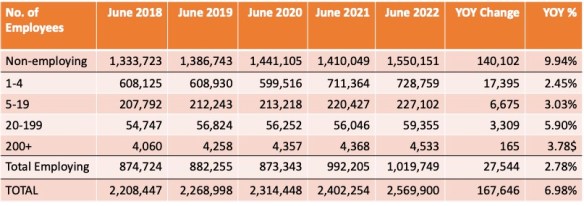
Number of Australian companies by employment size, 2018-2022 (Source: ABS)
There were some contentious views about the small business association’s pre-Summit MoU with the ACTU. Some peak industry bodies and other commentators felt that COSBOA had “sold out” in apparently agreeing to sector-wide negotiations on pay and conditions. However, this does not appear to be the case – COSBOA is merely seeking better co-operation and consultation on areas of mutual interest, and is not endorsing any form of enforced unionisation or compulsory sector bargaining. There have been suggestions that sector-wide collective bargaining will result in higher wages, but without more detail, and pending greater clarity on the “Better Off Overall Test”, this will simply add friction to the current debate about wage and employment growth.
If we do return to a previous form of Industrial Relations policy, it’s interesting to look at the latest ABS data on Australian businesses by employment size (table above). I think it’s worth noting the number of working people in Australia who are employed by SMEs. Large employers are actually small in number, so if multi-employer collective bargaining does come into effect, it could mean tens of thousands of businesses will be involved, and many probably for the first time. On the other hand, in an industry like construction, which is both highly unionised and covered by significant industry awards, many workers are either self-employed or they are employed by independent sub-contractors.
Representation at the summit was reasonably well-balanced, between Unions (including Industry Superfunds), Business (individual companies and industry associations), the NFP and Community sectors, Academia, Think Tanks, and of course Politics. The absence of the Leader of the Federal Opposition meant that his voter base was effectively disenfranchised, although his Deputy (and Leader of the National Party) did attend. Go figure.
Much was said about “streamlining” and “updating” parts of the Industrial Relations regime. Like Australia’s tax laws, the system of Modern Awards as overseen by the Fair Work Commission feels unwieldy, unnecessarily complex, over-bureaucratic, at times vague, and often archaic bordering on arcane. There are currently over 140 different awards in place – some of them relate to an individual company, some to a particular trade or profession, and some cover a whole industry. Interpretation is often in the eye of the beholder as to whether or not it applies to a particular employer and/or employee – here is an extract from one award:
“NOTE: Where there is no classification for a particular employee in this award it is possible that the employer and that employee are covered by an industry modern award or a modern award with occupational coverage.” (Emphasis added.)
I should add that one reason given by the Labor Government for removing the prohibition on sector-wide collective bargaining is because the process for employers to request an exemption from the relevant Minister is “too cumbersome”. I don’t see how this is so given that much of the IR system is overly bureaucratic. Surely the reason for this administrative process is to avoid collusion and other cartel-like activities that would otherwise fall foul of competition law and anti-trust provisions.
The Summit had some notable things to say about gender equality and pay parity, (“Legislate same job, same pay”), training, immigration and child care; but some proposals sound vague without defined objectives (“Boost quantum technology research and education”); draconian if they inhibit workplace flexibility, especially in seasonal industries (“Limit the use of fixed-term contracts”); or too aspirational without more detail such as specific goals and measurable targets (“Leverage greater private capital into national priority areas, including housing and clean energy”). We know that Labor ministers have been vocal in their dislike of the so-called “gig economy” (a “cancer” on the economy, and “I’d like to regulate the sh*t out of it”), but perhaps they need to do more to understand why some workers actually prefer it, and what benefits it brings in terms of workplace flexibility, especially in start-ups and emerging sectors, many of which are SMEs from where much of our longer-term innovation and employment opportunities actually come.
One item that didn’t receive as much attention was the “Digital Apprenticeships Scheme”, which (subject to details…) would likely have the combined support of the Tech Council of Australia and the ACTU. Certainly, despite a vibrant and innovative IT sector, and some notable high-tech and high-end manufacturing businesses in Australia, we lag behind in STEM education, and lack basic digital literacy skills in the wider population. (Hence the need for adjustments to the skilled migration scheme?) A friend of mine who runs a small manufacturing business in Melbourne recently hired an Office Assistant. The successful candidate claimed to be proficient in standard productivity tools such as Word and Excel. In fact, they didn’t know how to COPY-PASTE, nor how to use the SUM-ALL function, which are both very basic routines. They thought they could “wing it” by watching a YouTube video…
Finally, if there is one note of caution or concern about the Summit, it is the niggling thought that this was more of a talk-fest, and that any new ideas to have emerged were either covered by existing programmes and “policy settings”, or were already in train. Going through the list of Outcomes, I counted at least three dozen separate initiatives (Plans, Schemes, Agreements, Reports, Statements, Codes, Programs, Compacts, Task Forces, Working Groups or Funds) many of which already exist, or were part of Labor’s election promises, or have been proposed prior to the Summit. (And that list excludes Federal Ministries and Government Departments.) Sounds a lot like “Talks about Talks”, with “new” money already allocated and spoken for (hence Labor’s push back on some of the implied costs of the Summit proposals). At worst, this “wish list” represents a huge amount of expensive and bureaucratic overlay, whereas we need agile and flexible economic, education and employment measures.
Over the past week, the Leader of the Federal Opposition has been asking a series of questions on Twitter and elsewhere, about “what should Australia be building?”. As well as building the foundations of Labor’s Federal Election policy platform for boosting jobs in the manufacturing sector, it also provides lots of photo ops for pollies in hard hats and hi-viz clothing. (I do wonder why the potential Prime Minister hasn’t thought of this idea before, or why he appears to not know the answer – isn’t that his job? It also makes me wonder whether we need Parliament anymore, since our elected representatives prefer to conduct their “debates” via Social Media and Press Conferences…. it would save a lot of time and money!)
By this time next year, Albo could be PM (Photo sourced from Twitter)
There has been no shortage of suggestions from the Twitterati, which fall into the following main categories:
Renewable energy
Trains
Trams
Ferries
High-end engineering
But there has also been commentary around Labor’s ambivalence on the coal and gas sector (especially in the key state of Queensland), and the irony that we export cheap raw materials and import expensive finished goods. Then there is debate on the amount of local manufacturing content that already exists in Australia’s state-based trains and urban trams/light rail systems (skewed by the question of local vs foreign ownership). Plus, there’s the thorny issue of high-speed inter-city trains…
As I commented recently, the manufacturing sector accounts for fewer than 1m local jobs (less than 10% of the working population), and 6% of GDP. It has been declining steadily as a contributor to GDP since the 1960s, and more rapidly in recent years since we abandoned key subsidies to the car industry. I don’t think anyone is suggesting we return to the days of metal bashing and white goods. And while we’ve got to be selective about the type of manufacturing base we want to to develop, we also have to be realistic about the manufacturing capabilities we want to encourage and enhance.
The latter involves developing transferable skills, creating interoperable production lines, deploying modular designs and inter-changeable components, and recycling/repurposing. All of which should mean we don’t need to make every part of every item domestically, but we know how to assemble, service, maintain, repair and replace goods locally, and we can focus on adding value that can be fed back into the supply chain, which in turn can be exported (via know-how and services). Australia has some decent research and development capabilities, but we are not always very good at raising domestic investment, or commerciliasing our IP (so this value ends up being transferred overseas, with little to no return accruing locally).
I’m not a huge fan of simplistic “buy local goods/support local jobs” campaigns, or local content quotas. The former can degenerate into trade protectionism and economic nationalism; while the latter tend to favour inefficient incumbents within cozy duopolies (see the broadcasting and media sector). The current debate has also raised questions about procurement policies, and I for one would welcome a total revamp of government IT purchasing and deployment at Federal, State and LGA levels.
There’s also the consumer angle: Australians are notoriously “cost conscious”, so will they be prepared to pay more for locally-made goods, even if they are better designed, well-made and energy efficient, compared to cheaper, less-sustainable imports? (This is also linked to the question of wage growth and restrictive trade practices.)
The recent pandemic has highlighted some challenges for the structure of the local economy:
Disruption to distribution networks and supply chain logistics
Food security
Energy self-sufficiency
Inability to service equipment locally or source spare parts
Different standards across the States
Medicine and vaccine manufacture, sourcing and distribution
For an up-to-date perspective on where Australian manufacturing policy needs to be heading, I recommend taking a look at the Productivity Commission’s latest submission to a current Senate enquiry. (Am I alone in thinking that the PC, along with the ACCC, is doing more to develop and advance economic policy than our elected representatives?)
The PC’s submission addresses a number of key points:
R&D incentives are hampered by complex tax treatment
Policies (and subsidies) favouring one industry create uncertainty for others
Need for IP reform (especially “fair use” of copyright)
The National Interest test needs clarifying
More effort on up-skilling through more relevant education and training
The role of manufacturing capabilities in supporting supply chain infrastructure
Finally, while I agree that there needs to be some focus on renewable energy and public transport, we should not ignore food and agriculture, bio-tech, IT, automation, robotics, materials science and other high-end capabilities in specialist design, engineering and recycling (including reclaiming precious minerals from obsolete equipment).


 Content in Context