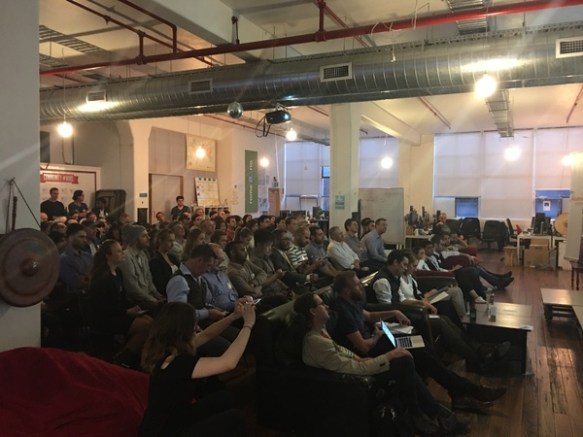
The FF17 Semi Finals in Melbourne

As part of the recent Melbourne Startup Week, Next Money hosted the Melbourne heat of the FF17 pitch contest, to decide which local FinTech startup will compete at the FF17 finals in Hong Kong later this week.

screen-shot-2017-01-15-at-8-15-03-pmAt the outset, I should declare an interest, as I myself was one of the pitch contestants, but hopefully that doesn’t preclude me from commenting on the event. The competing startups were as follows (as listed on the event Meetup page):

AirWallex

This payments solutions provider has featured in my blog before. Since the last time I saw AirWallex pitch, the market for cross-border remittance and payment solutions has drawn a lot of attention. First, the growing opportunity for exporters to market products and services to Chinese consumers and tourists means that payment platforms like AirWallex (and others like Novatti, LatiPay and Flo2Cash) are partnering with Chinese payment gateways such as WeChat Pay, AliPay, JDPay and Union Pay). Second, cross-border remittance services has become a key use case for Bitcoin and other digital currencies (as evidenced by the recent partnership between Novatti and Flexepin).

Analyst Web

Still in private beta, Analyst Web is aiming to disrupt the market structure (and payment model) for equity research. By enlisting qualified CFAs to write bespoke investment reports on listed companies, then distribute them via subscription services, Analyst Web claims to be bringing quality, objectivity and value for money to this investor service. Currently, investors have to rely on either brokers (who may offer “free” reports to their clients under soft dollar arrangements) to provide research on individual stocks; or subscribe to independent research houses (such as Morningstar). Typically, neither brokers nor the research houses cover the full market – tending to focus on the bigger stocks and those included in benchmark indices. Of course, companies themselves use investor relations services to issue commentary on their market performance and prospects, but these communications perhaps lack objectivity. There are also other models, such as the ASX Equity Research Service, whereby research providers are “sponsored” by the stock exchange to provide reports on qualifying companies to boost market coverage. Some of the challenges Analyst Web will need to overcome are: investor willingness to pay for research; market credibility and acceptance of their reports; and sustainable financial models that appropriately compensate the analysts without compromising independence and objectivity.

Proviso

Proviso has also been mentioned in my blog before, and they continue to impress with their solution to take friction out of the documentation processes for loan origination, and their ability to secure more financial institutions as clients. In my previous commentary, I noted that Proviso risked being disintermediated by an industry-owned utility. While I still think that is a possibility, I also see that the combination of Blockchain solutions (for distributed ledgers and bank data feeds) and more open APIs for financial data and account information may mean that customers themselves may be empowered to drive the process, since it will be easier for them to demonstrate their creditworthiness and establish their cashflow status, but also have better control over the disclosure of their data.

DragonBill

DragonBill, an invoicing solution for SMEs, is yet another of the FF17 contestants to appear in my blog, most recently when they presented at Startup Victoria’s regular pitch night. In addition to offering both direct payment and escrow options for micro-businesses and sole traders, DragonBill continues to mine an interesting niche market among sports clubs and associations – the reason being that many club members are themselves sole traders. As part of its future developments, the business is scoping a solution to help clients manage their superannuation obligations, and to provide informed advice on cashflow management.

BreezeDocs

Similar to Proviso, BreezeDocs is a document automation solution for lenders, although currently focusing on mortgage origination. And like Proviso, at the heart of the solution is the ability to streamline the extraction and processing of data from customer documents. On top of a core OCR capability, BreezeDocs also claims to be using machine learning to train their systems on different document types, formats, structure and content. Despite the use of ETL processes within financial institutions, the disparate nature of financial products and documentation; the way customer, product and transaction data is often maintained in different systems; and the fact that customers will often have accounts and products with different providers can undermine the need for standardised processes.

Vestabyte

As I commented in my previous blog, equity crowding may be about to come into its own as a way to connect investors with entrepreneurs and startups. Vestabyte are certainly enthusiastic exponents of this method for raising capital, but legal constraints mean that their platform still has to operate under a unit trust model, rather than offering access to investments in the form of direct shares in specific assets, companies or ventures. This may change if the proposed legislation can get through Parliament, although it’s far from being a done deal. But in the absence of formal legislation, it sounds like a great opportunity for a FinTech startup seeking funding to test ASIC’s first licensing exemption under its sandbox regime….

coHome

By their own admission, coHome is very much a nascent business – one that is still defining its customer offering. At its heart, this shared ownership service provides a matching service for aspiring property owners, along with some standard documentation for a co-ownership agreement, known legally as a tenancy in common. With multiple parties to the property transaction and mortgage application, coHome aims to streamline the process, make it easier for buyers to connect with other interested parties, and provide customers with appropriate legal safeguards. It’s clearly an admirable objective, and one that deserves to gain attention. But monetizing the service may prove challenging, unless coHome takes a commission from the mortgage providers, lawyers and conveyancers?

BugWolf

Not strictly speaking confined to the FinTech sector, nevertheless BugWolf, a tool for managing user-acceptance testing, has managed to gain traction with at least one of Australia’s Big 4 banks. Using gamification, competitions and other techniques to recruit, engage and manage teams of testers, BugWolf claims to support all aspects of functionality testing across software, websites and mobile apps. Combined with robust reporting and analytics, BugWolf can also help clients achieve shorter product development cycles.

Brave New Coin

I joined the team at Brave New Coin (BNC), a provider of market data for digital assets, in early 2016. So, it was the first time I have pitched, outside of hackathons, client presentations and sales conferences. And the fact that BNC was a last-minute confirmation for this event made it an even more interesting experience. Established about 3 years ago by a team of founders with an interesting mix of publishing, Bitcoin and full stack development experience, BNC has built a suite of data APIs (market prices, indices, exchange rates and analytics) for Bitcoin and most other crypto-currencies and Blockchain assets. While the APIs are typically used by developers, the growing interest in digital assets among brokers, investors and asset managers means that market data on these new asset classes is in demand, and BNC is busily building distribution partnerships and subscription deals with traditional brokers, market data vendors and exchanges. Recent price fluctuations for Bitcoin may suggest continued speculation in this currency, but the launch of investable and tradeable products such as CFDs, futures, ETFs and other derivatives also suggest that digital assets are starting to achieve broader market acceptance.

BankVault

Unlike other solutions to defeat hackers and hoaxers (e.g., anti-virus software, spam-filters, VPNs and proxy servers), BankVault uses virtual machine technology to protect customers’ bank details when they transact online. This means a “new and instant” machine is created for one-time use only, each time a customer launches the BankVault service. Offering both individual subscriptions and enterprise solutions, the business is in the process of launching in the USA.

Conclusion

The winner, based on the judges’ votes, was BugWolf, which came as something of a surprise to a number of the other contestants, myself included. Without wishing to sound churlish, this event was supposed to be about the future of finance (hence FF17…), so it would seem reasonable that the winner would be based in FinTech (as opposed to TechTech?). The result (although highly deserved and based on an impressive pitch), also reinforced my sense that this event did not draw the “usual” FinTech or startup audience in Melbourne, based on the many pitch nights and meetups I have attended over the past few years. From my perspective, neither was it an investor audience, nor a capital markets audience, meaning I wasn’t really sure who I was pitching to. I’m hoping that the organisers will reflect on this event, and look to make some changes for next year.

Next week: A few rules on pitching

Summing up the #FinTech summit

Coinciding with the launch of the inaugural EY FinTech Australia Census 2016*, FinTech Australia’s first industry summit Collab/Collide was a major beneficiary of the initial round of funding from the Victorian government’s LaunchVic program. The summit provided a useful opportunity to survey the global landscape, to compare notes and of course, to network. But did we learn anything new?

6278fd_bc2f12c8b40744a281f9afbb37ba1a3emv2The summit was programmed around key FinTech themes of payment services, alternative funding, robo-advice, Blockchain, data and regulation. Participation by some key industry figures from Asia, Europe and the USA (both founders and investors) also provided some international perspective.

While Australia appears to be maintaining a top 5 position in the global FinTech rankings, our focus on things like P2P lending, payments and robo-advice risks losing sight of bigger opportunities in Blockchain assets, enterprise solutions and institutional services.

And although it was good to see a team from the Treasury Corporation of Victoria in the audience, as well some of their colleagues from DEDJTR, it was surprising that there was hardly any representation from among institutional investors (superannuation funds, asset managers, insurance industry), major financial institutions, or the traditional financial markets (exchanges, intermediaries, brokers, vendors)**.

Some of the best sessions were the comparative panels on Blockchain, regulation and funding. In particular, there was an interesting discussion on whether Australia should be worried or concerned about UK opportunities post-Brexit, or focus more on Asian markets. But with the development of reciprocal financial licensing arrangements between Australia and the UK, and Australia and Singapore (and between the UK and Singapore), ASIC is clearly trying to engage with both markets.

The Federal Treasurer, Scott Morrison also took time out of his busy schedule to address the audience on the topic of Open Banking Standards, following on from the Productivity Commission’s Draft Report on Data Availability and Use. The overall goal is to have a system of FinTech data and operating standards that is “regulatory match fit”, that delivers frictionless inter-party transactions and enhanced industry participation and collaboration. For example: once the New Payment Platform launches in 2017, we should have more open access to transaction data; the ATO is implementing a “single-touch” payroll process; and ASIC is due to publish recommendations for the financial services Regulatory Sandbox by the end of 2016.

Unfortunately, given the changes in venue and content, the program struggled to stretch to a second full day, as audience numbers dwindled. Something for the organisers to think about next time? I would also advocate organising specific sessions, e.g., for B2B and B2C, or for vendors and institutions.

Finally, speaking to a member of the DEDJTR team, there is a clear desire on the part of the State government that the FinTech community will come together along with other market participants to figure out how to scale this emerging sector. In other words, how to turn the growing number of FinTech startups (often with directly competing products and services), hubs, incubators, accelerators and VC funds into a sustainable industry?

* For a handy summary of the EY survey, check out Lucinda de Jong’s blog for Timelio

** In the interests of full disclosure, a FinTech startup I work with, Brave New Coin (a market data vendor for Blockchain assets) was a Strategic Partner for the Summit

Next week: The Startup of Me v2.0

StartupVic’s #Pitch Night for October

The crowds are getting bigger, the list of sponsors is getting longer, there’s a new logo, and they’ve even managed to (sort of) fix the PA system. The Startup Victoria monthly pitch night is now a firm fixture on Melbourne’s Meetup calendar…

Image sourced from Startup Vic's Meetup page (Photo by Daniel)

Image sourced from Startup Vic’s Meetup page (Photo by Daniel)

As usual, there were 4 startup pitches, and I’ll comment on each in order of their presentations:

Next Address

This Ballarat-based startup has built a P2P website that offers “direct to market” property sales, removing the need for traditional estate agents. Recognising that the real estate sector is still ripe for some digital disruption, Next Address is challenging the commission-based fees and cost++ price markup on services that many estate agents charge their clients.

They have established an affiliate programme, and generated some positive media coverage, but have yet to complete any sales. Charging a fee of around $549 to vendors (there is a sliding scale), compared to similar competitors priced at between $800 and $2,000, Next Address is also offering a Facebook package.

I think it’s fair to say that this pitch did not come across as one of the strongest or most compelling presentations at these pitch nights (possibly due to some stage nerves?). There were also questions among people I spoke to about market traction, the customer acquisition model and the conversion process.

Given that there is a lot of competition within real estate listings and aggregation (often backed by major media companies), and given that many vendors still prefer to use the auction process, it was difficult to see how Next Address can cut through, unless they focus on a point of differentiation: geographic market, property type, price range, marketing support or add-on services.

However, the founders must be doing something right, as on the night they managed to attract the attention of a senior executive from a well-known real estate listings website.

DragonBill

DragonBill is an invoicing and remittance solution aimed at sole traders and micro businesses, which has featured in this blog before. The focus is on helping clients manage their cashflow and providing them with a level of financial literacy and education.

Since launching, DragonBill has found a substantial niche market among sporting clubs and associations, in large part because 50% of club members are also SME owners. They are continuing to build partnerships with accountants and are now starting to market themselves via co-working spaces.

Further ahead, there are plans to build some sort of superannuation offering, given that many SME owners and sole traders may not be making sufficient contributions to their personal funds. There are also regulatory changes in payroll administration following the roll out of SuperStream by the ATO.

The judges were interested to know what plans DragonBill has for international growth, and whether the platform can output financial and tax reporting for accounting purposes – both of which are under consideration. Meanwhile, DragonBill was recently shortlisted for an award by VISA.

Spee3d

In short, this business supports “3-D printing of metals at production speeds“. Using a proprietary “Lightspee3d” technology, the goal is to offer a low-cost, high-speed solution for full-scale production output, not just prototypes and medical devices. Primarily manufacturing in copper and aluminium 6061, current output is 100g/minute ( expecting to soon reach 250g/minute), and the maximum size is 300mm x 300mm x 300mm.

For the technically minded, the additive process is described as something like “bugs hitting a windshield”. It does not use any gasses, and deploys a “line of sight” process, meaning that some hollow objects are possible. The business has picked up a Bosch Venture Award.

Targeting products traditionally fabricated by sand casting, Spee3d is working with clients who have a preference for low-cost powders, initially within the university market, then the auto industry. They are also aiming at new products, and not parts manufactured from existing casts that have associated sunk costs. There was quite a lot of excitement around this pitch, judging by the number of questions it prompted.

Foddies

This startup is launching a fructose friendly food business, offering products, recipes and outlets (shops, cafes, catering) that can also appeal to people with other food allergies and dietary requirements. If, like me, you were unaware of the “Low FODMAP” diet,
it was researched and created in Melbourne (Monash Uni), and from my initial reading, it has some similarities with diets designed for people needing gluten-free, lactose free and low GI solutions.

Admittedly not the first to market, Foddies claims to be the first to develop a holistic solution, which includes a wholesale strategy for ready-made meals, a cafe franchise and an online store. Next, they plan to work with airlines and hospitals. Although building on their social media engagement, the biggest challenge, when asked by the judges, was the lack of public awareness or education on the Low FODMAP model.

From a personal perspective, I appreciate the importance of helping people with food allergies or intolerance to manage their condition through appropriate diet. But I can’t be alone in thinking that the higher reported incidence of these complaints may be due to multiple factors such as the increased use of chemicals in the environment (especially food production), the lower resistance in our immune systems caused by too many antibiotics, and our over-reliance on certain strains and varieties of crops. More research is called for.

So, after a very mixed bag of startup pitches, the winner was Spee3d, based on the audience and panel voting.

Next week: Richmond 3121

A Tale of Two #FinTech Cities – Part 2

It feels like the inter-city #FinTech and startup rivalry between Melbourne and Sydney is starting to get personal. The blow-up between Victorian Small Business Minister, Philip Dalidakis and Freelancer CEO, Matt Barrie over StartCon is perhaps the most strident example, but other discontent is bubbling underneath the service.

screen-shot-2016-10-05-at-10-51-49-amLet’s take a look at what’s actually been happening around #FinTech in Melbourne, and try to understand what might be the cause of this apparent disquiet:

First, the recently announced LaunchVic grants have been met with a mix of gratitude, bewilderment and some sour grapes, based on the people I have talked to in the start-up community. There was a sense of “jobs for the boys”, “usual suspects”, “who?”, and “yeah, good on ya”. Nothing new there, then, when public money is being handed out. High-profile beneficiaries of the initial A$6.5m of grants include FinTech Australia (as part of a major FinTech Conference to be held in Melbourne), FinTech Melbourne (which is now the largest group of its kind outside the US and UK), inspire9, Startup Victoria and Collective Campus.

Second, Stripe‘s CEO, John Collison was in town to celebrate their 2nd birthday in Melbourne. (This is the 3rd time in 2 years Collison has been in Australia – he must love what we are doing here? Or maybe it’s the Victorian government incentives that attracted Stripe to set up in Melbourne: see below.) This time around, there were some major announcements among the celebrations, including:

  • 25% of Australians have paid for something online using Stripe
  • Stripe is launching “Connect” in Australia – making it easier for local businesses to roll out payment solutions in multiple markets overseas
  • Stripe continues to keep its APIs as simple and streamlined as possible – they even support Amazon’s Alexa voice recognition system

There was also a panel discussion with some of Stripe’s local clients, and a Q&A with Collison himself:

  • Andre Eikmeier from Vinomofo commented that payment solutions (like all technology) should be invisible, and just work in the background
  • Ben Styles from Xero explained that integration with Xero’s own APIs is critical, and that they have co-developed some products
  • Nicole Brolan from SEEK said that thanks to Stripe, her business is finally allowing clients to pay invoices on-line

Asked about innovation, Collison argued that mobile phone technology was the spur for services like Uber. However, he’s not especially engaged with Blockchain, as he does not see the use case. He thinks the next major innovation will be in medtech (telemetrics & wearables), and machine learning (speech and image recognition). As he said, “driverless cars are not just about the sensors but what the data is telling you. We know more about the health of your car than your own body.” He also had some words of advice to aspiring local entrepreneurs and startup founders:

  • Having a global or international perspective is determined by your markets, your competition, and access to specific talent pools.
  • It’s probably wrong to aspire to be like Atlassian – you need to understand WHY Atlassian has been successful, not WHAT it did or HOW it did it – which means getting back to core values and core purpose.

Third, as the Stripe celebrations started to kick off, across town FinTech Melbourne hosted an event starring Alex Scandurra, from Sydney’s Stone & Chalk FinTech hub. This was billed as a “pre-launch” for Stone & Chalk’s planned foray into Melbourne, and was part information session, part FinTech love fest, and part fan-boy hangout. Scandurra’s presentation was quick to point out that the “plan is not to bring Stone & Chalk to Melbourne, but to create Melbourne’s own Stone & Chalk”. (Spot the subtle difference?)

To its credit, Stone & Chalk is home to 300 people and 75 startups, has helped start 21 companies and create 150 jobs, and participants have collectively raised $100m in funding, although Stone & Chalk does not take equity. Scandurra also commented that FinTech is not an industry in itself – it is a horizontal that serves all industries.

There seems to be a lot of local clamouring for a FinTech hub in Melbourne. However, unlike the NSW government which has directly partnered with Stone & Chalk, I understand that the Victorian government is not prepared or able to “invest” in such a project – and certainly not before there is some private sector funding on the table.

Meanwhile, the founder of a rival payment system expressed his frustration that the Victorian government “sponsored” Stripe to come to Australia, but won’t offer similar support to local startups. Another FinTech CEO I spoke to was irked that Stone & Chalk would appear to be breaching its own mandate if it set up shop outside NSW.

In fact, could be argued that Stone & Chalk was established in Sydney to directly compete with Melbourne’s startup ecosystem. In large part, this is thanks to the huge success that the Victorian government continues to have in luring major tech companies and global startups to come to Melbourne. Names such as Zendesk, Eventbrite, Slack, Square, Stripe and now Cognizant.

If the debate over Stone & Chalk coming to Melbourne is about creating a local FinTech hub (whether or not the Victorian government tips in some money), we have to examine the need for such a hub. For example, is it simply a question of real estate, so that all the FinTech startups can be co-located in one place? If so, I would have thought that was easy to resolve: there’s a lot of empty office space, and Melbourne rents are cheaper than Sydney; also, a growing number of office landlords recognise the mutual benefits and knock-on effects of hosting co-working venues in their buildings.

We also have to consider if Melbourne’s existing FinTech startup eco-system/infrastructure is willing to come together to underpin such a hub. If so, what is the hub going to do? What is its purpose? What is the missing piece that the hub is designed to fill? And who/what/where is best placed to fill that need/gap?

Looking back, Melbourne has been the home of a number of FinTech businesses, that are now global public enterprises – IRESS, Computershare, Touchcorp, Novatti, for example – so there is obviously something in the local water (or coffee). For me, however, a key barrier for FinTech specifically, and startups more generally, is the inability to connect to institutional funds and investors (Clover being a notable exception?). Other obstacles include the stodgy procurement processes used by the public sector and many large corporations, which make it more difficult for startups to compete for work, and the reluctance by enterprise clients to try a local product or service unless it has been tested and proven elsewhere.

Finally, on a more positive note, it was very interesting to see that founders from Atlassian and Vinomofo are backing Spaceship, a new superannuation fund appealing to a younger, tech-savvy audience.

Next week: Bridging the Digital Divide