10 Examples of Cold War Nostalgia: We Can’t Get Enough Of It…

I don’t know if any historian, politician or media commentator has ever said it publicly, but someone must have coined the phrase, “You knew where you stood during the Cold War”.
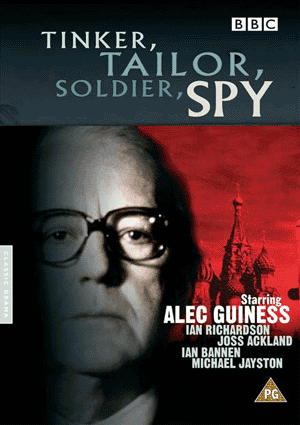
tinker-dvdlrg

There was some strange comfort to be had in knowing exactly where the geo-political lines were drawn in the days before the Soviet invasion of Afghanistan and the Iranian revolution of 1979* – events which could be argued to have brought about the dismantling of the Iron Curtain, but also heralded an era of constant challenge to American hegemony.

35 years after those momentous events of 1979, numerous books, TV series and films continue to feed our appetite for Cold War nostalgia. Here is a (highly subjective and selective) list of 10 such contributions from recent years:

  1. “Stasiland” (2003) – While not strictly speaking about the Cold War, Anna Funder’s  contemporary work of non-fiction on East Germany’s surveillance regime is a powerful account of her investigation into the activities of secret police operatives and their victims, and what has become of them since the Berlin Wall collapsed and the re-unification of Germany
  2. “The Lives of Others” (2006) – This film, set in 1984, is a somewhat romanticized look at events described in Funder’s “Stasiland”, but still manages to convey the numbing effects of life behind the Iron Curtain
  3. “Equals” (2014) – The year will not be allowed to pass without SOME sort of reference/homage/pastiche/exhumation/sequel to George Orwell’s dystopian novel, “1984”, which was published 65 years ago, and set 35 years in the future of the titular year itself. While not exactly a Cold War novel, it’s seen as an allegory for life in the Soviet Union under Stalin, and a veiled warning to the rest of us about the threat of a totalitarian regime. Upcoming movie “Equals” is supposed to be a romantic interpretation of “1984”….
  4. “Tinker Tailor Soldier Spy” (2011) – A movie adaptation of John Le Carre’s spy novel (itself published 40 years ago, and first dramatised for TV 35 years ago when the Cold War was very much alive and kicking).
  5. “Foyle’s War” (2000-2013) – The latest episodes in this long-running TV detective series show our hero transitioning from investigating crime during war-time to the new world of espionage, counter-intelligence and Cold War intrigue.
  6. “The Hour” (2012-13) – This short-lived TV drama series was ostensibly a behind-the-scenes look at a 1950’s news and current affairs programme, but uses the Cold War events like the Hungary uprising and the Suez Crisis as a backdrop (along with a healthy dose of “reds under the bed” which implicitly references the Soviet agent scandals that rocked the British establishment during the 1950’s and 1960’s and beyond – Burgess, Maclean, Philby, Blunt et al).
  7. “Stephen Ward Was Innocent, OK” (2013) – Geoffrey Robertson delves into the truth behind the criminal prosecution and media castigation of a bit-player in the so-called Profumo Affair, which likely contributed to Ward’s suicide in 1963. The Profumo Affair of 1961 had it all – prostitution, Cold War politics and Soviet agents. And even though it led to the resignation of the UK’s War Minister, it has been suggested that the Establishment demanded scapegoats, and Ward was seen as a suitable victim.
  8. “Solo: A James Bond Novel” (2013) – William Boyd is the latest novelist to be invited to add to the Bond canon (original Bond author, Ian Fleming died 50 years ago), and chose to set the story in 1969 with a strong Cold War context. Boyd is, of course, no stranger to this genre – nearly all of his recent novels (“Any Human Heart”, “Restless”, “Waiting for Sunrise” and “Ordinary Thunderstorms”) incorporate elements of war-time espionage, betrayal, double agents and industrial sabotage that span the 20th century.
  9. “Sweet Tooth” (2013) – Ian McEwan uses the Cold War politics of the early 1970’s as the setting for his novel about love, trust, (self-)deception, “official” propaganda and bureaucratic betrayal.
  10. “Jack Ryan: Shadow Recruit” (2014) – Finally, bang up to date with a film version of the Tom Clancy novel. Clancy, who died only a few months ago, was a veritable Cold War warrior of the fiction world, and this latest addition to the Jack Ryan saga includes some (reassuring) Russian elements. I haven’t seen it yet, but I’m sure it will satisfy my appetite for Cold War nostalgia.

* The events of the 1979 US embassy hostage crisis in Tehran, of course, were recently dramatised to great effect in “Argo” (2012). And just this month, The Atlantic described current US-Iran relations in Cold War terms.


Form over content – when the technology is the product?

This week, I had my first experience of 3D cinema, with the rather amazing “Gravity”.

Image source: gravitymovie.warnerbros.com

Image source: gravitymovie.warnerbros.com

I wouldn’t say I’m an instant convert to the 3D format, but I certainly agree with many of the critics – that “Gravity” is not only a film that warrants 3D, it is possibly the best space movie since “2001: A Space Odyssey”. And while the CGI and 3D technologies combine effectively to take a relatively simple story and turn it into an epic, it is not just a case of “form over content” – there is real substance in this film, a great example of using the technology to enhance the audience experience, rather than hoping it can paper over the cracks of clumsy narrative and lame dialogue.

My hesitation in embracing the 3D experience stems from a suspicion that the format dictates the story, that the technology is the product. A few days before watching “Gravity”, I saw posters advertising the new Hobbit movie, “The Desolation of Smaug”. Not content with the “standard” 3D version, there is also a new format “3D HFR” (High Frame Rate, whatever that means). Oh, and for traditionalists there is also “normal” 2D.

Personally, I could never get into the whole Lord of the Rings saga – even as a child, Tolkien’s stories left me cold. So I have not seen any of the films, but when I saw a 3D preview for “Smaug”, my worst suspicions were confirmed: this really is a case of form over content, which is ironic given the legacy of the source material. To me, the 3D images looked like the pages of a children’s pop-up book, because the depth of vision is so poor that the actors look like animated cardboard cutouts badly superimposed on CGI landscapes.

Many contemporary productions, full of CGI and “enhanced” for 3D make Walt Disney’s Penguin Dance in “Mary Poppins” look far more naturalistic in comparison. And what about “Who framed Roger Rabbit?” as the pinnacle of live action meets cartoon imagery – surely Jessica Rabbit has more vitality than all the characters in “Avatar” put together?

Technology is a wonderful thing – used creatively and effectively it can deliver fantastic results, making great content even better. But used slavishly, and as an end in itself, it cannot compensate for poor material, and at best becomes a sterile technical exercise.

Amazon finally comes to Australia; local retailers still want government action on sales tax

A short (and seasonal) post this week, as everyone starts easing off for the holidays.

It may just be coincidence, but about the same time Amazon launched their new Australian website local retailers renewed their campaign to lower the $1,000 sales-tax exemption for online purchases from overseas retailers. And both events came at the start of the Christmas shopping season….

Obviously too early to say which way this will go, but here are a few personal observations:

First, the local Amazon site is limited to e-books, games and Android apps. So, no access to music, television or film content (digital or physical), no sales of print books and no Amazon marketplace. For these products and services, customers are directed to the US site. (Previously, the dormant Amazon.com.au domain name referred customers to the UK site.)

[Note: neither the US nor the UK sites allow overseas customers to buy mp3 content, but they can download digital music via Amazon’s AutoRip service when purchasing physical goods – confused? Me too….]

Second, prices for e-books on Amazon’s Australian site appear to be comparable to the US store, and presumably include local sales tax (GST) to keep on-side of the local real world and online retailers (as well as the ATO, of course).

Third, the general consensus is that if the $1,000 threshold was lowered or even abolished, the amount of sales tax to be collected would be more than outweighed by the additional costs of processing, administration and remittance (which would likely be passed on to local consumers at a “cost-plus” rate by overseas online retailers).

Fourth, many local retailers who voice their opposition to the $1,000 tax-free exemption fail to understand some of the reasons why local shoppers prefer to buy from overseas online retailers:

1. Price – even if overseas sales attract the 10% GST, in some cases this would still be cheaper than buying locally (especially so when the A$ was above parity with the US$). For example, from time to time, Amazon’s UK store offers free shipping on physical goods to Australia….

2. Choice – many products available from overseas online stores just aren’t available in Australia. This is primarily due to geo-blocking, confusion over local distribution rights, and simple lack of interest in stocking some items for the local market

3. Service – from recent personal experience, buying from a local online retailer took much longer than buying the same product from an overseas site, because the supply chain logistics were woefully inept.

[Note: As a separate but related example, I recently ordered a new iPhone 5S direct from Apple’s local website, and received it within 3 days, including a weekend; whereas my telco provider – which prides itself on its on-line business model and customer service standards – took more than 2 weeks to send me a new nano SIM card….. I had also been told by a couple of local Apple re-sellers that it would take 3-4 weeks to order the new phone, unless I took out a new mobile plan with them – which may say more about Apple’s trading policies than the resellers’ business operations.]

My advice to local bricks and mortar and even some online retailers is to look at their own limitations before insisting that the government amend the GST-free threshold on overseas online purchases.

As for Amazon, I wish them well in developing their local service. Much has been made of the stated intention to focus on Australian titles, and the opportunity for local authors to self-publish via Amazon. But already there have been some rumblings that this new site may cannibalize Kindle sales made via some of Amazon’s local retail channel partners.

6 Melbourne Graduates of Boot Camp for Start-Ups

Another Monday night in Melbourne’s silicon laneway, another Monday night meeting of Lean Start-Up Melbourne. This month’s event, generously supported by inspire9, Kussowski Brothers, BlueChilli and Alphastation, featured 6 start-ups who have recently completed the AngelCube accelerator programme.

Screen Shot 2013-08-18 at 11.51.49 AM

In no particular order, here are Angelcube’s Class of 2013:

A couple of the presenting founders, Tablo and Coinjar, have both been mentioned previously in this blog. I’m still very impressed with the simplicity of Tablo, a self-publishing platform for ebooks, and if they can figure out a B2B or aggregation model, I think they will have a great future.

As for Coinjar, the idea is right (a trading and merchant platform for Bitcoins) but there are still too many regulatory uncertainties and other risks associated with virtual currencies. And as the good people of Hong Kong know only too well, even established voucher schemes such as cake coupons backed by real money and physical goods can have a detrimental effect on local markets…

OutTrippin is a cross between 99Designs, TripAdvisor and Airbnb – selling curated travel itineraries and booking facilities for FITs (free and independent travellers). My sense is that while there is an opportunity in this space, the trick will be to successfully match trip planners and holidaymakers. Given the initial focus on the niche honeymoon market, it will be interesting to see how much traction OutTrippin can generate in the next 12-18 months (given the long-term planning logistics of most wedding events….).

etaskr is an insourcing solution for larger companies – combining elements of Elance, Freelancer, oDesk, Yammer and LinkedIn. It aims to match employee skills (not job function or department) with specific tasks, to enable organisations to better utilise available resources to meet fluctuating workflow volumes. Based on audience questions raised on the night, etaskr may need to look at back-end solutions that facilitate intra-company cost allocation and revenue recognition – good luck with that one!

I will be the first to admit that I can’t really get my head around c8apps – a mobile gaming platform for fantasy sports. I’m probably the wrong demographic for this type of offering, so I can’t really express a view – but the fact that c8apps claim to have some significant media deals in the pipeline and are engaging with several major sporting codes probably means they are doing something right; unfortunately, I just don’t get it myself.

Finally, OziRig is bringing custom-designed professional rigging equipment to the global  film and photography industry. Essentially a component sourcing and assembly model, OziRig aims to undercut the competition on price and service – but several members of the Lean Start-Up audience wondered about the risks of copyright and design infringement.

These 6 graduates of the boot camp for start-ups are now embarking on a round of investor pitches in the USA. I wish them well and every success.

Footnote: Thanks to the sponsors for some much appreciated beer and pizza on the night. And for a couple of alternative perspectives on the evening’s events, please check out my fellow bloggers: Chris Chinchilla and Innerloop.